Delhi Has Been Built Eight Times. The Ruins of the First Seven Are Still Running the City.
Destination: Delhi
Category: destination
Delhi Has Been Built Eight Times. The Ruins of the First Seven Are Still Running the City.
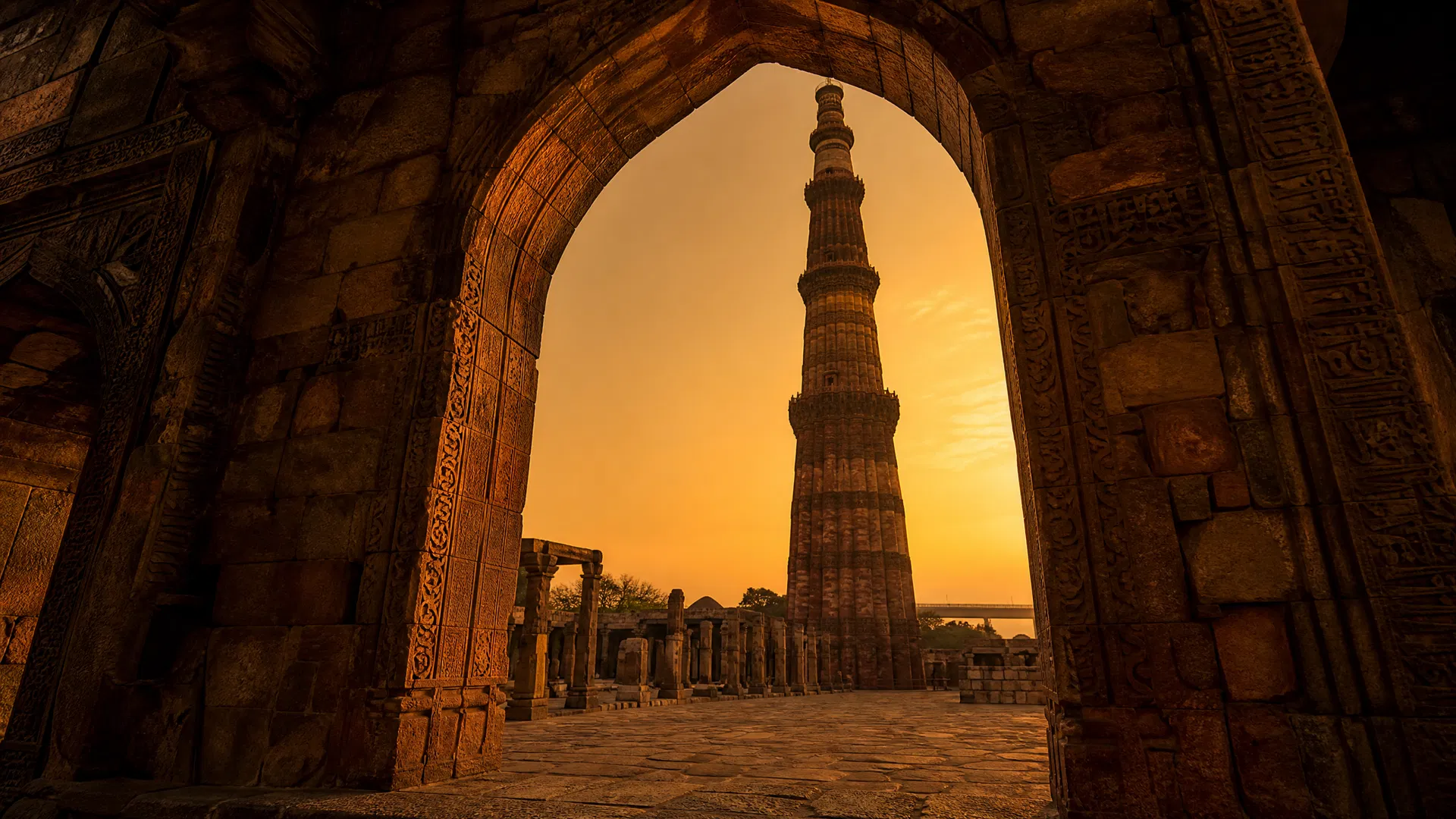
The photographs don't prepare you for the Qutb Minar. Not because it's taller than you expected — though it is, 72.5 metres of red sandstone tapering into the Delhi sky — but because of what's behind it. You're standing in the ruins of Qila Rai Pithora, the first of Delhi's eight cities, built by the Tomar Rajputs in the 11th century and expanded by Prithviraj Chauhan in the 12th. The complex around you is 800 years old. The Iron Pillar in the courtyard is 1,600 years old, a metallurgical achievement so precise that it has not rusted in sixteen centuries. And through the archway of the Quwwat-ul-Islam mosque — the first mosque built in India after the Islamic conquest, constructed in 1193 CE using columns pillaged from 27 Hindu and Jain temples, the original carvings still visible on the repurposed stone — you can see, if you look at the right angle, the elevated track of the Delhi Metro's Yellow Line.
That image — a 12th-century arch framing a 21st-century metro train — is not a contrast. It is the thesis.
Delhi has been built eight times. The Tomar Rajputs built the first city here. The Delhi Sultanate built five more. The Mughals built the seventh. The British built the eighth. Each new city was constructed on the ruins of the previous one, sometimes literally — the columns of Hindu temples became the pillars of mosques, the stones of one dynasty's fort became the quarry for the next dynasty's palace. The result is a city where 800 years of layered civilization are not preserved in museums but embedded in the operating geography of daily life. The ruins of the first seven cities are not heritage sites. They are the city's actual infrastructure — the neighborhoods, the food geography, the ritual calendar, the justice system — still running, still shaping the eighth city that has grown up around them.
Every other capital city in the world treats its past as heritage. Delhi treats it as plumbing.
The First City Is Still a Neighborhood
Mehrauli is where Delhi began. In 1052 CE, the Tomar Rajputs built Lal Kot here — a fortified settlement on the ridge south of the Yamuna plain. The Chahamanas expanded it into Qila Rai Pithora. The Slave Dynasty of the Delhi Sultanate built the Qutb Minar on its ruins. And then the city moved north, as it always does in Delhi, and Mehrauli was left behind.
Except it wasn't. Mehrauli is still a functioning urban village — auto-rickshaws navigate its lanes, vegetable sellers set up at the same corners they've occupied for generations, and the Archaeological Survey of India has been quietly restoring its monuments since 2019. What the ASI found when they began clearing the Mehrauli Archaeological Park was not a dead city but a living one: 80 monuments spread across 200 acres, many of them still in use as neighborhood landmarks, their stones incorporated into walls and boundaries by residents who have lived alongside them for centuries.
The most important monument in Mehrauli that almost no travel guide mentions is Balban's Tomb. Built around 1287 CE for Ghiyas ud din Balban, Sultan of Delhi, it is a low, austere structure that most visitors walk past on their way to the Qutb Minar. They shouldn't. Balban's Tomb contains the first true arch built on Indian soil — a pointed arch constructed without the corbelling technique that Indian architecture had used for millennia. The arch that changed Indian architecture forever is sitting in an overgrown park in a South Delhi neighborhood, and the ASI finished restoring it in 2025 at a cost of two crore rupees. The restoration used lime-surkhi mortar — a traditional blend of slaked lime, brick dust, and jaggery — and hand-cut Delhi quartzite to replace missing stones. To stand inside the tomb today is to feel it inhale again.
A ten-minute walk from Balban's Tomb is Jamali Kamali — a mosque and adjoining tomb built between 1528 and 1529 CE for the Sufi poet Jamali and his companion Kamali. Jamali's identity is documented: Shaikh Jamali Kamboh, a celebrated poet and mystic who served under the Lodis and the Mughals, whose verses found favor in the court of Babur and Humayun. Kamali's identity is not. Described variously as a djinn, a disciple, or a beloved, Kamali has been the subject of speculation for five centuries. The two graves lie side by side in a restored chamber whose ceiling — cleaned in 2023 with mild organic solvents and re-touched with lime putty and marble dust — glows with painted stars and floral arabesques in the afternoon light. The intimacy of the space is unlike anything else in Delhi. It is a monument to a love story whose terms have never been agreed upon.
If you want to understand Mehrauli before you go, the 4-day Delhi itinerary covers the Qutb Complex in depth — but Balban's Tomb and Jamali Kamali require a separate morning, ideally before 9am when the park is empty and the light comes through the trees at the angle the restorers intended.
The Sixth City Runs on Letters to Djinns
In 1354 CE, Sultan Firoz Shah Tughlaq built his capital on the banks of the Yamuna. He called it Firozabad — City 6 in Delhi's sequence — and at its center he built Feroz Shah Kotla, a fortified palace complex whose ruins still stand a few minutes south of the Old City, near what is now the Arun Jaitley Stadium.
Every Thursday, people come to Feroz Shah Kotla with letters.
The letters are addressed to djinns — supernatural beings of Islamic mythology, created from smokeless fire, capable of granting wishes and providing justice. The believers who come to Feroz Shah Kotla are not tourists. They are Delhiites: working-class families, people who have lost relatives, people with court cases that have stalled for years, people who need 20,000 rupees and cannot find them through any official channel. They write their petitions on paper — formatted, as anthropologist Anand Vivek Taneja documented in his study Jinnealogy, like government applications, complete with passport-sized photographs and addresses. They make photocopies and distribute them across multiple alcoves and niches throughout the ruins, as if filing the same application with different departments of a bureaucracy. Some alcoves contain dozens of copies of the same letter, each one a petition to a different djinn-saint who might be listening.
The practice began in 1977, a few months after Indira Gandhi declared the Emergency — the period of authoritarian rule during which hundreds of thousands of poor residents of Old Delhi were forcibly displaced to resettlement colonies across the Yamuna. When the state stopped listening, the displaced residents turned to the djinns of the 14th-century fort. They called the djinns Baba and the fort insaaf ki jagah — a space of justice. The djinns have been hearing cases ever since.
This is City 6 still running. A 14th-century Sultanate fort is operating as an alternative justice system for 21st-century Delhiites who have been failed by the official one. The smoke from the incense stings your eyes when you enter. The old man near the entrance will tell you not to loiter if you don't have business with the djinns. He means it.
The Seventh City Is Where You Eat
In 1638 CE, the Mughal Emperor Shah Jahan built Shahjahanabad — City 7 — on the western bank of the Yamuna. He built the Red Fort as its palace and the Jama Masjid as its mosque, and between them he laid out Chandni Chowk, the great market street that was, for a century, one of the wealthiest commercial districts in the world.
The British took the Red Fort in 1857. Partition in 1947 brought hundreds of thousands of refugees from what became Pakistan into Shahjahanabad, layering a new population onto the Mughal city's bones. The result is Old Delhi: a neighborhood where the 17th-century street plan is still the street plan, where the havelis of Mughal merchants have been subdivided into workshops and storage rooms, and where the food geography of the Mughal court is still the food geography of the neighborhood.
Karim's is in Gali Kababian — Kebab Lane — a narrow alley near the Jama Masjid that you will not find on the first try. It was established in 1913 by Haji Karimuddin, whose family traces its lineage to the royal Mughal kitchen. The restaurant is now in its fourth generation of family ownership. The nihari — a slow-cooked overnight stew of beef shank and bone marrow, spiced with fennel, cardamom, and dried ginger — has been served from the same kitchen for over a century. It is a breakfast dish, meant to be eaten in the morning after the overnight cook. Order it with kulcha. Arrive before 9am if you want the version that hasn't been sitting.
For a different register of Old Delhi's food culture, walk fifteen minutes to Shabrati, near the Jama Masjid, for nihari with Rahim's kulcha — a slightly different preparation, lighter on the bone marrow, heavier on the spice. The two restaurants represent the same dish interpreted by two different lineages of the same Mughal culinary tradition, and the difference between them is a genuine argument worth having.
On Thursday evenings, the Mughal city's spiritual geography becomes audible. The Hazrat Nizamuddin Dargah — the shrine of the 13th-century Sufi saint Nizamuddin Auliya, located in the neighborhood that bears his name — holds qawwali sessions every Thursday in two parts: 6:30 to 8pm and 8:45 to 10pm. There are no tickets. There is no barrier between the performers and the audience. The second session is quieter and more intimate than the first — the crowd thins, the musicians settle into longer improvisations, and the devotional music that Amir Khusrau composed for Nizamuddin in the 13th century is still being sung in the same courtyard where Khusrau himself performed it. The dargah is free. Cover your head. Remove your shoes at the entrance. Navigate the narrow lanes of Nizamuddin West by asking anyone selling kebabs or chai — they will point you correctly.
For a deeper orientation to Old Delhi's food and spiritual geography before you go, the Delhi 5-day itinerary guide maps both Chandni Chowk and Nizamuddin in sequence.
The Eighth City Runs on the Seventh's Bones
In 1911, the British announced they were moving their Indian capital from Calcutta to Delhi. They chose a site south of Shahjahanabad and commissioned the architect Edwin Lutyens to design a new city. Lutyens built his capital — wide boulevards, colonial bungalows, the Viceroy's House that is now Rashtrapati Bhavan — on land that contained the ruins of Cities 4, 5, and 6. He incorporated them into his plan not as heritage sites but as landscape features: Humayun's Tomb became a garden centerpiece, the Safdarjung Tomb became a neighborhood landmark, and Feroz Shah Kotla became a cricket ground.
The Aga Khan Trust for Culture spent six years and 200,000 work-days restoring Humayun's Tomb — the 1570 CE mausoleum of the Mughal Emperor Humayun, a UNESCO World Heritage Site and the architectural prototype for the Taj Mahal. The restoration was completed in 2016. The gardens, which had been neglected for a century, were replanted according to the original Mughal char bagh plan — four quadrants divided by water channels. The tomb now sits in a garden that looks as it was designed to look in the 16th century, surrounded by the planned avenues of Lutyens' 20th-century city.
A ten-minute walk from Humayun's Tomb is the Safdarjung Tomb — built in 1754 CE for the Nawab of Awadh, the last great Mughal-era mausoleum in Delhi, constructed when the empire was already in terminal decline. The tomb is surrounded on three sides by INA Market, where South Indian migrants who came to Delhi in the 1950s and 60s established a wholesale market for Kerala spices, Tamil pickles, and Andhra rice varieties. The market is named for the Indian National Army — a reminder that the neighborhood's history is itself layered: Mughal mausoleum, post-Partition migration, independence movement geography, all operating simultaneously within a single city block.
The Safdarjung Tomb charges ₹35 for Indian nationals and ₹550 for foreign visitors. It is almost always empty. The gardens are manicured. The light in the late afternoon comes through the sandstone screens at an angle that the architects of the 18th century understood and the tourists of the 21st century mostly miss because they've already spent the day at Humayun's Tomb and the Red Fort.
Lodi Garden: Where the City Goes to Breathe Among Its Own Dead
Lodi Garden is 90 acres of park in the center of South Delhi, containing the tombs of the Sayyid and Lodi dynasties — Cities 4 and 5 in Delhi's sequence, built in the 15th century. At 6am on any morning between October and March, the garden is full of Delhiites: joggers in tracksuits, elderly men doing breathing exercises on the lawns, couples walking in the early light, groups of women doing yoga near the Bara Gumbad mosque. The 600-year-old mausoleums are the backdrop to all of this. Nobody finds this remarkable. It is simply where you go to exercise.
The Bara Gumbad — the Great Dome, built around 1494 CE — is one of the most elegant structures in Delhi and one of the least visited. The mosque attached to it has a ceiling decorated with painted inscriptions that have survived five centuries of Delhi weather. The Muhammad Shah Tomb, built in 1444 CE, is surrounded by a garden that the Archaeological Survey of India maintains with the same care it applies to the Qutb Complex, except that almost no one comes here. On a weekday morning in October, you may have the tomb entirely to yourself, with the sound of parakeets in the trees and the distant traffic of Lodhi Road as the only evidence that you are in a city of 33 million people.
Lodi Garden is the most honest expression of Delhi's relationship with its own history: the dead are not sequestered in a museum. They are in the park where you go to run.
When Delhi Is and Isn't Itself
Delhi has two travel seasons and one window.
October to March is the window. October is the best month: the monsoon has ended, the air is clear, the temperatures are between 15 and 30°C, and the city is operating at full capacity. November brings the first haze of winter pollution — the AQI regularly exceeds 300 in November and 400 in December, driven by crop burning in Punjab and Haryana, vehicle emissions, and construction dust. The haze is real and it matters: on bad days in December, visibility drops to 50 metres and flights are grounded. If you are sensitive to air quality, October is your month.
January and February are cold — 5°C at night, dense fog in the mornings — but clear and manageable. March is the last good month before the heat arrives. April through June is not a travel season: temperatures reach 45°C, the air is dry and particulate-heavy, and the city operates in a kind of suspended animation between 11am and 5pm. July through September is monsoon season — the heat breaks, the city turns green, and the flooding of Old Delhi's lanes makes navigation genuinely difficult.
The honest advice: book October. If October is unavailable, book February. Avoid November through January if air quality is a concern. Never book May.
Getting Around Eight Cities at Once
The Delhi Metro is the most important piece of infrastructure in the city and the most underused by visitors. It is clean, air-conditioned, punctual, and cheap — a token costs between ₹10 and ₹60 depending on distance. The Yellow Line runs from Samaypur Badli in the north through Chandni Chowk and Rajiv Chowk (the central hub) to HUDA City Centre in Gurgaon. The Blue Line connects Dwarka to Noida. The Violet Line runs through Lajpat Nagar and connects to the airport via the Orange Line.
The metro gets you to the perimeter of every major historical site. It does not get you inside the lanes of Old Delhi, the alleys of Mehrauli, or the residential streets of Nizamuddin. For those, you need auto-rickshaws — negotiate the fare before you get in, or use the Ola/Uber app for a metered price. Walking in Old Delhi is mandatory and will disorient you. This is not a problem. The disorientation is the experience.
One practical note: the Qutb Minar complex is not on the metro. The nearest station is Qutab Minar on the Yellow Line, which is still a 15-minute auto-rickshaw ride from the complex. Budget accordingly.
How to Build a Delhi Trip That Doesn't Flatten It
The mistake most visitors make in Delhi is treating it as a checklist: Red Fort, Qutb Minar, Humayun's Tomb, Chandni Chowk, done. The checklist is not wrong — those are genuinely important places — but it produces a trip that moves across the surface of the city without ever going through it.
The eight-cities framework is a better organizing principle. Decide which layers you want to spend time in. If you're drawn to the Sultanate period — Cities 2 through 6 — spend a full day in Mehrauli, another at Feroz Shah Kotla on a Thursday, and a morning at Lodi Garden. If you're drawn to the Mughal city — City 7 — spend two days in Old Delhi: one for the Red Fort and Chandni Chowk, one for Karim's and the Jama Masjid and the Nizamuddin qawwali. If you want to understand how the British city was built on top of everything else — City 8 — spend a morning at Humayun's Tomb and an afternoon at the Safdarjung Tomb and INA Market.
Four days is the minimum to do this properly. Five days gives you the breathing room to follow a lane you weren't planning to follow. The Delhi 5-day explorer guide and the Delhi 4-day culture itinerary are both built around this layered approach — they sequence the historical periods rather than jumping between them, which is the difference between understanding Delhi and photographing it.
Delhi is also the natural entry point for the Rajasthan Golden Triangle — the circuit of Delhi, Agra, and Jaipur that connects three of the Mughal empire's most important cities. The Jaipur couples guide covers the Pink City in depth if you're extending the trip west. And if Delhi's spiritual intensity makes you want to go deeper into India's devotional geography, Varanasi is three hours by train — a city that makes Delhi look young.
The AskLeif itinerary generator can build a Delhi trip around whichever layer you want to prioritize — tell it which century you want to spend the most time in, and it will sequence the rest.
The City That Keeps Building Itself
There is a quality to Delhi that no other capital city possesses: the complete absence of nostalgia. Every other city with this much history — Rome, Istanbul, Cairo — treats its ruins with a kind of reverence that separates the past from the present. The ruins are over there, behind the barrier, under the glass, in the museum. The present is over here, in the café, on the street, in the apartment.
Delhi has never made that distinction. The ruins are the street. The past is the present. The 14th-century fort is the justice system. The 15th-century tombs are the park. The 17th-century market is the market. The 13th-century saint's shrine is where you go on Thursday night when you want to hear music that has been performed in that courtyard for 700 years.
This is not because Delhi is indifferent to its history. It is because Delhi's relationship with its history is so intimate that the distinction between heritage and infrastructure has never been necessary. The city has been built eight times on the same ground. Each time, the builders used what was already there. The stones of one dynasty became the columns of the next. The ruins of one city became the neighborhood of the following one. The justice system of one era became the alternative justice system of the next when the official one failed.
The eighth city — the one you will walk through, eat in, take the metro across — is built on seven previous cities, and all seven of them are still running beneath it. You feel this in Mehrauli when you sit inside Balban's Tomb and the first arch in India is above your head. You feel it at Feroz Shah Kotla on a Thursday when the smoke from the incense reaches you before you see the ruins. You feel it in Gali Kababian when the nihari arrives and you understand that the dish has been cooked in this lane, by this family, from this recipe, for longer than most countries have existed.
Closing
The Iron Pillar in the Qutb Complex has not rusted in 1,600 years. Metallurgists still argue about how. The pillar was made in the Gupta Empire, moved to Delhi by a Rajput king, incorporated into a mosque by a Sultanate conqueror, and is now surrounded by tourists who touch it for luck. It has passed through five civilizations and remained itself throughout. Delhi is the Iron Pillar. It has been conquered, renamed, rebuilt, and repurposed by every power that has ever held it, and it has remained, stubbornly, entirely, itself.