December Travel Is Not an Escape. These Six Places Prove It.
Destination: Global
Category: comparison
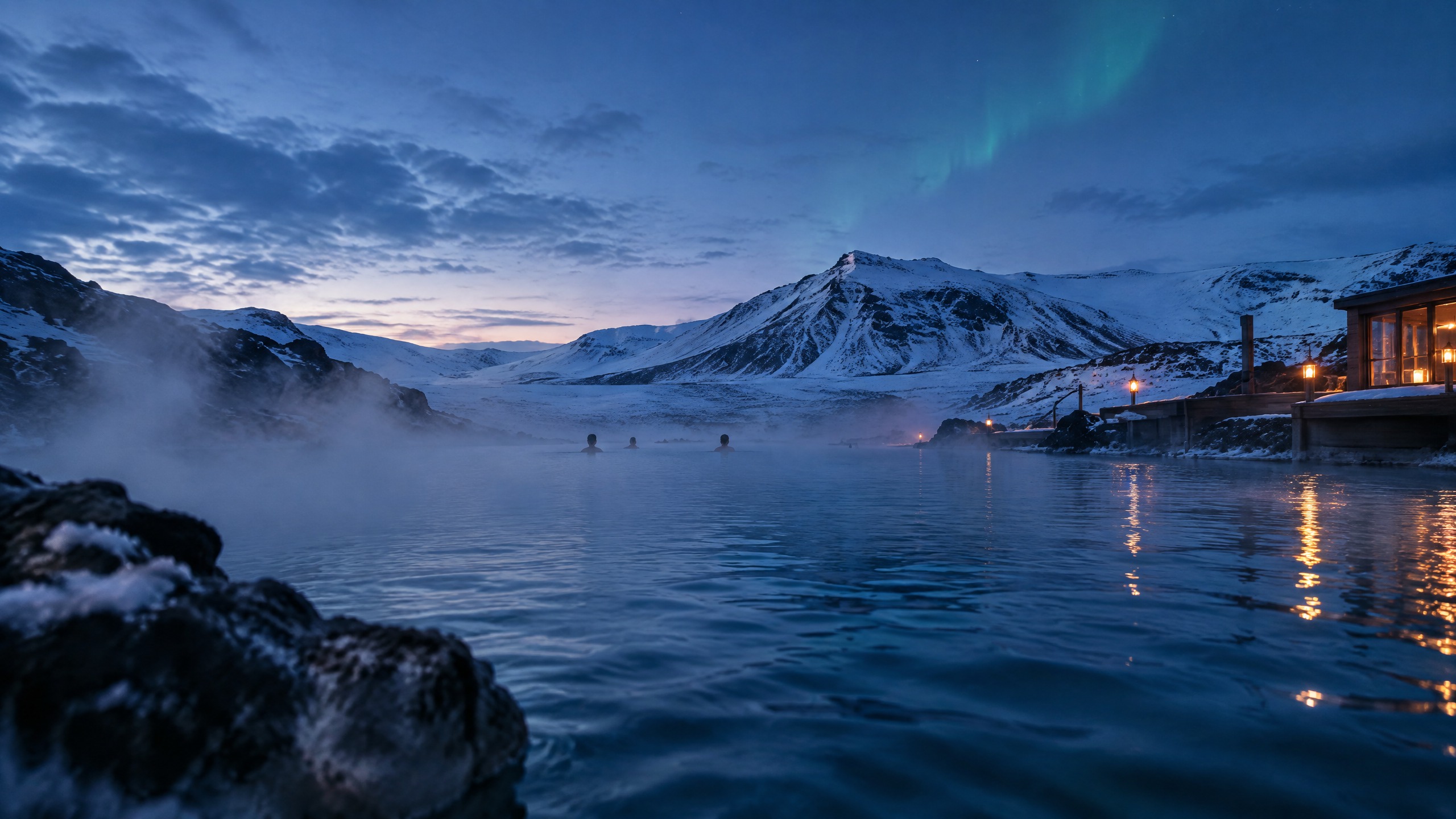
At 3:45 in the afternoon in Reykjavík, the day is already deciding what it will become. The light has thinned into blue. Steam rises from a neighborhood pool into air cold enough to make every face look more awake. Inside, people have finished work, lowered themselves into water warmer than the weather, and begun the most ordinary part of a winter evening in a place where winter refuses to be background scenery. The wrong instinct is to call this a substitute for the sun. The right one is to understand that the darkness has made another kind of day available.
December travel is usually sold as an exit. Escape the cold. Escape the office party. Escape the family table. Escape into a resort where the calendar has been chemically removed from the weather. Even the apparently opposite recommendation—the European Christmas market—is often framed as an escape into a version of December somebody else has prepared for you. The month becomes a problem to solve before the traveler has asked whether it might be a reason to go.
The best places to go in December are the ones that become specifically, irreducibly themselves because it is December: places where darkness, light, ritual, desert cold, city energy, or the first days of summer produce an experience no July itinerary could reproduce. That is why these six belong together. Iceland makes darkness into geography. New York makes it into urban illumination. Chile’s Atacama Desert turns it into astronomical clarity. Japan uses it to close a year with ritual. Morocco lets the desert host rather than punish. New Zealand begins the summer just as the Northern Hemisphere is closing its shutters.
This standard rules out the usual obvious answers. The Maldives deserves its reputation for dry-season water and easy warmth, but it is the most rehearsed form of December escape. Vienna’s Christmas markets are beautiful, yet they are also the most documented European December proposition on the internet. Thailand’s Andaman coast offers a genuinely excellent beach season, but it answers the familiar question—where can I get away from winter?—rather than the better one: where does December change the meaning of a place? This list is not anti-sun, anti-holiday, or anti-comfort. It is simply more demanding. December has to do real work.
What December Rewards When You Stop Trying to Escape It
A December destination earns its place when the month alters the experience rather than merely alters the packing list. The alteration can be atmospheric: an afternoon that darkens before dinner and asks a city to make its own light. It can be cultural: an end-of-year practice that opens a door not available in April. It can be geographic: long Southern Hemisphere days, desert nights suited to looking up, snow that changes the architecture of a landscape.
The distinction sounds abstract until you plan around it. A December trip to Iceland needs daylight discipline, aurora flexibility, and the acceptance that a thermal pool may be the evening’s central event. A December trip to New York needs timed tickets and the willingness to begin a skating session when locals do. Japan asks you to stay late enough for the year to turn. Morocco asks you to pack for a warm afternoon and a cold desert night in the same bag. New Zealand asks you to book early because its summer begins before many Northern Hemisphere travelers have decided they want one.
These are not six substitutes for one another. They are six answers to a more honest question: what kind of December do you want to inhabit?
Iceland: Where December Turns Darkness Into Geography
Iceland makes the strongest possible case for going toward December because the winter-solstice darkness changes the land itself into a different kind of map. In early and mid-December, the usable daylight around Reykjavík and the Ring Road shrinks to a concentrated window, with blue twilight replacing the clean separation between sunrise and sunset. A drive that would be incidental in June becomes deliberate in winter. A black-sand shore, a low ridge, or the first sight of steam lifting from a geothermal field arrives within a day that feels compressed, luminous, and unusually finite.
That compression is the point, not a defect to be planned around. The responsible December driver treats the daylight window as the first reservation of the day. Check road conditions, wind alerts, and weather before leaving Reykjavík; do not build an itinerary around a distant waterfall and assume the return will behave like a summer drive. The seven-day Iceland adventure guide is most useful in December when used as a framework for shorter, weather-responsive sections rather than a list to complete. The Ring Road remains the country’s great narrative line, but in December its story is told in concentrated chapters.
Then the day turns toward water. Reykjavík’s pool culture is the necessary human answer to this kind of darkness. Laugardalslaug has hot pots, a steam room, and the practical, social atmosphere of a place residents use in ordinary life; Sundhöllin, near the center, is a smaller and older alternative with its own outdoor water. Neither needs a luxury-spa script to work. The ritual is simpler: leave the cold, enter the heat, stay long enough for conversation to become the evening. Outside the city, a geothermal lagoon may offer a more designed version of the same contrast. Either way, Iceland in December teaches you that warmth is not the opposite of weather. It is a way of meeting it.
Aurora sightings should remain a possibility rather than an obligation. Clear sky, solar activity, darkness, and an open northern view have to align; anyone promising a nightly guarantee is selling the wrong relationship with the place. What December does provide is time in the dark, and that time makes the chance more meaningful. A four-day Reykjavík winter adventure can anchor the city portion while leaving room for a final, weather-led night outside the bright center.
Iceland darkens December until every practical choice—when to drive, when to stop, when to get in the water—becomes part of the landscape.
New York City: Where Winter Darkness Becomes Public Light
Where Iceland turns darkness into geography, New York City turns it into urban electricity. December’s early sunset gives Manhattan a steel-blue interval before night, and the city spends that interval refusing to disappear into it. The effect is not confined to Rockefeller Center. It is in the way a Fifth Avenue window becomes a piece of public theater, in the entrance to Lincoln Center before a performance, in the fact that dinner reservations, curtain times, subway platforms, and wet pavement all begin to reflect the same artificial glow.
The well-known rituals are worth seeing precisely because they reveal how seriously the city makes a season. The New York City Ballet’s George Balanchine’s The Nutcracker has a civic weight in December that an ordinary performance calendar cannot imitate. The Metropolitan Opera’s December programming adds another version of the same argument: a large city deciding that darkness is a reason to gather indoors with formal attention. Book both far in advance if they matter to you. In December, spontaneity is a poor strategy for the experiences that make New York feel most fully New York.
The more revealing counterpoint comes at the day’s quieter edges. Brooklyn Bridge Park, particularly the lawns and paths near the DUMBO waterfront, can give you a clean morning view back toward Lower Manhattan before the day begins to crowd itself. The cold is not decorative there; it is what gives the skyline space. For a city-wide framework that lets you place those early hours beside the larger cultural calendar, the seven-day New York City itinerary helps keep the trip from collapsing into a string of ticketed obligations.
Ice skating makes the same distinction. Wollman Rink can be packed later in the day, but a weekday opening session feels like a different institution: commuters and regular skaters moving through Central Park before the city turns fully performative. The surrounding bare branches reveal the park’s slopes and long perspectives in a way summer canopy conceals. Do not expect a private rink; expect a more local rhythm. The New York City budget guide is useful here because December can become expensive by momentum alone—shows, meals, taxis, and timed admissions all make a financial decision before you notice it.
New York illuminates December by making the dark a public medium. The city does not ask you to forget the season. It asks you to come out into it.
Chile’s Atacama Desert: Where December Opens the Sky Wider
If New York illuminates December at street level, Chile’s Atacama Desert clarifies it on a planetary one. San Pedro de Atacama sits high in the desert, where the air is dry, the horizons are abrupt, and the Southern Hemisphere summer stretches the day toward a late evening. December does not make the Atacama gentler in every respect—the altitude remains real, the sun remains serious, and temperature falls sharply after dark—but it gives the traveler a long, bright working day followed by a night sky whose scale cannot be simulated by a city observatory.
The practical order matters. Acclimatize before trying to turn every excursion into a sunrise mission. Carry water even when the temperature feels manageable. Treat altitude symptoms honestly rather than cosmetically. The desert’s power depends on alertness: you want enough energy left at sunset to see the landscape change, and enough patience after dinner to stay outside when the sky becomes the event. A four-day San Pedro de Atacama adventure gives the essential day structure without asking you to mistake speed for range.
Valle de la Luna is often reduced to a sunset photograph. Its better use is as an argument about light that takes time to develop. Salt ridges, clay forms, and the Licancabur silhouette begin the evening in hard desert contrast; as the sun falls, the terrain loses one kind of detail and acquires another. December’s long day lets you reach the viewpoint without turning the experience into a narrow race against an early dark. The correct response is to stay through the full shift, then let the return to San Pedro feel like the descent from one scale of attention to another.
The flamingo lagoons around Salar de Atacama make a different kind of December case. Chaxa Lagoon and its surrounding salt-flat environment reward a quieter pace than the desert’s headline excursions. The flamingos appear as moving color against mineral ground; the air often makes distance difficult to judge. Guides can help visitors understand how to observe without pushing too close to feeding and nesting areas. This is not a wildlife encounter to optimize by getting nearer. It is an encounter to let remain strange.
At night, the Atacama gives the month its most literal clarity. A well-run stargazing session uses darkness as instruction rather than spectacle: eyes adjust, familiar stars stop feeling familiar, and the Milky Way gains texture. The Atacama’s astronomical institutions, including ALMA on the high plateau, exist because this region’s atmosphere has unusual value for observing the universe. Public tours do not need to imitate scientific work to feel its implication. December gives a traveler from the Northern Hemisphere access to a Southern sky whose seasonal orientation is genuinely different.
Atacama clarifies December by removing the usual visual clutter. The month becomes less a deadline than a long evening with nowhere to look except outward.
Japan: Where the Year Is Completed on Purpose
Where Atacama asks the traveler to look upward, Japan turns December inward, using the month to complete a year with practices that cannot be downloaded into a generic holiday itinerary. December in Japan has illuminations, shopping streets, and winter food, but its deeper argument is about sequence: the year is gathered, released, and then begun again through a set of rituals whose precision gives the season a formal shape.
The first part is social. Bōnenkai—year-forgetting gatherings—fill izakaya rooms through December as work groups and friends mark the year’s end. A visitor does not need an invitation to a private office party to feel the city’s changed tempo. Walk through a neighborhood where small restaurants are full, listen to the way the evening begins earlier and runs warmer behind noren curtains, and reserve your own meal rather than assuming an empty table will appear. Tokyo’s food geography provides a practical entrance to the season; the Tokyo food guide can help you make dinner a destination while keeping the calendar in view.
The second part is ritual. On December 31, toshikoshi soba—year-crossing noodles—are eaten with the long, unbroken noodle standing in for a wish for long life. Later, Buddhist temples ring joya no kane, the New Year’s Eve bell, 108 times, a ritual associated with releasing worldly desires. The meaning does not require the traveler to perform expertise. It requires modesty: choose a temple or neighborhood setting, arrive early, follow local cues, and recognize that the night belongs to a living calendar rather than a staged event.
Kyoto intensifies this relationship with time. Kinkaku-ji in cold weather has a different visual logic than it does beneath spring foliage, and a rare snow day turns the garden into an example of yukimi—snow viewing—rather than a reason to chase a postcard. The stronger December choice is to allow temple visits to be shaped by weather and light, then hold the evening for a small meal or a walk through Gion when the streets have emptied. A Kyoto solo travel guide provides a useful pace for that more patient version of the city.
Stay through January 1 if you can. Hatsumōde, the first shrine visit of the new year, is the final proof that Japan makes December feel earned. The month has not been escaped. It has been carried all the way to its conclusion and turned into the opening of something else.
Japan completes December through ritual, proving that the year’s end can be an act of attention rather than a countdown.
Morocco: Where the Desert Becomes a Host
If Japan completes its year through ritual, Morocco hosts December through temperature, pace, and the rare generosity of a desert that can be lived in all day. The Sahara is not comfortable because it becomes warm in December; it is comfortable because the balance changes. Daytime exploration becomes possible without the punishing heat of high summer, while the night retains enough cold to make a fire, tea, wool, and shared shelter feel like the center of the experience rather than themed decoration.
Erg Chebbi is the clearest version of this argument. The dunes outside Merzouga change color throughout the day, but December gives you a reason to walk them in the afternoon and remain for the night. Temperatures can fall sharply after sunset, so a serious camp needs serious bedding and travelers need to pack layers rather than trust a desert stereotype. The cold is not a hardship to glamorize. It is what makes the first warm glass of mint tea, the circle around a fire, and the sound of wind changing the tent fabric feel earned. A ten-day Morocco route through Marrakech, the Sahara, Fez, and Chefchaouen helps put the desert into a broader journey without treating it as a quick overnight performance.
Marrakech offers the urban version. In August, Djemaa el-Fna can ask more of a traveler than it gives back. In December, evening lets the square operate at its natural temperature: food smoke, musicians, families, vendors, and the flow toward the surrounding medina. This is not an argument that the square becomes empty or private; it remains a public, intense place. It is an argument that the weather gives you enough time to absorb it without fleeing into an air-conditioned room. The Marrakech culture and food guide makes a good counterweight to the desert, especially for travelers who want to understand how the city’s morning markets and late-night tables carry different kinds of energy.
Then Fez and Chefchaouen offer Morocco’s December quiet. Fez’s medina works best when you let a guide or a deliberately slow route replace the urge to conquer its alleys. In the Rif Mountains, Chefchaouen can take on mist and low cloud that soften the blue walls into a condition rather than a color. Those are not guarantees, and they should not be scheduled as if they were. They are the kind of weather-led variation December makes available to a traveler who has stopped demanding summer from every place.
Morocco hosts December by showing how hospitality becomes more visible when the day is cool enough to linger in.
New Zealand: Where Summer Starts Before the Year Ends
Where Morocco makes the winter desert hospitable, New Zealand begins summer before the Northern Hemisphere has finished naming its winter. December is the opening act of the Southern Hemisphere’s long-day season, when the South Island’s roads, trailheads, lakes, and adventure operations begin to run at full volume. The appeal is not merely relief from cold. It is the psychological correction of waking to a bright summer morning while the people you left behind are buying gloves.
The Mackenzie Basin supplies the first visual proof. Around Lake Tekapo, the water, high-country air, and Southern Alps make an unusually clean landscape even before you add an activity. In the warmer months, introduced lupins can bloom in parts of the basin, creating bands of color that have become a familiar summer image; they are also an invasive species, so the right response is to enjoy the landscape without treating their spread as uncomplicated decoration. December’s more durable advantage is the length of the day, which gives a traveler time to walk, drive, or simply wait for the light to change without building every hour around an early sunset.
Queenstown turns that daylight into motion. The Kawarau Bridge bungee, jet boating, and hikes above town have a different energy once the summer operating rhythm begins, but December requires early decisions. Popular activities, restaurants, and accommodation can fill quickly around the holiday period. The five-day Queenstown adventure guide is most useful as an advance-booking map: decide what you will reserve, then leave enough empty time for the lakefront, a weather shift, or an unplanned drive into Central Otago.
Milford Sound supplies the corrective to the idea that summer should mean perfect weather. Fiordland remains wet, and that wetness is part of why the walls hold so much green and why temporary waterfalls can appear after rain. December often offers longer daylight and more workable travel windows, not a guarantee of blue sky. That is exactly the kind of distinction this post asks the traveler to value. A South Island ten-day road trip gives Milford enough context that it becomes part of a landscape sequence rather than a single day trip taken at any cost.
New Zealand begins December by making the year feel reversible. Summer is not a distant promise; it is already arriving through the window.
How to Choose Where to Go in December
Choose Iceland if you want to meet winter directly and can plan around weather rather than against it. Four to seven days works well for Reykjavík plus a flexible south-coast or Golden Circle extension, with winter driving treated as a serious decision rather than an adventurous accessory. Choose New York if you want the month to feel social, scheduled, and public. Four to six days can be enough, but December tickets, restaurants, and hotel rates reward early planning more than almost any other city break.
Choose Atacama if you want a December trip that expands the sky and can accept altitude, dry air, and a slower first day. Four to five nights around San Pedro lets you acclimatize, see the desert at several light conditions, and keep one evening for stargazing. Choose Japan if you want the emotional and cultural force of an ending rather than a conventional holiday break; stay through December 31 and ideally January 1 if the calendar is the point. A week split between Tokyo and Kyoto gives the argument room to breathe.
Choose Morocco if you want weather that lets you move from medina to desert without the heat deciding your entire day. A week can join Marrakech with the Sahara; ten days or more creates space for Fez and Chefchaouen. Choose New Zealand if you want a genuine seasonal reversal and can afford the distance. Ten days is a minimum for a South Island-focused trip; two weeks is better if you want both islands without turning the journey into a series of airport transfers.
Budgets divide along a different line than climate. Iceland and New York can become expensive quickly through accommodation, tours, dining, and December demand. Japan rewards careful rail and restaurant planning. Morocco can offer more range, but quality desert logistics are not where to economize blindly. Atacama and New Zealand both require transport decisions before arrival. The useful question is not which December destination is cheapest. It is which version of the season you actually want your money to buy.
If you combine destinations, do it for a real contrast. New York and Iceland make sense for a traveler who wants darkness first as light, then as landscape. Japan and New Zealand make sense for someone who wants the year to close with ritual and begin again in summer. Do not combine them merely because a flight map makes it possible. Each of these places earns time on its own terms.
December Is the Reason
Iceland darkens. New York illuminates. Atacama clarifies. Japan completes. Morocco hosts. New Zealand begins.
None of those verbs can be borrowed by another month. That is the real test of December travel. The best trip does not remove the season from the picture. It lets the season become the whole reason you went.