Cusco Doesn't Need Machu Picchu. It Never Did.
Destination: Cusco, Peru
Category: destination
You land in Cusco and the altitude hits you before the city does. The air is thinner than it should be. Your lungs work harder than they need to for the effort involved. You walk from the taxi to the hotel lobby and stop to catch your breath, which is embarrassing, because you haven't done anything yet. You're at 3,400 meters — 11,152 feet — and your body knows it even if your brain hasn't caught up.
Then you walk to the Plaza de Armas, and the city introduces itself properly.
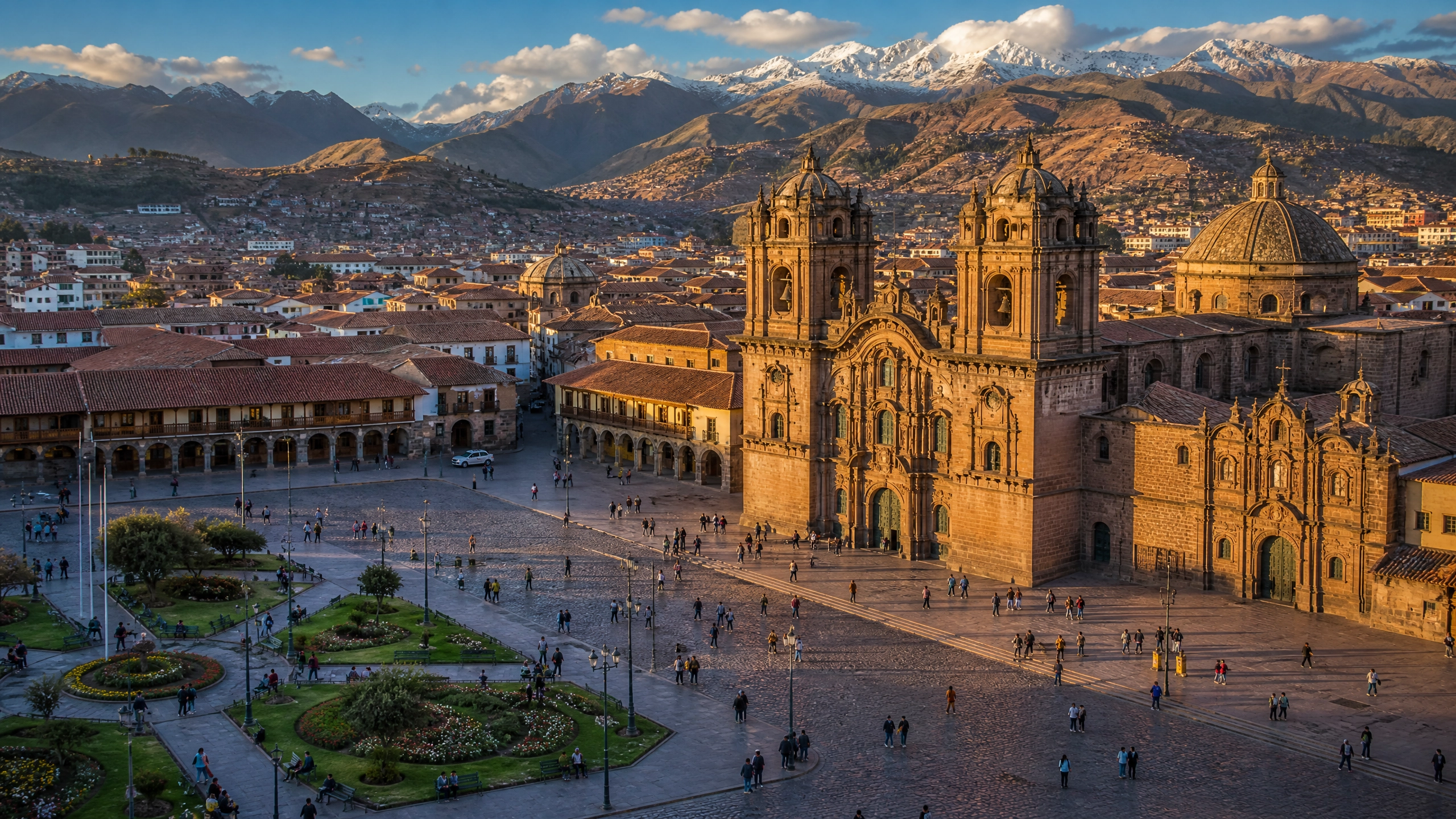
The square is enormous, ringed by stone arcades that have been here in some form since the 15th century. On one side stands the Cathedral Basilica of the Assumption of the Virgin, completed in 1654, built from stones quarried from Sacsayhuamán — the Inca fortress on the hill above the city. The Spanish didn't just build their cathedral in Cusco. They built it from the ruins of what they'd destroyed. And underneath the cathedral's foundations, underneath the plaza itself, underneath the cobblestones you're standing on, are the remains of the Inca ceremonial center that the Spanish built over. The Inca palace Kiswarkancha occupied this ground. The Suntur Wasi, the house of the sun, stood here. You are standing on top of an empire.
That is the argument this post is going to make: Cusco doesn't need Machu Picchu. It never did. The ruin in the mountains is extraordinary, and you should go. But it is a satellite. Cusco is the center. It always was.
The Navel of the World
Qusqu means "navel of the world" in Quechua. The Inca didn't name their capital modestly. At its height in the early 16th century, the Inca Empire — Tawantinsuyu, the Four Regions — stretched 4,000 kilometers from what is now Colombia to central Chile, encompassing 12 million people across dozens of distinct cultures and languages. It was the largest empire in the Western Hemisphere, and it was administered from this city, at this altitude, in this valley in the Andes.
The ceque system radiated outward from Cusco like spokes from a wheel — 41 imaginary lines connecting the capital to sacred sites, water sources, and astronomical markers across the empire. Everything was oriented toward the city. The roads of the Inca highway system, the Qhapaq Ñan, converged here. The gold from the mines of Bolivia passed through here. The finest textiles, the most sacred ceremonies, the political decisions that governed millions of lives — all of it happened in Cusco.
Machu Picchu was built around 1450, during the reign of Pachacútec, the same emperor who transformed Cusco from a regional center into an imperial capital. It was a royal estate — a retreat, a ceremonial site, possibly an astronomical observatory. It was extraordinary. It was also peripheral. When the Spanish arrived in 1532 and the empire collapsed, Machu Picchu was abandoned and forgotten. Cusco was not. The Spanish knew exactly what they had captured, and they built their colonial capital on top of it, stone by stone, wall by wall, church by church.
That decision — to build on top rather than beside — is why Cusco is unlike any other city in the Americas. The Inca stone is still here. It never left.
The Stone That Survived Everything
Walk down Hatun Rumiyoq street, northeast of the Plaza de Armas, and you'll find the 12-angled stone embedded in a wall at roughly knee height. Every guide mentions it. What they don't explain is what it actually is.
The stone is not a ruin. It is a structural element of the Archbishop's Palace, a colonial building constructed in the 16th century and still in active use today. The wall it sits in was once part of the palace of Inca Roca, the sixth Sapa Inca. The Spanish didn't demolish this wall — they incorporated it. The Inca masonry was too good to tear down, so they built on top of it and beside it and around it. The Archbishop of Cusco works in an office whose foundations were laid by the Inca six centuries ago.
The stone has 12 angles and fits against its neighbors without mortar, without gaps, without any visible means of adhesion. Inca stonemasons used a technique called ashlar — stones shaped to interlock so precisely that a knife blade cannot be inserted between them. The stones were shaped by abrasion, not cutting, using harder stones to grind softer ones into shape. It took years per stone. The walls of Cusco's Inca buildings have survived earthquakes that leveled their Spanish colonial successors. In the 1950 earthquake that devastated the city, the Inca foundations held. The colonial buildings on top cracked and fell.
Above the city, on the hill to the north, Sacsayhuamán makes the same argument at a scale that removes all doubt. The fortress — or ceremonial complex, or both, the function is still debated — was built from stones weighing up to 200 tons. The largest stone is 8.5 meters tall. The zigzag walls stretch 360 meters. No mortar. No gaps. The Spanish demolished two-thirds of the structure to build colonial Cusco — they used the stones as a quarry for 80 years — and what remains is still one of the most technically sophisticated stone constructions in human history.
Go in the late afternoon, when the sun comes from the west and the light hits the zigzag walls at an angle that makes the shadows between the stones sharp and deep. The city of Cusco spreads below you in the valley. You can see the Plaza de Armas from here, the cathedral roof, the red tile of the colonial buildings, and underneath all of it, the Inca stone. The view makes the thesis visible.
The Temple Under the Church
The Qorikancha is the most important building in Cusco, and most visitors spend less than an hour there.
It was the most sacred temple in the Inca Empire — the Coricancha, the Golden Enclosure — dedicated to Inti, the sun god. At its height, the interior walls were sheathed in 700 sheets of solid gold. The garden contained life-sized gold and silver replicas of plants and animals. The mummies of previous Inca emperors were kept here, brought out for ceremonies and seated as if alive. The high priest of the sun lived here. The ceque system originated here. Every important ceremony in the Inca calendar passed through this building.
In 1533, the Spanish melted the gold to pay Atahualpa's ransom — 6 tons of gold and 12 tons of silver, the largest ransom in history — and then killed him anyway. In 1534, they gave the Qorikancha to the Dominican order, who built the Convent of Santo Domingo directly on top of it. The curved walls of the Inca temple became the foundation walls of the convent. The apse of the Dominican church was built inside the Inca sanctuary.
The 1950 earthquake cracked the colonial structure and revealed what was underneath. The Inca walls — trapezoidal niches, perfectly fitted stone, the characteristic slight inward lean of Inca construction — emerged from behind the plaster. Today you can walk through both buildings simultaneously. The Inca walls are exposed inside the convent. You can put your hands on the stone. You can stand in a space where the original Inca masonry curves away from you and the 16th-century Spanish colonial arches rise above it and both are present at the same time, neither one erasing the other.
This is what Cusco is. Not a city with ruins nearby. A city that is itself the ruin and the living place simultaneously. The layers don't separate. They coexist.
Admission to Qorikancha is S/15 (roughly $4). It is not covered by the Boleto Turístico — the tourist ticket that covers Sacsayhuamán and the Sacred Valley sites. Budget for it separately. It is worth every sol.
San Blas and the Red Flag
San Blas is the neighborhood above and northeast of the Plaza de Armas, reached by steep cobblestone streets that will remind you, again, that you are at 3,400 meters. Take the climb slowly. The reward is a neighborhood that feels like Cusco before it became a destination.
The streets are narrow enough that two people can barely pass. The houses are whitewashed colonial buildings with carved wooden balconies. The workshops of Cusco's artisan community are here — woodcarvers, weavers, silversmiths — many of them operating out of the same family workshops that have been here for generations. The Plaza San Blas, at the top of the neighborhood, is small and quiet and has a church with a pulpit carved from a single tree trunk, considered one of the finest examples of colonial woodcarving in the Americas.
But what San Blas has that no mainstream travel guide mentions is the chichería system.
Traditional chicha de jora — fermented corn beer, the sacred drink of the Inca — is still brewed and sold in small neighborhood bars called chicherías. When a chichería has a fresh batch ready, it hangs a red flag or a red plastic bag outside the door. The flag means: open, fresh chicha available. This is a signaling system that has existed in the Andes for centuries. The chicherías are not on Google Maps. They don't have signs. You find them by walking the streets of San Blas and looking for the flag.
A glass of chicha de jora costs S/2-3. It tastes sour and slightly sweet, somewhere between a light beer and a cider, with a cloudiness that comes from the corn. The fermentation process uses germinated jora corn — the tourist myth that it's made with human saliva is a persistent misunderstanding of a different, older preparation method. The chicha you'll drink in San Blas is made the same way it has been made for 500 years, in the same neighborhood, served to whoever walks through the door.
Sit at a wooden table in a chichería in San Blas in the late afternoon, with the light coming through a small window and the sounds of the street outside, and you are as close to the living Inca city as it is possible to get. This is not a museum. This is a neighborhood that kept going.
The Market Before the City Wakes
The Mercado San Pedro opens before dawn. By 6 AM the stalls are set up and the market workers are eating breakfast. By 7 AM the juice stalls in the back section are running at full speed.
The front section of San Pedro, near the entrance on Calle Santa Clara, has been touristified — alpaca goods, souvenir textiles, the kind of market that exists in every tourist city. Walk past it. Walk past the butcher stalls, past the cheese sellers, past the stalls selling dried herbs and coca leaves in quantities that suggest medicinal rather than ceremonial use. The back section of the market is where Cusco's residents shop.
The juice stalls here serve combinations that don't exist anywhere else: lucuma (a subtropical fruit with a flavor somewhere between sweet potato and maple), maracuyá (passion fruit), chirimoya (custard apple), and combinations of all three. A large glass costs S/2-3. The women running the stalls will ask what you want and blend it in front of you. This is breakfast for market workers and for the residents of the neighborhoods around San Pedro who have been shopping here their whole lives.
The caldo de gallina stalls — hen broth with noodles, a hard-boiled egg, and a piece of chicken — open at the same hour. A bowl costs S/5-8. It is the local hangover cure and the standard breakfast for anyone who has been working since before dawn. It is also one of the best things you will eat in Cusco, not because it is refined but because it is exactly what it needs to be: hot, restorative, and specific to this place.
The market is at its best before 9 AM, before the tourist groups arrive. Go early. Eat something. Watch the city feed itself.
The Sacred Valley Is Not the Road to Machu Picchu
Most travel itineraries treat the Sacred Valley — the Urubamba River valley northwest of Cusco — as the corridor you pass through on the way to Machu Picchu. This is the wrong frame. The Sacred Valley is Cusco's extension, not Machu Picchu's approach.
The valley sits at around 2,800 meters, 600 meters lower than Cusco, which makes it warmer, more fertile, and easier to breathe. The Inca recognized this: the valley was the agricultural heartland of the empire, terraced with andenes — stone agricultural terraces — that are still in use today, still growing the same varieties of corn and potato that fed the empire. The Peru Sacred Valley 7-day road trip guide covers the full route, but even a day or two in the valley changes how you understand Cusco.
Pisac, 33 kilometers northeast of Cusco, has one of the best markets in the Andes — best on Sunday, when the village fills with traders from surrounding communities. The Inca ruins above the town include some of the finest agricultural terracing in the region. Ollantaytambo, at the far end of the valley, is the only Inca town in Peru where people still live in the original Inca buildings — the same stone houses, the same water channels, the same street grid that the Inca laid out in the 15th century. It is also where the Inca defeated the Spanish in battle in 1536, one of the few military victories of the conquest period.
The valley is not a day trip from Cusco. It is the context in which Cusco makes sense. The city was the administrative center; the valley was the food supply; the mountains were the sacred landscape; Machu Picchu was the royal retreat at the edge of all of it. Understanding the valley means understanding what the empire actually was, which means understanding why Cusco was its center.
What 3,400 Meters Actually Does to You
Let's be direct about this, because most travel guides aren't.
At 3,400 meters, your body produces less oxygen per breath than it does at sea level. The effects vary enormously between individuals — some people feel nothing, some are incapacitated for two days. The most common symptoms are headache, fatigue, shortness of breath on exertion, and disrupted sleep. The first night is often the worst: many people wake at 2 AM with a pounding headache and a feeling of breathlessness that is alarming even when you know what's causing it.
What actually helps:
Acetazolamide (Diamox) is a prescription medication that genuinely reduces altitude sickness symptoms. Start taking it 24 hours before arrival. Talk to your doctor before the trip — it's not appropriate for everyone, but for most healthy adults it makes a significant difference.
The Sacred Valley first strategy is the most underused acclimatization approach. Instead of flying directly from Lima (sea level) to Cusco (3,400m), spend the first night in Ollantaytambo (2,792m) or Urubamba (2,863m). The lower altitude gives your body a gentler introduction. You sleep better. You arrive in Cusco the next day already partially acclimatized. Almost no mainstream travel guide recommends this, but it is the approach that experienced Peru travelers consistently recommend.
Coca tea — mate de coca — is served free in most Cusco hotels and is genuinely helpful for mild altitude symptoms. It's legal in Peru, it's traditional, and it works. The leaves contain alkaloids that improve oxygen uptake. Don't try to bring it home.
Avoid alcohol for the first 48 hours. The bars around the Plaza de Armas are tempting and the pisco sours are excellent. Wait. Alcohol at altitude dehydrates faster, hits harder, and significantly worsens altitude symptoms. Two days of sobriety is a reasonable price for feeling functional.
Ibuprofen, not aspirin, for altitude headaches. Aspirin thins blood and can worsen symptoms.
The altitude is not a reason to avoid Cusco. It is a reason to plan for it. Everyone who has been there has gone through the same first day. The city is worth it.
When to Go
Cusco has two seasons: dry (May through October) and wet (November through April). The dry season is the obvious choice — blue skies, minimal rain, the best conditions for trekking and the Sacred Valley. June through August is high season, which means crowds at Machu Picchu, higher accommodation prices, and a city that is visibly oriented toward tourism.
The exception that makes June worth it regardless: Inti Raymi, the Festival of the Sun, celebrated on June 24th. It is the second-largest festival in South America after the Rio Carnival, drawing 100,000 people to Cusco for a recreation of the Inca ceremony honoring the winter solstice. The main ceremony takes place at Sacsayhuamán. Tickets for the main ceremony sell out months in advance. The processions through the city streets are free. If you're going to be in Cusco in late June, plan around it.
The shoulder months — May and September — offer the best combination of good weather and manageable crowds. May is particularly good: the rains have ended, the landscape is still green, and the tourist peak hasn't arrived yet.
The wet season (November through April) is not as bad as its reputation. Rain typically falls in the afternoon and evening, not all day. Mornings are often clear. Accommodation prices drop significantly. The crowds thin. Machu Picchu in the wet season has a particular quality — the clouds move through the ruins, the vegetation is intensely green, and the mountain is often shrouded in mist in a way that makes it look exactly like the photographs. If you don't need guaranteed blue skies, the wet season is worth considering.
Planning Your Cusco Trip
The question most people ask about Cusco is how many days to allow before Machu Picchu. The better question is how many days to allow for Cusco itself.
Three days is the minimum to do the city justice: one day for the Plaza de Armas, Qorikancha, and the Cathedral; one day for San Blas, Sacsayhuamán, and the smaller ruins above the city; one day for the San Pedro market and a slower walk through the neighborhoods. Four days gives you the Sacred Valley. Five days gives you the Inca Trail or the Salkantay Trek. The Cusco 3-day itinerary guide maps the essential version; the Sacred Valley 7-day road trip covers the extended version.
The Boleto Turístico — the tourist ticket — covers 16 sites including Sacsayhuamán, Qenqo, Puca Pucara, Tambomachay, and several Sacred Valley sites. It does not cover Qorikancha (S/15 separate) or the Cathedral (S/25 separate). Buy the boleto at any of the covered sites or at the official office on Avenida El Sol. The 10-day version (S/130) is worth it if you're spending time in the Sacred Valley. The 1-day version (S/70) covers only the city ruins.
For travelers focused on budget, the Cusco budget guide covers the free and low-cost version of the city — the Inca walls visible throughout the historic center, the free viewpoints above San Blas, the market breakfasts. For couples, the Cusco couples guide covers the slower, more atmospheric version of the same city. For families, the Cusco family guide handles the Machu Picchu logistics alongside the city.
If you want AskLeif to build a personalized itinerary — one that accounts for your specific dates, your acclimatization needs, whether you're doing the Inca Trail, and how much time you actually have — the itinerary generator does this in minutes. The difference between a good Cusco trip and a great one is usually sequencing: what you do on day one (nothing strenuous), what you save for day three (Sacsayhuamán in the afternoon light), and whether you've built in the Sacred Valley before or after Machu Picchu. The Machu Picchu first-timer guide covers the logistics of combining both.
The Closing
There is a moment in Cusco that happens to almost everyone, usually on the second or third day when the altitude has eased and the city has started to make sense. You're walking somewhere — down Hatun Rumiyoq, or through the back of San Pedro, or up the hill toward San Blas — and you stop and look at a wall. Not a famous wall. Just a wall. And you notice that the bottom third is Inca stone, fitted without mortar, and the top two-thirds is colonial Spanish, and above that is a modern door with a plastic handle, and someone's laundry is hanging from the window above it.
Five hundred years of history in one wall. All of it still standing. All of it still in use.
Machu Picchu is a ruin. Cusco is a city that never stopped. That's the difference. That's why it doesn't need the mountain. It has always been the point.
Guide Links
- Cusco in 3 Days: The Essential General Traveler's Guide
- Cusco on a Budget: 4-Day Guide to Free Inca Ruins & Sacred Valley
- Cusco for Couples: A Romantic 3-Day Peruvian Escape
- Cusco with Kids: 5-Day Family Adventure to Machu Picchu & Sacred Valley
- Machu Picchu & Cusco: 4-Day Adventure for Every Traveler
- Peru Sacred Valley 7-Day Road Trip: Cusco, Machu Picchu & Andean Adventures