The Best Road Trip Destinations for Travelers Who Refuse to Fly Over the Good Part
Destination: Global
Category: comparison
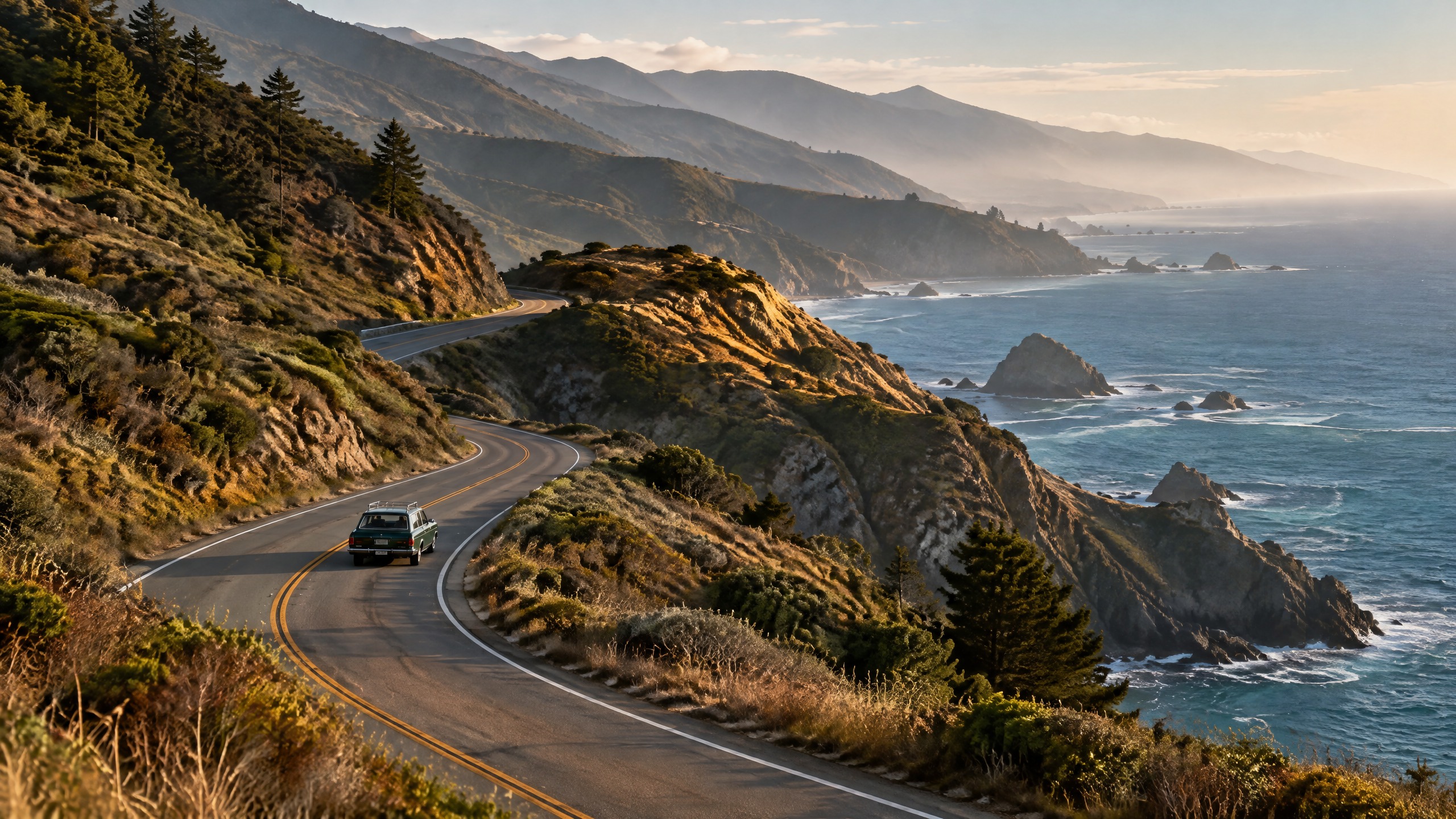
At the north end of the Bixby Creek Bridge, there is a moment when the Pacific disappears beneath the hood of the car and then returns all at once, far below the passenger window. Nobody arriving in Carmel by plane has that moment. Nobody taking the coast by train gets the private calculation that follows it: pull over now, keep going, or take the unmarked-looking turn toward a ridge whose weather has just changed the color of the sea. A road trip earns its place in a traveler’s memory through those small decisions, not through the pin dropped at the end of the day.
Most rankings of the best road trip destinations get this backward. They count landmarks at either end, then treat the route as the adhesive between them. The road gets a few scenic adjectives, a photo stop, and a fuel estimate. Yet a truly great road trip creates a form of attention that the destination cannot provide. You learn the length of a coastline by watching its headlands keep interrupting the horizon. You understand a glacier’s authority when the road keeps rerouting around its runoff. You begin to see a country as a system of weather, rock, farming, water, and human improvisation because the windshield keeps giving you the next piece before you have fully processed the last one.
The best road trip destinations are the routes where driving—not arrival—reveals the place: where the landscape changes at car-window speed, where a fork in the road becomes a real decision, and where the unplanned stretch is often the part that stays with you. That is why these six are here. They are not interchangeable scenic drives. Each makes a different argument about what a car can teach a traveler: California slows the ocean to a human scale; Iceland circles geology in motion; South Africa turns a highway into a living survey; the Amalfi Coast makes driving a physical conversation with the terrain; the Highlands rewrite themselves every few miles; and New Zealand compresses nearly every version of the road-trip idea into one island.
That standard also rules out several routes people will expect. Route 66 belongs to American imagination, roadside signs, and the pleasure of moving through a national archive, but its primary subject is nostalgia rather than land. Norway’s fjord routes contain some extraordinary road sections, but the crossings make them a road-and-ferry composition instead of a continuous driving argument. The Utah parks loop deserves its own story—and Ask Leif already has one—because its power comes from a sequence of parks. These six are different. On them, the route itself is where you are.
What the Best Road Trip Destinations Ask of the Driver
A good road trip does not reward speed. It rewards calibration. The first hour teaches you the road’s scale; the second teaches you whether it is safe to keep the itinerary rigid; by the third, you understand that the useful question is no longer “How quickly can we get there?” but “What would we miss by making this faster?”
Each route below asks for a different kind of calibration. The Pacific Coast Highway asks the driver to accept that the ocean dictates the tempo. Iceland asks for seriousness about weather, tires, fuel, and the distance between services. The Garden Route asks a traveler to read environmental transitions instead of treating them as background. Amalfi asks for patience and honest self-assessment behind the wheel. Scotland asks for flexibility when a single-track road, a passing place, or an incoming squall changes the day. New Zealand asks the hardest and most rewarding question: how do you resist turning a country full of reasons to stop into a race between them?
That is also the dividing line between this list and a collection of pretty drives. The correct route must give the driver agency without rewarding recklessness. The best decision is sometimes a detour, sometimes a weather hold, sometimes a café in the wrong town, and sometimes an early stop because the road has already given the day enough. A car makes those decisions possible. It does not make them automatic.
Pacific Coast Highway: Where the Ocean Finally Has a Speed Limit
The Pacific Coast Highway belongs among the best road trip destinations because it makes the Pacific Ocean legible at the speed of a car. Between the Central Coast and Carmel, Highway 1 repeatedly puts the sea beside you, below you, and suddenly ahead of you as the road rounds a promontory. The destination may be Big Sur or Monterey, but the experience is the changing relationship between the lane and the water: a long exposed shelf of asphalt, then a redwood fold, then a bluff whose edge keeps the horizon from becoming a simple line.
The strongest version of this trip is built around the middle stretch rather than around a hurried San Francisco-to-Los Angeles transfer. A seven-day Pacific Coast Highway road trip gives the route enough room to let San Luis Obispo, Cambria, Big Sur, and the Monterey Peninsula function as changes in scale rather than overnight labels. Northbound travel through Big Sur often places the afternoon light more favorably for the driver’s view of the cliffs and ocean, though fog can overturn any neat promise. What matters more is starting early enough to stop when the light changes rather than when a reservation says you should.
Bixby Creek Bridge remains famous because it earns the fame through approach. The bridge becomes visible only after the road has taught your eyes to expect another curve, not a span hanging over the canyon. Farther south, the pullout for the elephant seals at Piedras Blancas works for the same reason: it interrupts the coastal grandeur with a more intimate, noisier fact of life. At McWay Falls, the impulse to rush in, photograph, and leave misses the road-trip logic. The better experience comes from feeling how quickly the air, vegetation, and traffic rhythm changed in the last ten miles before you reached it.
There is also a piece of driving intelligence that separates a real PCH trip from a generic itinerary. Highway 1 through Big Sur is vulnerable to landslides, washouts, and long closures; the responsible driver checks Caltrans road conditions immediately before departure and treats any inland diversion as part of the trip, not an inconvenience to outsmart. Nacimiento-Fergusson Road can offer a startling climb above the coast when it is open, but it has also faced extended closures. Do not build the route around it. Let it be the kind of fork that road travel makes possible only when conditions permit. For a tighter, coastal-middle version of the experience, the Highway 1 Big Sur driving guide gives the central section the attention it demands.
The Pacific Coast Highway slows you down because the ocean keeps changing the terms of the drive. A flight gives you California as a map. This road gives you California as a sequence of exposures, curves, fog banks, and decisions to stop.
Iceland’s Ring Road: Where a Country Reveals Its Unfinished Geology
Where California slows the driver against one ocean, Iceland’s Ring Road circles the driver through a country that still looks as if it is being assembled. Route 1 is not simply the practical way to connect waterfalls, beaches, and towns. It is the line that lets a traveler watch volcanic ground, braided glacial rivers, basalt coast, geothermal steam, and ice-bound valleys keep replacing one another before the mind can settle on a single idea of Iceland.
The Ring Road works because the motion is essential to the comprehension. Reykjavik day trips can introduce familiar icons, but they cannot convey how the country’s terrain behaves when the road leaves the capital’s orbit. The black sand near Vík does not read the same after a long drive through southern farmland and beside glacial runoff. Vatnajökull carries more force when you have watched the road skirt the water systems coming out of it. The route does not make Iceland smaller. It gives the traveler enough consecutive evidence to understand why the distances feel so large.
A twelve-day Ring Road circuit with the Westfjords is the more generous framework if you want detours to remain choices rather than penalties. Clockwise travel from Reykjavik can work particularly well for drivers who want the first days to establish the country’s rhythm before the long east and southeast stretches demand concentration, but the direction matters less than leaving margin. The Ring Road punishes the instinct to treat every map pin as a contractual obligation. Wind can change the nature of an exposed section; rain can turn a familiar viewpoint into a different landscape; a grocery stop can become the last convenient one for many miles.
The country’s interior makes the distinction between a road trip and a casual drive even sharper. Iceland’s F-roads are seasonal highland tracks, generally for properly equipped high-clearance four-wheel-drive vehicles in the summer access window, not upgrades for a standard rental car because a photograph made them look tempting. River crossings and remote terrain change the mechanical and safety calculation. They are a separate type of journey. A seven-day Ring Road adventure plan makes a better base for the standard route than pretending every traveler should add an interior crossing.
Winter presents the opposite version of the same lesson. Rural dark skies can make a late drive feel charged with possibility, but the Northern Lights are never a reason to drive beyond the day’s conditions. Check road.is, weather forecasts, wind alerts, and vehicle requirements; accept that an icy road may decide the evening for you. Iceland circles you because it turns every practical choice—fuel, daylight, tire, wind, distance—into a reminder that geology remains in charge.
The Garden Route: Where 300 Kilometers Become a Biological Argument
If Iceland makes the driver read geology, South Africa’s Garden Route makes the driver read habitat. The road between Mossel Bay and Storms River compresses coast, forest, fynbos, lagoon, river mouth, and mountain weather into a distance that rewards a car-window pace. The N2 is not merely a connector between Cape Town and the eastern coast. It is the instrument through which the traveler notices that the vegetation, birds, moisture, and shape of the land keep changing even when the map insists the route is one continuous line.
The key is to resist treating the Garden Route as a single scenic label. Around Wilderness, the lakes, estuaries, and forest margins make early morning a better use of time than another late hotel departure. Birders will find the transitions themselves compelling: waterbirds around the lagoons, forest species in the denser cover, and the fynbos ecology reasserting itself as the road rises or turns. The drive asks you to watch for these shifts. You do not need to identify every species for the road to make its point.
Knysna provides a different kind of pause. The Heads are often reduced to a viewpoint, but the more revealing move is to understand the lagoon as a working threshold between protected water and the sea. The road gets you to the edge; the ferry and walk in Featherbed Nature Reserve, when operating and booked appropriately, reveal the perspective that the road cannot. That distinction matters. A road trip is not a claim that the car reaches everything. It is an argument that driving tells you which interruptions are worth making. A Cape Town and Garden Route journey is useful here because it gives the route enough duration to keep the N2 from becoming a transit day between bigger names.
Then there is the Bloukrans River crossing, whose drama has an almost absurdly delayed reveal. The N2 arrives at the bridge with far less ceremony than the 216-meter gorge beneath it deserves. The nearby bungee operation is marketed around the height; drivers who have no interest in jumping still feel the interruption of scale once they understand what they have just crossed. Continue toward Tsitsikamma and the road moves again—from lagoon country toward forest and river gorge—until the suspension bridge at Storms River Mouth gives the day a walking counterpoint.
The Garden Route educates you because the road is a moving field guide. It is the right choice for the traveler who wants the windshield to keep altering the question rather than simply delivering a bigger answer at the end.
Amalfi Coast: Where the Road Demands a Conversation, Not a Performance
Where the Garden Route teaches through abundance, the Amalfi Coast teaches through constraint. The SS163 belongs among the best road trip destinations because its curves, width, buses, blind corners, and vertical geography make driving an active exchange with the landscape. It is not a road for proving that you can handle a difficult drive, and it is never improved by treating the local traffic as an obstacle course. Its value comes from the fact that the coast will not let the driver become passive.
The road was built long before contemporary visitor volume, and that history remains visible in every section where two large vehicles negotiate the same narrow bend. A westbound drive from the Salerno side toward Positano puts the vehicle on the mountain side for much of the route, which many cautious drivers find less visually intimidating while preserving the Tyrrhenian view. The correct time matters even more than the direction. In the warmer, busier months, leaving early—before the peak tour-bus and day-traffic rhythm fully begins—can change the experience from an endurance test into an attentive morning drive. A five-day Amalfi Coast itinerary lets you build those quieter hours into the structure instead of hoping they appear by accident.
That does not mean every traveler should rent a car. Some should use ferries, local drivers, or a combination; someone uncomfortable with narrow roads has nothing to prove on the SS163. The road is powerful precisely because it demands an honest match between driver, vehicle, season, and temperament. The traveler who needs an effortless coastal transfer should choose another format. The traveler who wants to understand why villages seem attached to cliffs by conviction as much as masonry will feel the difference from behind the wheel.
The Ravello turnoff is the road’s essential counterargument. You leave the coast, climb through a different set of turns, and arrive at a town whose elevation changes the entire visual logic of the shore. Villa Cimbrone’s Terrace of Infinity does not replace the SS163 view; it clarifies it from above. The road gives you the coast as proximity. Ravello gives it back as form. A longer Amalfi Coast food-and-beach route makes room for both without forcing each stop into the same day.
Amalfi engages you because it refuses to let scenery be passive. The road demands your full presence, then rewards it with an understanding that a ferry passenger and a helicopter passenger do not get in the same way.
Scottish Highlands: Where the Landscape Rewrites the Drive Every Ten Minutes
Where Amalfi compresses a driver against the coast, the Scottish Highlands keep moving the terms of the landscape. The North Coast 500 is a useful circuit not because 516 miles produces a trophy, but because farmland, sea lochs, moorland, old rock, exposed beaches, and weather systems arrive in a sequence no single base can explain. The road gives the Highlands a grammar of abrupt change.
Begin with the practical truth: a Highland road is not a place to drive at the national limit simply because the sign permits it. Many single-carriageway roads have a 60 mph limit for cars, but sightlines, sheep, rain, camper vans, and passing places commonly make a much slower pace the responsible one. That slower tempo is not a compromise. It is the route’s central instruction. You notice the difference between a managed farm edge and open moor because nothing about the road lets you hurry past it without consequence.
Bealach na Bà, the Applecross Pass, gives that instruction its sharpest form. The climb from near sea level rises rapidly through a sequence of tight hairpins and severe gradients, with signs that are clear about the road’s limitations. It is unsuitable for many larger vehicles, can close in winter, and rewards no one who approaches it as a social-media challenge. In clear conditions and an appropriate vehicle, it makes the driver feel the altitude arriving through the steering wheel long before the view opens. The North Coast 500 road-trip guide is a good planning base because it treats the circuit as a set of decisions, not one long lap to be completed.
Torridon brings another change in scale. Late-day western light can pull rust and deep red from the ancient sandstone of Liathach and Beinn Eighe; even on a cloudy day, the mountains have a density that makes the neighboring road feel temporary. This is the place to avoid making the entire day about reaching a distant overnight stop. Give the road time to stop being functional. A Scottish Highlands adventure guide can help locate the loop’s hiking and accommodation choices without collapsing the driving days into a checklist.
Scotland changes you because it keeps proving that a road can be the most honest way to meet scale. The driver begins by measuring miles and ends by measuring weather, passing places, cloud cover, and how long the light stayed on a ridge.
New Zealand’s South Island: Where Every Kind of Road Trip Appears at Once
If Scotland makes the road a sequence of changes, New Zealand’s South Island makes it a concentrated anthology of road-trip logic. State Highway 6 can take a traveler from Central Otago’s schist country through lake edges, alpine passes, wet forest, glacial valleys, and the Tasman Sea side of the island in a distance that looks manageable on a map and becomes much richer when you refuse to compress it into a single transit day. This is the road trip for a traveler who wants every argument on this list to arrive in one sustained run.
Start near Queenstown or Wanaka and the road already asks you to choose between efficiency and experience. The direct line has its own beauty, but the Gibbston Valley detour makes an argument for moving through the Kawarau Gorge at a slower scale. Vineyards sit in a landscape shaped by rock and river, and tasting rooms can become a useful pause rather than a decorative add-on if they are treated as part of Central Otago’s geography. A South Island ten-day road trip gives the westward route enough days to keep Wanaka, Haast, and the West Coast from becoming names you drove past on the way to a single headline attraction.
Haast Pass is where the island’s compression becomes most apparent. The road changes from drier inland country toward rainforest and water, and the car’s speed should fall accordingly. Kea sometimes appear near high-country pullouts; they are intelligent alpine parrots, not roadside entertainment. Keep distance, do not feed them, and protect loose vehicle parts. Whio, or blue duck, are more elusive and reward quiet early-morning river attention rather than a rushed stop. Dawn and dusk can make the pass feel full of wildlife possibility, but they also demand careful driving in changing light.
On the West Coast, Punakaiki’s limestone formations are strongest when sea conditions and tide create movement through the blowholes. Check the tide before turning the stop into a destination in itself. That small act of timing captures the South Island’s larger lesson: the road does not merely connect a series of attractions; it lets you respond to conditions as they happen. For a broader country-scale comparison, the New Zealand fourteen-day road-trip guide helps distinguish the South Island’s intensity from the North Island’s different rhythm. And when the route returns toward Queenstown, a Central Otago food and wine guide can turn the final stretch into a continuation of the landscape rather than a reward for surviving the drive.
New Zealand contains you because it packs coastal drama, geological change, wildlife timing, technical mountain roads, and unplanned detours into one island. It is the choice for travelers who do not want to choose one road-trip mood at all.
How to Choose Among the Best Road Trip Destinations
Choose the Pacific Coast Highway if you want one dramatic relationship—the road and the ocean—to deepen over several days. It works best for the scenery maximalist who understands that fog, closures, and changing light are part of the deal. Choose Iceland if logistics, weather, and raw terrain are not distractions from travel but the very things you want to learn to manage. It needs at least seven days for the main circuit, and more if the Westfjords or weather margin matter to you.
Choose the Garden Route if you like a drive that keeps changing ecological subject matter without making every day a major expedition. Seven days from Cape Town through the route creates a sensible pace. Choose Amalfi if your ideal road trip is compact, technical, and best experienced through a few carefully chosen mornings rather than maximum mileage. A car is optional there; the question is whether you want the physical engagement of the SS163 enough to accept its constraints.
Choose the Scottish Highlands if weather romance, long light, and the pleasure of not knowing exactly how a day will unfold are more attractive than certainty. Give the NC500 at least a week and leave room for a pass closure or a night that needs to move. Choose New Zealand’s South Island if you want the broadest range of road-trip conditions in a single journey and can devote ten days or more to resisting the urge to rush.
Budgets vary most sharply in Iceland and Amalfi, where fuel, accommodation, season, and vehicle choice can change the math quickly. Scotland and the Garden Route offer more flexibility if you are comfortable with a range of small towns and self-catering stays. California and New Zealand reward a vehicle that feels good for long hours, not merely one with the lowest daily rate. Across all six, the useful planning choice is the same: book the anchors, then protect empty time between them. A route needs reservations. A road trip needs room.
Practical Road Intelligence Before You Turn the Key
Do not treat navigation time as driving time. Add margin for roadworks, animal crossings, weather, scenic pullouts, slower local traffic, and the simple fact that a mountain road asks more attention than a highway. In California, verify Highway 1 access before you commit to the coastal middle section. In Iceland, use official road and weather services every day, and stay within the limits of the rental agreement. In South Africa, plan daylight driving and keep the Garden Route’s short distances from creating false confidence about arrival times.
On the Amalfi Coast, settle vehicle and parking strategy before the first bend, not when a bus is waiting behind you. In Scotland, learn passing-place etiquette and be willing to use them generously. On New Zealand’s South Island, keep left, expect narrow bridges and wildlife, and let the route take longer than the map’s first estimate.
The itinerary should set the conditions for freedom rather than eliminate it. Choose two or three non-negotiable nights, identify the road sections where weather or closures would change the order, and decide in advance which optional stop you will gladly lose if it preserves the day. That is not underplanning. It is how a road trip stays a road trip.
The Road Trips Where the Drive Becomes the Place
The Pacific Coast Highway slows you down. Iceland circles you. The Garden Route educates you. Amalfi engages you. Scotland changes you. New Zealand contains you.
Those verbs are the reason these routes cannot be collapsed into one generic list of scenic drives. Each gives the traveler a different relationship with movement itself. On the right road, the arrival does not compete with the drive. It becomes one more part of a day that was already complete long before the keys came out of the ignition.