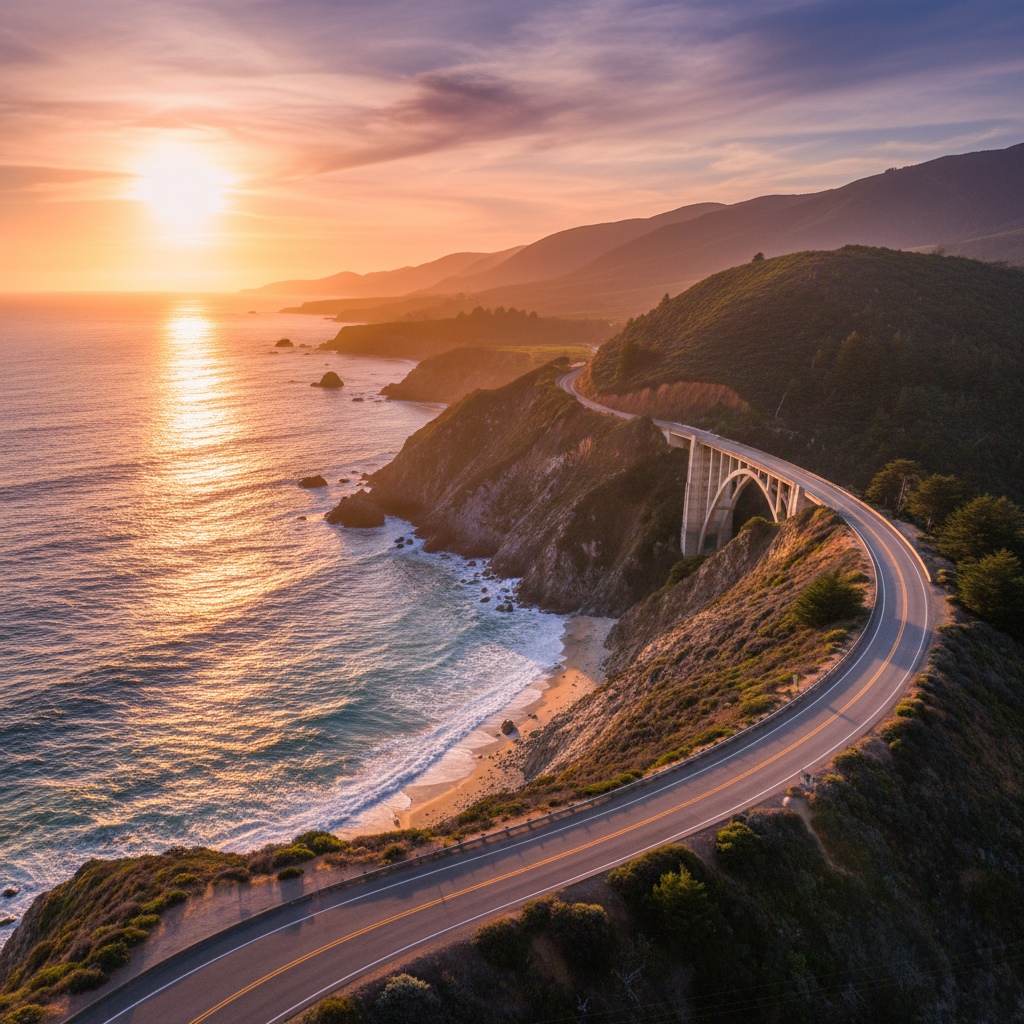
Pacific Coast Highway Road Trip: The Complete 7-Day Guide from SF to LA
The definitive 7-day Pacific Coast Highway road trip from San Francisco to Los Angeles — Muir Woods, Half Moon Bay, Santa Cruz, Monterey, Big Sur, Morro Bay, and Santa Barbara. Real logistics, real stops.
- Duration: 7 Days
- Estimated Budget: $3,500–$6,000
- Best Time to Visit: April–June and Sept–Oct offer clear skies, 60–70°F, and minimal fog. Summer brings coastal fog that can obscure views. Big Sur's Hwy 1 is occasionally closed by landslides — check Caltrans before you go.
- Destination: Pacific Coast Highway, California, USA
The Pacific Coast Highway is one of the great drives of the world — 655 miles of two-lane road hugging the California coast from the Oregon border to San Diego, with the Pacific Ocean on one side and mountains on the other. The San Francisco to Los Angeles section (about 450 miles) is the most dramatic stretch: Muir Woods redwoods, the elephant seal colony at Año Nuevo, the Monterey Bay Aquarium, the Bixby Creek Bridge at Big Sur, the Hearst Castle, and the Spanish colonial architecture of Santa Barbara. Seven days is the perfect amount of time to drive it properly — stopping when something looks beautiful, eating at the roadside seafood shacks, and arriving in Los Angeles with the kind of calm that only a great road trip can provide.
The Pacific Coast Highway is America's most iconic road trip — 656 miles of two-lane highway that hugs the California coastline, passing through some of the most dramatic scenery on earth. This is a route where every turn reveals something extraordinary: the old-growth redwoods of Muir Woods, the elephant seal colonies at Año Nuevo, the Big Sur cliffs at Bixby Bridge, the sea otters floating in the kelp forests of Monterey Bay, the wine country of Paso Robles, the Hearst Castle perched above the Pacific at San Simeon. No other road trip in America packs this much variety into a single route.
Seven days is the ideal length for the full PCH experience — long enough to stop at the major highlights without rushing, short enough to maintain the momentum that makes a road trip feel like an adventure rather than a commute. The key is choosing your stops strategically: you cannot stop everywhere (there are hundreds of worthy pullouts), but you can identify the five or six experiences that are genuinely unmissable and build your days around those anchors. Big Sur is non-negotiable. Strolling through the Danish-inspired village of Solvang is non-negotiable. The historic fishing pier at Santa Cruz is non-negotiable. Everything else is a bonus.
The PCH rewards the traveler who drives slowly, stops often, and resists the urge to check off destinations like a list. The best moments on this route are unplanned: the sea otters you spot from a pullout near Moss Landing, the perfect wave you watch break at Mavericks, the roadside farm stand selling strawberries so ripe they're almost wine. This itinerary gives you the structure — the right stops on the right days, the best restaurants, the places to sleep — but the PCH's magic lives in the spaces between the planned stops.
San Francisco to Half Moon Bay — The Opening Act
Start in San Francisco. Cross the Golden Gate Bridge and stop at the Marin Headlands viewpoint (Battery Spencer) for the best photograph of the bridge.
The view of the Golden Gate Bridge from the Marin Headlands is the definitive San Francisco photograph — the full span of the bridge with the city behind it and the bay below. You cannot get this view from the bridge itself. This is the shot.
Drive to Muir Woods National Monument — a 2-mile walk through old-growth coastal redwoods, some over 1,000 years old.
Muir Woods is the closest old-growth redwood forest to a major American city. Walking among trees that are 500–1,200 years old, 250 feet tall, and 14 feet in diameter is a genuinely humbling experience. The forest floor is cathedral-quiet and the light filtering through the canopy is extraordinary.
Drive south on Highway 1 through Pacifica and Devil's Slide — the first dramatic coastal section. Lunch at Sam's Chowder House in Half Moon Bay.
Devil's Slide is one of the most dramatic stretches of coastal highway in California — the road clings to a cliff 200 feet above the Pacific, with views that extend to the horizon. Sam's Chowder House has the best clam chowder in a sourdough bowl on the California coast, served on a deck overlooking the harbor.
Continue south through Pescadero and stop at Pigeon Point Lighthouse — the tallest lighthouse on the West Coast.
Pigeon Point Lighthouse (1872) stands 115 feet tall on a dramatic rocky headland. The adjacent hostel has hot tub access on the cliff edge (book in advance) — one of the most unique experiences on the PCH. The tidepools below the lighthouse are excellent for wildlife.
Año Nuevo State Park — the largest mainland breeding colony of northern elephant seals in the world.
Año Nuevo is one of the most extraordinary wildlife experiences in California. From December through March, 2,000+ elephant seals haul out on the beach to breed, give birth, and fight. The males weigh up to 5,000 pounds and their battles are genuinely dramatic. Outside breeding season, seals are still present year-round.
Check in at your Half Moon Bay accommodation. Dinner at Pasta Moon in downtown Half Moon Bay.
Half Moon Bay is the perfect first night on the PCH — a small coastal town with excellent restaurants, a beautiful state beach, and a pace that immediately tells you you've left the city behind. Pasta Moon has been the best restaurant in Half Moon Bay for 30 years — house-made pasta, local seafood, and California wines.
Leif's Tip: The PCH is best driven north to south (San Francisco to Los Angeles) — you're always on the ocean side of the road, which means every coastal view is through your window rather than across oncoming traffic. The light is also better for photography in the afternoon when driving south.
Most visitors to the California coast spend their first morning trying to decipher conflicting advice on where to stop, often missing hidden gems or getting stuck in tourist traps. The sheer length of the Pacific Coast Highway, combined with the ever-changing coastal conditions and the multitude of small towns and natural wonders, makes crafting a truly seamless road trip a complex puzzle. You're not just picking hotels; you're navigating variable cell service, understanding which overlooks offer the best views at specific times of day, and discerning which roadside eateries are genuinely worth your time versus those catering solely to fleeting tourists. Then there's the challenge of balancing iconic must-sees with quieter, more authentic experiences, all while ensuring your daily driving distances are enjoyable rather than exhausting. Leif cuts through this noise, providing a meticulously curated path that anticipates these specific challenges, ensuring your journey unfolds with effortless discovery.
Pigeon Point Lighthouse offers more than just stunning views; it's also a prime spot to consider your next delicious meal. Instead of fumbling with multiple apps or guidebooks trying to find an authentic lunch spot, Leif suggests a family-run taqueria in San Simeon, known for its fresh fish tacos and ocean views, complete with directions and even a note about their daily specials. This isn't just about getting from point A to point B; it's about optimizing every single mile, every stop, and every meal to maximize your enjoyment and minimize stress, allowing you to immerse yourself fully in the grandeur of the drive without a single logistical worry.
The crisp, salty air fills your lungs as you pull over at a designated vista point, the vast Pacific stretching endlessly before you, a feeling of profound calm washing over you. This is the reward for a journey thoughtfully planned, where every turn reveals beauty, and every stop enriches your understanding of this iconic stretch of California. You're not just seeing the sights; you're experiencing the PCH as it was meant to be, with the confidence that you're making the most of every moment, free from the anxiety of missed opportunities or unexpected detours. Your PCH adventure, tailored precisely to your desires, awaits.
Best Time to Visit Pacific Coast Highway, California, USA
September–November: ideal weather, thinning crowds, warm ocean, perfect coastal light
April–May: wildflowers, green hills, manageable crowds, elephant seal pups at Año Nuevo
Avoid June–August: peak crowds, parking nightmares at Big Sur viewpoints, fog in the mornings
December–March: elephant seal breeding season at Año Nuevo, empty roads, higher landslide risk
Getting Around Pacific Coast Highway, California, USA
A rental car is essential — there is no public transportation on the PCH
Book a one-way rental (SFO to LAX or reverse) — most rental companies allow this for a modest fee
Check Caltrans (dot.ca.gov) for road closures before each day's drive — Big Sur closes regularly due to landslides
Gas stations are sparse between Big Sur and San Simeon (90 miles) — fill up in Carmel before entering Big Sur
What to Pack
- Layers for all weather — coastal temperatures vary 20–30°F between morning and afternoon
- Binoculars for wildlife viewing (sea otters, elephant seals, whales)
- Camera with a wide-angle lens — the PCH's landscapes demand wide shots
- Offline maps downloaded before departure — cell service is nonexistent in Big Sur
- Snacks and water for the Big Sur section — no services for 90 miles
- Windbreaker — coastal wind is constant and can be cold even in summer
Money-Saving Tips
- California State Parks annual pass ($195) covers parking at all state parks on the route — worth it for a 7-day trip
- Pack your own lunch for the Big Sur section — the few restaurants there are expensive
- Monterey Bay Aquarium tickets are cheaper online — buy in advance
- Cambria and Morro Bay are significantly cheaper than Carmel and Santa Barbara for accommodation
Local Insights
- The PCH through Big Sur is one of the most photographed roads in the world — but the best views are at the pullouts that aren't marked on maps. Stop whenever something looks interesting.
- McWay Falls (the waterfall that falls directly onto the beach) is best photographed in the morning when the light hits the cliff face
- The Monterey Bay Aquarium's kelp forest tank is the best single exhibit in any aquarium in the world — spend at least 30 minutes there
- Bixby Bridge is best photographed from the north side pullout in the late afternoon — the bridge is lit golden and the canyon is in shadow
- Highway 1 through Big Sur has essentially no cell service — download offline maps, save your hotel's address, and tell someone your route before you drive it
Frequently Asked Questions
Should you drive the PCH north to south or south to north?
North to south (San Francisco to Los Angeles) is strongly recommended. You're always on the ocean side of the road, so every coastal view is through your window. The afternoon light (when you're typically driving) is better for photography heading south. You also get the most dramatic scenery (Big Sur) in the middle of the trip rather than at the beginning or end.
How long does the full PCH drive take?
The drive from San Francisco to Los Angeles on Highway 1 is approximately 450 miles and takes 9–11 hours of pure driving time. With stops, 5–7 days is ideal. If you only have a weekend, focus on the Big Sur section (Carmel to San Simeon) — this 90-mile stretch is the most dramatic and can be done as a day trip from Monterey.
Is the PCH safe to drive?
Yes, with appropriate caution. The highway is narrow and winding in sections, especially through Big Sur. Drive the speed limit, use pullouts to let faster traffic pass, and never stop in the road for photographs. Fog can reduce visibility significantly in the morning — wait until it burns off before driving the most dramatic sections. The road occasionally closes due to landslides — check Caltrans for current conditions before departure.
What is the best time of year to drive the PCH?
September–November is ideal: summer crowds have thinned, temperatures are perfect (65–75°F), and the ocean is warmest. April–May offers wildflowers and green hills. Avoid summer (June–August) if possible — Highway 1 through Big Sur is extremely crowded and parking at major viewpoints is difficult. Winter (December–February) has the elephant seals and empty roads but higher landslide risk.
What are the must-stop points on the PCH?
Muir Woods (old-growth redwoods), Año Nuevo State Park (elephant seals), Monterey Bay Aquarium, 17-Mile Drive in Pebble Beach, Bixby Bridge in Big Sur, McWay Falls at Julia Pfeiffer Burns State Park, Hearst Castle at San Simeon, Morro Bay, and the Gaviota Coast near Santa Barbara. If you only have time for three stops, choose Monterey, Big Sur, and Hearst Castle.
Where should you stay on the PCH?
Half Moon Bay (Night 1), Santa Cruz or Monterey (Night 2), Big Sur (Night 3 — book Ventana or Post Ranch Inn 6+ months ahead), Cambria near Hearst Castle (Night 4), Morro Bay or San Luis Obispo (Night 5), Santa Barbara (Night 6), and Los Angeles (Night 7). Big Sur lodging is the most limited and books up fastest — prioritize that reservation first.