The Best Food Destinations Do Not Serve Cuisine. They Reveal a Civilization.
Destination: Global
Category: comparison
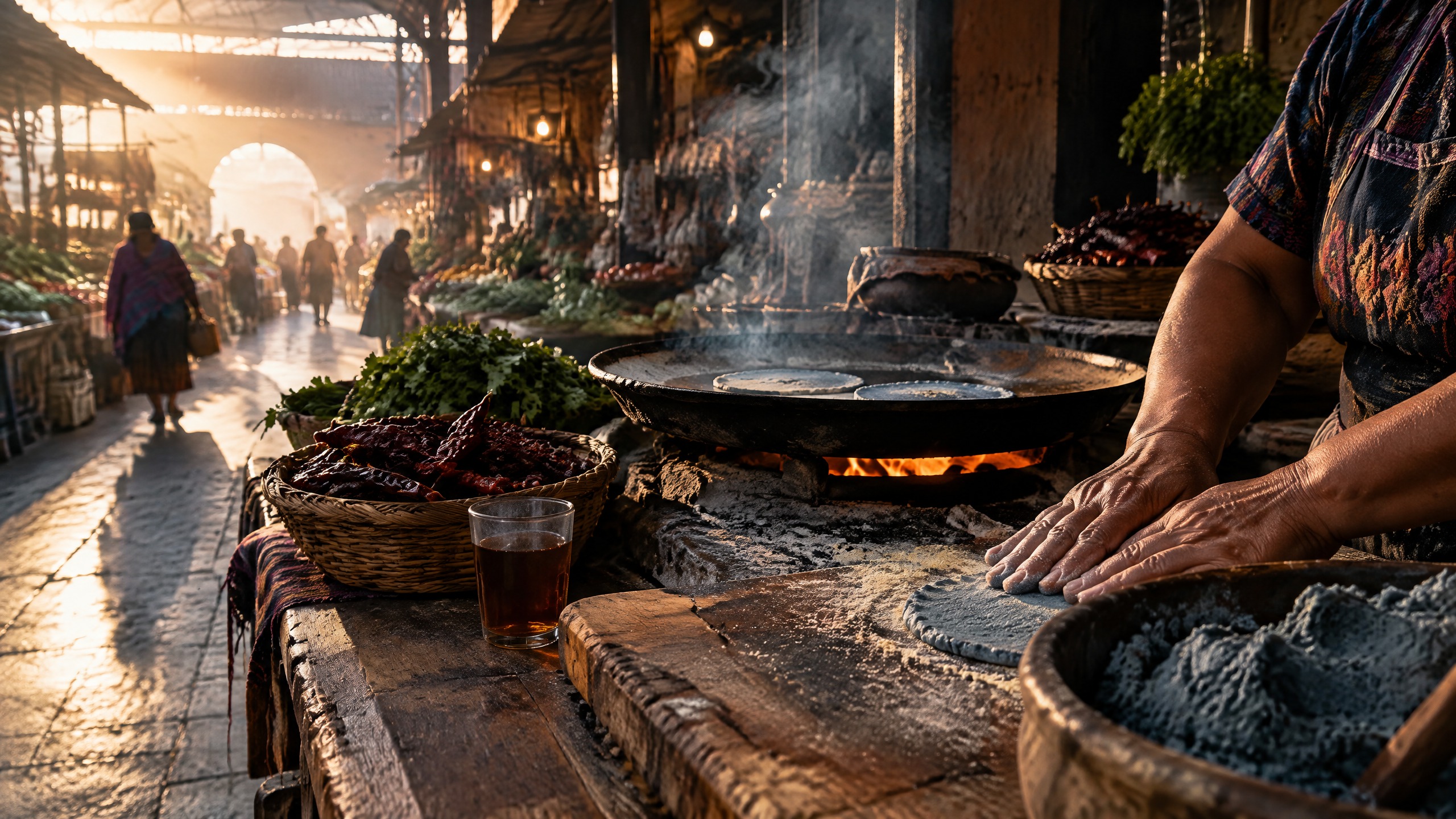
At nine in the morning in Mexico City, the line outside a neighborhood tortillería may already be bending around a corner. The best destinations for food obsessives begin with a system like that. It is not a line for a travel experience. It is a line for lunch, dinner, breakfast tomorrow, and a household’s ordinary expectation that corn should taste of corn. Inside, masa is pressed, cooked, stacked, and carried away in warm paper. A visitor who sees only a taco has missed the larger fact: the meal begins in an agricultural system, passes through a mill, arrives in a family kitchen, and remains public enough to produce a line on the pavement.
That is the standard for the best destinations for food obsessives. The decisive cities are not merely places with famous dishes, celebrated chefs, or a market worth photographing. They are places where food makes the deeper organization of a society visible: its landscape, migration, labor, faith, class, time, and habits of gathering. A great meal may be memorable anywhere. In the six cities below, it is evidence.
The best food destinations do not serve cuisine as an attraction layered onto the trip. They reveal a civilization through the way people source, cook, share, sell, argue about, and repeat their meals. Mexico City makes corn a daily civic infrastructure. Bologna makes ingredient discipline legible. Hanoi makes time itself edible. Istanbul makes a strait into a table. Oaxaca gives smoke and maize the status of memory. Naples treats appetite as a public right.
That thesis excludes a few obvious names on purpose. Paris remains one of the great restaurant cities, but this is not a ranking of restaurant reservations. Singapore’s hawker centers are a profound civic achievement, and Bangkok’s food stalls can rearrange an entire day, but both need their own arguments about multicultural public dining and street-scale abundance. The six places here were chosen because each reveals a different system beneath the plate. For the food obsessive, that is more useful than another list of dishes to order.
The Best Destinations for Food Obsessives Begin Where Food Explains the City
Food becomes serious travel when it changes what you notice. A bakery queue is suddenly an account of wheat, fuel, labor, and morning routine. A bowl of broth becomes evidence of when a city wakes up. A shared table becomes a map of family, obligation, and hospitality. These cities do not ask a visitor to eat more. They ask a visitor to understand what eating is doing there.
Mexico City: Where Corn Is Not an Ingredient but a Public System
Mexico City reveals a civilization by making corn visible as a public system rather than a culinary theme. The city’s food is often reduced to tacos because tacos are the most portable expression of an enormous underlying structure: nixtamalized maize, neighborhood mills, griddles, markets, regional migration, and the daily demand for something warm enough to wrap around lunch.
Start by noticing the difference between a tortilla made from fresh masa and one made from industrial flour. The distinction is not a food-trivia test. Nixtamalization—the process of cooking dried corn with an alkaline solution before grinding it—changes nutrition, flavor, texture, and the entire local supply chain. At a tortillería, that work turns over in public. At a market, the same corn appears as tlacoyos, tamales, atole, and a hundred regional memories brought into one metropolitan basin.
Mercado de la Merced is useful not because it is a spectacle but because its scale reveals the city’s food geography: produce, chilies, herbs, flowers, and prepared food moving through a system that serves millions. In the morning, the smell of simmering stock and masa comes before any polished “food scene” framing. Later, in Coyoacán, a tostada can sit alongside a long family lunch; in the Centro, a standing counter can solve hunger quickly without reducing the meal to convenience. The point is not to chase a famous stall across the city. It is to learn that the city has built ordinary life around eating in public, at every price point.
A Mexico City food guide is the right starting structure for learning those patterns, while a broader five-day Mexico City itinerary places markets and meals inside museums, neighborhoods, and the city’s immense historical geography. Mexico City belongs here because it makes the first claim of this post concrete: food is not something the civilization produces after the important work is done. Food is one of the ways the civilization keeps itself running.
The food obsessive should also pay attention to the city’s regional pluralism. A plate of cochinita pibil speaks of Yucatán; a bowl of pozole has other geographies and occasions; a fish taco can carry a northern coastal logic into the capital; a tlacoyo belongs to a corn vocabulary older than any contemporary restaurant trend. Mexico City is not a museum of these traditions. It is the place where they meet, change hands, and become metropolitan without becoming interchangeable. That is why the most useful meals are often the least branded ones: breakfast in a market aisle, a midday comida corrida, a counter where the person taking the order knows exactly how much salsa you can handle. The city asks you to notice how migration becomes lunch.
Bologna will make that labor system quieter and more codified. Where Mexico City gives corn a daily public life, Bologna shows how a region can turn restraint, precision, and ingredients into a moral language.
Bologna: Where a Region Turns Discipline Into Pleasure
Where Mexico City makes a staple into infrastructure, Bologna reveals a civilization through the discipline of ingredients. The city is often introduced with a short list—ragù, tortellini, mortadella, Parmigiano Reggiano—and the list is correct but inadequate. Bologna matters because the dishes tell you how the Emilia-Romagna region thinks about provenance, patience, and what a name obliges a cook to do.
In the Quadrilatero, the old market streets beneath the city center, the most revealing stops are not necessarily the most theatrical ones. Look for the logic of specialization: pasta in one shop window, cured meats in another, cheese with a place and aging behind it, a counter built around a precise cut rather than a generic selection. The architecture of the meal begins outside the restaurant. It starts in a regional confidence that an ingredient should have a history, a method, and a recognizable limit.
That is why ordering spaghetti Bolognese is less illuminating than asking how tagliatelle works with ragù in the place that gave both their context. The point is not to police a visitor’s order. It is to understand why a sauce developed around a certain pasta shape, why tortellini belongs in broth, and why a long lunch can be organized around sequence rather than abundance. At the Mercato delle Erbe, the everyday version of this intelligence is visible: produce, wine, bread, pasta, and counters serving workers rather than staging Italy for tourists.
This Bologna food guide helps a traveler give the city enough time to see the relationship among the markets, trattorie, and the agricultural region beyond the porticoes. Bologna, rather than Florence or Rome, earns its place because it makes the food obsessive confront an important truth: culinary pleasure is often the finished surface of a culture that has spent centuries refusing to be casual about raw materials.
The city also rewards a particular kind of restraint from the visitor. Do not arrive with the impulse to order the greatest possible quantity of famous things. Order one dish and ask what it needs from its ingredients. A plate of tagliatelle al ragù works because the pasta catches the sauce at a certain thickness; tortellini in brodo works because the broth frames rather than overwhelms the filling. The same regional intelligence appears in Parmigiano Reggiano, prosciutto, balsamic vinegar, and Lambrusco: each name carries a method and an origin, but each becomes meaningful only when it enters an actual meal. Bologna turns the food obsessive away from novelty and toward standards. Its pleasure is precise because someone, for a very long time, decided that “close enough” would not do.
Hanoi will reverse the tempo. Bologna makes time slow through curing, aging, and long preparation. Hanoi makes time fast, cyclical, and visible at the curb before most visitors have finished their first coffee.
Hanoi: Where the Clock Is Set by the Broth
Where Bologna turns restraint into regional discipline, Hanoi reveals a civilization by organizing the day around cooking time. In this city, a dish is rarely just an item on a menu. It often has an hour, a season, a neighborhood, and a person whose production schedule determines whether it exists when you arrive.
Phở is the obvious example, but the useful lesson is not “eat phở.” It is to understand what a bowl at dawn means. Broth has been tended overnight. Bones, aromatics, and charred onion have done their quiet work while the city slept. By morning, stools appear on the pavement, herbs are set out, and office workers, students, grandparents, and visitors sit down before the day gains speed. The meal’s value is not hidden inside a clever recipe. It is visible in the relationship between an overnight process and a morning public.
The same logic travels through the city differently at lunch and in the evening. Bún chả has its own noon gravity: grilled pork, noodles, herbs, and dipping broth arriving with smoke and pace. In the Old Quarter, a vendor may make one thing exceptionally because that is what the rhythm permits. In Chợ Đồng Xuân, wholesale and retail energy explain why the city eats with such density. A traveler should resist the urge to convert every stop into a verdict. Go back to the same street twice. Notice what has changed and what has sold out.
A Hanoi food guide provides a grounded route through that daily sequence, while a Hanoi and Halong Bay itinerary gives the food culture a broader landscape beyond the capital. Hanoi belongs here because it teaches the food obsessive to ask not only what a dish is, but when it becomes itself. That question turns eating from consumption into observation.
Coffee provides a second clock. In a narrow café, dark robusta drips through a metal phin while conversations begin, pause, and begin again. Egg coffee is often reduced to a visitor novelty, yet its useful lesson is structural: a familiar drink can be remade by local ingredients, scarcity, ingenuity, and habit until it takes on a different social meaning. The same goes for green papaya salad at a small counter, for sticky rice wrapped to travel, or for a late afternoon snack that would feel out of place at breakfast. Hanoi requires the visitor to abandon the restaurant-hour model. The city eats according to a sequence of labor, heat, and availability; the person who follows that sequence finds a more generous city than the person trying to eat every famous dish at noon.
Istanbul expands that observation across water. Hanoi makes a city’s clock edible; Istanbul makes its geography edible, turning the Bosphorus from a dividing line into an ingredient in the day.
Istanbul: Where Geography Keeps Reappearing at the Table
Where Hanoi reveals time through broth, Istanbul reveals a civilization by letting geography keep reappear at the table. The city sits across continents, but the useful food lesson is less grand than that slogan. It is in the ferry ride, the fish sandwich, the tea glass, the bakery counter, the market spice, and the fact that a meal can be shaped by crossing the water rather than merely looking at it.
Take the public ferry between Eminönü and Kadıköy with enough time to do nothing productive. The route makes the city’s food logic legible. On one side, the old peninsula and the Egyptian Bazaar; on the other, a market district where shopkeepers, commuters, students, and families are eating because that is what the neighborhood does. A simit from a street seller is not a complete explanation of Istanbul, but its sesame crust and portable form make sense in a city built around movement. Balık ekmek near the water carries the same lesson more directly: the Bosphorus is not scenery behind dinner; it is part of the supply chain.
At the Kadıköy market, cheese, olives, pickles, fish, coffee, and small specialty shops show how the city’s cuisines meet without dissolving into one generic “Turkish food” category. In Karaköy, a breakfast spread can stage the same geography through bread, dairy, jams, eggs, herbs, and tea. The dishes matter, but the more important fact is how easily food moves between trade, worship, neighborhood, migration, and a commuter’s afternoon.
An Istanbul food guide can help a first visit move beyond a Sultanahmet-only meal plan, while this five-day Istanbul guide builds in the ferries, markets, and cross-city pacing that make the food intelligible. Istanbul earns this section because it turns a physical condition—the strait—into a daily edible reality.
The detail to watch is repetition. Tea arrives not as a grand beverage ceremony but in small tulip-shaped glasses across the day: at a shop counter, after a negotiation, at a table where the meal is over but the conversation is not. A meze spread works by accumulation—cold vegetables, yogurt, fish, olive oil, bread—rather than by a single star dish. A fish restaurant on the Asian side may express another relation to the Bosphorus than a grill near the old city, and both can be correct. For the food obsessive, Istanbul is an education in refusing the flattened label. “Turkish food” is too broad to explain a city whose meals keep changing with neighborhood, water, trade, religion, and the direction of the commute.
Oaxaca will make that relationship more elemental. Istanbul’s table is built from movement across water and empires. Oaxaca’s begins with maize, fire, and a regional memory that refuses to be compressed into a single sauce.
Oaxaca: Where Smoke Carries Memory
Where Istanbul makes geography edible, Oaxaca reveals a civilization through the memory carried by maize, chiles, and smoke. Travelers often arrive with a single word—mole—and leave thinking they have understood Oaxacan food. Mole is a beginning, not a conclusion. Its many forms point toward the actual subject: a cuisine built from layered regional practices, seasonal ingredients, market labor, milling, grinding, roasting, and family knowledge that cannot be reduced to a color or a menu heading.
At Mercado Benito Juárez, the first useful act is to slow down. See the piles of dried chiles, the moles sold by the spoonful, the chocolate worked with cinnamon and sugar, the baskets of tlayudas waiting to become dinner. Then notice how much of the city’s food vocabulary depends on transformation: corn becomes masa; chiles change through drying and toasting; meat is cooked underground for barbacoa; cacao becomes a morning drink rather than a dessert accessory.
Smoke is the recurring signal. It appears in grilled meats, toasted chiles, mezcal, and the charcoal that finishes a tlayuda. That does not make Oaxaca a “smoky food destination.” It makes fire an active part of the local grammar. At a fonda, you may hear a customer discuss a family member’s mole with the seriousness another city reserves for wine. At a market counter, the scale is domestic even when the volume is commercial. The food obsessive should treat that as instruction: do not look for the city’s essence in a single famous dish. Look for the processes its people consider worth repeating.
This Oaxaca guide for food and culture gives a four-day framework for markets, cooking, neighborhood meals, and the wider cultural context. Oaxaca belongs because it makes technique inseparable from memory. After it, Naples will show what happens when a food tradition becomes less private and more defiantly public.
Breakfast gives the visitor a quieter entry into that grammar. A cup of tejate, pale with cacao, maize, and the foam created from flor de cacao, does not need to be made exotic to be interesting; it is interesting because it remains part of a local morning. At a market, a person can buy ingredients for a home meal beside someone buying a prepared lunch, and both transactions belong to the same food economy. Mezcal, too, becomes more useful when treated as an agricultural spirit with regional methods, not a shorthand for a bar menu. Oaxaca teaches the food obsessive that knowledge need not be hidden or rare to be profound. It can be carried in the hands that grind, toast, stir, and decide whether a batch tastes right.
Naples: Where Appetite Is a Public Right
Where Oaxaca carries memory through fire, Naples reveals a civilization by treating appetite as a public right. Pizza is the global shorthand, but Naples is not a city that asks you to admire pizza from a safe distance. It asks you to understand why a food that began as affordable urban sustenance became a code of quality, rhythm, and local allegiance.
A proper Neapolitan pizza is not complicated in the way a tasting menu is complicated. Its drama comes from constraint: dough, fermentation, heat, tomatoes, mozzarella, oil, basil, timing, and an oven that makes every decision public. The classic margherita story matters less than the present-tense fact that people still debate the cornicione, the balance of wet center and crisp edge, the queue at a pizzeria, and the difference between a quick lunch and a ritualized evening table.
Walk Spaccanapoli before deciding where to eat. The street folds churches, laundry, repair shops, shrines, scooters, pastry counters, and children going home into a single narrow argument about density. A fried pizza in a paper sleeve, a sfogliatella filled with ricotta, or a plate of pasta with a sauce that respects tomatoes rather than conceals them all become more legible after you have watched how close public life is to the kitchen. At Pignasecca Market, fish, produce, and sellers calling across the stalls turn procurement into theater without stopping it from being work.
A Naples food guide makes room for pizza, pastry, market culture, and the city’s larger southern Italian frame. A three-day Naples itinerary helps put meals alongside the archaeology, streets, and coastal geography that produced them. Naples is the final proof because it refuses the false divide between “great food” and ordinary life. Its most famous dish remains a way a crowded city feeds itself with seriousness.
The city’s breakfast and coffee culture makes the same point at another scale. An espresso is short, direct, and usually taken standing at a bar; lingering is possible, but the default rhythm is social speed. The tradition of caffè sospeso—paying forward a coffee for someone who may need it—has become famous enough to risk sentimentality, yet its endurance as an idea reveals something real about food and small generosity in public. Later, a pastry shop’s sfogliatella or baba is not merely a dessert stop. It is an argument about what a city considers worth making before noon. Naples asks the food obsessive to see that accessibility can be a form of rigor: the most beloved things are not simplified for mass appeal; they are made exact enough to survive being eaten every day.
How Food Obsessives Should Choose a Destination That Teaches Them Something
Choose Mexico City if you want to understand how a staple feeds a metropolis and how market systems keep a food culture active at every scale. Choose Bologna if you care about ingredients, technique, and the discipline behind the most casually satisfying meal. Choose Hanoi if you want food to organize your days rather than punctuate them. Choose Istanbul if you want trade routes, water, neighborhoods, and migration to keep altering what arrives at the table. Choose Oaxaca if you are interested in process—nixtamal, roasting, milling, smoke, and the transfer of knowledge between generations. Choose Naples if you want to see a globally famous food returned to the city that still treats it as a public standard.
Budget should shape the route but not determine the argument. Hanoi and Oaxaca can reward a patient eater at a lower daily cost, while Bologna and Istanbul reward longer lunches and market browsing over a compressed itinerary. Mexico City and Naples demand stamina as much as money: use neighborhoods rather than crisscrossing the city for every famous counter. Four days is a credible minimum for any one of these destinations; five or six gives markets, repeat visits, and a slower meal its rightful place. Do not combine them on a single trip merely because airfare makes a map look tidy. A food obsessive learns more by returning to one market twice than by collecting six signature dishes across six airports.
For a trip built around an actual appetite rather than a generic dining list, Leif can construct the itinerary around opening hours, market days, neighborhood pace, dietary needs, and the spaces between meals that make the meals make sense.
The Meal Is the Evidence
Mexico City makes corn public. Bologna makes discipline delicious. Hanoi makes time edible. Istanbul makes geography tangible. Oaxaca makes memory smoky. Naples makes appetite civic.
The food obsessive does not need another recommendation for dinner. They need to know what dinner is capable of revealing. Go to the places where a meal gives the answer.