The Best Budget Travel Destinations Do Not Feel Like Compromise.
Destination: Global
Category: comparison
The best budget travel destinations have been misunderstood for years. Too much advice begins with a spreadsheet: dorm bed, bus fare, plate of food, total. It asks how little a person can spend before a trip becomes impossible. That is an accounting question, and it produces an accounting answer: pick the cheapest place, sleep in the smallest room, eat the least expensive thing, call the result freedom.
But that is not what people are trying to buy when they travel. They are trying to enter a life that would not exist at home. A dinner where the person cooking has made the same dish for thirty years. A mountain route that rearranges one’s sense of scale. A city whose public life is so rich that the price of admission is simply arriving with enough attention. The cost matters. It matters enormously. The best budget travel destinations are places where low cost opens a direct, local, alive experience that a higher price cannot improve.
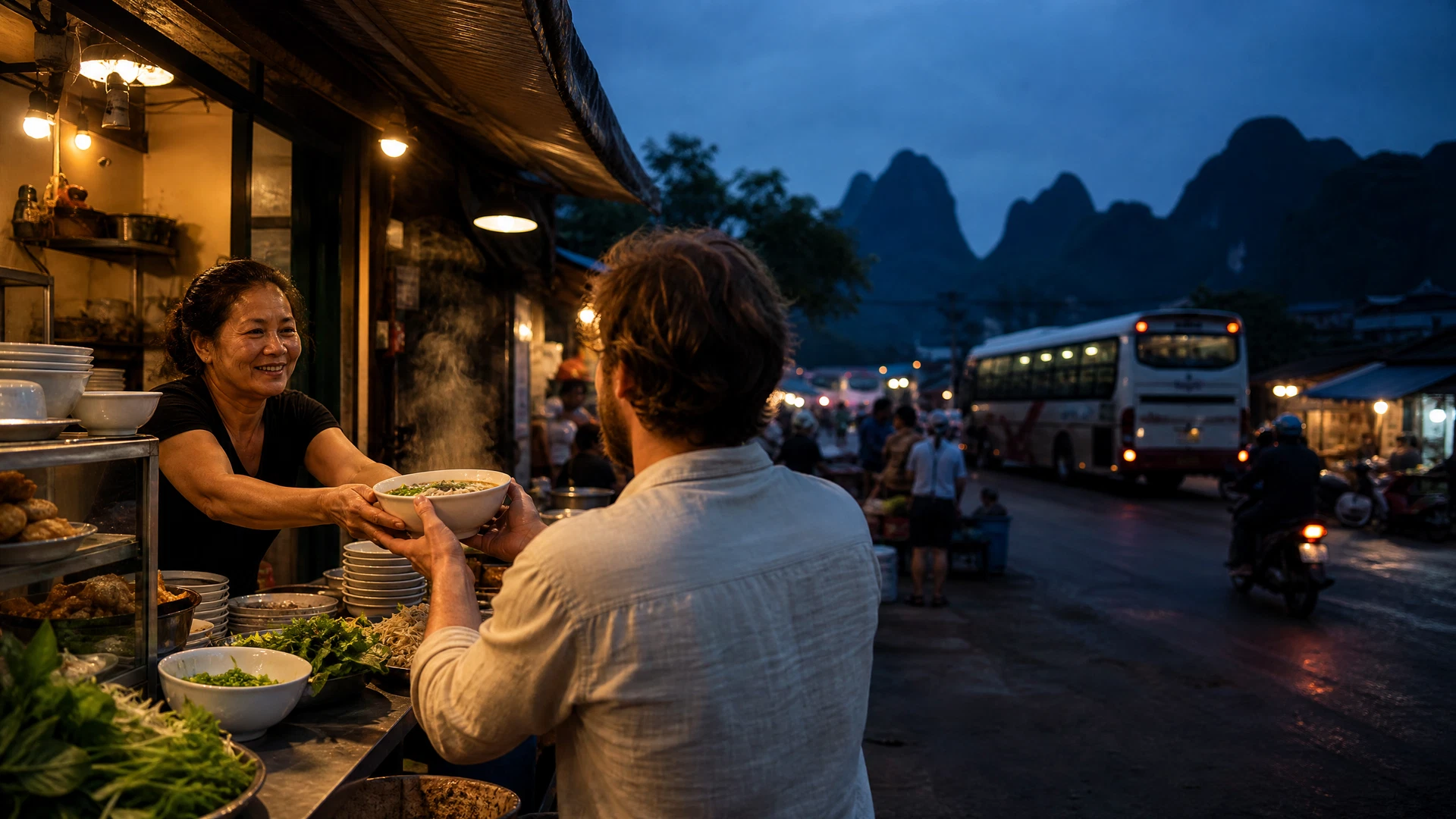
That distinction changes the list. It moves the conversation away from the usual promise of adequacy—places that are fine because they are inexpensive—and toward places where the lower-cost choice is often the more correct one. The best budget travel destinations are places where low cost opens the door to an experience that becomes less direct, less local, or less alive as the price rises. The better bowl of pho is not behind the heavier door. The better glass of wine does not require a sommelier’s permission. The better view of the mountains does not care whether the person looking at it arrived with a luxury transfer or a shared minibus.
This is the argument in practice. Vietnam reveals it through food and motion. Georgia through the astonishing looseness of daily life. Colombia through a reinvention shared in public. Montenegro through the Adriatic before every encounter is monetized. Nepal through scale. Mexico City through cultural density.
None of these places asks the traveler to accept a smaller version of travel. They ask the traveler to notice that much of what makes travel matter was never expensive in the first place. A private room over a dorm bed. A neighborhood lunch over a branded concept. A public transport line that tells the story of a city better than a private car ever could. The budget, in these six places, is not a concession. It is the instrument that puts you in the right room.
Vietnam: Where Spending Less Is Often the Better Decision
Vietnam is the first proof of the thesis because its most consequential pleasures become less convincing as the price rises. The country’s food, coffee, and street life do not sit at the bottom of a hierarchy beneath a polished dining room. They are the hierarchy. A traveler who learns that early stops treating inexpensive meals as a category of sacrifice and starts understanding the country on the terms it has set for itself.
In Ho Chi Minh City, a bánh mì from a cart on Huỳnh Thúc Kháng Street can arrive wrapped in paper, still hot from the grill, with a crackling crust and a filling assembled in seconds. It costs a fraction of the version served in a café designed around air-conditioning and English menus, yet that fraction is not the point. The cart is working at the speed, texture, and social distance that made bánh mì a city food. You stand where the office workers stand. You watch the assembly. You eat before the bread has had time to surrender its heat. The more expensive version may be comfortable; it cannot reproduce the relationship.
Hanoi makes the same case more quietly. Café Giang’s cà phê trứng, built from coffee and whipped egg yolk, is not valuable because it is inexpensive. It is valuable because it is specific: a drink with an origin story, a texture, and a room full of people who came for precisely that thing. The street-side pho served at dawn carries a similar logic. Broth that has been working through the night does not need marble tables to announce itself. Its seriousness is evident in the steam, the herbs, and the speed with which the stools fill. A four-day Hanoi budget itinerary is useful here because it keeps the city’s core pleasures at their natural scale instead of pushing the traveler toward a synthetic upgrade.
Vietnam also makes a more practical budget argument: the private room is often the correct baseline. In Hanoi, Da Nang, Hoi An, and Ho Chi Minh City, a compact mini-hotel room can cost little more than the arithmetic of a dorm bed and deliver the privacy that makes long travel days sustainable. You get a door that closes, a shower of your own, a place to set down a wet shirt after a motorbike ride, and enough quiet to hear the city again the next morning. Budget travel has too often confused communal sleeping with courage. Vietnam demonstrates that value can include rest.
The route through the country deepens that lesson. Open-tour buses connect cities with a kind of democratic efficiency: the overnight seat, the roadside stop, the driver collecting tickets with practiced impatience, the slow realization that everyone aboard is moving through the same narrow national spine. The journey from Hanoi south through Da Nang and Hoi An does not need to be luxury transport to feel complete. It needs time. It needs the willingness to let the country arrive in sections.
Hoi An offers perhaps the most extravagant expression of Vietnam’s value logic. Tailor shops are undeniably tourist-facing; pretending otherwise would be silly. But a custom shirt, dress, or suit made over a few fittings is one of the rare purchases that can be both conspicuous and genuinely useful. The point is not to accumulate fabric. It is to take part in a local commercial skill that remains accessible because it is ordinary work to the people doing it. This Ho Chi Minh City budget guide gives the other half of the country’s argument: the city can feel loud, fast, and commercially relentless, but its best daily choices still happen at sidewalk level.
Then there is Hà Giang. The loop in Vietnam’s far north is not a cheap thrill; it is a serious mountain journey whose cost happens to remain human. The road curls through limestone country near the Chinese border, past villages where homestays make the night feel like an exchange rather than a transaction. A modest motorbike rental and a family-run room place the traveler inside a landscape that would be priced beyond recognition in many other countries. Vietnam belongs on this list because it teaches the first and most useful lesson: paying less does not mean seeing less. It can mean getting closer to the reason you came.
Georgia: Where the Cost of Daily Life Lets You Stay Longer
Where Vietnam makes the inexpensive choice the more vivid one, Georgia makes the entire day feel unexpectedly available. The revelation in Tbilisi is not that one meal costs less than it would in Paris or London. It is that nearly every part of an ordinary day—coffee, wine, a long lunch, a taxi when your feet give up, a room with a balcony, another day added to the trip—remains within reach. The budget traveler is no longer rationing experience. They are deciding what to do with an afternoon.
Start in the old city, where carved wooden balconies lean toward narrow streets and the sulfur baths sit below the fortress. The architecture has a complicated, lived-in quality: Persian influence, Russian imperial scale, Soviet interruption, Georgian insistence. It does not present itself as a preserved set. Laundry appears where a photographer might prefer emptiness. A child cuts through a courtyard. A shop sells a phone charger beside a bottle of homemade chacha. That lack of performance is part of what money cannot purchase elsewhere.
The food turns the principle into a habit. At Pasanauri around Meidan Square, khinkali arrive with their pleated tops and broth held inside like a test of manners. You take the dumpling by its knot, bite carefully, drink the liquid first, then eat the rest. A plate of them can cost less than an appetizer in a capital that has decided its diners need theater. Khachapuri, hot cheese bread with its regional variations, gives the same disproportionate return: a meal with real heft, made for people who have work to return to. This Tbilisi food and wine guide follows those daily pleasures into the city’s markets, bakery counters, and tables rather than treating Georgian food as a footnote to a wine bar.
Georgia’s wine is central, but it deserves a more exact description than “cheap.” Qvevri fermentation, in clay vessels buried underground, connects contemporary bars to a very old practice without turning that practice into museum material. At Fabrika, a converted Soviet sewing factory, a bottle from Kakheti can be shared without the usual calculation that turns ordering wine into an event. The price lets curiosity lead. You can try an amber wine, dislike it, order another, stay for the conversation, and still feel that the night belonged to you. That is liberation in the practical sense.
Tbilisi is only the entry point. A shared marshrutka can pull the traveler toward Mestia and Svaneti, where medieval towers still punctuate mountain villages beneath the Caucasus. Guesthouses fold dinner and breakfast into the rhythm of the hike. The luxury in that arrangement is not polish; it is proximity. You sleep close enough to see how the weather decides the next day. You eat what has been made. You walk toward a valley that has not been converted into a lifestyle brand.
Vardzia offers another version of the same imbalance. The cave monastery complex is cut into a volcanic cliff in southern Georgia, a settlement of rooms, passages, and chapel spaces that forces a traveler to look up and then keep looking. It is the sort of site for which other countries build a premium corridor of ticketing, timed-entry packages, and compulsory interpretation. Georgia has its own systems and pressures, of course, but the encounter still reaches you with remarkable little mediation. A four-day Tbilisi itinerary helps build the city stay that makes these extensions possible without treating the capital as merely a transit lounge.
Georgia earns its place because it changes the time equation of a trip. When accommodation, food, wine, and transport do not require constant defensive calculation, you can remain. You can take the second bathhouse visit. You can sit over lunch until it becomes dinner. You can decide that three nights are not enough and stay four. In travel, extra time is frequently the most expensive thing. Georgia makes it affordable.
Colombia: Where the City Shares Its Reinvention With You
If Georgia makes room in the itinerary, Colombia makes the most important parts of the experience public. Its budget argument is not built on being inexpensive in a generic Latin American sense. It is built on the fact that some of the country’s defining transformations—its cable cars, cycling routes, street-art districts, neighborhood energy, and coffee landscapes—are things a traveler can join without purchasing distance from everyone else.
Medellín is the clearest case. The Metrocable rises from the city into comunas built on hillsides, treating mobility as civic infrastructure rather than private privilege. Riding it is not a curated attraction added after the city was finished. It is part of the city’s attempt to make itself more connected, more navigable, more shared. The fare costs little. The view is immense. And the experience teaches more about Medellín’s geography and reinvention than an expensive rooftop could. A Medellín budget itinerary is the appropriate guide link because the city’s value comes from moving through it intelligently, not from checking it off quickly.
The details matter. In Laureles, streets slow into a neighborhood rhythm of cafés, corner bakeries, football shirts, and trees that soften the heat. In El Centro, the city feels more compressed, more commercial, more impatient. The budget traveler can use the Metro to pass between these versions without treating one as authentic and the other as disposable. Medellín does not ask you to pay for access to its contrast; it puts the contrast on the same transport network.
Bogotá carries the argument into public space. On Sundays, ciclovía closes long stretches of road to cars. Families, runners, skaters, vendors, and cyclists take over the city’s arteries and turn circulation into a social event. It costs nothing to participate, but it is not a lesser experience for being free. It is one of the rare chances to encounter a capital through the way its residents choose to use it when the usual rules are suspended.
Cartagena can be more complicated because the old walled city knows its own value, and the price of a poor meal can be absurd. That is exactly why Getsemaní matters. The neighborhood has murals, music, guesthouses, laundry lines, and the small-scale food economy that makes a city legible again. An arepa de huevo from a cart on a corner is not elevated because it is cheap; it is elevated because the vendor is participating in a daily grammar that existed before the visitor arrived and will continue after they leave. Colombia’s budget value requires attention. Spend automatically and you can end up in a version designed to separate you from your money. Spend deliberately and you enter the country’s actual exchange.
The coffee region offers the long-form version. Salento is a useful base, but it is not the point. The point is to walk toward the wax palms of Cocora Valley, ride out to a finca, taste coffee where the landscape and labor behind it are visible, and stay long enough to understand why a cup in a distant café cannot carry the same meaning. A small tasting at a place such as Don Elías is not a luxury substitute. It is a direct line to the thing itself. This Colombia Coffee Region adventure guide is designed around that relationship between Salento, Cocora, and the farms beyond the first viewpoint.
Ciudad Perdida belongs in the same sentence, with an important qualification. The trek is a substantial outlay for a budget trip because access requires an organized guided journey. Still, measured against other major archaeological hikes, it can offer an extraordinary return: four days through the Sierra Nevada toward the stone terraces of the Tairona. Colombia is not cheap because every moment costs nothing. It is valuable because its defining moments—urban transformation, coffee country, Caribbean street life, and deep archaeological terrain—remain closer to the traveler than the global tourist economy usually allows.
Montenegro: Where the Adriatic Still Rewards the Traveler Who Looks Past the Script
Where Colombia puts reinvention on the street, Montenegro protects a different kind of value: an Adriatic experience that has not yet been entirely converted into a price list. This is why Montenegro replaces Albania in this curation. The coast is no secret, and Kotor has become a recognizable stop for cruise passengers. Yet the country still offers a way to move beyond the cruise-day script through public buses, family-run rooms, short ferries, mountain roads, and towns that return to themselves after the ships leave.
Kotor’s walls climb the mountain above the old town in a line that looks less constructed than insisted upon. Walk them early, before the narrow streets fill and before the heat turns each step into a negotiation. The view from the Fortress of San Giovanni looks over the Bay of Kotor, a folded inland sea framed by steep limestone slopes. It is easy to call that view expensive because the region is beautiful. It becomes far more meaningful when the day begins on foot rather than from a packaged deck itinerary. This three-day Kotor itinerary gives the city enough room to become a base rather than a single photographed morning.
Perast, reached around the bay, changes the scale. It is smaller, calmer, and built around two islets that have attracted painters, day-trippers, and sailors for generations. A boat ride to Our Lady of the Rocks can feel theatrical if treated as an item to consume. It becomes something else when paired with the slow route around the water: the ferry crossing at Kamenari, the pause for coffee in a town not designed to rush you back to a coach, the realization that the bay’s shape is the real subject.
The budget advantage here is subtle. Montenegro is not Vietnam; it does not offer the same everyday arithmetic. Its distinction is that you can still choose a small guesthouse over a resort, a market picnic over a waterfront menu, a bus over a private transfer, and find that the choice puts you nearer to the country’s actual pace. The traveler who spends more can accidentally purchase insulation: a polished room facing the water, a managed excursion, a restaurant that serves an idea of the Balkans rather than dinner. The traveler who spends with care gets mobility and time.
Move inland and the argument strengthens. The road toward Lovćen leaves the bay behind in a series of turns that strip away the coastal expectation. Cetinje, the old royal capital, carries another Montenegro: diplomatic buildings, museums, cafés, and the particular quiet of a place that once had more formal importance than it does now. Durmitor National Park, farther north, brings lakes, high pasture, and a terrain that makes the coast feel like only one chapter. The broader Montenegro adventure guide is helpful for travelers who want to stitch the bay to the country’s higher, less scripted landscapes.
Montenegro belongs here because “budget” can also mean refusing the most expensive interpretation of a place. You do not have to pretend the Adriatic is cheap. You have to understand that the best version is frequently found one turn past the waterfront menu, one bus ride after the port, one night longer than the day trip permits. The value lies in access to a coastline and mountain country still capable of surprising you outside the polished corridor.
Nepal: Where the Scale of the Experience Makes the Price Look Strange
Montenegro shows that a lower spend can remove the barrier between traveler and place. Nepal takes the argument to its furthest point: the world’s most consequential mountain landscapes remain available through teahouses, walking paths, shared meals, and a willingness to carry less. No hotel upgrade can purchase a better relationship with altitude. No concierge can make the Himalaya more immense. In Nepal, the budget choice places the traveler inside the only experience that matters.
Everest Base Camp is often discussed as an expensive ambition because getting to the trail involves permits, flights or long ground approaches, gear, guides for those who choose them, and time away from ordinary life. But compared with the scale of the encounter—a long approach toward the base of the highest mountain on earth—the total can remain astonishingly reachable. The path is not a private adventure park. It is a working trail through villages, stone walls, bridges, bakeries, and rooms warmed by a stove when conditions allow. The point is never to buy “Everest.” The point is to walk through the days that make the mountain legible.
The teahouse is central to that logic. A basic private room, dal bhat, hot lemon tea, a drying line for damp socks, and a dining room full of people comparing the weather: this is not deprivation dressed up as virtue. It is an efficient, social infrastructure for being where you are. Dal bhat refills have become famous among trekkers for a reason. At altitude, a plate of rice, lentils, vegetables, and whatever else the kitchen has prepared is fuel, hospitality, routine, and relief. It costs far less than the theatrical meals sold as “mountain dining” elsewhere because it is meant to sustain the people already there.
Kathmandu supplies the necessary contrast. Thamel is noisy, dense, and full of equipment shops, bakeries, travel agencies, rooftop restaurants, and people about to leave for trails. It can be overdone, particularly when travelers treat it as a bargain-hunting maze. Used well, it is a practical launching point: a modest guesthouse, a bowl of momo, a last-minute water filter, a map, a conversation with someone who has just returned. This Kathmandu adventure guide keeps the city connected to its temples, hills, and mountain-bound energy rather than reducing it to an outfitting stop.
Nepal’s second route is the Annapurna side, where Pokhara provides the softer entry: Phewa Lake, paragliders moving above the valley, the Annapurna massif appearing and disappearing with the weather. From there, trails toward Ghorepani and Poon Hill offer a different experience of Himalayan scale. Rhododendrons can turn sections of the spring trail into a sequence of color before dawn reveals the larger peaks. The spectacle is real, but the more durable memory may be the simple order of the day—walk, stop for tea, walk again, arrive before dark, eat what the kitchen is serving. A Pokhara adventure itinerary gives that side of Nepal its own rhythm instead of forcing every visitor into the Everest narrative.
There are costs that should never be minimized. Remote travel requires appropriate insurance, proper acclimatization, sound decisions around weather, and respect for changing regulations and local guidance. The budget traveler’s advantage is not recklessness. It is understanding where money improves safety and where money merely creates distance. Spend on preparation, warm layers, reliable advice, and enough time. Do not spend on the fiction that the mountains become more meaningful from behind a heated window.
Nepal earns its place because it dismantles the assumption that the greatest experiences belong to the greatest budgets. The person walking toward a high pass with a worn duffel, a thermos, and a room reserved at the next village is not receiving a reduced version of the Himalaya. They are receiving the only version that counts.
Mexico City: Where a Great Capital Is Still Priced for the Street
If Nepal humbles the traveler through scale, Mexico City proves budget value through density. It is a capital of museums, parks, markets, architecture, design, neighborhoods, and food traditions so extensive that a week can feel like an introduction. In many major cities, that range is guarded by high admission prices, expensive transport, and a dining scene that turns curiosity into an expensive habit. Mexico City still allows a traveler to follow appetite and attention across an entire day without feeling financially punished for it.
Begin with the Metro, whose low fare is not a novelty but a fact of city life. It links enormous distances beneath one of the world’s largest urban areas, carrying office workers, students, grandparents, musicians, vendors, and visitors who have learned to keep their bearings. The system requires basic urban awareness—watch your belongings, avoid peak crowding when possible, choose your route deliberately—but it lets the traveler encounter the city as a whole rather than as a series of expensive rides between fashionable islands.
The Museo Nacional de Antropología should be approached with time. The Aztec Sun Stone, the galleries devoted to Mesoamerican civilizations, the scale of the collections, and the setting in Chapultepec Park all make a case for slow looking. In another global capital, a museum of this magnitude would likely demand a larger share of a limited budget. Here, entry remains within reach of a traveler who has arrived without a cultural institution’s membership card or a luxury itinerary. This Mexico City budget guide helps turn that access into a day-by-day plan that does not confuse affordability with staying in one neighborhood.
Food is where the city’s value becomes undeniable. At Mercado de la Merced, the sheer concentration of ingredients, prepared food, work, noise, and movement makes a supermarket feel like an administrative error. Mercado de Jamaica, known for flowers and pre-dawn trade, offers another version of the city before the more polished districts have opened their doors. These are not attractions created for the budget traveler. They are commercial worlds in which the budget traveler can participate because ordinary food remains the backbone of the place.
Tacos al pastor make the case in miniature. At El Huequito on Ayuntamiento Street, the vertical spit, the pineapple, the quick cutting motion, and the small plate in hand connect a modest purchase to the layered story of migration and adaptation that produced one of Mexico’s defining foods. A taco eaten standing up at the right counter is not an imitation of fine dining. It is a complete cultural act. The Mexico City food guide follows that argument through tacos, markets, and neighborhood eating without asking the traveler to spend their way out of the city’s best meals.
Roma and Condesa can be lovely places to stay, especially for first-time visitors who want walkable streets and easy access to cafés, parks, and galleries. But they are not Mexico City itself. Coyoacán has its own slower cadence around plazas and courtyards. Centro Histórico has density, ceremony, vendors, and architecture on a scale that can feel overwhelming until you yield to it. Santa María la Ribera, San Rafael, and other districts reveal still more. The advantage of a constrained budget is that it encourages movement. A traveler rides the Metro, eats where people are already eating, walks further, and learns faster.
Mexico City belongs on this list because it refuses the false division between affordable and serious travel. The city has the intellectual and sensory range people seek in the world’s major capitals. What it has not entirely lost is street-level access to that range. You can look at pre-Columbian art in the afternoon, eat something perfect for the price of loose change in the evening, and take the Metro home with the feeling that the city has given you more than you could reasonably have expected.
Why These Are the Best Budget Travel Destinations—and Why the Obvious Choices Are Missing
The best budget travel destinations must be judged by more than a daily-cost table. That is why Thailand does not appear here, despite being genuinely good value and deservedly beloved. Thailand’s low-cost travel circuit is so extensively documented that it no longer serves this post’s purpose. Its routes, hostels, islands, cafés, and price comparisons have been mapped by nearly every budget guide already written. Thailand deserves careful travel, and AskLeif has substantial coverage for it. This curation is looking for the places where the budget argument changes the experience rather than merely lowering the bill.
India is absent for a different reason. Few countries can offer more intensity, depth, food, architecture, and spiritual or geographic range for the money. But India asks for a particular kind of preparation and a tolerance for complexity that cannot be compressed into one section of a six-destination article. Transport, sensory overload, regional variation, hygiene decisions, and planning stakes require their own serious treatment. Putting India here would make the list look more comprehensive while making the reader less prepared. It deserves an article built around its own conditions.
The usual Central European alternatives—Prague, Budapest, Kraków—also deserve respect. They are accessible, handsome, and often less costly than Western Europe. Yet their budget story has become familiar, and their inclusion would repeat a route the reader already knows. Montenegro makes the more useful European case here because the question is not which city offers inexpensive beer or a cheaper old town. It is where a traveler can still choose the less expensive path and find it leads closer to the landscape, the ferry, the market, the mountain road, and the actual tempo of a country.
That is the separating line. Vietnam does not compete with Georgia. Georgia does not compete with Colombia. Colombia does not compete with Montenegro, Nepal, or Mexico City. Each answers the same question through a different dimension: food, time, public life, access, scale, and density. The list is not six cheap places. It is six demonstrations that value can take six entirely different forms.
How to Choose Among the Best Budget Travel Destinations
Choosing among the best budget travel destinations starts with identifying the kind of richness you want more of. Vietnam is for the traveler who wants each day to be edible, walkable, audible, and full of motion. Georgia is for someone who wants a table that keeps expanding: wine, bread, mountains, a room for another night, the ease to say yes. Colombia is for a traveler drawn to cities that have changed themselves in public and landscapes that reward a few extra bus rides. Montenegro is for an Adriatic route built around independence rather than a resort wristband. Nepal is for the person willing to trade comfort theater for genuine scale. Mexico City is for anyone who wants a major capital to meet them at street height.
The practical budget range differs. Vietnam and Nepal reward a low daily spend, though remote trekking and internal flights can change the total quickly. Georgia and Colombia allow a traveler to live generously without defaulting to luxury. Montenegro requires more care around season and coastline, but becomes far more reasonable when the trip uses local transport and looks beyond the most obvious waterfronts. Mexico City rewards a slightly higher lodging budget if it provides a safe, well-connected base, then gives it back through food, museums, markets, and transit.
Trip length matters more than travelers expect. Vietnam wants ten days or more if you intend to let north and south feel distinct. Georgia deserves at least a week, with Tbilisi as a beginning rather than an endpoint. Colombia can be extraordinary in eight to twelve days when a city and the coffee region are paired instead of overpacked. Montenegro works in five to eight days if the bay and interior both receive time. Nepal needs sufficient days for acclimatization and weather variability, which makes rushing especially foolish. Mexico City can justify four intense days, but seven is better if you want the city to stop feeling like a collection of districts and start behaving like a place you know.
Combining destinations is possible, but this article is a defense of depth. Vietnam pairs naturally with another Southeast Asian country only if you resist the urge to turn the journey into a sprint. Georgia can sit within a Caucasus trip, though its table and mountains deserve their own attention. Colombia and Mexico City can form a long Latin American city-and-landscape conversation, provided you leave enough days between flights. Montenegro can be combined with the neighboring Balkans, but do not mistake crossing borders for understanding them. Nepal is usually strongest when it is the central commitment, not a detour attached to something else.
Once you know which kind of experience you want, bring the trip to Leif with the real constraints: the amount you are comfortable spending, whether a private room matters, how much walking you want, what food means to you, whether you want cities or mountains, and how much uncertainty feels exciting rather than exhausting. The useful plan is never the one that makes every day look identical on a spreadsheet. It is the one that spends where safety and meaning improve—and preserves the freedom to follow what a place is offering.
The Budget Is Not the Limitation. It Is the Lens.
There is a particular relief in discovering that the trip you wanted is still available. Not the bargain imitation. Not the stripped-down version where every decision feels like an apology. The real thing: coffee made in the room where it was invented, a cable car that carries a city into view, a bowl of dal bhat after a long climb, a taco at a counter that does not need to explain itself.
Vietnam reveals. Georgia liberates. Colombia surprises. Montenegro discovers. Nepal humbles. Mexico City exceeds.
The point is not to spend less for the sake of spending less. The point is to stop assuming that price and depth travel together. In these places, they often move in opposite directions. The closer you get to the daily life of the destination—the food, transport, guesthouse, market, trail, neighborhood—the less you may spend and the more of the country you are allowed to keep.
That is the part most budget travel advice misses. A low-cost trip can be a smaller life, carefully fenced by fear and scarcity. Or it can be the moment you realize that the things you came for were never behind the expensive door.