Berlin: The City That Refuses to Be Anything But Itself
Destination: Berlin, Germany
Category: Destination Guides
Berlin Doesn't Care What You Think of It. That's Why You'll Love It.
There is a city in the middle of Europe that has been destroyed, divided, reunified, reinvented, and reinvented again — and it has emerged from all of it not polished or resolved or at peace with itself, but raw, restless, and more alive than almost anywhere on earth. It has no interest in being beautiful in the way that Paris is beautiful, or charming in the way that Prague is charming, or grand in the way that Vienna is grand. It is something else entirely: a city that wears its wounds as decoration, that turned its trauma into art, that built its nightclubs in the ruins of its power stations and its galleries in the wreckage of its history, and that has somehow, through all of it, become the most creatively fertile city in the Western world.
This is Berlin. And it will not meet you halfway.
It will not seduce you with a postcard skyline or a perfectly preserved old town. It will not offer you the easy pleasures of a city that has decided what it wants to be. What it will offer you is something rarer and more valuable: the experience of a city that is still in the process of becoming, that is still arguing with itself about what it means, that is still building and tearing down and rebuilding with an urgency that feels almost desperate — and that, in that urgency, produces a quality of creative energy that you will not find anywhere else.
Come to Berlin without expectations. Come with curiosity and stamina and a willingness to be surprised. Come ready to walk further than you planned, stay out later than you intended, eat things you've never heard of, and talk to strangers who will become, for the duration of a single night, the most interesting people you've ever met.
Come to Berlin. It will change you.
The Weight of the Wall
You cannot understand Berlin without understanding the Wall. Not the physical structure — most of it is gone, replaced by a double row of cobblestones that runs through the city like a scar you can follow with your feet — but the idea of it, the 28-year reality of it, the way it divided not just a city but families, lives, futures, and the very concept of what it meant to be German.
The Berlin Wall Memorial on Bernauer Strasse is the place to begin. This is not a museum in the conventional sense — it is a preserved section of the actual border strip, the "death strip" between the inner and outer walls where 140 people were killed trying to cross, maintained as it was in 1989 with the watchtower, the floodlights, the raked sand that would show footprints. Standing here, reading the names and stories of the people who died trying to reach the other side of their own city, you feel something that no amount of reading can prepare you for. The Wall was not ancient history. It fell in 1989. There are people alive today who were born on one side and lived their entire childhoods without ever seeing the other.
The East Side Gallery is the Wall's other face — the longest remaining section, 1.3 kilometers of concrete covered in murals painted by artists from around the world in 1990, the year after the Wall fell. The most famous image — Brezhnev and Honecker locked in a fraternal kiss, captioned "God, help me to survive this deadly love" — has been reproduced so many times it has become almost abstract. Standing in front of the original, understanding what it meant for a Soviet-era artist to paint this on the Wall that had just fallen, it recovers its power.
The Topography of Terror is the hardest and most necessary stop. Built on the excavated foundations of the SS and Gestapo headquarters, it documents the mechanics of Nazi terror with a thoroughness that is almost unbearable — not because it is gratuitous, but because it is so precise, so specific, so determined to name names and show faces and trace the exact bureaucratic pathways through which ordinary people became perpetrators of extraordinary evil. Berlin does not look away from this. It builds its museums on top of it.
The Memorial to the Murdered Jews of Europe, designed by architect Peter Eisenman, is a field of 2,711 concrete stelae of varying heights that covers an entire city block near the Brandenburg Gate. There is no inscription, no explanation, no guidance for how to feel. You walk into it and the ground undulates and the stelae rise around you and the city disappears and you are alone with something enormous and unresolved. It is one of the most powerful pieces of public art in the world.
Neighborhoods: A City of Villages
Berlin is not one city. It is a collection of villages — each with its own character, its own history, its own relationship to the larger whole — that were stitched together by politics and geography and have never fully merged. Understanding this is the key to understanding Berlin.
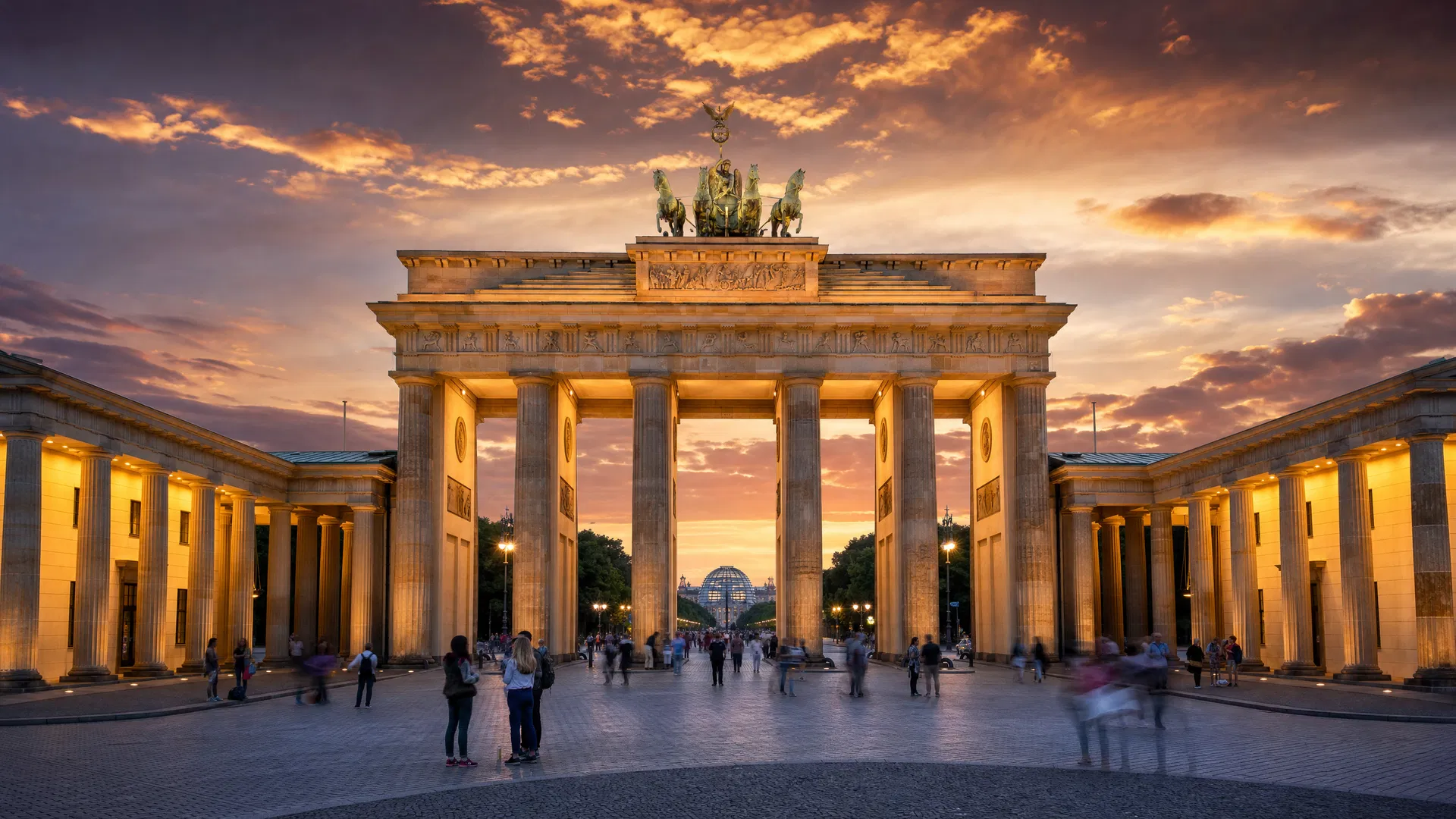
Mitte is the geographic and historic center — the Brandenburg Gate, Museum Island, the Reichstag, the grand boulevards of Unter den Linden. It is the Berlin of official photographs and state visits, and it is genuinely impressive, but it is also the least Berliner part of Berlin. Spend a morning here, see the monuments, walk through the Holocaust Memorial, then move on.
Prenzlauer Berg was East Berlin's bohemian quarter before the Wall fell, and it has since become the city's most gentrified neighborhood — the place where the artists who moved in during the 1990s were replaced by the families who moved in during the 2000s, who were replaced by the professionals who moved in during the 2010s. The streets around Kollwitzplatz are lined with beautifully restored Wilhelmine apartment buildings, independent coffee shops, organic bakeries, and bookstores. On Saturday mornings, the farmers market at Kollwitzplatz is one of the city's great social rituals — a place where the new Berlin and the old Berlin briefly coexist over coffee and sourdough.
Friedrichshain is where the energy went when Prenzlauer Berg got expensive. East Berlin's working-class district has become the city's most reliably interesting neighborhood — the clubs along the East Side Gallery, the bars on Simon-Dach-Strasse, the street art that covers every available surface. The RAW Gelände — a former railway repair yard that has been colonized by bars, clubs, a skate park, a climbing wall, and a flea market — is the purest expression of what Berlin does with its industrial ruins: not demolish them, not restore them, but inhabit them.
Kreuzberg is the neighborhood that defined Berlin's alternative identity for decades — the place where Turkish immigrants built a community in the 1960s and 1970s, where squatters occupied empty buildings in the 1980s, where the city's queer community found its home, where punk and techno and döner kebab all coexist on the same block. The Görlitzer Park is the neighborhood's chaotic heart — a former railway station turned public park that is simultaneously beautiful and anarchic and completely unrepeatable. The Turkish Market on Maybachufer on Tuesdays and Fridays is the city's best outdoor market: stalls selling fresh produce, spices, fabrics, and street food along the canal, with the kind of crowd that represents the real demographic complexity of modern Berlin.
Neukölln is where the energy went when Kreuzberg got expensive. The neighborhood south of Kreuzberg has been Berlin's most rapidly changing district for the past decade — a place where long-established Arab and Turkish communities coexist with the wave of artists, musicians, and young professionals who arrived when rents were still affordable. The Richardplatz area, with its village-like square and surrounding streets, feels like a different city entirely — quiet, local, unhurried. The bars and restaurants on Weserstrasse and Sonnenallee represent the city's most genuinely multicultural food scene.
Charlottenburg is West Berlin's answer to Mitte — the grand, bourgeois, slightly formal neighborhood that was the center of West Berlin during the divided years and has never quite recovered from the loss of that status. The Kurfürstendamm shopping boulevard is still impressive in scale, the Kaiser Wilhelm Memorial Church — its bombed-out tower deliberately preserved as a war memorial alongside a modernist new structure — is one of the city's most striking sights, and the Charlottenburg Palace and its gardens are worth a half-day. But Charlottenburg is where you go to understand what Berlin used to be, not what it is becoming.
The Food: From Döner to Natural Wine
Berlin's food culture is one of the most misunderstood things about the city. The clichés — currywurst, döner kebab, cheap beer — are all real and all worth experiencing, but they represent only the surface of a food scene that has become, over the past decade, one of the most interesting in Europe.
The döner kebab is not a Turkish import that happened to land in Berlin. It is a Berlin invention — created by Turkish immigrant workers in the 1970s who adapted the traditional Turkish döner for the German market, adding salad and sauce and the specific bread that makes a Berlin döner different from anything you'll find in Istanbul. The best döner in the city is a matter of fierce local debate, but Mustafa's Gemüse Kebap in Kreuzberg (yes, the queue is real, yes, it is worth it) and Imren Grill in Neukölln are the standards against which all others are measured.
Currywurst — sliced pork sausage doused in ketchup and curry powder, served with fries — is Berlin's other great street food contribution to world culture. It was invented in 1949 by Herta Heuwer, who obtained ketchup and curry powder from British soldiers and combined them into a sauce that became the defining taste of postwar West Berlin. The Currywurst Museum in Mitte is a monument to this improbable achievement. The best currywurst is still found at the street stalls — Curry 36 in Kreuzberg is the institution, open until 4 AM and serving the same thing it has served since 1980.
But beyond the street food, Berlin has developed a restaurant scene that reflects the city's broader character: unpretentious, experimental, genuinely international, and deeply serious about ingredients without being precious about presentation. The natural wine movement found Berlin early and has never left — the bars on Weserstrasse in Neukölln and around Boxhagener Platz in Friedrichshain pour bottles from small producers across Europe with the same casual expertise that other cities reserve for craft beer. The brunch culture is legendary — Berlin invented the concept of the three-hour weekend brunch, and the queues outside the best spots on Saturday and Sunday mornings are as much a social institution as the brunches themselves.
The Markthalle Neun in Kreuzberg — a restored 19th-century market hall that hosts a weekly Street Food Thursday, a farmers market, and a rotating cast of food events — is the best single expression of where Berlin's food culture has arrived: rooted in the neighborhood, open to the world, serious without being solemn.
The Nightlife: A Theology, Not a Scene
You have heard about Berlin's nightlife. Whatever you have heard, it is both true and insufficient.
The techno scene that emerged from the ruins of the Wall in the early 1990s — in abandoned power stations, empty warehouses, former Stasi buildings, underground bunkers — was not just a music scene. It was a response to a specific historical moment: the sudden availability of vast amounts of empty space in a city that had just been reunified, combined with the energy of a generation that had grown up under surveillance and restriction and was now, suddenly, free. The music was hard and repetitive and relentless, and it was played in rooms that were dark and loud and deliberately disorienting, and it created a culture of collective experience that was unlike anything that had existed before.
Berghain is the cathedral of this culture — a former power plant in Friedrichshain that has been operating as a club since 2004 and has become the most famous and most mythologized nightclub in the world. The door policy is real and it is strict and it is not about what you're wearing — it is about whether you look like you're there for the music or there for the experience of being at Berghain. The music is extraordinary. The room — the Hauptraum, with its 18-meter ceilings and industrial architecture — is unlike any other space on earth. The Panorama Bar upstairs plays house music in daylight through windows that look out over the city. People go in on Saturday night and come out on Monday morning. This is not an exaggeration.
But Berghain is not the whole story, and the obsession with getting into Berghain misses the point. Tresor, in a former power plant in Mitte, is where Berlin techno was born — the basement vault with its metal grating and its 140 BPM soundtrack is as close to the original 1990s experience as anything still operating. Watergate, on the banks of the Spree in Kreuzberg, has a floor-to-ceiling glass wall that looks out over the river and a terrace that is one of the great outdoor party spaces in Europe. Sisyphos, in a former dog food factory in Lichtenberg, operates as a 24-hour weekend party that encompasses multiple rooms, outdoor stages, a lake, and a camping area — a temporary autonomous zone that exists for 48 hours and then disappears.
The point is not to get into the most famous club. The point is to understand that Berlin's nightlife is a culture — one with its own ethics (no photography on the dance floor, no talking during the music, no performing for social media), its own aesthetics, its own history — and that engaging with it seriously is one of the most genuinely transformative experiences the city offers.
Art, Museums, and the Creative City
Berlin has more museums per capita than almost any city in the world, and Museum Island — a UNESCO World Heritage Site in the middle of the Spree — contains five of the most important: the Pergamon Museum (currently partially closed for renovation, but the Ishtar Gate and the Market Gate of Miletus are among the most extraordinary objects in any museum anywhere), the Neues Museum (home of the Nefertiti bust, which is more beautiful and more present than any photograph suggests), the Alte Nationalgalerie (19th-century German and European painting in a Greek temple on a river island), the Bode Museum (Byzantine art and sculpture), and the Altes Museum (Greek and Roman antiquities).
But the museum culture extends far beyond Museum Island. The Jewish Museum, designed by Daniel Libeskind, is one of the most architecturally significant buildings in the world — its zinc-clad exterior, its voids, its deliberately disorienting interior spaces are not just a building but an argument about memory and loss and the impossibility of representing what was lost. The Hamburger Bahnhof — a former railway station converted into a contemporary art museum — houses one of the best collections of post-1960 art in Europe, including works by Joseph Beuys, Andy Warhol, and Cy Twombly. The KW Institute for Contemporary Art in Mitte is the city's most important contemporary art space, consistently showing work that is genuinely challenging and genuinely important.
And then there is the street art — the unofficial, uncurated, constantly changing art that covers Berlin's walls, its underpasses, its construction hoardings, its abandoned buildings. The Urban Nation Museum in Schöneberg attempts to bring this tradition indoors, with some success, but the real thing is outside: the murals in Kreuzberg and Friedrichshain and Neukölln that represent the work of artists from around the world, painted on surfaces that will eventually be painted over or demolished, existing in the present tense with a vitality that no gallery can replicate.
Day Trips: Beyond the City Limits
Berlin's position in the flat, lake-studded landscape of Brandenburg makes it an ideal base for day trips that offer something completely different from the urban intensity of the city.
Potsdam, 30 minutes by S-Bahn, is the answer to Berlin's deliberate anti-grandeur — a city of palaces and gardens built by the Prussian kings who found Berlin too chaotic for their tastes. Sanssouci Palace, Frederick the Great's summer retreat, is one of the most beautiful rococo buildings in Europe, set in a terraced garden that descends to a fountain and a vineyard. The New Palace at the other end of the park is more imperial and more overwhelming. The Dutch Quarter in Potsdam's old town is a neighborhood of red-brick Dutch-style houses built in the 18th century for Dutch craftsmen invited by Frederick William I — one of the more improbable architectural ensembles in Germany.
Sachsenhausen Concentration Camp, 35 kilometers north of Berlin, is a necessary and deeply difficult day trip. The camp, which operated from 1936 to 1945 and was used primarily for political prisoners, is now a memorial and museum that documents the Nazi concentration camp system with unflinching precision. It is not an easy visit. It is an important one.
The Spreewald, 90 minutes south of Berlin, is a UNESCO Biosphere Reserve — a network of rivers and canals through a forest that has been inhabited and farmed by the Sorbian people for centuries. Rent a kayak or take a punt tour through the waterways, eat fresh fish and pickles (the Spreewald is famous for its gherkins), and experience a landscape that feels completely removed from the city.
Your Ask Leif Berlin Guides
Berlin rewards the traveler who comes with a plan — not because the city is difficult, but because it is so vast and so layered that without some structure, you can spend a week in Mitte and miss everything that makes Berlin worth visiting. The Ask Leif team has built a comprehensive set of guides for every kind of Berlin trip:
The Berlin Family Adventure: 4-Day History & Fun Trip Guide takes the city's extraordinary history and makes it accessible for children — a guide that balances the weight of the past with the energy of a city that is genuinely fun for families.
For those whose Berlin is defined by what they eat, the Berlin Food & Markets: A 4-Day Culinary Journey Through Germany's Capital and the Berlin Food Guide: 5 Days of Döner, Brunch, and Natural Wine offer two takes on a food scene that is far more sophisticated and far more interesting than the city's reputation suggests.
Solo travelers will find their footing quickly with the Berlin Solo Travel Guide: 4 Days of History, Street Art & Clubbing — a guide that leans into the city's natural openness to the solo traveler, where the bar culture, the club culture, and the general Berliner attitude of benign indifference make it one of the easiest cities in the world to be alone in without feeling lonely.
For couples, the Berlin for Couples: A Romantic 5-Day Itinerary for Two finds the romance in a city that doesn't advertise it — in canal-side walks at dusk, in candlelit wine bars in Prenzlauer Berg, in the shared experience of standing in front of something enormous and true.
And for the traveler who wants to experience everything Berlin offers without spending a fortune, the Berlin on a Budget: 5-Day Guide to Free Art, Cheap Eats & Legendary Nightlife demonstrates that Berlin remains, despite a decade of rising costs, one of the most accessible major cities in Western Europe — a place where the best experiences are still, by design or by accident, free or nearly so.
Before You Go: What Nobody Tells You
Berlin is enormous. The city covers 892 square kilometers — nine times the area of Paris. The neighborhoods that matter are spread across this vast canvas, and the distances between them are real. Build your days around neighborhoods rather than individual sights, and use the U-Bahn and S-Bahn rather than trying to walk everywhere.
The city is still being built. Construction cranes are Berlin's unofficial symbol. The city has been in a state of continuous reconstruction since 1990, and entire neighborhoods are still being developed, demolished, and reimagined. This is not a bug — it is the feature. The city's incompleteness is part of its energy.
Cash is still king. Berlin is one of the last major European cities where many restaurants, bars, and shops still prefer or require cash. Carry euros. The ATMs are everywhere and the fees are reasonable.
The weather is not Mediterranean. Berlin has cold, dark winters and warm, occasionally very hot summers. The shoulder seasons — April through May and September through October — are the best times to visit: warm enough for outdoor eating and evening strolling, cool enough for the kind of walking the city demands.
The Berliner attitude is not rudeness. Berliners have a reputation for directness that visitors from more effusively polite cultures sometimes mistake for hostility. It is not. It is a form of respect — the assumption that you are an adult who can handle a straight answer. Once you understand this, the city becomes much warmer.
The City That Refuses to Be Finished
There is a phrase that Berliners use about their city — arm aber sexy, "poor but sexy" — coined by the city's former mayor Klaus Wowereit in 2003, when Berlin was broke and beautiful and completely itself. The city has gotten less poor since then, and the rents have risen, and some of the clubs have closed, and the artists have moved to Leipzig and Warsaw and other cities that are now what Berlin was in 1995.
But the essential quality — the refusal to be finished, the insistence on remaining in process, the willingness to sit with contradiction and complexity and unresolved history — that has not changed. You feel it in the gap between the preserved ruins and the glass towers. You feel it in the conversation between the Turkish market and the natural wine bar. You feel it in the music that comes through the walls of a former power plant at 6 AM on a Sunday morning, when the city is simultaneously going to sleep and waking up.
Berlin is not a destination you visit and check off. It is a city you return to, and each time you return it has changed, and each time it has changed it is somehow more itself. The Wall is gone but its line is still in the cobblestones. The clubs are different but the music is the same. The neighborhoods are more expensive but the energy is still there, somewhere, in the spaces between the buildings, in the conversations that start at midnight and end at dawn.
Go to Berlin. Go more than once. Go ready to be changed.
Ready to start planning? Create your personalized Berlin itinerary with Ask Leif — built by travelers, for travelers.