Athens Doesn't Want Your Sympathy. It Wants Your Full Attention.
Destination: Athens, Greece
Category: Destination Guides
Athens Doesn't Want Your Sympathy. It Wants Your Full Attention.
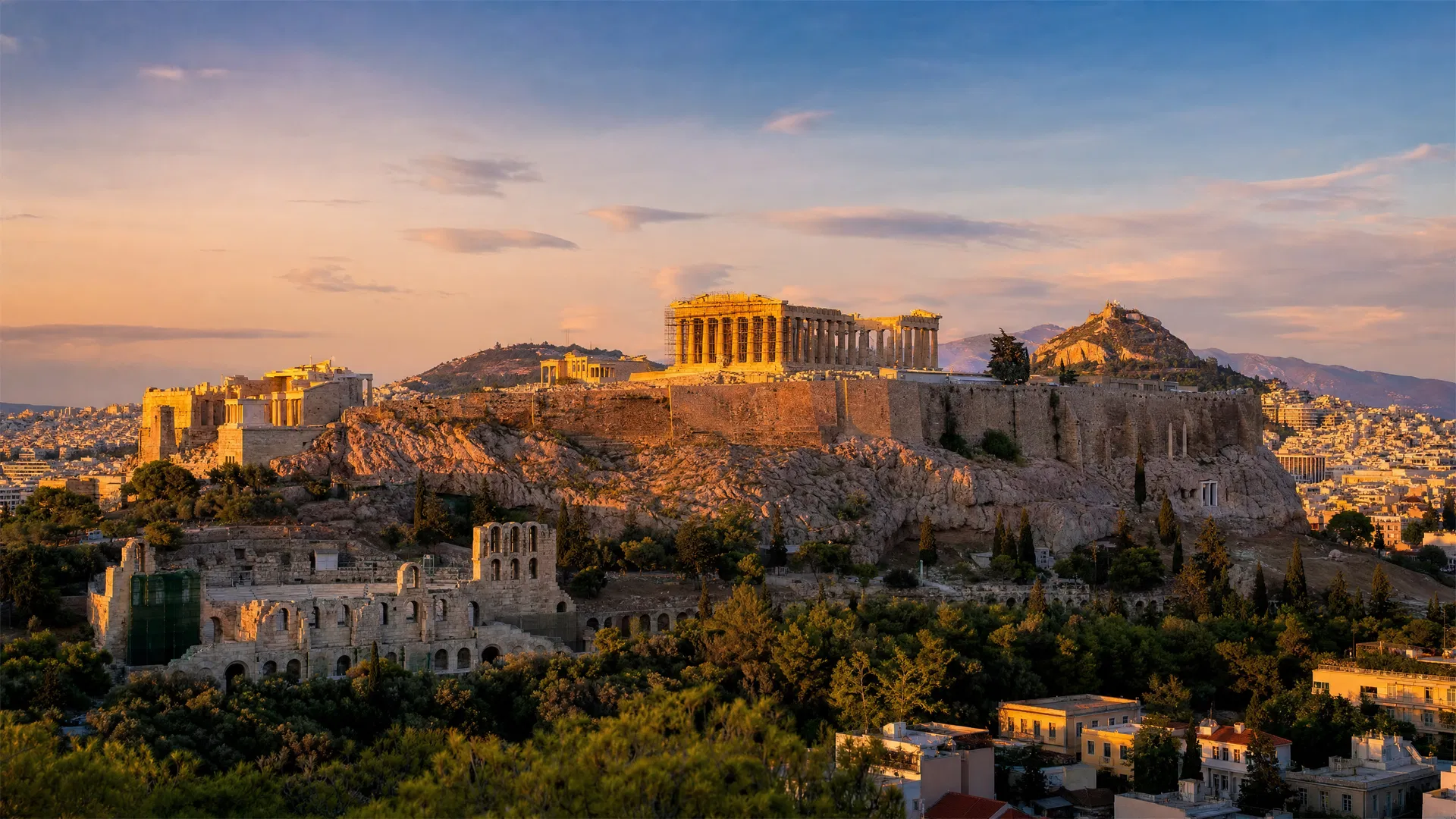
There is a moment that happens to almost everyone who visits Athens for the first time. You are standing somewhere ordinary — maybe waiting for a coffee in Monastiraki, maybe walking a side street in Psyrri — and you look up. And there it is. The Acropolis. Just sitting there above the city like it has been doing for 2,500 years, completely unbothered by the fact that you exist, that your flight was delayed, that you have seventeen unread emails and a half-formed opinion about whether Athens is worth visiting.
It is worth visiting. But not for the reasons most people think.
The travel industry has done Athens a quiet disservice for decades. It sold the city as a stopover — a place you fly into before catching a ferry to Santorini, a checkbox on a Greek island circuit, a morning at the Acropolis followed by an afternoon at the airport. Millions of people have passed through Athens this way, seen the marble, bought the olive oil, and left thinking they understood it. They did not understand it. They barely scratched the surface of one of the most layered, contradictory, alive cities on earth.
Athens is not a museum. It is a city of four million people who eat dinner at 10pm, argue passionately about football and politics in the same breath, make some of the best coffee in Europe, and have built an extraordinary contemporary culture directly on top of the ruins of the ancient world. The Acropolis is real and it is staggering and you should absolutely go. But Athens is also the neighborhood of Exarcheia, where anarchist murals cover walls next to some of the city's best record shops. It is the Central Market on Athinas Street, where butchers and fishmongers have been working the same stalls since before your grandparents were born. It is the rooftop bars of Koukaki where young Athenians drink Assyrtiko wine and watch the Parthenon turn gold at sunset. It is the tavernas in Pangrati where the menu is handwritten and the owner will tell you what to order and be right every time.
This is the Athens that deserves your full attention. This is the Athens worth planning a real trip around.
The City That Refused to Be Defined
Athens is one of the oldest continuously inhabited cities on earth, and it carries that weight in a way that is neither precious nor performative. The ancient and the contemporary exist here in a state of constant negotiation. You will walk past a Byzantine church that is older than most countries, turn a corner, and find yourself in front of a brutalist apartment block covered in world-class street art. You will eat lunch in a taverna where the recipe has not changed in a hundred years, then walk two blocks to a cocktail bar that could hold its own in Tokyo or New York.
This layering is not accidental. Athens has been conquered, occupied, liberated, bombed, and rebuilt so many times that the city has developed a particular genius for absorbing the new without surrendering the old. The Ottoman mosques and Byzantine churches and neoclassical government buildings and modernist apartment towers all coexist in the same neighborhoods, sometimes on the same block, occasionally on the same street corner. Walking Athens is an act of time travel that no other European city can quite replicate.
The city's recent history adds another dimension. The economic crisis that hit Greece between 2010 and 2018 was devastating, and Athens bore the brunt of it. But something unexpected happened in the aftermath: the crisis forced a creative reinvention. Rents dropped, young Athenians who had been priced out of the city came back, and neighborhoods that had been neglected for decades became incubators for galleries, restaurants, coffee shops, and cultural spaces. The Athens that emerged from the crisis is more interesting, more authentic, and more worth visiting than the pre-crisis city ever was. Hardship, it turns out, is an extraordinary catalyst for culture.
The Acropolis: Go Early, Go Prepared, Go Twice
Let's address the obvious. The Acropolis is the reason most people come to Athens, and it deserves every superlative that has ever been applied to it. The Parthenon, dedicated to Athena in 438 BC, is the most architecturally refined building in human history. That is not hyperbole. The ancient Greeks understood something about proportion, light, and optical illusion that architects are still studying today — the columns are not perfectly straight, they bow slightly outward to counteract the visual distortion that would make them appear to curve inward from a distance. Every element of the Parthenon was designed to be seen, to be experienced, to communicate the power and sophistication of Athenian civilization.
Standing in front of it for the first time is genuinely disorienting. You have seen photographs your entire life. You think you know what it looks like. You do not know what it looks like until you are standing there with the Aegean light hitting the Pentelic marble and the city spread out below you in every direction.
Go early. The site opens at 8am, and if you arrive at opening time in the shoulder seasons (April-May, September-October), you will have the Sacred Rock largely to yourself for the first hour. By 10am in peak summer, the crowds are significant. By noon, they are overwhelming. The heat in July and August is also serious — the Acropolis is fully exposed, there is almost no shade, and the marble reflects heat with remarkable efficiency. Bring water, wear a hat, wear sunscreen.
The ticket also includes the Ancient Agora, the Roman Agora, Hadrian's Library, the Kerameikos archaeological site, the Temple of Olympian Zeus, and the Lykeion. Buy the combination ticket. The Ancient Agora in particular is undervisited and extraordinary — this is where Socrates taught, where Athenian democracy was practiced, where Paul preached to the Athenians. The Stoa of Attalos, a reconstructed ancient shopping arcade, houses a museum of daily life objects that will make the ancient world feel suddenly, surprisingly human.
Go twice if you can. The Acropolis at sunset, viewed from the hill of Philopappos or from a rooftop bar in Koukaki, is a completely different experience from the Acropolis at dawn. The light changes everything.
For a deep dive into every aspect of the Acropolis experience — the best approach routes, what to prioritize inside, how to avoid the worst of the crowds — our 4-Day Athens City Break guide covers it in detail.
The Neighborhoods: Where Athens Actually Lives
Plaka is the oldest continuously inhabited neighborhood in Athens, a labyrinth of neoclassical houses and Byzantine churches climbing the northern slope of the Acropolis. It is also the most touristy neighborhood in the city, which means you should visit it (it is genuinely beautiful) but not base your entire Athens experience around it. The tavernas on the main drag are overpriced and mediocre. Walk two streets back from the main tourist flow and the quality improves dramatically.
Monastiraki is where Plaka bleeds into the city's commercial heart. The flea market here is one of the great urban bazaars of Europe — not just for tourists, but a real working market where Athenians buy and sell furniture, vintage clothing, tools, electronics, and antiques. On Sunday mornings, the market expands significantly and the energy is extraordinary. The square itself, with its Ottoman mosque and Byzantine church and the Acropolis visible above everything, is one of the great urban compositions in the world.
Psyrri sits just north of Monastiraki and is the city's nightlife and arts district. Ten years ago it was rough around the edges; today it is home to excellent restaurants, cocktail bars, galleries, and live music venues. The streets are narrow and the buildings are covered in murals. It gets going late — Athenians do not eat dinner before 9pm and do not go out before 11pm — but if you can adjust your schedule to local rhythms, Psyrri at midnight on a Friday is one of the great urban experiences in Europe.
Koukaki is the neighborhood immediately south of the Acropolis, and it has become the city's most interesting residential district over the past decade. It is where young Athenians who care about food, coffee, and design have set up shop. The coffee culture here is exceptional — Athens has developed one of the most sophisticated specialty coffee scenes in Europe, and Koukaki is its epicenter. The rooftop bars with Acropolis views are also here, and they are worth every euro.
Exarcheia is the city's anarchist neighborhood, and it is unlike anywhere else in Europe. The streets are covered in political murals, the bookshops are radical, and the tavernas are some of the cheapest and most authentic in the city. It is not dangerous — it is a functioning residential neighborhood with a strong community identity — but it is genuinely different from the rest of Athens, and visiting it gives you a dimension of the city that the tourist circuit completely misses.
Pangrati is the neighborhood east of the Panathenaic Stadium where Athenians go when they want to eat well without paying tourist prices. The tavernas here are family-run, the menus are seasonal, and the experience is as close to eating in a Greek home as you will get in the city. Kalamaki (grilled meat skewers), taramosalata, horiatiki (the real Greek salad, which contains no lettuce), and whatever the daily fish is — this is the food Athens actually eats.
Our Athens Food & Culture guide maps the best eating and drinking across all these neighborhoods, with specific recommendations for every meal and budget level.
The Food: Greece's Most Underrated Culinary City
Greek food has a reputation problem. Outside of Greece, it is represented by the same five dishes — moussaka, souvlaki, spanakopita, tzatziki, Greek salad — served in the same format in every Greek restaurant from London to Los Angeles. This representation bears almost no relationship to what Greek food actually is, which is one of the most sophisticated, regionally diverse, and historically deep culinary traditions in the world.
Athens is where all of Greece's regional food cultures converge. The city has been absorbing migrants from every corner of the country for a century, and each wave brought its food with it. The result is a city where you can eat Cretan dakos (barley rusks with tomato and mizithra cheese) for lunch, Thessaloniki-style bougatsa (custard pastry) for breakfast, and Aegean seafood for dinner, all within a few blocks of each other.
The Central Market on Athinas Street is the best introduction to Greek food culture in the city. The meat hall, with its hanging carcasses and shouting butchers, is not for the faint-hearted, but the fish market next door is extraordinary — a daily display of everything the Aegean and Ionian seas produce, from sea urchins to red mullet to the giant prawns that will end up grilled with olive oil and lemon on a taverna table that evening. The market opens at dawn and winds down by early afternoon.
For coffee, Athens has developed a culture that deserves its own essay. The freddo espresso — a double shot of espresso blended with ice until it is cold and frothy — was invented here and is now the default coffee order for most Athenians. The freddo cappuccino adds cold-frothed milk. Both are consumed slowly, over conversation, in the shade, at a pace that has nothing to do with the grab-and-go coffee culture of northern Europe or America. Sitting at a café in Athens and drinking a freddo is not a caffeine delivery mechanism. It is a social ritual, and participating in it is one of the great pleasures of the city.
The wine culture is equally underappreciated. Greek wine has been made continuously for longer than almost any other wine tradition in the world, and the indigenous grape varieties — Assyrtiko from Santorini, Xinomavro from Macedonia, Agiorgitiko from the Peloponnese — produce wines that are unlike anything from France or Italy. The natural wine movement has taken hold in Athens, and the bars in Psyrri and Koukaki that specialize in Greek natural wine are doing something genuinely exciting.
Beyond the Acropolis: The Athens That Most Visitors Miss
The National Archaeological Museum is one of the greatest museums on earth, and it is consistently undervisited because it sits slightly north of the main tourist circuit. The collection includes the Antikythera Mechanism — a 2,000-year-old analog computer used to predict astronomical events that is so sophisticated it was not believed to be ancient when it was first discovered — as well as the Mask of Agamemnon, the Artemision Bronze (a life-size bronze of either Zeus or Poseidon, the debate continues), and room after room of objects that will fundamentally change how you think about the ancient world. Allow at least three hours. Allow more if you can.
Cape Sounion is 70 kilometers south of Athens, at the tip of the Attica peninsula, where the Temple of Poseidon sits on a cliff above the Aegean. Lord Byron carved his name into one of the columns in 1810 (it is still visible). The drive down the coast road is beautiful, the swimming at the beaches along the way is excellent, and the temple at sunset is one of the great views in Greece. It is an easy half-day trip from the city.
The Athens Riviera stretches south from the city along the Saronic Gulf, a string of beach towns and swimming spots that Athenians use as their summer escape. Vouliagmeni, with its thermal lake and beach clubs, is the most famous. Glyfada has good restaurants and a lively beach scene. None of it is undiscovered, but all of it is genuinely enjoyable, and swimming in the Aegean after a morning at the Acropolis is a combination that is hard to beat.
Piraeus is Athens's port city, technically a separate municipality but functionally part of the urban fabric. Most visitors pass through it only to catch ferries to the islands, but the port itself has a fish market and a cluster of seafood restaurants that serve some of the best and most honest fish in the greater Athens area. If you are catching an early ferry, arrive the night before and eat at the port.
Our 5-Day Athens Travel Guide covers all of these day trips and excursions in detail, with logistics, timing, and the specific spots worth your time.
Athens for Every Kind of Traveler
The city accommodates every travel style with unusual generosity.
For couples, Athens is one of the most romantic cities in Europe — not in the self-conscious, performative way of Paris, but in the way of a city that is genuinely beautiful, where the food is excellent, where the evenings are warm and long, and where the Acropolis lit up at night provides a backdrop that no amount of money can manufacture. Our Romantic Athens guide and the Greece for Couples: Athens & Santorini itinerary are both built around this experience.
For families, Athens is more manageable than most ancient cities. The mythology is genuinely captivating for children, the food is accessible, and the city has good parks and open spaces. The Athens Family Adventure guide approaches the city through the lens of Greek mythology — which turns every ruin into a story rather than a history lesson.
For solo travelers, Athens is one of the safest and most welcoming cities in Europe for independent travel. Greeks are extraordinarily hospitable to strangers, the public transport is functional, and the city has a strong solo travel infrastructure. Our Athens Solo Travel Guide covers the logistics and the best ways to meet people and find your own rhythm in the city.
For budget travelers, Athens is one of the best-value capital cities in Europe. A meal at a good taverna costs €10-15. A freddo espresso costs €2. The combination archaeological ticket is €30 and covers six sites. Accommodation in good neighborhoods is significantly cheaper than comparable cities in Western Europe. Our Athens on a Budget guide shows how to do the city properly for around €55 a day.
When to Go
April and May are the best months. The weather is warm but not brutal (20-25°C), the wildflowers are in bloom across Attica, the tourist crowds have not yet arrived in full force, and the light — the famous Attic light that painters and photographers have been chasing for centuries — is at its most extraordinary.
September and October are the second-best option. The summer crowds have thinned, the sea is still warm enough to swim, and the city returns to something closer to its natural rhythm after the tourist season.
June through August is peak season. The heat is serious (regularly 35-40°C in July and August), the crowds at major sites are significant, and prices are at their highest. If you must go in summer, adjust your schedule radically — do outdoor sightseeing before 10am and after 5pm, spend the middle of the day in museums or cafés, and embrace the Athenian tradition of the afternoon rest.
November through March is the off-season, and Athens in winter is a genuinely interesting proposition. The city is quiet, prices drop significantly, the museums are uncrowded, and the weather, while occasionally rainy, is mild by northern European standards. The light is different — softer, more diffuse — but the Acropolis in winter mist has its own kind of drama.
The Practical Reality
Athens is served by Athens International Airport (ATH), with direct connections from most major European cities and many North American hubs. The metro from the airport to the city center takes 40 minutes and costs €9. Taxis are metered and generally honest; the fare from the airport to the center is around €40.
The metro system covers the main tourist areas efficiently. Walking is the best way to explore the central neighborhoods — Athens is a walking city, and the distances between major sites are smaller than they appear on a map. The main tourist area, from Monastiraki to Koukaki to Syntagma, is entirely walkable.
Greek is the official language, but English is widely spoken in tourist areas and by most younger Athenians. Learning a few words of Greek — efharisto (thank you), parakalo (please/you're welcome), yia sas (hello/goodbye, formal) — is appreciated and will generate genuine warmth.
Tipping is not mandatory but is appreciated. Rounding up the bill or leaving 10% at a sit-down restaurant is standard. At cafés, leaving the small change is sufficient.
The currency is the euro. Cash is still widely used, particularly at markets and smaller tavernas, though cards are accepted almost everywhere in the city center.
The City That Changes You
Every great city does something to you that you cannot fully articulate until you have left. Athens does something particular. It puts your own civilization in perspective. You walk through a city that has been continuously inhabited for 7,000 years, that produced democracy and philosophy and drama and mathematics and architecture that the entire Western world still builds on, and you realize that the things you think of as permanent — your institutions, your cities, your certainties — are extraordinarily young and fragile and contingent.
This is not a depressing realization. It is a liberating one. Athens teaches you that civilizations rise and fall and that what endures is not the power but the ideas, not the empire but the art, not the marble but the conversation that the marble was built to honor. The Parthenon was built to celebrate human achievement. Two and a half thousand years later, it still does.
Go to Athens. Go with time and curiosity and an appetite for both the ancient and the alive. Eat the food, drink the wine, walk the neighborhoods, climb the Acropolis at dawn. Let the city show you what it actually is, rather than what you expected it to be.
It will not disappoint you. It will do something better than that. It will surprise you.
Ready to plan your Athens trip? Let Leif build your personalized Athens itinerary — whether you have 4 days or 10, whether you are traveling solo, as a couple, or with family. Start planning your Athens adventure →