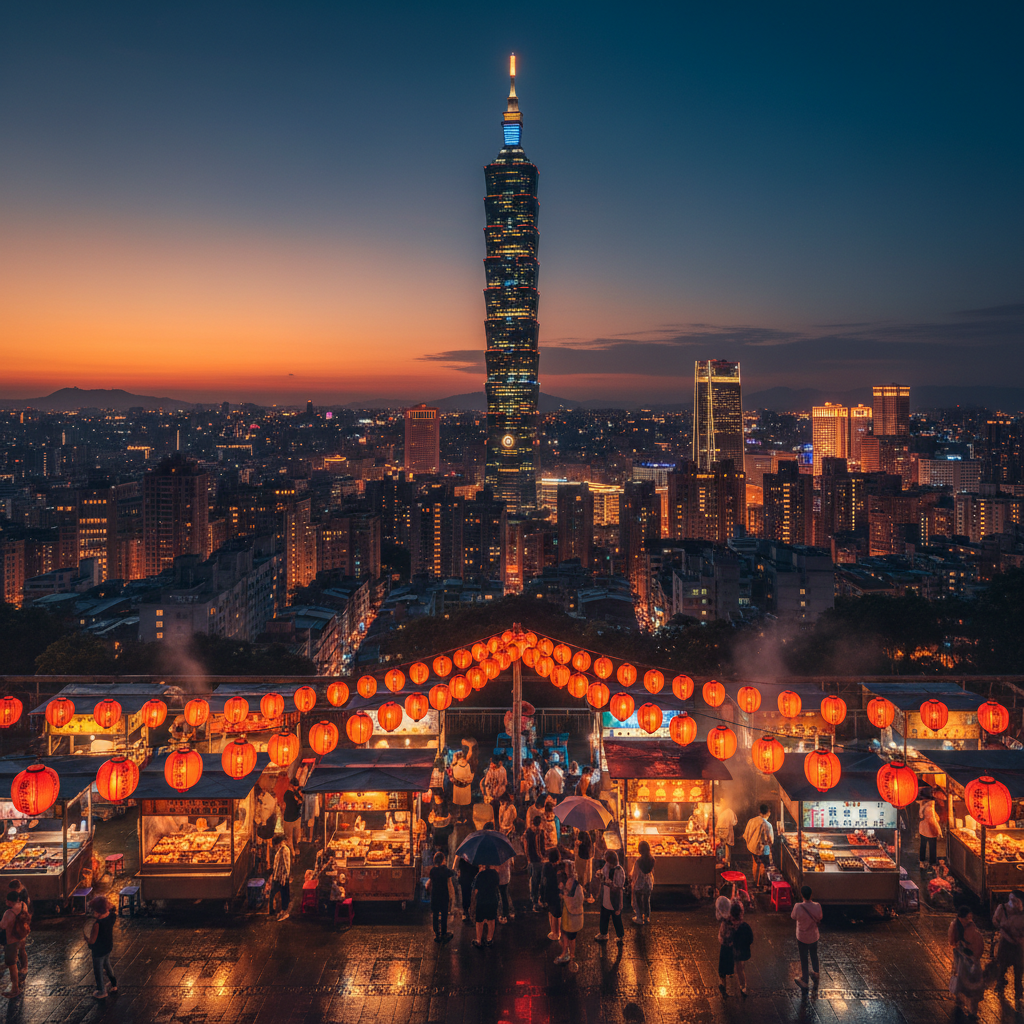
The City That Rewired Me: Why Taipei Belongs at the Top of Every List
Destination: Taipei, Taiwan
Category: Destination Guides
There's a particular kind of traveler who comes back from Taipei and can't quite explain what happened to them. They went in expecting a stopover, a footnote between Tokyo and Bangkok, a city they'd heard was "nice." They came home three weeks later talking about it the way people talk about places that rearranged something fundamental inside them. The food. The people. The way the whole city operates at this frequency of warmth and efficiency that you don't find anywhere else in Asia. Taipei doesn't announce itself. It just gets under your skin.
What makes this particularly disorienting is that Taipei has somehow stayed off the radar of the mass-tourism machine that has consumed so many of Asia's great cities. While Bangkok floods its streets with bachelor parties and Bali drowns in Instagram influencers, Taipei remains stubbornly, gloriously itself. The night markets are where locals actually eat dinner, not where they perform "authenticity" for foreign cameras. The MRT is one of the cleanest, most efficient transit systems on the planet, and it costs less than a dollar a ride. The hot springs in Beitou are a 30-minute subway ride from downtown, and you'll share them mostly with retired Taiwanese couples who've been coming every Sunday for 40 years. The city has figured out something that most places are still trying to: how to be genuinely great without needing anyone to notice.
Taipei sits at the intersection of Chinese, Japanese, and indigenous Taiwanese cultures in a way that produces something entirely its own. The Japanese colonial period left behind a grid of tree-lined boulevards, a love of precision and cleanliness, and a breakfast culture that would make a Parisian weep with envy. The Chinese heritage brought 3,000 years of culinary tradition, one of the world's greatest collections of Chinese imperial artifacts, and a temple density that means you're never more than a few blocks from incense smoke and red lanterns. The indigenous Taiwanese influence runs through the mountain food, the aboriginal art in the National Palace Museum's lesser-visited wings, and the hiking trails that climb out of the city into jungle within 20 minutes. Nowhere else in the world does this particular combination exist. Taipei is the only place on earth where you can eat a bowl of beef noodle soup that traces its lineage back to Sichuan province, then take the subway to a Japanese-era hot spring bathhouse, then hike to a waterfall that the indigenous Atayal people have been visiting for centuries — all before dinner.
The food alone is reason enough to come. Taipei is not a city with a food scene. Taipei is a food scene that happens to have a city built around it. The night markets — Shilin, Raohe, Nanjichang, Tonghua — are not tourist attractions. They are where people eat. Where grandmothers argue with vendors about the quality of the scallion pancakes. Where teenagers line up for 45 minutes for a single cup of bubble tea from the original shop that invented the drink. Where you can spend NT$300 — roughly ten US dollars — and eat better than you would at a $60 restaurant in most Western cities. The stinky tofu that smells like a crime scene and tastes like a revelation. The oyster vermicelli in its thick sweet potato starch broth. The pineapple cakes from bakeries that have been perfecting the recipe for three generations. The beef noodle soup, which Taipei takes so seriously that the city holds an annual competition to crown the best bowl, with chefs treating the event with the gravity of a Michelin three-star review.
Then there's the question of the people. Travelers who've spent time in Japan often describe Taiwanese people as "Japanese-level polite but without the formality." That's accurate as far as it goes, but it undersells something. In Tokyo, politeness is a social contract enforced by invisible pressure. In Taipei, warmth is just how people are. Strangers on the MRT will help you figure out which stop to get off at without being asked. The vendor at the night market will notice you're struggling to eat the oyster omelet with chopsticks and wordlessly bring you a fork, then refuse to make it weird. The person behind you in line at the convenience store will tap you on the shoulder to tell you that you dropped your change. This isn't performance. It's just Taipei.
The Neighborhoods That Make Taipei Worth Getting Lost In
Every great city has a neighborhood that tells you who it really is, and in Taipei that neighborhood is Da'an. It's where the city's best breakfast spots are — Fu Hang Soy Milk, which has been serving freshly ground soy milk and fried dough sticks since before most of its customers were born, draws a line that wraps around the block by 7am. It's where the university students spill out of National Taiwan University onto tree-shaded streets lined with independent bookshops and tea houses that take their craft as seriously as any Kyoto tea ceremony. Da'an Forest Park, the city's green lung, is where you'll find tai chi practitioners at dawn, families on weekend afternoons, and couples watching the fireflies emerge at dusk in summer. Da'an is Taipei without the performance — the city as it actually lives.
Ximending is the city's id — loud, neon-lit, unapologetically young. This is where bubble tea was born, where the cosplay kids gather on weekends, where the street food is so good and so cheap that you'll eat four meals in an afternoon without meaning to. The covered pedestrian streets have a Tokyo Harajuku energy but with a distinctly Taiwanese flavor: the fashion is more eclectic, the food is better, and nobody is trying to be seen. Ximending is also where you'll find the Red House, a century-old octagonal market building that now houses the city's most interesting independent designers and a weekend outdoor market that's become a gathering point for Taipei's creative community.
For the city's soul, walk through Dadaocheng, the old merchant quarter along the Danshui River. This is where Taipei's tea trade made its first fortunes in the 19th century, and the old Baroque-style merchant houses still line the main streets, now converted into tea houses, fabric shops, and the kind of cocktail bars that feel like they've been there for a hundred years even when they opened last year. The Yongle Fabric Market has been selling bolts of silk and cotton since the Japanese colonial era. The weekend market along Dihua Street draws locals hunting for dried goods, traditional medicine ingredients, and the New Year snacks that have been made the same way for generations. Dadaocheng is the part of Taipei that reminds you this city has been a serious place for a very long time.
Zhongshan, the neighborhood that runs north from the main station, is where the city's design culture lives. The old Japanese-era buildings along Chifeng Street have been converted into some of the best independent coffee shops in Asia — and Asia has extraordinary coffee shops. The Zhongshan MRT Line above-ground stretch is lined with boutiques, concept stores, and galleries that feel like they belong in a design magazine. This is also where you'll find the best hotel options in the city: the Mandarin Oriental, the W, and a dozen boutique properties that occupy renovated colonial buildings with the kind of attention to detail that makes you want to cancel your other plans and just stay in the lobby.
The Experiences That Separate Taipei From Every Other City
The hot springs of Beitou are one of the most extraordinary urban experiences in Asia, and almost nobody outside Taiwan knows about them. Beitou sits at the end of the MRT's red line, 30 minutes from downtown Taipei, in a valley carved by volcanic activity that has been producing geothermal water for millennia. The Japanese developed the area into a resort district during the colonial period, and the old bathhouses — some of them still operating, some converted into museums — give the neighborhood a faded-grandeur quality that feels like stepping into a Hayao Miyazaki film. The public hot spring park is free. The private bathhouses range from basic to extraordinary. The Beitou Hot Spring Museum, housed in a 1913 Japanese bathhouse, is one of the most beautiful buildings in Taiwan. You can be soaking in mineral-rich geothermal water, surrounded by mountains, having paid less than $15 for the experience, and the nearest skyscraper is 30 minutes away. No other major Asian capital offers anything remotely like this.
Jiufen, the mountain village that inspired the setting of Hayao Miyazaki's Spirited Away, is 40 minutes from Taipei by bus and feels like it exists in a different century. The old tea houses cling to the hillside above the Pacific Ocean, their red lanterns glowing in the evening mist. The narrow stone staircases wind between buildings that were built during the Japanese gold rush era, when Jiufen was one of the wealthiest towns in Taiwan. The A-Mei Tea House, with its terraced wooden decks overlooking the sea, is the most photographed building in Taiwan — and for once, the reality exceeds the photograph. Come in the late afternoon, when the tour buses have mostly gone and the light turns the ocean gold, and you'll understand why this place has been inspiring artists for a century.
The National Palace Museum contains the world's greatest collection of Chinese imperial art — 700,000 pieces, the bulk of the Qing dynasty imperial collection, evacuated from the Forbidden City in 1933 and brought to Taiwan in 1949. The Louvre has more total objects. The British Museum has more breadth. But for Chinese art — jade carvings, bronze vessels, imperial porcelain, calligraphy scrolls, paintings — nothing in the world comes close. The Jadeite Cabbage, a piece of jade carved to look exactly like a Chinese cabbage, complete with a cricket and a locust hidden in the leaves, draws more visitors per square foot than almost any artwork on earth. The museum is enormous and can be overwhelming; the trick is to go early, pick three or four galleries, and spend real time with them rather than trying to see everything.
For a different kind of elevation, Elephant Mountain (Xiangshan) offers the best view of Taipei 101 and the city skyline, and it's a 20-minute hike from the MRT station. The trail is steep and the stone steps are slippery when wet, but the viewing platforms at the top — particularly the one at the 1,000-step mark — offer a perspective on the city that no observation deck can match. Go at sunset. Bring water. The city spread below you, with Taipei 101 catching the last light and the mountains rising behind it, is one of those views that makes you understand why people fall in love with this place.
The Night Markets: A Deeper Education
Every travel guide tells you to go to Shilin Night Market. Shilin is fine — it's enormous, it's chaotic, it has everything, and it's been the most famous night market in Taiwan for decades. But the travelers who really understand Taipei will tell you that Nanjichang Night Market is the one. Smaller, less polished, more local, and with a concentration of food quality that makes Shilin look like a food court. The oyster vermicelli here is the standard against which all other oyster vermicelli is measured. The scallion pancakes are made by a woman who has been making them the same way for 30 years and has no interest in changing anything. The stinky tofu vendor operates from a cart that has been in the same spot since the 1980s. Nanjichang is what Shilin was before it became famous, and it's still what Taipei's night markets are actually about.
Raohe Night Market, running along the old railway line in Songshan district, is the most photogenic of the major markets — the entrance is framed by the Ciyou Temple, whose red and gold facade glows against the night sky in a way that makes every photograph look like a movie still. The black pepper buns here, baked in a clay oven and filled with pork and scallions, are one of the great street foods of Asia. The line is always long. It's always worth it. Raohe is also where you'll find the best medicinal herb soup in the city, served by vendors who will ask about your constitution and recommend a broth accordingly — a practice that bridges traditional Chinese medicine and street food in a way that only Taipei manages to make feel completely natural.
Planning Your Taipei Trip
The best time to visit Taipei is October through December, when the summer humidity has broken, temperatures are comfortable (20–25°C), and the city is at its most livable. Spring (March–May) is also excellent. Summer (June–September) is hot, humid, and typhoon season — manageable, but not ideal. Winter (January–February) is mild by most standards but can be grey and rainy; it's also when the Lunar New Year transforms the city, with temple celebrations and lantern festivals that are worth planning a trip around.
Getting around is simple. The EasyCard — available at any MRT station for NT$100 deposit — works on the MRT, buses, YouBike bicycle share, and even at convenience stores. The MRT covers the city comprehensively and runs until midnight. Taxis are cheap and drivers are honest. The city is safe at any hour; solo travelers, including solo women travelers, consistently rate Taipei among the safest cities in Asia.
Budget travelers can live extraordinarily well on NT$1,500 per day (roughly $45 USD) — night market meals, MRT transport, and a clean guesthouse in a central neighborhood. Mid-range travelers spending NT$3,000–5,000 per day will eat at excellent restaurants, stay in boutique hotels, and have money left over. Taipei is one of the few major Asian capitals where budget and luxury travelers both feel like they got a deal.
The Itinerary Guides: Where to Start
We've built out a full library of Taipei itinerary guides to help you plan every kind of trip. Whether you're coming solo, as a couple, with family, or on a tight budget, there's a guide that maps out exactly how to spend your time.
For solo travelers, our Solo Taipei: 4-Day Itinerary for Night Markets, Hot Springs & City Views covers the city's best solo-friendly experiences — the izakaya-style bars where you'll meet other travelers, the hot spring bathhouses that are perfect for solo visits, and the hiking trails where you can be completely alone inside a major city.
Couples will find everything they need in our Taipei for Couples: A Romantic 5-Day Hot Spring & Mountain Village Escape, which weaves together the Beitou hot spring ryokan experience, the Jiufen mountain village at golden hour, and the Tamsui riverside sunset that locals consider one of the most romantic views in Taiwan. We also have a shorter 4-Day Romantic Escape to Night Markets & Hot Springs for those with less time.
Families traveling with children will find Taipei surprisingly accommodating — the city is clean, safe, and full of experiences that work for all ages. Our Taiwan with Kids: 5-Day Taipei Family Itinerary covers Elephant Mountain (manageable for older kids), the National Palace Museum (more engaging than it sounds for children, especially the Jadeite Cabbage), Shilin Night Market, and the Maokong Gondola tea mountain ride. There's also a 4-Day Taipei Itinerary for Kids that focuses on the city's most family-friendly highlights.
For food-focused travelers, our Taipei Foodie Adventure: 4-Day Culinary Journey Through Night Markets & Bubble Tea Origins is the definitive guide to eating your way through the city — from the breakfast culture of Da'an to the night market circuit to the restaurants that have been perfecting single dishes for decades.
Budget travelers should start with our Taiwan on a Budget: 4-Day Taipei Itinerary (NT$1,500/Day), which proves that Taipei is one of the few major Asian cities where you can travel on a genuine shoestring without sacrificing quality.
What Taipei Teaches You
There's a concept in Mandarin — rénqíng wèi — that roughly translates as "the flavor of human feeling." It describes the quality of warmth and consideration that exists in relationships and communities, the sense that people genuinely care about each other's wellbeing. Taipei has rénqíng wèi in a way that's increasingly rare in major cities. The vendor who gives you extra scallion pancake because you look hungry. The elderly man who walks you to the temple entrance because you seemed uncertain about the direction. The stranger who offers you their umbrella in a sudden downpour and refuses to take it back. These aren't exceptional moments in Taipei. They're Tuesday.
What the city teaches you, if you stay long enough to let it, is that efficiency and warmth are not opposites. That a city can be clean and affordable and safe and also deeply, genuinely human. That the best food in the world doesn't require a reservation or a dress code. That a hot spring in the mountains can be 30 minutes from a skyscraper and both can be real. Taipei is the city that makes you question every assumption you had about what a great city needs to be — and then makes you wonder why you didn't come sooner.
The travelers who come back from Taipei and can't quite explain what happened to them? They're not confused. They just found a city that changed the standard. And now everywhere else has to measure up.