The Month Every Destination Stops Performing and Starts Being Itself
Destination: Multiple Destinations
Category: Travel Tips
The Month Every Destination Stops Performing and Starts Being Itself
There is a specific moment in early September when the Oia sunset viewpoint on Santorini holds two hundred people instead of two thousand. The caldera is the same. The whitewashed houses are the same. The Aegean light is the same. What is different is that the destination has stopped performing the version of itself that August required and has returned to the version that made it famous in the first place. The two hundred people watching the sun drop behind the volcanic rim are not experiencing a lesser version of the August sunset. They are experiencing the actual thing — the one that the August crowd paid more for and understood less.
This is the September argument. Not that September is quieter than July and August — though it is. Not that September is cheaper — though it often is. The argument is that September is the specific month when the world's most over-performed destinations remember what they actually are. The tourist infrastructure that July and August require — the queues, the density, the defensive posture that a city adopts when it has more visitors than residents — recedes almost overnight when the school calendar sends families home in late August. What remains is the destination itself: the food culture, the light, the neighborhoods, the specific annual events that have nothing to do with tourism and everything to do with the place being alive.
The traveler who understands September doesn't just get fewer crowds. They get a fundamentally different experience of the same places — one that is more authentic, more specific, and more connected to the actual life of the destination. The thesis of this post is not that September is the best month to travel in the abstract. It is that September is the specific month when these six destinations — Santorini, Barcelona, the Dolomites, New York City, Morocco, and Tuscany — stop performing for their summer visitors and start being themselves. Each one undergoes a different transformation. Each transformation is irreplaceable by any other month. And each one is the version of that destination that the destination's own reputation was built on, before July and August made that reputation a liability.
Santorini: The Island That August Broke and September Restored
The Santorini that August produces is not the island that made Santorini famous. The Oia sunset viewpoint — the castle ruins above the village where the caldera view is most dramatic — holds two thousand people in August. They arrive two hours early. They hold their phones above their heads. The photograph they take is of the crowd as much as the sunset. The caldera-view restaurants are booked months in advance. The narrow lanes of Fira are impassable at midday. The beach clubs at Perissa and Perivolos have sun beds arranged wall-to-wall from June through August, and the experience of lying on black volcanic sand is indistinguishable from lying in a car park.
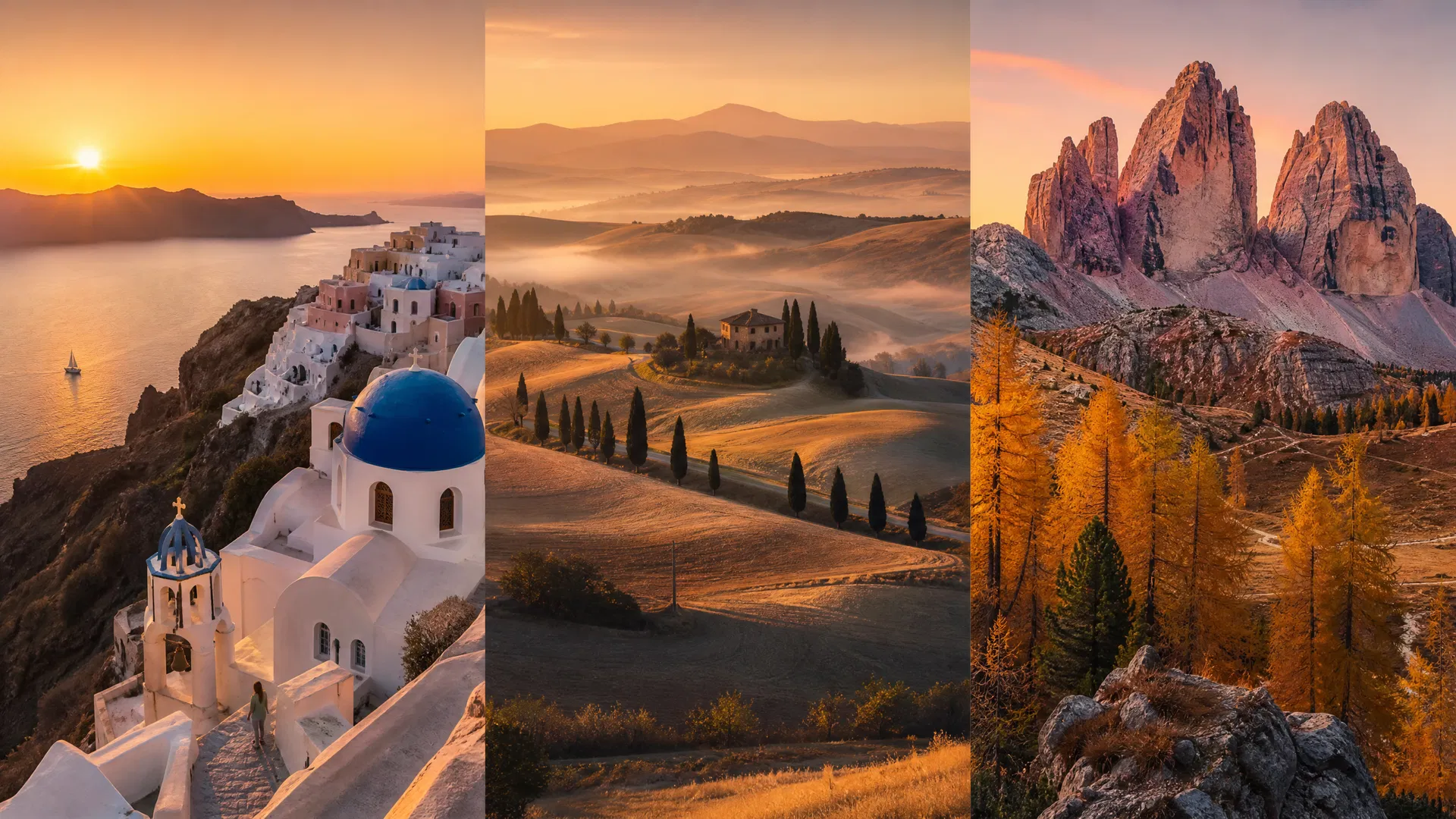
September restores the island that all of those August visitors thought they were getting. The Oia viewpoint in September holds two hundred people. The specific September light — the lower sun angle that produces longer shadows across the whitewashed facades, the specific atmospheric clarity that follows the summer heat haze — is the light that photographers specifically seek out in this month. The August sun is overhead and harsh; it flattens the architecture. The September sun is lower and warmer in tone, and it illuminates the caldera rim at golden hour with the kind of definition that makes the buildings appear to glow from within. The photographs that appear on every Santorini tourism calendar were taken in September, not August.
The Assyrtiko grape harvest begins in late August and continues through September, and this is the specific annual event that makes September Santorini irreplaceable. Santorini's volcanic soil — the pumice and ash from the Minoan eruption of 1600 BCE — produces a white wine with a mineral character available nowhere else on earth. The Assyrtiko grape grown in this specific soil produces a wine that tastes of the island: saline, citrus-forward, with an acidity that cuts through the heat. Venetsanos Winery, operating since 1947 on the caldera rim above Megalochori, offers harvest-season tastings in September that include the barrel-fermented Assyrtiko not available in the standard tourist season portfolio. The outdoor terrace provides the caldera view without the Oia crowds, and the September tasting menu is the most complete expression of what the island's wine culture actually is.
The water temperature in September — 24 to 26 degrees Celsius, warmer than June — means the swimming is at its best precisely when the beach clubs have reduced their sun bed density. The black sand beaches of Perissa and Perivolos, which in August are a performance of summer, in September become actual beaches: the kind where you can find a spot without a reservation, where the water is warm enough to stay in for an hour, and where the volcanic landscape behind the beach is visible rather than obscured by umbrellas.
For the full Santorini itinerary — the caldera villages, the ancient site of Akrotiri, the specific wine route through the island's interior — the Santorini 5-day Greece itinerary and the Santorini couples guide cover the island in depth. The September traveler should build any itinerary around the harvest timing: the second and third weeks of September are typically the peak of the Assyrtiko harvest, and the wineries that accept visitors during this period offer an experience that no other month provides.
Barcelona: The City That Reclaims Itself After La Diada
Where Santorini's September transformation is about the island returning to its natural state, Barcelona's is about the city returning to its political and cultural identity — the version of itself that exists when it is not performing for its summer visitors.
Barcelona in July and August has more tourists than residents in the city center. The Gothic Quarter's lanes are so congested that locals avoid them entirely. The Barceloneta beach is a performance of summer rather than an experience of it. The Boqueria market, which is one of the finest food markets in Europe, has been so thoroughly colonized by tourist-oriented vendors selling overpriced smoothies and pre-cut fruit that the professional chefs who supply the city's restaurants do their buying at the Mercat de l'Abaceria in Gràcia or the Mercat de Sarrià instead.
September 11th is La Diada — Catalonia's National Day — and it marks the specific moment when Barcelona stops performing for its summer visitors and starts being itself again. The day is not a tourist event. It is a statement of political identity: the Catalan independence demonstrations that transform the city's streets, the human towers — castellers — that perform in the Plaça de Sant Jaume, the neighborhood celebrations in Gràcia and Sarrià that most tourists never see because they are not on the official tourist circuit. The traveler who arrives in Barcelona in the second week of September arrives into a city that is fully occupied with its own life, and the experience of being present for that — of watching a city assert its identity rather than perform its attractions — is the specific September experience that no other European city offers in the same form.
Two weeks after La Diada, the Festes de la Mercè transforms the city again. Barcelona's biggest annual festival, celebrating the patron saint of the city, runs for four days in late September and fills every major public space with free concerts, theatre, and the correfoc — the fire run through the Gothic Quarter on the festival's final Saturday, in which fire-breathing dragons and devils run through the streets while participants dance in the sparks. The correfoc is the most viscerally intense free event in any European city's annual calendar. It is not a tourist attraction. It is a neighborhood tradition that tourists are welcome to witness, and the distinction matters: you are not watching a performance designed for you. You are watching something the city does for itself.
The September Boqueria is a different market from the August Boqueria. The professional chefs return to their regular morning buying. The wild mushroom vendors appear with the first autumn rovellons — saffron milk cap mushrooms specific to Catalonia, available nowhere in the summer market — and the market's actual function as a food supply infrastructure reasserts itself over its tourist-season identity as a smoothie destination. The restaurants in El Born and Poble Sec that are fully booked through August have tables available on 48 hours' notice in September. The Sant Pau Art Nouveau complex — Lluís Domènech i Montaner's masterpiece, which rivals the Sagrada Família in architectural ambition and surpasses it in accessibility — has no summer queue in September.
The Barcelona 7-day city guide, the Barcelona solo guide, and the Barcelona food guide all cover the city's neighborhoods and food culture in depth. The September traveler should structure the trip around the festival calendar: arrive before September 11th to experience La Diada, stay through the Festes de la Mercè in late September, and use the days between to explore the neighborhoods — Gràcia, El Born, Poble Sec, Sarrià — that the summer tourist infrastructure never reaches.
The Dolomites: The Mountains After the Crowds and Before the Snow
If Barcelona's September transformation is cultural and political, the Dolomites' is geological and chromatic. The specific thing that September does to the Dolomites is turn the larch trees gold — and the combination of gold larch forests against rose-colored limestone peaks, under the specific clarity of early autumn mountain air, produces a landscape that July and August, for all their hiking traffic, cannot replicate.
The Dolomites are the most dramatically beautiful mountain landscape in Europe. The specific rose-colored limestone — Dolomia, named after the French geologist Déodat de Dolomieu who first described its composition — turns pink at sunset in a phenomenon called enrosadira, and the combination of this color with the Tyrolean villages below and the Italian alpine food culture has made the Dolomites one of the most visited mountain destinations on the continent. July and August bring the hiking crowds and the accommodation prices that reflect peak demand. October brings the first serious snow and the closure of the higher trails. September is the specific month when the Dolomites exist in their most complete form.
The Tre Cime di Lavaredo — the three distinctive limestone spires that are the Dolomites' most iconic image — are best experienced at dawn in September. The circular trail around the three spires, which in August has five hundred hikers visible from any viewpoint, has fewer than fifty at dawn in September. The specific September morning phenomenon — the first frost forming on the north-facing rock faces, the contrast between the frost and the pink limestone producing a color combination that summer heat makes impossible — is the image that the Dolomites' most serious photographers specifically time their visits to capture. The lower September sun angle creates shadows across the spire faces that July's overhead sun eliminates entirely, and the resulting definition of the rock structure is what makes September the superior photographic month.
The larch trees on the Alpe di Siusi plateau above Castelrotto begin their color change in late September. The Dolomites' larches are deciduous conifers — unusual in an alpine environment — and their September-to-October color transition from green to gold produces the most photographed autumn landscape in the Alps. The combination of gold larch forests, the Sassolungo massif rising behind them, and the specific September morning mist that sits in the valleys below the plateau is the image that appears on every Dolomites tourism calendar. It exists for approximately three weeks in late September and early October, and it does not exist in any other month.
Rifugio Locatelli, the mountain hut at the base of the Tre Cime, operates from June to mid-October. In August, booking requires weeks of advance notice. In September, same-week reservations are possible, and the dinner menu — Tyrolean canederli (bread dumplings in broth), local Lagrein wine from the Alto Adige valley below — is the correct September mountain meal. The rifugio system throughout the Dolomites operates on the same September logic: the summer crowds have thinned, the huts are still open, and the experience of staying overnight at altitude — waking before dawn to watch the enrosadira on the Tre Cime from the rifugio terrace — is available without the August booking competition.
The September traveler should prioritize the Alpe di Siusi plateau for the larch color and the Tre Cime loop for the dawn light — these are the two September experiences that the Dolomites offer and that no other mountain destination replicates. The Dolomites 5-day adventure guide covers the trail network, the rifugio system, and the specific routes that reward September timing — including the Alta Via 1 traverse and the Cortina d'Ampezzo section where the larch color concentrates most dramatically in the final week of September.
New York City: The City That September Gives Back to New Yorkers
Where the Dolomites' September transformation is a matter of light and color, New York's is a matter of cultural infrastructure. The specific thing that September does to New York is restart it — the Broadway season, the gallery openings, the restaurant industry's return from summer — and the city that emerges from this restart is the city that New York's actual reputation was built on.
New York City in July and August is the city that New Yorkers leave. The humidity is brutal. The tourist density in Midtown and lower Manhattan is at its annual peak. The specific cultural institutions that define the city's actual character — the theater season, the gallery programs, the restaurant industry — are either closed or in their quietest period. The Broadway shows that run through August are the ones that can survive on tourist audiences alone. The galleries in Chelsea close for August staff vacations. The restaurants that define the city's food culture take their annual break.
September is when New York comes back to itself. The Broadway season opens in the first two weeks of September, and the shows that open in this window are the ones that the theater industry considers its most ambitious — the productions that want the full season ahead of them rather than the compressed spring calendar. The TKTS booth in Times Square, which in July has lines for shows that are already sold out, in September has same-day tickets to productions that were unavailable all summer at 40 to 50 percent discount. The theater experience in September is not a consolation prize for missing the spring season. It is the beginning of the season that the spring reviews will be written about.
The Chelsea gallery district's September opening weekend — typically the second or third weekend of the month — is the specific annual event that defines the New York art world's calendar. Every gallery on West 25th and West 26th Streets opens a new show simultaneously. The streets fill with the art community rather than tourists. The galleries that were closed in August open their most ambitious shows of the year. The experience of walking through Chelsea on a September opening weekend — moving from gallery to gallery, encountering work that has not yet been reviewed or contextualized — is the specific New York experience that no other month provides in the same form.
The September light is the light that photographers call the city's best. The lower sun angle, the specific atmospheric clarity that follows the summer humidity's departure, the way the light hits the glass towers of Midtown at golden hour — this is the light that appears in the photographs that make people want to visit New York. The High Line, the elevated park on Manhattan's West Side that in July and August is too crowded to move through comfortably, returns in September to its intended function as a neighborhood park. The horticultural team designs the September plantings to peak in this specific month: the grasses turn amber, the late-season wildflowers bloom, and the park's landscape is at its most complete precisely when the summer crowds have thinned enough to experience it.
The New York City 7-day itinerary, the NYC couples guide, and the NYC budget guide cover the city's neighborhoods, food culture, and logistics in depth. The September traveler should build the trip around the cultural calendar: the Broadway opening week in the first two weeks of September, the Chelsea gallery opening weekend in the second or third week, and the Smorgasburg food market in Williamsburg on Sunday mornings — the outdoor market that runs through October and that in September, when the summer peak has passed, returns to its best version of itself.
Morocco: The Desert After the Summer Heat
New York's September transformation is cultural and meteorological. Morocco's is elemental. The specific thing that September does to Morocco is make it navigable again — and the version of Morocco that becomes navigable in September is the version that Morocco's entire reputation was built on.
Morocco in July and August is the destination that experienced travelers consistently advise against. The Sahara Desert in summer reaches 50 degrees Celsius at midday. The medinas of Marrakech and Fes are physically exhausting to navigate in the heat. The tanneries at the Chouara in Fes — the leather dyeing complex that is one of the most visually extraordinary working industrial sites in the world — produce an overwhelming smell in the summer heat that makes the full viewing experience impossible. The Todra Gorge in the High Atlas, the 300-meter limestone canyon that is one of Morocco's most dramatic landscapes, is subject to flash flooding from the mountain thunderstorms that characterize the summer months.
September marks the specific transition when Morocco becomes itself again. Temperatures drop to 35 to 38 degrees Celsius in the Sahara and 28 to 30 degrees in the cities — still warm, but navigable. More importantly, the summer dust settles, and the specific clarity of the Saharan air returns. The Erg Chebbi dunes near Merzouga — the massive dune field in the southeastern Sahara — in September at dawn produce the most dramatic dune shadow photography of the year. The lower September sun angle creates shadows across the dune faces that July's overhead sun eliminates entirely, and the specific silence of the dunes at 5am in September, when the summer tourist reduction means the dawn experience is genuinely solitary rather than shared with a dozen other tour groups, is the Sahara that the destination's reputation was built on.
The Chouara tanneries in September are navigable for the full viewing experience. The leather workers are dyeing rather than drying hides in the September morning, and the color contrast between the dye vats — the saffron yellow, the poppy red, the indigo blue — is at its most photogenic when the hides are wet and the colors are saturated. The Todra Gorge in September is at its driest and most accessible. The specific afternoon light that illuminates the gorge's eastern wall for exactly 45 minutes on September afternoons — the image that made the gorge famous — is available only when the summer flooding has subsided and the air has cleared.
The argane oil harvest begins in September in the Sous Valley south of Marrakech. The Berber women's cooperatives that produce argan oil using traditional stone presses are accessible to visitors in September, and the specific September morning at a cooperative — watching the hand-pressing process, tasting the fresh oil on bread, understanding the specific labor that produces one of the world's most expensive culinary oils — is an experience that the tourist infrastructure of July and August makes impossible. The cooperatives are not tourist attractions. They are working production facilities that happen to welcome visitors during the harvest, and the distinction produces a different quality of experience.
The Morocco road trip guide, the Marrakech couples guide, and the Marrakech solo guide cover the country's logistics and the specific routing that connects the imperial cities to the desert. The September traveler should build the itinerary around the temperature gradient: Marrakech and the Atlas in the first days, when the city heat is still present but manageable, the Sahara in the middle of the trip when the dawn temperatures are at their most dramatic, and Fes at the end, when the medina is at its most navigable and the tanneries are at their most photogenic.
Tuscany: The Harvest Season That Only Exists in September
Where Morocco's September transformation is about the landscape becoming accessible, Tuscany's is about the landscape producing what it was designed to produce. September is not Tuscany's shoulder season. It is Tuscany's harvest season — the specific annual moment when the grape harvest begins in the Chianti Classico zone, the white truffle season opens in the San Miniato hills, and the Val d'Orcia landscape reaches the specific combination of golden stubble fields and long cypress shadows that appears on every Tuscany photograph ever taken.
Tuscany in July is the destination that Italian food writers describe as their personal nightmare. The tour bus traffic on the Chianti road between Florence and Siena is continuous from June through August. The restaurants in San Gimignano exist exclusively for people who will never return. The hill towns — Montepulciano, Pienza, Montalcino — are navigable in the early morning and impassable by ten. The Val d'Orcia landscape, which is a UNESCO World Heritage Site specifically for its agricultural character, looks in July like a landscape waiting for something to happen. In September, that something happens.
The vendemmia — the grape harvest — typically begins in the second or third week of September in the Chianti Classico zone between Florence and Siena. The specific September morning at a working estate during the harvest — the pickers moving through the rows before the heat builds, the specific smell of crushed Sangiovese grapes that is the smell of Tuscany's most important annual event — is the experience that the region's food culture was built on. Badia a Coltibuono, the Benedictine monastery-turned-wine estate near Gaiole in Chianti, has offered harvest participation to visitors since 1994. The estate's September program — working the harvest in the morning, lunch in the estate's restaurant, afternoon tasting of the estate's wines — is the most direct access to the Chianti Classico harvest available to visitors, and it exists only in September.
The San Miniato white truffle market opens in September with the pre-season finds. The hilltop town between Florence and Pisa, which hosts the main truffle festival in November and December, is accessible in September without the festival crowds. The truffle hunters who work the oak forests around San Miniato begin their first finds of the year in September, and the September market — smaller than the November festival, but more authentic — is where the local restaurants source the first truffles of the season. The specific September dinner in San Miniato — tagliolini with fresh white truffle shaved at the table, the truffle's specific aroma filling the room — is the dinner that the November festival crowds are trying to replicate at three times the price.
The Val d'Orcia landscape in September at 7am is the Tuscany photograph. The mist sits in the valleys between the rolling hills. The cypress trees cast long shadows across the golden stubble fields left by the summer wheat harvest. The specific road from Pienza to Montalcino — the road that appears on every Italian tourism calendar — produces this image for approximately three weeks in September, when the stubble is still golden and the morning mist is still present before the day's heat burns it off. The image does not exist in July, when the fields are green and the mist has gone. It does not exist in November, when the fields are plowed and brown. It exists in September, and the traveler who arrives in September to find it is not lucky. They are correct.
The Tuscany couples wine guide and the Tuscany family guide cover the region's wine estates, hill towns, and logistics. For the harvest experience specifically, the Florence food guide provides the Florence base from which the Chianti Classico zone is most easily accessed. The September traveler should time the trip to the harvest: arrive in the second week of September, spend the first days in Florence, move to the Chianti Classico zone for the harvest participation, and end in the Val d'Orcia for the morning landscape before the mist lifts.
Planning Your September Trip
The six destinations in this post span four continents and do not suggest a single routing. They are not a September itinerary. They are six separate arguments for why September changes the experience of a specific place — and the traveler who understands the argument can apply it to whichever destination is most relevant to their own travel life.
The September calendar matters more for this post than for any other month, because several of the specific experiences described above are tied to specific dates and windows rather than the month as a whole.
| Destination | Optimal September Window | Specific Event/Phenomenon |
|---|---|---|
| Santorini | Second and third weeks | Assyrtiko harvest peak; September light quality |
| Barcelona | September 11 + last week | La Diada (Sep 11); Festes de la Mercè (Sep 24–27) |
| Dolomites | Late September | Larch color change begins; Tre Cime dawn frost |
| New York City | First two weeks | Broadway season opening; Chelsea gallery weekend |
| Morocco | Full month, dawn hours | Erg Chebbi dawn light; Chouara tanneries navigable |
| Tuscany | Second and third weeks | Chianti Classico harvest; Val d'Orcia morning mist |
The budget reality across these destinations varies significantly. Santorini in September is cheaper than August but still one of the more expensive destinations in the Mediterranean — expect accommodation prices 20 to 30 percent below August peak. Barcelona and New York are year-round cities where September pricing is marginally lower than summer but not dramatically so; the value in both cases comes from availability rather than price. The Dolomites in September are cheaper than August, and the rifugio system provides accommodation at a price point that the valley hotels cannot match. Morocco is the most affordable destination on this list in any month, and September's lower tourist density makes negotiation easier across the board. Tuscany in September — specifically during the harvest — can be expensive at the estate level, but the hill towns and the Val d'Orcia are accessible at any budget.
For travelers who want to combine destinations, the most natural September pairings are Barcelona and the Dolomites (both in southern Europe, accessible by a short flight), and Morocco and Tuscany (both harvest-season destinations with complementary food cultures). New York and Santorini do not combine naturally — they are best treated as separate September arguments for separate trips.
The AskLeif itinerary generator builds September trips around the specific windows and events described above. The difference between a September trip that catches the Chianti harvest and one that misses it by a week is the difference between the thesis of this post and a generic shoulder-season trip. The generator sequences the timing correctly — the harvest window, the festival dates, the dawn light hours — so that the September trip you build is the one this post is arguing for, not a generic version of it.
The Exclusion Argument
Three destinations belong on every September travel list that is not this one. They are absent here for specific reasons, and the reasons are part of the thesis.
American fall foliage does not appear because the New England foliage season peaks in October, not September. Including it here would be factually incorrect and would undermine the argument. The foliage belongs on the October post, where it is the correct evidence for the correct thesis.
Southeast Asia and the Indian subcontinent do not appear because September is still within the monsoon season for most of the region. Thailand, Vietnam, and India's most visited destinations are experiencing their heaviest rainfall in September. These destinations are the correct evidence for the November through February posts, where the dry season peak applies. The September argument for these destinations does not exist.
Scandinavia does not appear because the Nordic cities already have their own destination posts on AskLeif, and the September argument for Scandinavia — cooler temperatures, the beginning of the aurora season — is a weaker version of the argument that the Dolomites and Tuscany make more specifically. The September Dolomites are a better argument for September mountain travel than September Norway. The exclusion is a decision, not an omission.
What September Actually Is
Santorini breathes. Barcelona reclaims. The Dolomites turn. New York returns. Morocco clears. Tuscany harvests.
Six verbs. Six September dimensions. Each one irreplaceable by any other month. The traveler who arrives in Oia in September and finds two hundred people at the viewpoint instead of two thousand is not experiencing a diminished version of the August destination. They are experiencing the destination that the August crowd was trying to find and couldn't, because the destination was buried under the performance of itself that August required.
The school calendar is the mechanism. The crowds are the symptom. The restoration is the point. September is not the end of the travel year. It is the month when the travel year becomes worth taking.