Seattle Is Not What You Think It Is. It's Better.
Destination: Seattle, Washington
Category: Destination Guides
Seattle Is Not What You Think It Is. It's Better.
You think you know Seattle. You've seen the Space Needle in a thousand Instagram photos. You know about the rain. You know about the coffee — the city that gave the world Starbucks and then, in a fit of civic self-correction, produced a generation of independent roasters so good that Starbucks became the thing locals apologize for. You know about grunge, about Kurt Cobain, about the flannel-and-feedback mythology of a music scene that rewired popular culture in the early 1990s and left a permanent mark on the city's identity.
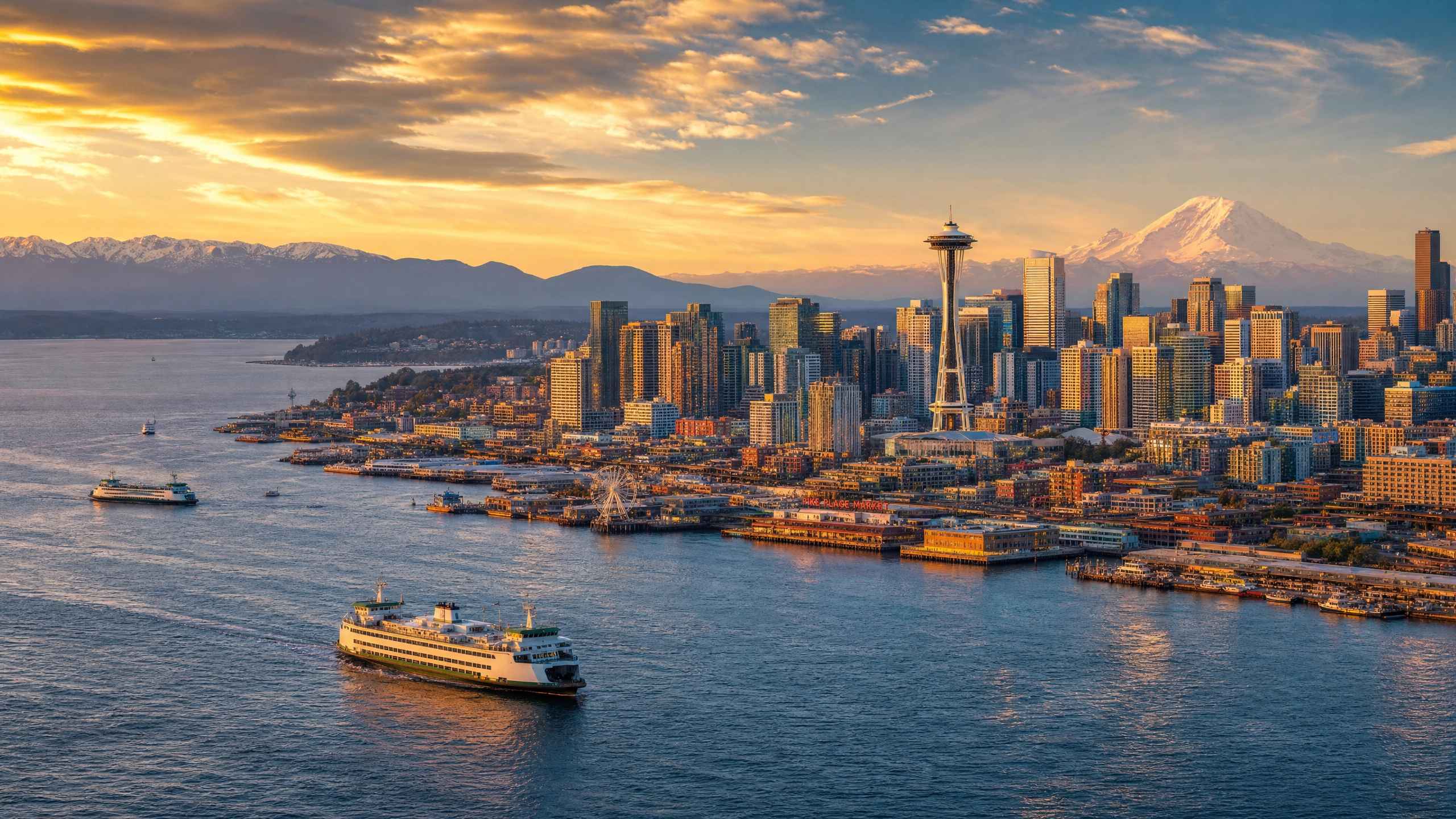
But here is what you don't know about Seattle until you actually go: it is one of the most beautiful cities in the world. Not beautiful in the way of Paris, which is beautiful by design and by centuries of deliberate cultivation. Beautiful in the way of a place that got lucky with its geography and then, over time, figured out how to be worthy of it. Seattle sits between Puget Sound to the west and Lake Washington to the east, with the Olympic Mountains rising beyond the water on one side and the Cascades on the other, and Mount Rainier — a 14,411-foot stratovolcano that dominates the southern horizon on clear days — watching over everything like a benevolent giant. On a clear day in Seattle, the view from almost any elevated point is so extravagant that it seems like the city is showing off.
And then there is everything else: the food scene that has become one of the most exciting in the country, the neighborhoods that reward slow exploration on foot, the music and art and literature that have made Seattle a genuine cultural capital, the outdoor access that puts wilderness within reach of the city center in a way that no other American metropolis can match. Seattle is not what you think it is. It is considerably better.
The City That Invented Itself
Seattle's origin story is one of the great American reinvention narratives. The city was founded in 1851 on a mudflat that was entirely unsuitable for a city — so unsuitable, in fact, that in the 1890s, Seattle's engineers undertook one of the most audacious urban engineering projects in American history, using hydraulic hoses to wash away entire hills and fill in the tideflats, literally reshaping the city's topography to make it work. The original street level of Pioneer Square — Seattle's oldest neighborhood — is now underground, accessible on the famous Underground Tour, a subterranean walk through the city's buried Victorian past.
From those unpromising beginnings, Seattle became a city of successive reinventions. The Klondike Gold Rush of 1897 made it a boomtown overnight — the last major American city before Alaska, the place where prospectors outfitted themselves before heading north. The Boeing Company, founded in Seattle in 1916, made it a manufacturing powerhouse and a center of aerospace innovation. The 1962 World's Fair — the Century 21 Exposition — gave the city the Space Needle and a forward-looking identity that it has never entirely abandoned.
And then, in the 1990s, two things happened simultaneously that changed Seattle's place in the world. Grunge exploded out of the city's club scene and onto the global stage, carried by Nirvana, Pearl Jam, Soundgarden, and Alice in Chains — four bands from the same city in the same era, each of them genuinely great, collectively producing a body of work that defined a decade. And a software company called Microsoft, already headquartered in the suburbs, was joined by a new startup called Amazon, which chose Seattle as its home and proceeded to become one of the most valuable companies in human history.
The result is a city that contains multitudes: grunge mythology and tech-bro wealth, artisanal coffee and billion-dollar campuses, old-growth forest within the city limits and a waterfront that has just completed a billion-dollar renovation. Seattle is a city of contradictions that somehow cohere into something singular and unmistakable.
Pike Place Market: The Soul of the City
Every great city has a place that contains its essence — a single location where the city's character is most concentrated, most legible, most itself. For Seattle, that place is Pike Place Market.
Pike Place is the oldest continuously operating farmers market in the United States, open since 1907, and it is one of the few tourist attractions in any American city that is also genuinely, authentically beloved by the people who live there. This is not a theme park version of a market. It is a working market — a place where farmers from the Skagit Valley and the Yakima Valley bring their produce every morning, where fishmongers have been throwing salmon across the counter for decades (the famous fish throw is real, not staged, and it is genuinely impressive), where flower vendors sell dahlias and tulips and peonies for prices that make you want to buy armfuls of everything.
The market sprawls across multiple levels, and the lower levels — the "Down Under" shops — are where the real exploration begins. This is where you find the original Starbucks (the one with the original logo, the one that tourists photograph and locals roll their eyes at affectionately), the magic shop that has been in the same location since 1937, the comic book stores and vintage poster shops and small galleries that give the market its particular atmosphere of organized chaos.
The food at Pike Place is exceptional and specific to place. Pike Place Chowder serves New England and Manhattan clam chowder that has won national competitions, and the line outside is always worth joining. The Crumpet Shop makes crumpets fresh to order, which sounds modest until you eat one. DeLaurenti Specialty Food and Wine is a European-style deli and wine shop that has been a market institution since 1946, and their prepared foods counter is one of the best lunch options in the city.
The insider's move at Pike Place is to arrive early — before 9 AM, before the tour groups — and walk the main arcade when it belongs mostly to the vendors setting up and the regulars who have been coming here for years. The market at that hour has a quality of light and a quality of quiet that the midday crowds obscure entirely.
The Waterfront Reborn
Seattle's relationship with its waterfront was, for decades, a civic embarrassment. The Alaskan Way Viaduct — a double-decker elevated highway — ran directly along the waterfront, cutting the city off from Puget Sound and blocking the views that should have been the city's greatest asset. In 2019, after years of planning and construction, the viaduct came down. In its place: a 20-acre waterfront park that has become one of the most impressive urban renewal projects in recent American history.
The new waterfront is a revelation. The Overlook Walk connects Pike Place Market to the water with a series of terraced gardens and viewing platforms that frame the Olympic Mountains across the Sound in a way that makes you stop walking and just look. The Seattle Aquarium, recently expanded, sits at the water's edge and houses one of the best Pacific Northwest marine exhibits in the country — the giant Pacific octopus exhibit alone is worth the admission. The Great Wheel, a 175-foot Ferris wheel at the end of Pier 57, offers views of the city skyline and the Sound that are particularly spectacular at sunset.
But the best thing about the new waterfront is simply walking it — the full length, from the ferry terminal at Colman Dock to the Olympic Sculpture Park at the northern end. The Olympic Sculpture Park, a free outdoor museum operated by the Seattle Art Museum, sits on nine acres of reclaimed industrial land and contains major works by Alexander Calder, Richard Serra, Louise Bourgeois, and others, all arranged so that the art and the landscape and the water and the mountains compose themselves into something that feels both curated and inevitable.
Take the Washington State Ferry from Colman Dock to Bainbridge Island — a 35-minute crossing that is one of the great free (or nearly free) urban experiences in America. The view of Seattle's skyline from the water, with Mount Rainier rising behind it on clear days, is the view that defines the city. Bainbridge Island itself is worth a few hours of exploration: a small, walkable downtown with excellent restaurants, galleries, and the Bainbridge Island Museum of Art, which is free and consistently excellent.
The Coffee Culture That Changed the World
Seattle's relationship with coffee is not a marketing construct. It is a genuine cultural phenomenon with roots that go back to the city's position as a Pacific Rim port city — one of the first American cities to have direct access to coffee beans from Asia and the Pacific Islands. The coffee culture that developed here over decades produced Starbucks, yes, but it also produced a counter-reaction to Starbucks that has been far more interesting: a generation of independent roasters and cafés that have pushed the craft of coffee to levels that would have seemed absurd twenty years ago.
Victrola Coffee Roasters, with multiple locations across the city, is the standard against which Seattle's independent coffee scene measures itself — their single-origin offerings and seasonal blends are exceptional, and the Capitol Hill flagship is a beautiful space. Lighthouse Coffee Roasters, a worker-owned cooperative on Capitol Hill, produces some of the most consistently excellent espresso in the city. Caffe Vita, another Seattle institution, has been roasting in the city since 1995 and remains one of the best.
But the coffee experience in Seattle is not just about the coffee itself. It is about the culture around it — the way that coffee shops function as community spaces, as offices, as living rooms for a city that spends a lot of time indoors. The Seattle coffee shop is a specific institution: warm, unhurried, full of people who are clearly regulars, with a particular quality of light on rainy afternoons that makes you want to stay for hours. This is not an accident. It is the city's response to its climate, and it is one of the things that makes Seattle feel like a place where people have figured out how to live well.
Capitol Hill, Ballard, and the Art of the Neighborhood
Seattle's neighborhoods are the city's real treasure, and each one has a personality so distinct that visiting them feels like visiting different cities within the same city.
Capitol Hill is Seattle's most alive neighborhood — dense, walkable, politically engaged, and home to the city's LGBTQ+ community, its best independent music venues, its most interesting restaurants, and a street life that continues well past midnight. The stretch of Pike and Pine streets between Broadway and 15th Avenue is the neighborhood's commercial spine, and walking it on a Friday evening is a master class in urban vitality. Cal Anderson Park, the neighborhood's green heart, hosts everything from pickup soccer games to political demonstrations to summer concerts, and it is one of the most genuinely public spaces in the city.
Ballard, in the city's northwest, was a Scandinavian fishing village before it was absorbed into Seattle, and traces of that identity persist in the neighborhood's character — a certain directness, a love of the water, a commitment to doing things properly. The Ballard Locks, where Lake Washington Ship Canal meets Puget Sound, are one of the city's most fascinating free attractions: you can watch boats of every size navigate the locks while salmon make their way up the fish ladder below. The Ballard Sunday Farmers Market runs year-round and is one of the best in the Pacific Northwest. And the restaurant scene here — anchored by places like The Walrus and the Carpenter, the legendary oyster bar that has been turning people into oyster converts since 2010 — is exceptional.
Fremont calls itself "the Center of the Universe" with a self-awareness that is either deeply ironic or completely sincere, and the neighborhood's character makes it impossible to tell which. The Fremont Troll — a massive concrete sculpture of a troll clutching a Volkswagen Beetle under the Aurora Bridge — is one of Seattle's most beloved public art works. The neighborhood's Sunday market, its independent bookshops, its breweries and coffee shops and the general sense that everyone here has made a deliberate choice to live this way — all of it adds up to one of the most charming urban neighborhoods in the Pacific Northwest.
The Music That Defined a Generation
You cannot visit Seattle without acknowledging the grunge mythology, and you should not try. The music that came out of this city in the late 1980s and early 1990s was not a trend or a marketing category. It was a genuine artistic movement — a response to the slick, overproduced pop of the preceding decade, a return to rawness and emotional honesty, a sound that emerged from the specific conditions of a rainy, isolated, working-class city on the edge of the continent.
The Museum of Pop Culture (MoPOP), designed by Frank Gehry in a building that looks like a guitar that has been melted and reassembled by a fever dream, is the city's monument to that legacy. The permanent Nirvana exhibit — featuring Kurt Cobain's guitars, handwritten lyrics, and personal artifacts — is one of the most moving music exhibits in any museum anywhere. The broader collection, which covers the history of rock and roll, science fiction, horror, and hip-hop with equal seriousness, is consistently excellent.
For those who want to experience the geography of grunge rather than just its artifacts, the places are still there. The Central Tavern in Pioneer Square, where Nirvana and Pearl Jam played early shows. The Vogue, where the scene coalesced in the mid-1980s. Kurt Cobain Hill in Viretta Park near Denny Blaine, an unofficial memorial where fans still leave flowers and notes and guitar picks. These are not tourist attractions in the conventional sense. They are places of genuine pilgrimage for people who understand what this music meant and still means.
Mount Rainier: The Mountain That Watches Over Everything
Sixty miles southeast of Seattle, Mount Rainier rises to 14,411 feet above sea level — the most glaciated peak in the contiguous United States, a stratovolcano that last erupted in the 1890s and that volcanologists monitor with the careful attention you give to something that is dormant but not dead. On clear days, Rainier is visible from Seattle as a white pyramid on the southern horizon, so large and so close that it seems impossible that it is sixty miles away. Locals have a term for it: "the mountain is out," they say, as if it has been hiding and has chosen today to reveal itself.
The drive to Mount Rainier National Park takes about 90 minutes from Seattle, and the park itself is one of the most spectacular in the National Park system. Paradise — the visitor center at 5,400 feet elevation — is surrounded by wildflower meadows in summer that are among the most beautiful in North America, a carpet of lupine and paintbrush and avalanche lily that blooms for a few weeks each July and August and draws visitors from around the world. The Skyline Trail from Paradise offers a 5.5-mile loop with views of the Nisqually Glacier and, on clear days, the summit of Rainier itself.
For a deeper dive into planning a day trip to the mountain, our Mount Rainier Adventure: 3-Day Wildflower & Glacier Itinerary from Seattle guide covers the best trails, the optimal time of year, and the logistics of making the most of a single day at one of America's great natural wonders.
The Food Scene That Deserves More Credit
Seattle's food scene is built on an extraordinary natural pantry. The Pacific Northwest produces some of the best seafood in the world — Dungeness crab, Pacific oysters, wild salmon, geoduck, halibut, spot prawns — and Seattle's restaurants treat this abundance with the seriousness it deserves. The oyster culture here is particularly exceptional: the cold, clean waters of Puget Sound and Hood Canal produce oysters of such quality and variety that Seattle has become one of the great oyster cities in the world, on par with New Orleans and Paris.
The Walrus and the Carpenter in Ballard is the city's most celebrated oyster bar, a small, perpetually crowded space where the oyster selection changes daily based on what's available from the farms of Puget Sound and the Pacific Coast. Taylor Shellfish Farms, which operates several oyster bars around the city, offers a more casual experience with the same exceptional product. Both are essential.
Beyond seafood, Seattle's restaurant scene has developed a sophistication that reflects the city's position at the intersection of Pacific Rim culinary traditions and Pacific Northwest ingredients. The Japanese influence is particularly strong — Seattle has one of the oldest and most established Japanese-American communities in the country, and the result is a Japanese food scene of exceptional quality. Nishino, in the Madison Valley neighborhood, has been serving some of the best Japanese cuisine in the Pacific Northwest for decades. Japonessa, in the Pike Place Market area, brings a modern, fusion sensibility to Japanese flavors that works better than it has any right to.
The Ethiopian community in Seattle has produced a restaurant scene that is, by any measure, one of the best in the country outside of Washington, D.C. The stretch of Rainier Avenue South known as "Little Ethiopia" is worth a dedicated visit — the injera and the stews and the coffee ceremony at restaurants like Jebena Café and Habesha are experiences that stay with you.
Planning Your Seattle Trip: Every Angle Covered
Seattle's guide library at Ask Leif covers every kind of traveler and every kind of trip:
For food lovers, the Seattle Foodie Adventure: 4-Day Culinary Guide for Food Lovers is the definitive itinerary — four days built around Pike Place Market, the city's best oyster bars, the coffee culture, the neighborhood restaurants, and the farmers markets that supply them all.
For outdoor enthusiasts, the Seattle Outdoor Adventure: 4-Day Guide covers everything from kayaking on Lake Union to hiking in the Cascades, with a Mount Rainier day trip built in. Seattle's access to wilderness is genuinely extraordinary, and this guide makes the most of it.
For couples, Seattle for Two: A 3-Day Romantic Escape to the Emerald City is built around the city's most memorable experiences for two — sunset ferry rides, intimate oyster bars, the Olympic Sculpture Park at golden hour, and the neighborhoods that reward slow, unhurried exploration.
For families, the Seattle Family Vacation: 5-Day Guide with Kids covers the Seattle Aquarium, the Museum of Pop Culture, the Pacific Science Center, the ferry to Bainbridge Island, and the Pike Place Market fish throw — everything that makes Seattle one of the best family destinations in the Pacific Northwest.
Traveling on a budget? Seattle is more accessible than its reputation suggests. The Seattle on a Shoestring: 4-Day Budget Travel Guide Under $75/Day proves that the city's best experiences — the waterfront, the neighborhoods, the farmers markets, the parks, the free museums — are available to travelers who are watching their spending.
And for those who want the full cultural immersion — the coffee, the music history, the art scene, the neighborhoods — the Seattle 5-Day Itinerary: Coffee, Culture & PNW Nature is the comprehensive guide to experiencing Seattle as a city rather than a collection of attractions.
When to Go (And the Truth About the Rain)
Let's address the rain directly, because it is both real and misunderstood. Seattle does not get a lot of rain by total annual precipitation — it receives less rainfall per year than New York City, Houston, or Miami. What Seattle gets is a lot of rainy days: gray, overcast, drizzly days that accumulate from October through May and give the city its reputation for perpetual dampness. The rain is rarely dramatic. It is more of a persistent mist, a softening of the light, a quality of atmosphere that the city has learned to embrace rather than resist.
The best time to visit Seattle is July through September, when the city experiences what locals call "the Seattle summer" — a stretch of warm, clear, genuinely beautiful weather that arrives late (often not until mid-July) but lingers through October. Summer in Seattle is exceptional: temperatures in the low-to-mid 70s, long evenings that stay light until 9 PM, the mountains visible and snow-capped against blue skies, the waterfront alive with activity, every patio in the city full.
The shoulder seasons — May/June and September/October — offer the city at its most local: fewer tourists, lower prices, and the particular pleasure of experiencing a place as it actually is rather than as it presents itself for visitors. October in Seattle is especially beautiful — the fall colors in the city's parks and neighborhoods, the return of the rain as a gentle backdrop, the sense that the city is settling back into itself after the summer performance.
The Feeling You Leave With
Seattle does something to people. It gets under your skin in a way that is hard to explain to someone who hasn't been there. Part of it is the beauty — the mountains and the water and the light on overcast days that is somehow both gray and luminous. Part of it is the culture — the music and the coffee and the food and the sense that this is a city where people take things seriously, where craft matters, where the question "but is it good?" is asked constantly and sincerely.
But mostly it is the feeling of a city that has figured out how to be itself. Seattle has been through gold rushes and aerospace booms and grunge explosions and tech revolutions, and through all of it, it has maintained a character that is recognizably, stubbornly its own. It is a city that is proud of its rain, proud of its coffee, proud of its music, proud of its mountains, proud of the fact that it is not Los Angeles or New York or anywhere else. It is Seattle, and it is enough.
You will leave wanting to come back. Almost everyone does.
Ready to plan your Seattle adventure? Build your personalized itinerary at askleif.com — tailored to your travel style, budget, and dates in under 60 seconds.