Reykjavik Made Björk, Sigur Rós, and More Authors Per Capita Than Anywhere on Earth. The Darkness Did It.
Destination: Reykjavik
Category: Destination
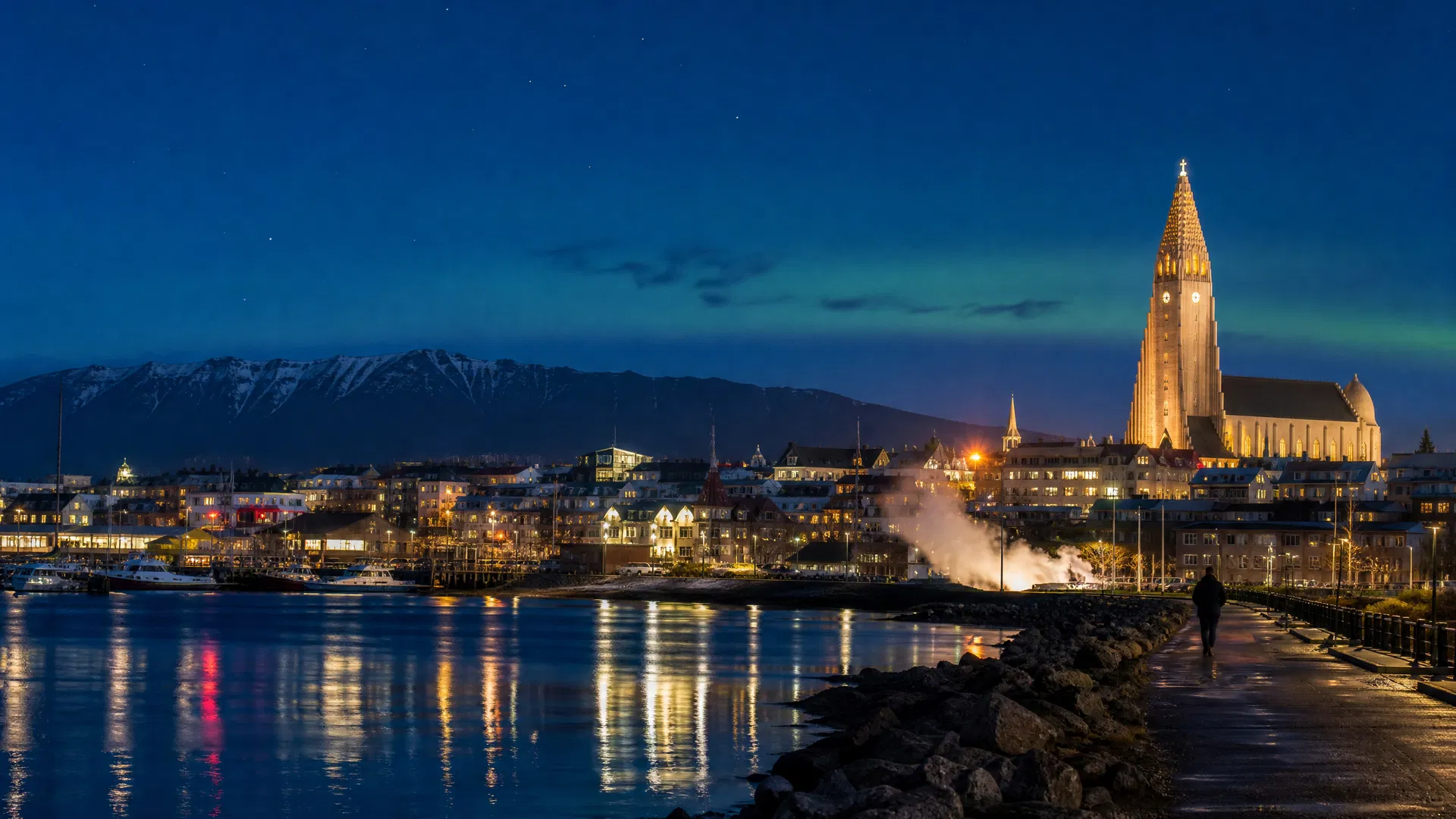
title: "Reykjavik Made Björk, Sigur Rós, and More Authors Per Capita Than Anywhere on Earth. The Darkness Did It." slug: reykjavik-iceland-darkness-creativity-travel-guide excerpt: "Reykjavik is a city of 130,000 people that produced Björk, Sigur Rós, and more published authors per capita than anywhere on Earth. The darkness made them do it — and understanding that changes everything." coverImageAlt: "Reykjavik harbor at dusk with Hallgrímskirkja church illuminated against a sky shifting from deep blue to aurora green, the city's colored rooftops reflected in the still harbor water"
There is a moment, usually around 11pm in late June, when you are standing somewhere in Reykjavik — on the harbor, or on a hill above Laugavegur, or just outside a bar that has no reason to be closing — and the sky does something that your brain refuses to process. The sun is still up. Not setting. Not rising. Just there, low on the horizon, painting everything in a color that doesn't have a name in English. The Icelandic word is kvöldroði — evening redness — but it lasts for hours, and it isn't really evening, and it isn't really red.
Your circadian rhythm gives up. Your sense of time dissolves. And then, if you're paying attention, you feel something else: the city is completely awake. Not in a Vegas way, not in a New York way. In a way that suggests the people who live here have a different relationship with time than anyone else you've ever met. They do. They've had to.
Reykjavik is the capital of a country that spends four months of the year in near-total darkness. In December, the sun rises at 11:30am and sets at 3:30pm. For centuries, before electricity, before central heating, before the geothermal infrastructure that now heats 90% of the city's homes, Icelanders spent those four months in baðstofur — communal sleeping rooms where entire farms would gather under the same roof, sharing body heat and stories. The stories were the sagas. The sagas are the reason Reykjavik is the first non-English-speaking UNESCO City of Literature. The darkness made them do it.
This is the thesis of Reykjavik, and it explains everything: why a city of 130,000 people produced Björk, Sigur Rós, and Of Monsters and Men. Why it has more published authors per capita than any city on Earth. Why its geothermal pools are UNESCO Intangible Cultural Heritage. Why, in 2008, when the entire banking system collapsed overnight, citizens didn't riot — they banged pots and pans outside parliament until the government resigned. The darkness is not the obstacle. The darkness is the engine.
The Skammdegi That Built a Culture
The Icelandic word for the short-day period is skammdegi. It runs roughly from November through January, and at its peak, Reykjavik receives about four hours of usable daylight. The sun never gets high enough to clear the horizon properly — it skims along the edge of the sky, casting long shadows even at noon, and then disappears.
Every other culture in the northern latitudes treats this as something to survive. Icelanders treat it as something to use.
The sagas — the medieval prose narratives that are the foundation of Icelandic literary culture — were composed and transmitted during skammdegi. Families gathered in the baðstofa, the communal sleeping room that served as kitchen, workshop, and living space, and someone read aloud while others spun wool or carved wood. The sagas are not simple stories. They are psychologically complex, morally ambiguous, and structurally sophisticated — the product of a culture that had nothing to do for four months except think and tell stories.
That tradition didn't end with electricity. It transformed. The baðstofa became the living room. The oral tradition became a publishing industry. Iceland today publishes more books per capita than any country on Earth — a phenomenon so well-known that it has its own name: bókaflóð, the book flood. Every November, publishers release the majority of their annual titles in a concentrated rush. On Christmas Eve, Icelanders give each other books and spend the night reading. The tradition is called Jólabókaflóð — the Christmas Book Flood — and it is not a marketing campaign. It is a cultural practice that predates modern publishing, rooted in the same skammdegi logic that produced the sagas: when the darkness comes, you go inward, and you make something.
Reykjavik's UNESCO City of Literature designation — the first ever awarded to a non-English-speaking city — is the formal recognition of this. But the designation understates the reality. This is not a city that has a literary culture the way Paris has a literary culture, meaning a café tradition and a handful of famous addresses. This is a city where the act of reading and writing is woven into the social fabric at the level of infrastructure. The city library stays open late in November. Bookstores are as common as coffee shops. And the authors per capita statistic — more published writers per person than anywhere else on Earth — is not a quirk. It is the logical outcome of a culture that has been going inward every winter for a thousand years.
The Pool Is Not a Spa. It Is a Parliament.
Every city has a third space — the place that isn't home and isn't work, where the social contract gets negotiated in real time. In Britain, it's the pub. In Finland, it's the sauna. In Reykjavik, it's the sundlaug.
The geothermal swimming pool is not a tourist attraction. It is infrastructure. There are 17 of them in the Reykjavik capital area alone, heated by the same volcanic energy that powers the city's homes, and they are open every day of the year, including Christmas, including the days when the temperature drops to -11°C and the puddles freeze solid. At Vesturbaejarlaug on Hofsvallagata, locals arrive at 7am to do jumping jacks on the frozen deck before climbing into the hot tub. "That's why we show up so early," one regular told the New York Times. "We're all by ourselves."
The pools were built a century ago for a practical reason: too many Icelandic fishermen were drowning within sight of the shore because no one could swim. The government went on a construction spree, building pools in every town and village, and made swimming lessons mandatory for all children. The pools solved the drowning problem. Then they became something else entirely.
In 2025, UNESCO inscribed Iceland's swimming pool culture on its Representative List of Intangible Cultural Heritage of Humanity. The nomination document uses a phrase that deserves to be read twice: the hot tubs, it says, have become "informal debating parlours." This is not metaphor. In a country where the president is listed in the phone book by first name, where the prime minister takes the bus, where the concept of social hierarchy is treated with active suspicion, the hot tub is where the hierarchy dissolves completely. You cannot tell, in a heitur pottur with eight other people in swimsuits, who is a banker and who is a fisherman. That is the point.
The social rules of the pool are strict and non-negotiable. Before entering, you shower — fully, thoroughly, naked, without exception. Many locker rooms display a body diagram in case anyone needs a reminder. The pools are only lightly chlorinated, which means the shower is not optional hygiene theater; it is the price of admission to the community. Tourists who skip it are corrected, sometimes gently, sometimes not. The shower is the first test of whether you are a participant or a spectator.
The contrast with the Blue Lagoon — Iceland's most famous geothermal experience — is instructive. The Blue Lagoon costs approximately $150 for a basic ticket. The sundlaug costs $10, or $300 for an annual pass. The Blue Lagoon has a swim-up bar, silica mud masks, and an Instagram-optimized aesthetic. The sundlaug has no phones on the deck, no cocktails, and a mandatory naked shower. The Blue Lagoon is what Iceland sells to tourists. The sundlaug is what Iceland is.
Sundhöll Reykjavíkur, on Barónsstígur, is the oldest pool in the city — built in 1937, Art Deco interior, in the heart of the city. It is where tourists and locals mix most, which means it is also where the tension between the two is most visible. Vesturbaejarlaug, on Hofsvallagata, is where the locals go when they want to be left alone. Laugardalslaug, the largest in the city, is where families go on weekday evenings, where teenagers flirt in the hot tubs after homework, where the social life of the city plays out at a scale that no bar or restaurant can match.
Go to the pool. Shower first. Get in the hot tub. Say nothing for a while. Then say something. That is how Reykjavik works.
If you want to build your Reykjavik days around the pool culture rather than the tourist checklist, Leif's 3-day Reykjavik itinerary is structured exactly that way — the pools, the food halls, the harbor walk, the Settlement Exhibition, in a sequence that makes sense.
The Square Where a Government Fell
Austurvöllur is a small public square in the center of Reykjavik, surrounded by the parliament building, a cathedral, and a statue of Jón Sigurðsson, the leader of Iceland's independence movement. Tourists walk through it every day on the way to Hallgrímskirkja. Most of them don't stop.
They should stop.
In October 2008, Iceland's three major banks collapsed within a week of each other. The total debt was approximately ten times the country's GDP — the largest banking collapse relative to the size of an economy in history. Overnight, the Icelandic krona lost half its value. Savings evaporated. Mortgages doubled. The country was, in any conventional economic sense, finished.
What happened next is the part that doesn't appear in most travel guides. Citizens began gathering at Austurvöllur Square, initially in small groups, then in hundreds, then in thousands. They brought pots and pans. They banged them. They kept coming back, every day, in the dark, in the cold, until the noise outside the parliament windows was impossible to ignore. The government resigned. New elections were called. Iceland prosecuted the bankers responsible — something that almost no other country affected by the 2008 financial crisis managed to do. The prime minister was eventually charged with negligence. The country recovered, faster than anyone predicted, by letting the banks fail rather than bailing them out.
The Pots and Pans Revolution, as it came to be known, is studied in political science departments around the world as a model of democratic accountability. The square where it happened looks ordinary. It has a fountain and some benches and a lawn that gets muddy in the rain. But it is the same square where, for weeks in the winter of 2008 and 2009, ordinary people decided that the social contract had been broken and that the only appropriate response was to stand outside in the dark and make noise until someone listened.
That is Reykjavik. The surface is unremarkable. The depth is not.
The City That Reads Itself to Sleep
Reykjavik became a UNESCO City of Literature in 2011 — the fifth city in the world to receive the designation, and the first that does not have English as its native language. The other four were Edinburgh, Melbourne, Iowa City, and Dublin. Reykjavik, with a population smaller than any of them, was chosen because of what it produces: more published authors per capita than any city on Earth, a publishing industry that releases a significant portion of its annual output in a single month, and a cultural relationship with books that is not aspirational but habitual.
The Jólabókaflóð — the Christmas Book Flood — is the most visible expression of this. In November, Icelandic publishers release their new titles in a concentrated rush. Bookstores fill up. Families compile wish lists. On Christmas Eve, books are exchanged, and then people spend the night reading. The tradition is old enough that no one is entirely sure when it started — it predates modern publishing, rooted in the same skammdegi logic that produced the sagas. The darkness comes, you go inward, you read.
The Reykjavik City Library system is unusually well-funded and unusually well-used. The main branch, Borgarbókasafnið, stays open late in the winter months. There are reading rooms that fill up on dark afternoons with people who are not students and not researchers — just people who came to read because the library is warm and quiet and the book they wanted was there.
The literary culture is not confined to the library. The Reykjavik International Literary Festival, held in the spring, draws writers from around the world and is taken seriously in a way that most literary festivals in larger cities are not. The Icelandic Sagas are not historical curiosities — they are actively read, discussed, and argued about. The Settlement Exhibition, in the center of the city, is built around an actual Viking-age longhouse excavated beneath the streets, and the interpretive material engages seriously with the sagas as historical documents, not just literature.
This is a city that takes its own story seriously. That is rarer than it sounds.
The Music That Came From the Dark
In 1977, a girl named Björk Guðmundsdóttir released her first album. She was eleven years old. She had been playing flute since she was five, had been accepted to the Reykjavik School of Music at six, and had recorded the album — a collection of Icelandic folk songs and covers — after a music teacher sent a tape of her singing to a radio station and the station played it. She was, by any measure, a prodigy. But she was also a product of a city that treats music the way other cities treat sport: as something everyone does, from childhood, seriously.
Reykjavik's per-capita output of internationally recognized musicians is statistically extraordinary. Björk is the most famous, but the list includes Sigur Rós — whose album Ágætis byrjun (1999) is considered one of the most important records of its decade — and Of Monsters and Men, whose debut album went platinum in multiple countries. For a city of 130,000 people, this is not a coincidence. It is the product of a cultural infrastructure that takes music seriously at every level: mandatory music education, a network of rehearsal spaces, a festival culture (Iceland Airwaves has been running since 1999) that gives emerging artists real audiences, and a social environment in which being a musician is not a career risk but a reasonable life choice.
The darkness plays a role here too, though it is harder to quantify. Sigur Rós's music — the glacial tempos, the invented language (Vonlenska, or "Hopelandic"), the sense of vast space and slow time — sounds like what it feels like to be in Iceland in November. Björk's work, across its many phases, returns repeatedly to themes of nature, transformation, and the relationship between the human and the geological. These are not aesthetic choices made in a vacuum. They are the product of a landscape that imposes itself on everyone who lives in it, and a cultural tradition that has always responded to that imposition by making something.
Iceland Airwaves, held every November in Reykjavik, is worth planning a trip around. It runs across the city's venues — from concert halls to record shops to swimming pools — and features a mix of international headliners and Icelandic artists who are, reliably, more interesting than the headliners. The November timing is not accidental. It is the beginning of skammdegi. The festival is the city's annual argument that the darkness is not something to endure but something to fill.
Leif's 4-day Reykjavik adventure guide is timed to work with the November festival season — glacier walks and Golden Circle in the days, Airwaves in the evenings.
How to Eat Like Someone Who Lives Here
The most important meal in Reykjavik costs about $5 and is served from a red-and-white stand near the harbor on Tryggvagata. Bæjarins Beztu Pylsur — "the best hot dogs in town" — has been operating since 1937, which makes it exactly as old as Sundhöll Reykjavíkur and the geothermal pool system, a coincidence that feels meaningful. The hot dog is made with lamb, not beef, which gives it a flavor that is distinctly Icelandic — slightly gamey, slightly sweet, with a snap to the casing that suggests it was made by people who take hot dogs seriously.
The correct order is "eina með öllu" — one with everything — which gets you mustard, ketchup, remoulade, raw onion, and crispy fried onion. Bill Clinton, who visited in 2004, ordered "one with mustard only," which Icelanders have been gently mocking ever since. The queue is always there. Go at midnight in June, when the sun is still up and the harbor is golden, and you will be standing in line with locals who have been going to this stand their entire lives. That is the correct context for the hot dog.
For something more substantial, Hlemmur Mathöll — the old bus terminal on Laugavegur, converted into a food hall — is where the city's food culture is most concentrated. The Arctic char is the thing to order: Iceland's native fish, caught in cold freshwater rivers and lakes, with a flavor somewhere between salmon and trout but cleaner than either. The lamb soup (kjötsúpa) is the other essential — a thick broth with root vegetables and tender lamb that has been cooking for hours, the kind of food that makes sense in a country where the wind comes off a glacier.
Kolaportið, the flea market on Geirsgata near the harbor, is open only on weekends from 11am to 5pm. It sells vintage Icelandic wool sweaters (lopapeysa), used books in Icelandic, and food that is not for the faint-hearted: hákarl (fermented Greenlandic shark, which smells powerfully of ammonia and tastes, to the initiated, like very strong blue cheese) and harðfiskur (dried fish, usually cod or haddock, eaten like chips with butter). Both are acquired tastes. Both are worth acquiring, because they are the food that kept Icelanders alive through centuries of skammdegi, and eating them in a cold warehouse on a Saturday morning is a more honest introduction to Iceland than any geothermal spa.
The Grandi district, the old harbor area west of the city center, has become Reykjavik's most interesting food and culture neighborhood over the past decade. The Marshall House, a former fish processing plant, now contains three galleries and a restaurant. Grandi Mathöll, the food hall on Grandagarður, is newer and more tourist-oriented than Hlemmur but has better fish and chips. The neighborhood still has the bones of its industrial past — the cranes, the warehouses, the smell of the sea — and the contrast between that history and the galleries and coffee shops that have moved in is the most visible sign of what Reykjavik has been doing to itself since the 2008 collapse: rebuilding, deliberately, on its own terms.
The Grandi Shift
The 2008 financial crisis did not just change Iceland's politics. It changed its geography. Before the collapse, Reykjavik's development had been moving outward — new suburbs, new shopping centers, the kind of sprawl that comes with a boom economy. After the collapse, the city turned inward and backward, toward the harbor, toward the old industrial areas that had been neglected during the boom years.
Grandi is the most visible result. The old harbor district, which had been a working fishing port and fish processing area for most of the twentieth century, began attracting artists, designers, and food producers in the years after 2008. The rents were low. The spaces were large. The bones were good. The Marshall House opened in 2016. The Whales of Iceland exhibition — life-size models of all 23 whale species found in Icelandic waters — opened in 2014 in a former fish factory. The Saga Museum moved to the harbor. Grandi Mathöll opened in 2017.
The neighborhood is not finished. There are still working fishing boats at the docks, still the smell of salt and diesel, still warehouses that haven't been converted yet. That incompleteness is part of what makes it interesting. Reykjavik is a city that is still in the process of deciding what it wants to be, and Grandi is where that process is most visible.
The walk from Laugavegur to Grandi takes about twenty minutes along the harbor. Do it in the evening, when the light is low and the mountains across the bay are catching the last of the sun. The Esja, the flat-topped mountain that dominates the view north of the city, turns pink in the evening light. The harbor is quiet. The city feels, for a moment, like a village — which is what it is, really, underneath everything else.
When to Go, and What the Season Does to You
There is no wrong time to visit Reykjavik, but there is a right reason for each season, and they are very different experiences.
Summer (June–August) is the midnight sun. The sun does not set. Children play football at midnight. Bars stay open because there is no signal to close. The energy is feverish and slightly unreal — the city runs on a different clock, and visitors either adapt or spend a week slightly jet-lagged in a place that has no jet lag. The Golden Circle day trips (Þingvellir, Geysir, Gullfoss) are at their most accessible. Whale watching from the harbor is reliable. The hiking is extraordinary. Accommodation prices are at their peak, and the city is at its most crowded.
Winter (November–February) is skammdegi, the Northern Lights, and the city at its most itself. The darkness is real — four hours of usable daylight at the solstice — but the city responds to it with light and warmth rather than retreat. The pools are at their best: steam rising from the hot tubs in the dark, the Northern Lights occasionally visible overhead. The Christmas Book Flood is in November. Iceland Airwaves is in November. The city is less crowded, accommodation is cheaper, and the experience is more intimate. The Northern Lights require clear skies and darkness, which means leaving the city center — but the city's tour operators run nightly aurora hunts, and the success rate in a good winter is high.
Shoulder seasons (March–May, September–October) offer the best of both: reasonable prices, manageable crowds, and the dramatic light of the transition seasons. The midnight sun begins in late May; the Northern Lights season begins in late August. September is arguably the best month: the summer tourists have gone, the winter darkness hasn't fully arrived, and the landscape is in its autumn colors.
If Reykjavik is the start of a longer trip, the 7-day Iceland nature guide covers the South Coast, Snæfellsnes, and the Westfjords from the city as a base. For the full Ring Road, the 7-day Ring Road guide is the fast version; the 12-day Ring Road with Westfjords is the one that lets you stop.
Budget reality: Iceland is expensive. A meal at a mid-range restaurant costs $30–50 per person. The sundlaug costs $10. The hot dog costs $5. Accommodation in Reykjavik runs $150–250 per night for a decent hotel in high season. The Golden Circle tour costs $60–80. Budget accordingly, and don't let the cost deter you — this is one of the few places on Earth where the expense is genuinely justified by what you get.
Planning Your Reykjavik Trip with Leif
Reykjavik rewards depth over breadth. The city itself is small enough to walk in a day, but the experiences that matter — the pools, the food culture, the music scene, the day trips — require time to do properly. Three days is the minimum for a meaningful visit; four or five is better.
All five Leif guides for Iceland are linked in context above — the 3-day city guide, the 4-day adventure guide, the 7-day nature guide, the 7-day Ring Road, and the 12-day Ring Road with Westfjords. Use Leif to sequence them into a trip that matches how long you have and what kind of traveler you are.
One practical note: book accommodation in Reykjavik at least two to three months in advance for summer travel. The city's hotel capacity has grown significantly since 2008, but demand has grown faster. The same applies to the Blue Lagoon, which requires advance booking regardless of season.
The Light Returns
In late January, something happens in Reykjavik that is not on any tourist itinerary. The sun, which has been skimming the horizon for months, rises just slightly higher than it did the day before. The change is imperceptible to anyone who hasn't been watching. But Icelanders notice. There is a word for the first day when you can feel the light returning: vorið er að koma — spring is coming. It is said with the same relief and anticipation that people in other climates reserve for the first warm day after a hard winter, except that in Iceland, the relief is more earned.
The darkness made everything. The sagas, the music, the books, the pool culture, the democratic instinct that filled Austurvöllur Square in 2008 — all of it is the product of a culture that has been going inward every winter for a thousand years and coming out with something to show for it. The midnight sun is extraordinary. The Northern Lights are extraordinary. But the thing that will stay with you, if you pay attention, is the quality of the light when it finally comes back: low and golden and lasting, the sky doing something that doesn't have a name in English.
The city earned that light. So will you.
Reykjavik is a city that rewards the traveler who slows down. Use Leif to build an itinerary that matches your pace — whether that's three days in the city or three weeks on the Ring Road.