Peru Didn't Prepare Me for Machu Picchu. Nothing Could.
Destination: Peru
Category: destination-guide
Lima: The City That Earns Its Own Trip
Most travelers treat Lima as a layover. They land, sleep, and catch the morning flight to Cusco. This is one of the great miscalculations in modern travel. Lima is, by any serious culinary measure, one of the most exciting food cities on the planet. Central, the restaurant run by chef Virgilio Martínez, has held the title of best restaurant in Latin America and ranked second in the world. Maido, which fuses Japanese and Peruvian traditions into something called Nikkei cuisine, is regularly in the global top ten. These are not restaurants you stumble into — they require reservations made weeks or months in advance — but they represent the tip of an iceberg that goes all the way down to the cevicherías on the street corners of Miraflores, where a plate of fresh ceviche with leche de tigre costs less than a cup of airport coffee.
The neighborhood of Barranco is Lima's bohemian soul — a coastal district of painted colonial houses, street art that rivals anything in Berlin or São Paulo, and bars that stay open until the Pacific fog rolls in at dawn. The Puente de los Suspiros, the Bridge of Sighs, is a wooden footbridge over a ravine that has been a meeting point for lovers and poets since the 19th century. Wander it at dusk, then follow the stairs down to the waterfront and watch the paragliders launching off the cliffs of Miraflores in the last light of the day. This is a city that rewards slowness.
Spend at least two nights in Lima. Eat ceviche for breakfast — yes, breakfast, the way locals do, because the fish is freshest in the morning. Drink a pisco sour at the Gran Hotel Bolívar, where the recipe has not changed since 1924. Walk the Malecón de la Reserva at sunset and watch the city stretch south along the Pacific coast. Then, and only then, fly to Cusco.
If you're looking to build your Lima itinerary in detail, our Romantic Lima Getaway: A 3-Day Couples Itinerary for Foodies & Explorers and Lima Foodie's Dream: 4-Day Culinary Journey Through Peru's Capital go deep on the neighborhoods, restaurants, and experiences that make the city worth its own trip.
The Altitude Is Real, and It Will Humble You
Cusco sits at 11,154 feet above sea level. That is higher than any point in the continental United States outside of Colorado's highest peaks. The air contains roughly 40% less oxygen than at sea level. Your body, regardless of how fit you are, will notice. The headache usually arrives within hours of landing. The shortness of breath comes when you climb a flight of stairs. Some people feel nauseous. Some feel nothing at all. There is no reliable way to predict how altitude sickness will affect you, and there is no shame in being leveled by it.
The single most important piece of advice for any Peru trip: do not fly directly from sea level to Cusco if you can avoid it. Lima sits at 154 feet above sea level. The Sacred Valley, which lies between Cusco and Machu Picchu, sits at roughly 9,400 feet — high enough to begin acclimatization, low enough to spare you the worst of the symptoms. The ideal itinerary builds altitude gradually: Lima, then the Sacred Valley for a night or two, then Cusco, then Machu Picchu. Each step up the ladder gives your body time to produce more red blood cells and adapt.
In Cusco, drink coca tea. It is everywhere, it is free in most hotels, and it genuinely helps — not because of any psychoactive effect (the amount of coca alkaloid in a cup of tea is negligible), but because it is a mild stimulant that helps with the fatigue and headache. Eat lightly on your first day. Avoid alcohol for the first 24 hours. Walk slowly. Sleep as much as you can. The city will still be there tomorrow, and you will enjoy it infinitely more when your head stops pounding.
Acetazolamide (Diamox) is the pharmaceutical option — a prescription diuretic that accelerates acclimatization. Many travelers swear by it. Consult your doctor before departure if you are concerned, particularly if you have a history of altitude sensitivity.
Cusco: The Navel of the World
The Inca called their capital Qusqu — "navel of the world" — and standing in the Plaza de Armas at dusk, surrounded by baroque colonial churches built on top of Inca foundations, you understand why. The Spanish conquistadors who arrived in the 16th century did not destroy Cusco so much as layer themselves on top of it. The Cathedral of Santo Domingo was built directly over the Qorikancha, the most sacred temple in the Inca Empire, whose walls were once lined with 700 solid gold panels. The Inca stonework that forms the base of half the buildings in the city is so precisely engineered that it has survived earthquakes that leveled the Spanish construction above it.
Spend a full day in Cusco before you do anything else. Walk the San Blas neighborhood, a maze of cobblestone alleys above the Plaza de Armas where artisans have worked in the same workshops for generations. Visit the Qorikancha and let the juxtaposition of Inca and Spanish architecture tell you everything you need to know about the violence and beauty of this city's history. Eat at a chicharronería — a restaurant specializing in fried pork — for lunch, because you are in the Andes and this is what you do. Drink chicha morada, the purple corn drink that has been made in Peru for thousands of years.
The market at San Pedro is not a tourist market. It is where Cusco feeds itself — stalls of fresh produce, dried herbs, whole roasted guinea pig (cuy, a delicacy here, not a pet), and women in traditional dress selling everything from quinoa to pig's feet. Walk through it with your eyes open and your phone in your pocket.
Our Cusco for Couples: A Romantic 3-Day Peruvian Escape and Cusco in 3 Days: The Essential General Traveler's Guide cover the city in the depth it deserves, including the best restaurants, the neighborhoods worth exploring, and how to structure your days around the altitude adjustment.
The Sacred Valley: Peru's Best-Kept Secret
Between Cusco and Machu Picchu lies a valley that the Inca considered so sacred they built their most important agricultural and ceremonial sites along its length. The Urubamba River runs through it. The mountains rise on either side. And the towns that dot the valley — Pisac, Ollantaytambo, Chinchero — contain ruins, markets, and living communities that most travelers rush past on their way to the main event.
Do not rush past them.
Pisac is a market town with Inca ruins above it that most visitors never climb to — the terraces and temples up on the ridge are some of the finest examples of Inca engineering in the entire country, and on a weekday morning you may have them almost entirely to yourself. The Sunday market in the town below is one of the most vibrant in the Andes, but go early before the tour buses arrive.
Ollantaytambo is where the Sacred Valley ends and the train to Machu Picchu begins, but it deserves more than a transit stop. The fortress here is the only Inca site in Peru where the Incas actually defeated the Spanish in battle — in 1536, Manco Inca routed a Spanish force from these very terraces. The town itself is one of the few places in Peru where the original Inca urban grid is still inhabited, the same water channels still running through the streets that ran through them 500 years ago.
Moray and the Maras salt mines are the Sacred Valley's most underrated detour. Moray is a series of circular agricultural terraces that descend into the earth like an amphitheater — the Incas used the temperature differential between the top and bottom terraces (up to 27°F) to experiment with growing crops at different altitudes, essentially creating the world's first agricultural research station. The Maras salt mines, a short drive away, are over 4,500 individual salt ponds carved into a hillside, still harvested by the same families who have worked them for centuries. The pink-white salt catches the afternoon light in a way that photographs cannot capture.
For a deep dive into the Sacred Valley and the route from Cusco to Machu Picchu, our Peru Sacred Valley 7-Day Road Trip: Cusco, Machu Picchu & Andean Adventures is the most comprehensive guide in our library for this journey.
Getting to Machu Picchu: The Decisions That Matter
There is no road to Machu Picchu. This is not a quirk — it is the reason the site survived. The only ways to arrive are by train from Ollantaytambo or Cusco to Aguas Calientes (the town at the base of the mountain), or on foot via one of several multi-day treks. This logistical constraint is also what makes the arrival feel earned.
The Inca Trail is the most famous route — a 4-day, 26-mile trek along an original Inca road through cloud forest, high mountain passes, and a series of Inca ruins, arriving at Machu Picchu through the Sun Gate at dawn. It is physically demanding, emotionally overwhelming, and limited to 500 people per day (including guides and porters). Permits sell out months in advance — sometimes a full year ahead for peak season (June–August). If the Inca Trail is on your list, book it before you book your flights.
The Salkantay Trek is the most popular alternative — a 5-day route that crosses the Salkantay Pass at 15,213 feet, passes through jungle and cloud forest, and arrives at Machu Picchu from a different direction. The scenery is arguably more dramatic than the Inca Trail, the permits are easier to obtain, and the altitude gain will test you in ways the Inca Trail does not. Humantay Lake, a turquoise glacial lake at 14,000 feet, is one of the most beautiful places in South America.
The train is the right choice for travelers who are not trekkers, who have limited time, or who have already done the hike on a previous trip. PeruRail and Inca Rail both operate services from Ollantaytambo to Aguas Calientes. The Hiram Bingham, PeruRail's luxury service, includes a gourmet meal, open bar, and live music — it is a genuine experience, not just transportation. The Vistadome offers panoramic windows and costs a fraction of the price. Book in advance; trains sell out.
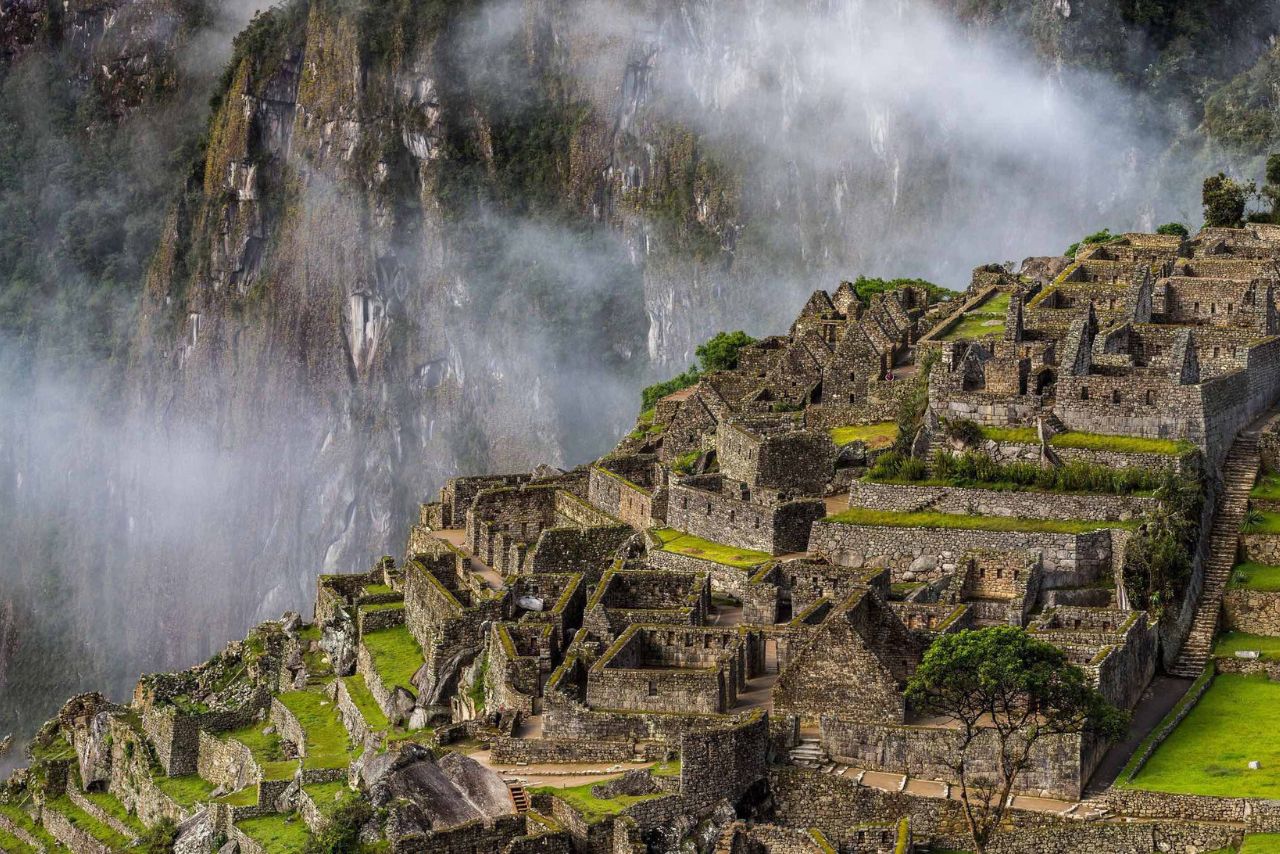
Aguas Calientes is not a beautiful town. It is a functional one — a collection of restaurants, hotels, and souvenir shops crammed into a narrow valley with a river running through it. But staying here the night before your Machu Picchu visit is strongly recommended. The first buses up to the citadel leave at 5:30 AM, and being in Aguas Calientes the night before means you can be on the first bus, arrive before the crowds, and watch the morning mist burn off the ruins in the early light. That experience — Machu Picchu in the first hour of the day, with the clouds still wrapped around the peaks and the llamas grazing on the terraces — is worth every logistical inconvenience.
Machu Picchu: What to Actually Do When You Get There
Buy your tickets in advance. This cannot be overstated. The Peruvian Ministry of Culture sells timed entry tickets through the official portal at tuboleto.cultura.pe, and during high season (June through August, and around Inti Raymi in late June) they sell out weeks or months ahead. There are multiple circuits — different routes through the site — and you must choose when you book. Circuit 1 covers the agricultural terraces and the Sun Gate. Circuit 2 is the classic route through the main citadel. Circuit 4 includes the Inca Bridge. If you want to hike Huayna Picchu or Machu Picchu Mountain, those require separate tickets with their own daily limits.
Huayna Picchu is the dramatic peak that rises behind the citadel in every photograph of Machu Picchu. The hike to the top takes about 45 minutes of near-vertical climbing on stone steps with chains for handholds. The view from the summit — looking down at the entire citadel spread out below you, with the Urubamba River snaking through the valley thousands of feet below — is one of the most extraordinary perspectives in travel. Only 400 people per day are permitted. Book months in advance.
Machu Picchu Mountain is the larger peak on the other side of the citadel. The hike takes 3–4 hours round trip and climbs higher than Huayna Picchu, but the trail is less vertiginous. The view from the top is broader and more panoramic — you can see the entire Sacred Valley stretching toward Cusco. Only 800 people per day are permitted.
Inside the citadel itself, hire a guide. Not because you cannot wander on your own, but because the site is so dense with meaning that without context, you are looking at beautiful stonework without understanding what you are seeing. A good guide will show you the Intihuatana stone — the "hitching post of the sun," a carved granite ritual object that aligns precisely with the solstices and equinoxes, one of the few such stones in Peru that was not destroyed by the Spanish. They will show you the Temple of the Sun, built over a natural granite outcropping so that the rising sun on the winter solstice shines directly through a trapezoidal window onto the stone below. They will tell you that Machu Picchu was not a city in the conventional sense but a royal estate — built for the Inca emperor Pachacuti around 1450, inhabited for perhaps a century, then abandoned and never mentioned in any Spanish colonial record, which is why it survived intact while every other major Inca site was looted and dismantled.
The most important thing to know about Machu Picchu: it does not disappoint. In an era of over-hyped bucket list destinations, this one delivers everything it promises and then some. The scale is larger than photographs suggest. The engineering is more precise than you can comprehend until you are standing in front of it. The setting — clouds, mountains, the sound of wind — is genuinely otherworldly. Give it a full day. Arrive early. Stay until the afternoon light turns the stones gold. And then go back to Aguas Calientes and eat a plate of lomo saltado and drink a beer and sit with what you have just seen.
The Practical Details That Will Make or Break Your Trip
When to go: The dry season runs from May through October, with June, July, and August being peak months. The wet season (November through April) brings daily rain, lush green landscapes, and significantly fewer crowds. Machu Picchu in the rain, with the clouds swirling through the ruins, is its own kind of spectacular — but the Inca Trail closes in February for maintenance. The shoulder months of May and September/October offer the best balance of good weather and manageable crowds.
How long to spend: A minimum of 7 days to do Peru any justice — 2 in Lima, 1 in the Sacred Valley, 2 in Cusco, 1 in Aguas Calientes, 1 at Machu Picchu. Ten to fourteen days is better, and allows you to add Lake Titicaca (the highest navigable lake in the world, shared with Bolivia) or the Colca Canyon (twice as deep as the Grand Canyon, home to condors with 10-foot wingspans). Our Lake Titicaca Adventure: 3-Day Bolivia & Peru Itinerary is the guide for that extension.
What to pack: Layers. The Andes have four seasons in a single day — warm sun at noon, cold wind by 3 PM, possible rain by 5 PM. A waterproof layer is essential. Good walking shoes are non-negotiable. Sunscreen at altitude is more critical than at sea level — the UV index in Cusco regularly hits 14, which is extreme. Bring altitude medication if your doctor recommends it. Bring a reusable water bottle; the tap water in Peru is not safe to drink, but buying plastic bottles for two weeks is both expensive and environmentally irresponsible.
Machu Picchu tickets: Book through the official portal at tuboleto.cultura.pe. Be aware that the website can be unreliable and the interface is not always in English — many travelers use licensed tour operators to handle the booking for a small fee, which is worth it for the peace of mind. If you want to hike Huayna Picchu, book it the moment you know your travel dates.
Getting around: Domestic flights connect Lima to Cusco in about an hour and a half. The overland journey by bus takes 20+ hours and is not recommended unless you have serious time and a serious tolerance for mountain roads. Within the Sacred Valley, shared colectivo vans are the cheapest and most local option. Taxis in Cusco are cheap and plentiful but should always be negotiated in advance.
What Peru Will Do to You
There is a particular kind of traveler who goes to Peru expecting a highlight reel — Machu Picchu, a few ruins, some good food — and comes back having been fundamentally rearranged. It happens to people who are not expecting it. It happens because Peru is one of the few places on earth where the weight of history is not abstract. You stand on stones that were cut by hand 600 years ago, fitted together with a precision that modern engineers still cannot fully explain, and you feel the gap between what humans have been capable of and what we give ourselves credit for.
It happens because the Sacred Valley is genuinely, achingly beautiful in a way that photographs cannot prepare you for. Because the altitude does something to your body that also does something to your mind — strips away the noise, forces you to slow down, makes you pay attention to the simple act of breathing. Because the food in Lima is so extraordinary that it resets your baseline for what a meal can be. Because the people you meet — the guides, the market vendors, the women weaving on the hillsides of Chinchero in textiles that have not changed in design since the Inca Empire — are carrying a culture that survived conquest and colonization and is still, stubbornly, magnificently alive.
Peru is not the easiest trip you will ever take. The altitude will challenge you. The logistics require planning. The distance from North America or Europe is real. But it is, for many travelers, the most important trip they have ever taken. And Machu Picchu — that impossible citadel between the clouds — is not the reason to go. It is the reward for going.
Plan your Peru trip with Ask Leif. Our Machu Picchu & Cusco: 4-Day Adventure for Every Traveler is the starting point for first-timers, and our Peru Sacred Valley 7-Day Road Trip is the guide for travelers who want to go deeper. The itinerary that changes everything is waiting.