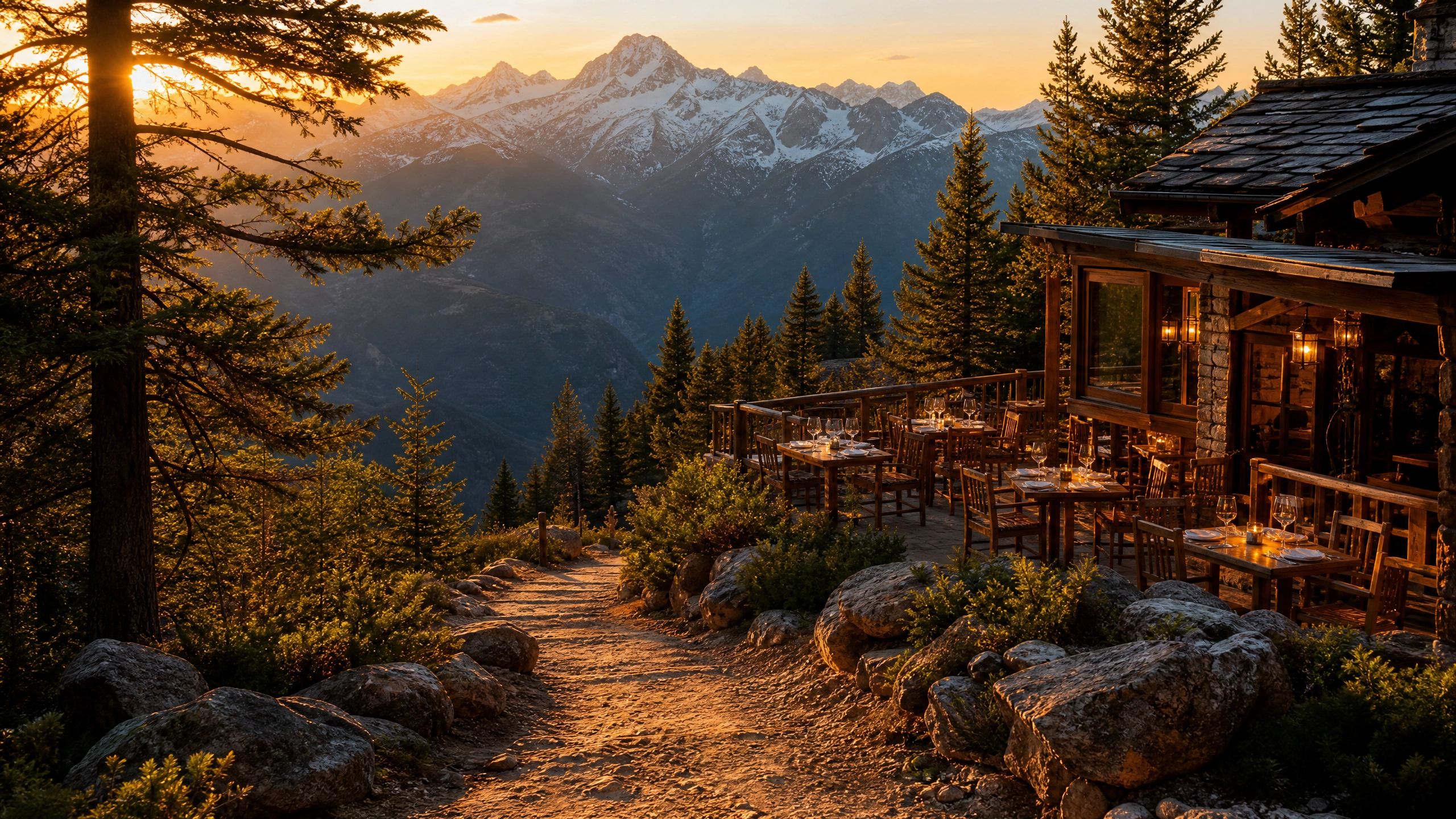
The Cities Where the Trail Ends at a Table Worth Sitting Down For
Destination: Global
Category: Travel Inspiration
The outdoor travel market has a content problem. Every list of "best cities for outdoor enthusiasts" treats restaurants the same way — as recovery infrastructure. The fuel stop between adventures. The place you go when your legs are too tired to do anything else. The best burger in town, ranked by caloric density per dollar.
This is the wrong frame. And the cities on this list are proof of it.
The question that produced this list was not "which outdoor destinations have restaurants good enough to not embarrass the landscape?" It was harder than that: which cities have achieved the specific and rare combination where the outdoor access and the food culture are both world-class simultaneously — where the mountain and the meal are equally the reason to go, and where the specific culture that produces extraordinary outdoor access and the specific culture that produces extraordinary food developed together, from the same geography, rather than in spite of each other?
That question eliminates most of the cities you'd expect to see here. Denver has both, but they developed independently. Whistler has both, but the food culture is resort-dependent — it serves international purchasing power, not a local agricultural tradition. Jackson Hole has both, but the food culture is driven by the wealth of its visitors, not the conditions of its landscape.
The cities that remain are the ones where the trail and the table are expressions of the same place. Where the altitude that makes the hiking extraordinary also makes the wine or the cheese or the corn different. Where the outdoor community and the food community are the same people, and where the culture that sends you up a mountain at 6am is the same culture that knows exactly what you should eat when you come back down.
There are six of them. Here is the argument for each.
Queenstown, New Zealand: The Adventure Capital That Learned to Cook
The Remarkables are the mountain range that frames Queenstown from the south. They are called the Remarkables because, uniquely among the world's mountain ranges, their ridgeline runs almost perfectly north-south — which means that at sunrise and sunset, the entire face catches the light at the same angle simultaneously. The effect is extraordinary. It is also, incidentally, the same exposure and drainage pattern that makes the Central Otago valley below one of the world's most distinctive wine-growing regions.
This is not a coincidence. It is the argument.
Central Otago Pinot Noir is produced under conditions that are extreme by the standards of any wine region: the highest altitude commercial viticulture in New Zealand, the most continental climate, the greatest diurnal temperature variation. The same mountain geography that makes the skiing at Coronet Peak and the Remarkables exceptional — the elevation, the cold air, the dramatic seasonal shifts — produces a Pinot Noir that is unlike anything grown at sea level. The landscape that sends you down a bungee cord over the Kawarau Gorge is the same landscape that grew the grapes in the glass at Amisfield Winery on the way back.
Queenstown is a town of 15,000 people with a restaurant scene that has no business existing at this scale. Rata, the restaurant opened by Josh Emett — one of New Zealand's most decorated chefs — sources almost entirely from Central Otago producers: the stone fruit from Cromwell, the lamb from Otago high country stations, the venison from the same hills where the mountain bike trails run. The Saturday farmers market at Earnslaw Park brings the producers themselves into town, and the gap between the person who grew the food and the person eating it is measured in kilometres, not supply chains.
The trajectory from Fergburger — the legendary burger institution that has been feeding post-adventure crowds since 2001 — to Rata is the trajectory of a town that took its outdoor identity seriously enough to build a food culture worthy of it. Fergburger is not a consolation prize. It is a genuine institution, with a queue that forms before noon and a menu that understands exactly what a body needs after four hours on the Routeburn Track. The fact that Rata exists in the same town is the proof that Queenstown matured.
The AskLeif Queenstown Food & Wine Guide maps the Central Otago wine trail alongside the outdoor itinerary. The Queenstown Adventure & Romance Guide builds the hiking and the table into the same day.
Bend, Oregon: The High Desert City That Took Both Seriously
At 3,600 feet above sea level on the eastern slope of the Cascade Mountains, Bend sits in a high desert landscape that receives 300 days of sunshine per year. This is the condition that makes the outdoor access extraordinary: the Deschutes River Trail runs through downtown, the volcanic landscape of the Three Sisters Wilderness begins 30 minutes west, and the mountain biking on the Deschutes National Forest trail network is among the most varied in the American West.
It is also the condition that makes Tumalo Farm possible.
Eight miles from downtown, on a high desert plateau where the temperature swings 40 degrees between noon and midnight, Tumalo Farm produces aged goat cheese under conditions that exist almost nowhere else in American artisan cheesemaking. The extreme diurnal variation — hot days, cold nights, low humidity — produces a mineral content in the milk that is specific to this landscape. The same volcanic soil that makes the trail surfaces on the Phil's Trail network unlike anything in the Pacific Northwest is the same soil that the goats graze on. The cheese tastes like the place.
The Bend Ale Trail is the largest beer trail in the American West: more than 30 breweries spread across the city, most of them within cycling distance of the Deschutes River Trail. This is not accidental. Bend's craft beer culture grew from the same outdoor community that built the trail network — the breweries were founded by people who moved to Bend for the mountains and the river, and who built taprooms that were designed to receive people coming off trails, not off office chairs. 10 Barrel Brewing's downtown taproom sits adjacent to the Deschutes River Trail. The trail ends at the door.
Pine Tavern has been operating in downtown Bend since 1936. Two ponderosa pine trees grow through the floor of the dining room — they were there before the building, and the building was constructed around them. The menu sources from the same regional producers that supply Bend's newer restaurants, and the outdoor patio on Mirror Pond is the specific Bend experience that no other city can replicate: the river, the mountains, the pines, and a plate of food that came from within 50 miles of where you're sitting.
The AskLeif Bend, Oregon Adventure Guide integrates the brewery trail and the outdoor itinerary as a single experience.
San Sebastián, Spain: The City That Proved Outdoor Access and Michelin Stars Are Compatible
San Sebastián has more Michelin stars per capita than any city on earth. It also has Monte Urgull, a 123-metre hill that rises directly from the old town and takes 30 minutes to walk from base to summit. The Camino del Norte — the northern route of the Camino de Santiago — passes through the city. The surf break at Zurriola beach has produced multiple WSL competitors from a city of 180,000 people.
The combination should not work. Michelin-starred restaurants and serious outdoor access are, in the conventional understanding of both, incompatible. Michelin restaurants exist in cities with money and density. Serious outdoor access exists at the edges of things, away from density. San Sebastián is the proof that this understanding is wrong.
The Basque Country's relationship to food and to landscape is not separable. The pintxos culture — the practice of eating standing at a bar counter, moving from bar to bar, ordering by pointing at what's on the counter — is not a restaurant culture in the conventional sense. It is a social practice that happens to involve extraordinary food. The bars on Calle 31 de Agosto open at 11am, and the people arriving at that hour are frequently coming off the Monte Urgull walking path or the Camino del Norte. The pintxos are freshest in the first two hours of service. The outdoor access and the food culture operate on the same schedule.
The argument that San Sebastián makes is not that you can do both. It is that in the Basque Country, the outdoor relationship to landscape and the culinary relationship to landscape are expressions of the same cultural identity. The txakoli wine — the sharp, slightly sparkling white wine poured from height to aerate it — is grown on the steep hillsides above the coast. The same hillsides that the Camino del Norte traverses. The anchovies in the pintxos come from the Cantabrian Sea that the surfers at Zurriola are riding. The landscape is not the backdrop to the food. It is the source of it.
The AskLeif San Sebastián Foodie Guide and the San Sebastián for Couples Guide both build the Monte Urgull walk and the pintxos circuit into the same morning.
Chamonix, France: The Mountain Capital Where the Food Earned Its Place
The first cable car to the Aiguille du Midi leaves at 8am. At 3,842 metres, it is the highest cable car station in the Alps, and on a clear morning in late September, the queue for the first departure is composed almost entirely of alpinists — people carrying ice axes and crampons, checking weather windows on their phones, speaking in the clipped shorthand of people who have been planning this specific day for weeks.
There is a café at the top. The coffee is unremarkable. But the act of drinking it — at 3,842 metres, before the day visitors arrive, with the Mont Blanc massif filling the window — is not about the coffee.
This is the Chamonix food experience in its most compressed form: the food earns its place because of where it is and what you did to get there. The tartiflette at Le Bistrot des Sports at the end of a day on the Mer de Glace is not a great dish because the recipe is exceptional. It is a great dish because the Reblochon cheese in it comes from the Aravis valley 30 kilometres away, because the potatoes are from the Haute-Savoie, because the caloric demands of alpinism produced this specific high-fat, high-protein mountain food tradition over centuries, and because you have just spent eight hours at altitude and your body knows exactly what it needs.
Tartiflette is not a tourist dish. The correct version — potatoes, bacon lardons, onions, white wine, and a whole Reblochon split and laid face-down on top before going into the oven — is the food that the people who live in this valley eat in winter. The version served in ski resort restaurants in other parts of France is an approximation. In Chamonix, the proximity to the source is close enough that the approximation disappears.
The Tour du Mont Blanc — the 170-kilometre circuit of the Mont Blanc massif through France, Italy, and Switzerland — passes through Chamonix. The refuge food culture along the TMB is its own subject: the set-course dinners at mountain refuges, the blueberry pie at Refuge de Miage, the omelettes at Auberge de la Nova, the five-course dinner for 18 euros at Refuge du Couvercle. The food is not fine dining. It is food that was earned, and that distinction makes it taste different.
The AskLeif Chamonix Adventure Guide covers the Aiguille du Midi approach, the Mer de Glace, and the post-climb food protocol.
Oaxaca, Mexico: The Food Capital That Is Also Sierra Norte
The Sierra Norte mountain range begins 60 kilometres north of Oaxaca City. At 2,800 metres above sea level, the village of Llano Grande sits at the trailhead of a cloud forest circuit that passes through pine-oak forest, past endemic birds found nowhere else on earth — the Oaxacan chachalaca, the dwarf jay — and through a landscape that has been managed by the Zapotec community of Llano Grande since 1995, when Sierra Norte Expediciones was established as the first community-owned ecotourism network in Mexico.
The same altitude and cloud forest climate that makes the Sierra Norte trail network biologically extraordinary produces the wild mushrooms — chanterelles, porcini, huitlacoche — that appear in Oaxacan restaurants every September and October. The Sierra Juárez range contains the highest concentration of native corn varieties in Mexico: 35 distinct landraces, some cultivated for 5,000 years, each adapted to a specific microclimate within the mountains. The same altitude variation that makes the hiking in the Sierra Norte diverse is the reason that the corn in a Oaxacan tlayuda is not the same corn that grows anywhere else.
This is the argument that Oaxaca makes that no other food capital can: the landscape that produces the outdoor access is the same landscape that produces the food. The mole negro at Restaurante Las Quince Letras uses chiles grown in the Cañada region, chocolate from the Papaloapan basin, and herbs from the Central Valleys. The sourcing map of a single Oaxacan dish is a topographic map of the state. The outdoor access and the culinary tradition are not parallel attractions. They are the same landscape, approached from different directions.
The 6am birding window on the Llano Grande cloud forest trail — the hour before the mist burns off, when the endemic species are most active — and the 8pm table at a Oaxacan restaurant sourcing from Sierra Norte producers are the same day. The trail ends at the table. The table is made from what the trail grows.
The AskLeif Oaxaca for Couples Guide integrates the Sierra Norte day trip with the Oaxacan food circuit.
Moab, Utah: The Red Rock Desert That Learned to Feed Itself
The Slickrock Trail is 10.3 miles of mountain biking on petrified sand dunes. The surface is Navajo sandstone — 190-million-year-old desert dunes compressed into rock — and the traction it provides is unlike any other trail surface on earth. The trail was originally built for motorcycles in 1969. The mountain biking community discovered it in the 1980s and built the culture of technical desert riding that now defines Moab's identity.
The Desert Bistro has been operating in Moab since 2001, in an 1892 adobe building on the National Register of Historic Places that was originally the town's dance hall. The menu is internationally inspired with a Southwestern foundation — Colorado lamb, Utah bison, local game — and the outdoor patio is shaded by cottonwood trees that have been growing in this desert for longer than the building has been standing.
The connection between the Slickrock Trail and the Desert Bistro is not incidental. Moab's food culture evolved in direct response to its outdoor community. The town that existed before the mountain biking boom was a uranium mining town with a diner culture. The town that exists now has a restaurant that sources Colorado wine from the Grand Valley AVA — 60 miles north near Grand Junction, where the high altitude and extreme diurnal temperature variation produce Cabernet Franc and Merlot under conditions that are specific to the Colorado Plateau. Maison La Belle Vie in Palisade is growing wine in the same geological formation that the Slickrock Trail crosses.
The Colorado River running community added a different food tradition. Dutch oven cooking — the cast-iron camp cooking technique that river guides developed over decades of multi-day canyon trips — is the culinary tradition of the Colorado Plateau. Palisade peaches, grown 60 miles upriver, appear in both river camp desserts and on the Desert Bistro menu. The food culture of Moab is not a transplant from somewhere else. It grew from the same red rock landscape that the trails cross.
Ray's Tavern in Green River, 50 miles west of Moab, has been serving the river running community since 1976. The green chile cheeseburger is the specific meal that river guides have been eating at the end of multi-day Colorado River trips for half a century. It is not a great burger by the standards of a restaurant critic. It is a great burger by the standards of someone who has been living on Dutch oven camp food for five days and has just pulled out at Mineral Bottom.
The AskLeif Arches & Moab Canyon Country Road Trip Guide and the Moab Family Adventure Guide both cover the Desert Bistro and the Grand Valley wine corridor.
The Exclusion Argument
Three cities are conspicuously absent from this list, and the reasons are instructive.
Denver has extraordinary outdoor access — Rocky Mountain National Park, the Front Range trail network, world-class skiing within two hours — and a genuinely excellent restaurant scene. But the outdoor culture and the food culture developed independently. Denver became a food city because of population growth, purchasing power, and the arrival of serious chefs. It did not become a food city because the same geography that produces the hiking also produces the ingredients. The connection between the landscape and the table is not the argument Denver makes.
Whistler has both outdoor access and restaurants, but the food culture is resort-dependent. It serves international ski clientele with international purchasing power. The restaurants that exist in Whistler exist because wealthy visitors from Vancouver, Los Angeles, and London expect them. The local agricultural tradition that would make Whistler's food culture indigenous to its landscape does not exist at the scale required.
Jackson Hole is the most instructive exclusion. The outdoor access is world-class. The restaurant scene has improved dramatically over the past decade. But the food culture is driven by the wealth of its visitors — the second-home owners, the hedge fund managers, the people who fly private into Jackson Hole Airport. The restaurants exist to serve that purchasing power, not to express the landscape. The Snake River valley produces some food — the Snake River Farms Wagyu program is genuinely excellent — but the food culture of Jackson Hole is not a product of its geography in the way that Oaxaca's or San Sebastián's is.
The distinction matters because it is the distinction between a city that has outdoor access and good restaurants, and a city where the outdoor access and the food culture are expressions of the same place. The first category is large. The second is the list above.
How to Choose
The six cities on this list are not interchangeable. Each makes a different argument, and the right one depends on what you're looking for.
If you want the most dramatic combination of outdoor access and fine dining in a single city, San Sebastián is the answer. The concentration of Michelin stars in a city with genuine hiking and surf access is not replicated anywhere else on earth.
If you want the most direct connection between the landscape and what's on the plate — the place where the geography of the outdoor access and the geography of the food are most literally the same — Oaxaca is the answer. The Sierra Norte trail and the Oaxacan kitchen are sourced from the same mountains.
If you want the outdoor access to feel earned in a way that makes the food taste different, Chamonix is the answer. The tartiflette after a day on the Mer de Glace is not the same dish as the tartiflette in a Paris bistro. The altitude and the effort change the chemistry.
If you want the most complete integration of outdoor culture and food culture in an American city — the place where the trail network and the brewery trail and the farmers market are all expressions of the same community — Bend is the answer.
If you want the most surprising combination — the place that has no business being on this list by conventional logic, the outdoor destination that built a food culture that exceeds its size by every measure — Queenstown is the answer.
And if you want the place where the food culture grew directly from the outdoor culture, where the restaurant that exists today is a direct consequence of the mountain biking community that arrived in the 1980s and built a town around the trails — Moab is the answer.
The Closing Argument
The cities on this list have one thing in common that the cities excluded from it do not: the outdoor access and the food culture are not parallel attractions. They are the same place, approached from different angles.
Queenstown matures. The adventure capital that built a food culture worthy of its landscape. Bend harvests. The high desert city that understood that 300 days of sunshine produces both trails and cheese. San Sebastián connects. The Basque city where the Camino del Norte and the pintxos bar are expressions of the same cultural relationship to landscape. Chamonix earns. The mountain capital where the food tastes different because of what you did to deserve it. Oaxaca grows. The food capital where the trail and the table are sourced from the same mountains. Moab evolves. The red rock desert that built a food culture from the community that came for the trails and stayed for the landscape.
The trail ends at a table worth sitting down for. In each of these six cities, that sentence is not a metaphor. It is a description of a specific walk, a specific restaurant, and a specific reason to go.
Explore These Destinations with AskLeif
- Queenstown Food & Wine Guide: 4 Days of Central Otago Flavors
- Queenstown Adventure & Romance: A 5-Day Couples' Guide
- Bend, Oregon: 4-Day Outdoor Adventure Itinerary & Brewery Trail Guide
- San Sebastián Foodie Paradise: A 4-Day Culinary Journey
- San Sebastián for Couples: A Romantic 4-Day Itinerary
- Chamonix Adventure: 4-Day Thrills in the Mont Blanc Valley
- Oaxaca for Couples: A Romantic 4-Day Itinerary for Foodies & Culture Lovers
- 7-Day Utah Canyon Country Road Trip: Arches, Canyonlands & Moab Base Camp
- 5-Day Moab Family Adventure: Arches, Canyonlands, Jeeps & Dinosaurs