New Orleans Doesn't Let You Leave the Same Person You Arrived
Destination: New Orleans, Louisiana
Category: Destination Guides
New Orleans Doesn't Let You Leave the Same Person You Arrived
There is no city in America — not New York, not San Francisco, not Chicago — that does what New Orleans does to you. It gets inside you. It rewires something. You arrive thinking you're going on a trip and you leave wondering if you've been somewhere else entirely.
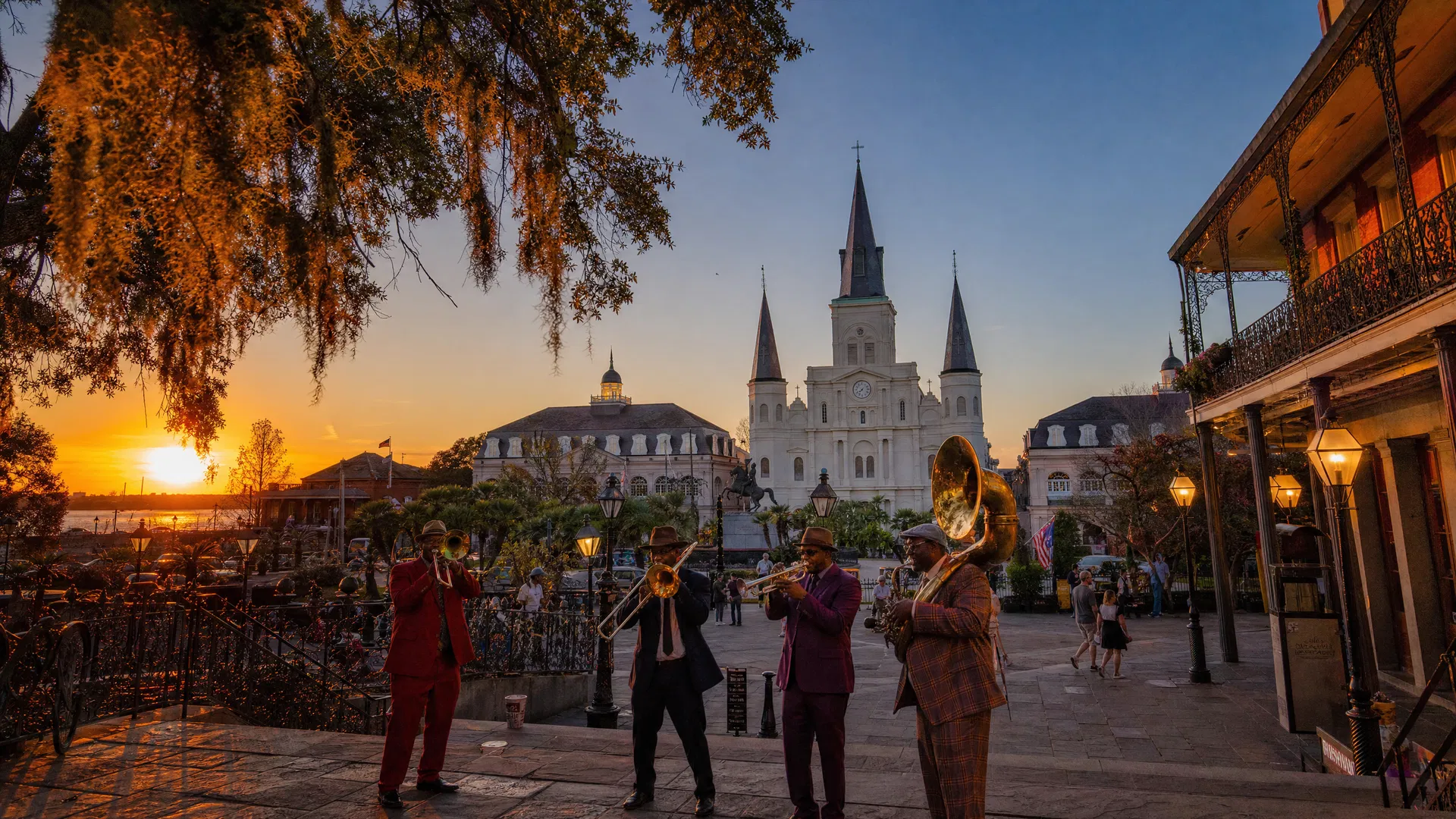
The French Quarter is the part everyone knows. The Bourbon Street photos, the plastic cups of frozen daiquiris, the beads, the noise. But that's the lobby. The real New Orleans — the one that ruins you for every other American city — is found in the second line parades that materialize on Sunday afternoons in neighborhoods tourists never find. It's in the shotgun houses of the Tremé, the oldest African American neighborhood in the country, where jazz didn't just happen — it was born. It's in the kitchens of Uptown restaurants where chefs are still cooking from handwritten recipes passed down through generations of Creole families. It's in the cemeteries, the bayous, the live oak canopies of the Garden District, and in the particular quality of the light at dusk when the whole city seems to glow amber and gold and you understand, finally, why people come here once and never fully leave.
New Orleans is the most unique city in America. That's not a marketing slogan. It's a fact that becomes more obvious the longer you stay.
The City That History Couldn't Kill
To understand New Orleans, you have to understand what it has survived. This is a city that has been French, Spanish, French again, and then American — all within a few decades. It was the largest slave market in North America, a fact that sits at the center of everything here: the food, the music, the architecture, the language, the entire cultural DNA of the place. It was devastated by yellow fever epidemics that killed tens of thousands. It was nearly destroyed by Hurricane Katrina in 2005, when the levees failed and 80 percent of the city flooded. And yet New Orleans not only survived all of it — it came back stranger, louder, more itself than ever.
That resilience is not incidental. It's the whole personality. New Orleans has a relationship with mortality that no other American city has, which is why it throws the best parties, buries its dead with brass bands and dancing, and treats every Tuesday night like it might be the last one. The city's unofficial motto — laissez les bons temps rouler, let the good times roll — is not a casual suggestion. It is a philosophy forged in the knowledge that everything is temporary and the only rational response is to live fully, loudly, and with excellent food.
The French Quarter: Start Here, But Don't Stay Here
Every visit to New Orleans begins in the French Quarter, and that's fine. The Quarter is extraordinary — a 13-by-6-block neighborhood of wrought-iron balconies, gas lamps, and Creole townhouses that looks like nowhere else in America. The architecture is a hybrid of French, Spanish, and Caribbean influences, and the oldest buildings date to the 18th century. Walk down Royal Street in the morning before the crowds arrive and you'll understand why this neighborhood is a UNESCO candidate.
But Bourbon Street, despite its fame, is the least interesting street in the Quarter. The real Quarter lives on Frenchmen Street (technically just outside the Quarter, in the Faubourg Marigny), where local musicians play in clubs that don't charge a cover and the crowd is half tourists and half locals who've been coming here for decades. The Spotted Cat, the Maison, d'ba — these are the rooms where jazz, blues, and funk happen the way they're supposed to: loose, loud, and alive.
Within the Quarter itself, seek out the Old Ursuline Convent on Chartres Street — the oldest building in the Mississippi River Valley, completed in 1752, and one of the most beautiful structures in America. Walk through the French Market, not for the tourist trinkets but for the Café Du Monde, where you will eat beignets covered in powdered sugar and drink café au lait and understand that some things are famous for a reason.
The Cabildo and Presbytere on Jackson Square are the best history museums in the city — the Cabildo is where the Louisiana Purchase was signed in 1803, and its collection on slavery and Creole culture is essential context for everything else you'll see here. Don't skip them.
The Tremé: Where Jazz Was Born
Walk north from the French Quarter across Rampart Street and you enter the Tremé, and the city changes completely. This is the oldest African American neighborhood in the United States, and it is the birthplace of jazz. Not metaphorically — literally. The musicians who invented jazz in the late 19th and early 20th centuries lived here, practiced here, and played in the social aid and pleasure clubs that still exist today.
Congo Square, now part of Louis Armstrong Park, is where enslaved Africans were permitted to gather on Sundays to play music and dance — one of the only places in the American South where this was allowed. The rhythms and traditions preserved in Congo Square became the foundation of jazz, blues, and eventually rock and roll. Standing there, you're standing at the origin point of American popular music.
The Tremé is also where you'll find the best second line parades. These are neighborhood processions organized by social aid and pleasure clubs — brass bands leading crowds through the streets in a rolling, dancing, joyful celebration that has no equivalent anywhere else. They happen almost every Sunday from September through June, and the routes are posted online. Go. Wear comfortable shoes. Dance badly. Nobody cares.
The Food: The Best Eating City in America
This is not a controversial claim. New Orleans has the most distinctive, most historically layered, most technically accomplished food culture in the United States. It is not a city with a few good restaurants. It is a city where the food itself is the culture.
Creole cuisine — the cooking that defines New Orleans — is a synthesis of French technique, West African ingredients and methods, Spanish flavors, Native American knowledge, and Caribbean influences. It produced dishes that exist nowhere else: gumbo, jambalaya, étouffée, red beans and rice, muffulettas, po-boys, beignets, bananas Foster, bread pudding with whiskey sauce. Every one of these dishes has a history, and every one of them tastes better in New Orleans than anywhere else you'll eat them.
Commander's Palace in the Garden District is the cathedral of Creole cooking — a grande dame restaurant that has been operating since 1893 and has launched the careers of chefs including Emeril Lagasse and Paul Prudhomme. The Saturday jazz brunch, with its 25-cent martinis and tableside bananas Foster, is one of the great restaurant experiences in America. Reserve weeks in advance.
Dooky Chase's Restaurant in the Tremé is equally essential and more historically significant. Leah Chase, who died in 2019 at 96, cooked here for decades and fed everyone from Ray Charles to Barack Obama. Her gumbo z'herbes — a meatless gumbo made with seven greens, traditionally served on Holy Thursday — is one of the most important dishes in American culinary history. The restaurant continues under her family's care.
For po-boys, Domilise's on Annunciation Street in Uptown is the standard. A roast beef debris po-boy — the shredded meat and drippings from the bottom of the roasting pan, piled onto French bread — is one of the great sandwiches on earth. Parkway Bakery & Tavern in Mid-City is the other essential stop, particularly for the hot sausage po-boy.
For the full New Orleans food experience across multiple days and styles, the New Orleans Foodie Deep Dive: 4-Day Culinary Adventure guide covers Commander's Palace, beignets, po-boys, crawfish, and Creole classics in a structured itinerary that doesn't miss anything essential.
Café Du Monde is mandatory. The beignets are fried to order, dusted with enough powdered sugar to coat your entire shirt, and best eaten at 2 AM after a night on Frenchmen Street. The café au lait — half strong chicory coffee, half hot milk — is the correct beverage.
The Garden District: Old Money, Live Oaks, and Anne Rice's House
The Garden District is what happens when 19th-century American merchants got very rich and decided to build the most ostentatious houses they could imagine. The result is one of the most beautiful residential neighborhoods in the United States: block after block of Greek Revival and Italianate mansions set behind wrought-iron fences and shaded by live oak trees so old their roots buckle the sidewalks.
Walk Magazine Street for the independent shops and restaurants. Stop at Stein's Market & Deli for a muffuletta — the round Italian sandwich with olive salad that was invented at Central Grocery in 1906 and has been a New Orleans staple ever since. Walk past 1239 First Street, where Anne Rice lived and set much of her vampire fiction. The house is private, but the exterior is unmistakable.
Lafayette Cemetery No. 1 on Washington Avenue is the Garden District's above-ground cemetery, and it's one of the most atmospheric places in the city. New Orleans buries its dead above ground because the water table is too high for conventional burial — a practical necessity that became one of the city's most distinctive visual signatures. The cemetery is free to enter and has been used as a filming location for everything from Interview with the Vampire to American Horror Story.
Frenchmen Street and the Music Scene
If you want to understand why New Orleans is the most musical city in America, spend a night on Frenchmen Street. This two-block stretch in the Faubourg Marigny has more live music per square foot than anywhere in the country, and almost none of it costs a cover charge. The Spotted Cat Music Club, the Maison, d'ba, the Bamboula's — every room has a different band, a different sound, and a different crowd, and you can wander between them all night.
The music here is not a performance for tourists. It is the city's actual social life. Local musicians who play here are the same musicians who play second lines on Sunday afternoons and jazz funerals on weekday mornings. The tradition is continuous and living, not preserved in amber.
For a deeper dive into the music scene alongside the food and neighborhood culture, the New Orleans 5-Day Jazz & Food Culture Itinerary covers Frenchmen Street, the Tremé, the Jazz & Heritage Festival, and the best music venues in a structured five-day framework.
The New Orleans Jazz & Heritage Festival, held over two weekends in late April and early May, is one of the great music festivals on earth. Unlike most festivals, Jazz Fest is rooted in the city's own culture — the lineup is heavy on New Orleans artists, Louisiana food vendors, and local craftspeople. It draws 400,000 people over two weekends and sells out months in advance.
The Bayou and the Swamp: New Orleans Beyond the City
New Orleans sits at the edge of one of the most extraordinary ecosystems in North America: the Louisiana bayou. Within 30 minutes of the French Quarter, you can be in a flat-bottomed airboat skimming through cypress swamps, watching alligators sun themselves on logs and great blue herons lift off from the water. This is not a theme park experience. The swamps are real, the alligators are real, and the landscape — ancient cypress trees draped in Spanish moss, black water reflecting the sky — is genuinely unlike anything else in America.
Jean Lafitte National Historical Park and Preserve, 25 miles south of the city, offers hiking trails through the Barataria Preserve that wind through bottomland hardwood forest and marsh. The park is named for the pirate Jean Lafitte, who operated out of these bayous in the early 19th century and helped Andrew Jackson defend New Orleans against the British in 1815.
For the full outdoor experience — swamp hikes, bayou kayaking, Honey Island Swamp tours, and Mississippi River levee cycling — the 4-Day New Orleans Outdoor Adventure: Swamps, Bayous & Levee Cycling guide covers everything beyond the city limits that most visitors never see.
Mardi Gras: The Real Thing
Mardi Gras is not a single night. It is a six-week season that begins on January 6th (Epiphany, or "Twelfth Night") and builds to Fat Tuesday, the day before Ash Wednesday. The parades start weeks before Fat Tuesday, with dozens of krewes rolling through different neighborhoods on different nights. The biggest parades — Endymion, Bacchus, Orpheus, Zulu, Rex — roll in the final week and draw hundreds of thousands of spectators.
The Bourbon Street version of Mardi Gras — the one in the photos — is the tourist version. The real Mardi Gras is in the neighborhoods: the Zulu parade through Central City, the Mardi Gras Indians in their hand-sewn suits of feathers and beads, the St. Anne parade in the Bywater where locals dress in elaborate costumes and walk from the Marigny to the river. The Indians, in particular, are one of the most extraordinary cultural traditions in America — African American men who spend the entire year hand-sewing suits of thousands of feathers and beads, then parade through the streets on Mardi Gras morning in a tradition that honors Native American tribes who sheltered escaped slaves.
The National WWII Museum: The Best Museum in America
The National World War II Museum on Magazine Street is, by most rankings, the best museum in the United States. It is certainly the most emotionally powerful. The museum was founded in 2000 on the 56th anniversary of D-Day, and it has grown into a 300,000-square-foot complex that covers every theater of the war — Europe, the Pacific, the home front — through artifacts, oral histories, immersive environments, and film installations produced by Tom Hanks and Steven Spielberg.
The 4D film experience narrated by Tom Hanks, Beyond All Boundaries, is the most technically sophisticated museum film in the world. The Road to Berlin and Road to Tokyo pavilions are built around the actual vehicles, weapons, and personal effects of the soldiers who fought in them. The oral history recordings — veterans speaking directly to camera about what they saw and did — are devastating in the best possible way.
Allow a full day. The museum is open daily, tickets are $30 for adults, and it is worth every minute and every dollar. It is also, somewhat unexpectedly, one of the most important reasons to visit New Orleans — a reminder that this city, which sent more men per capita to World War II than almost any other American city, has a relationship with sacrifice and survival that runs deeper than the party.
Jazz Funerals: The Most New Orleans Thing There Is
The jazz funeral is the most New Orleans thing in a city full of New Orleans things. When a prominent community member dies — a musician, a neighborhood elder, a member of a social aid and pleasure club — the funeral procession is led by a brass band playing dirges on the way to the cemetery and jubilant second line music on the way back. The logic is theological and deeply human: mourn the loss, celebrate the life, and trust that the deceased has gone somewhere better.
The tradition comes directly from the African American community of the Tremé, and it is one of the clearest surviving expressions of the West African cultural traditions that were preserved in New Orleans when they were suppressed everywhere else in the American South. The music — the slow, mournful Just a Closer Walk with Thee on the way to the grave, the explosive, joyful When the Saints Go Marching In on the way back — is not performance. It is ritual. It is how this community has processed loss for two centuries.
Jazz funerals are not scheduled events for tourists. They happen when someone dies. But if you happen to encounter one — and if you spend enough time in the Tremé, you might — stop, watch, and understand that you are seeing something that exists nowhere else in the world. The combination of grief and joy, of brass bands and dancing, of community gathering in the street to send one of their own home — it is the most complete expression of what New Orleans is and has always been.
Practical New Orleans: When to Go, Where to Stay, How to Move
When to go: The best time to visit New Orleans is October through May, when temperatures are mild (60s–70s°F) and the humidity is manageable. June through September is hot, humid, and hurricane season — not impossible, but demanding. Mardi Gras (February/March) and Jazz Fest (late April/early May) are the peak events; book accommodation 6–12 months in advance for either.
Where to stay: The French Quarter puts you at the center of everything but is noisy and expensive. The Garden District is quieter and more residential, with excellent B&Bs in historic mansions. The Marigny and Bywater are the neighborhoods where locals actually live — walkable to Frenchmen Street, more affordable, and increasingly full of excellent restaurants and bars.
Getting around: New Orleans is a walking city in the French Quarter and Marigny. The St. Charles streetcar runs from the CBD through the Garden District and Uptown — it's the oldest continuously operating streetcar line in the world, and a $1.25 ride. For the rest of the city, rideshares are the most practical option.
Safety: New Orleans has a reputation for crime that is partly deserved and partly exaggerated. The tourist areas — French Quarter, Garden District, Frenchmen Street — are well-trafficked and generally safe. Common sense applies: don't walk alone late at night in unfamiliar neighborhoods, keep your phone in your pocket on Bourbon Street, and stay aware of your surroundings.
For first-time visitors who want a structured framework that covers all the essentials — jazz, food, neighborhoods, and nightlife — the New Orleans Long Weekend: Jazz, Creole Food, and the City That Never Stops guide covers four days of the city's best in a format that doesn't waste a single hour.
Traveling on a tight budget? The New Orleans on a Budget: 4-Day Guide to Free Jazz, Po-Boys & Cemetery Tours proves that the best of New Orleans — Frenchmen Street music, $3 po-boys, free cemetery tours, second line parades — costs almost nothing.
Visiting with family? The New Orleans Family Vacation: 4-Day Kid-Friendly Itinerary covers the Audubon Zoo, the National WWII Museum, City Park, and the family-friendly side of a city that's often assumed to be adults-only.
Traveling solo? The New Orleans Solo Travel: 4-Day Jazz, Food & Garden District Itinerary is built for the solo traveler who wants to move at their own pace through the city's best neighborhoods and music venues.
For the deepest possible immersion — seven full days covering every neighborhood, every food tradition, and every musical tradition — the New Orleans for Couples: A 7-Day Deep Dive into Jazz, Creole Cuisine & Culture is the most comprehensive New Orleans guide we've built.
The Thing About New Orleans
There's a reason people come to New Orleans for a weekend and end up moving here. The city has a gravitational pull that's hard to explain and impossible to resist once you've felt it. It's not just the food, though the food is extraordinary. It's not just the music, though the music is unlike anything else in America. It's the combination of all of it — the history, the culture, the architecture, the people, the particular way the city holds grief and joy in the same hand and refuses to choose between them.
New Orleans is the only American city that feels genuinely old — not in a museum sense, but in the sense that the past is still present here, still alive in the streets and the kitchens and the music. The French colonial architecture, the Creole cooking, the jazz funerals, the Mardi Gras Indians — these are not recreations. They are living traditions that have survived everything the city has been through.
Go to New Orleans. Eat everything. Listen to everything. Walk everywhere. Stay out too late. Sleep too little. Let the city do what it does.
You will not leave the same person you arrived.
Ready to start planning? Build your perfect New Orleans itinerary with Ask Leif — tell us how long you have, what you love, and we'll handle the rest.