Polish Food Has a Reputation Problem. Kraków Is Where It Dies.
Destination: Kraków, Poland
Category: Destination Guides
Polish Food Has a Reputation Problem. Kraków Is Where It Dies.
The reputation arrived before you did. Heavy, beige, starchy, repetitive — the kind of food people describe as "filling" when they can't think of anything better to say. Polish cuisine has spent decades absorbing this dismissal from travelers who ate one bad plate of pierogi at an airport and considered the matter settled. Kraków is the city that makes that argument impossible to sustain. Not because it has reinvented Polish food — it hasn't, and it doesn't need to — but because it serves the real version, in the right places, with enough context to understand what you're actually eating. The milk bars, the pierogi taxonomy that extends far beyond what the outside world knows exists, and the Jewish-Polish culinary revival happening in Kazimierz right now: these are the three places where the reputation dies. This is what it looks like when you eat in Kraków properly.
The Reputation Problem Is Real, and It Has a Specific Origin
Polish food's image problem is not accidental. It is the product of a specific historical sequence: decades of communist-era austerity that made variety a luxury, followed by a wave of Polish emigration that carried the most basic, portable dishes — pierogi, bigos, kielbasa — into diasporic communities where they became frozen and simplified versions of themselves. The food that traveled was not the food that stayed. What stayed in Kraków was the full version: the regional variations, the seasonal rhythms, the specific techniques that require time and proximity to source ingredients that don't survive a transatlantic journey.
The second source of the reputation problem is the tourist trap. Kraków's Rynek Główny — the main market square, one of the largest medieval squares in Europe — is ringed with restaurants that have learned exactly what foreign visitors expect Polish food to be and have optimized accordingly. Oversized portions of pierogi ruskie, gloopy bigos in bread bowls, menus with photographs of every dish. None of it is actively bad. None of it is what Cracovians eat. The food that built the reputation is the food served to people who didn't know where else to go.
The antidote is not a reservation at a Michelin-starred restaurant, though Kraków has those too — Bottiglieria 1881 holds a star, and Karakter has developed a devoted following among locals for its creative Polish cuisine without pretension. The antidote is knowing where the city actually eats, and why those places exist in the form they do.
What a Milk Bar Actually Is (and Why It Matters)
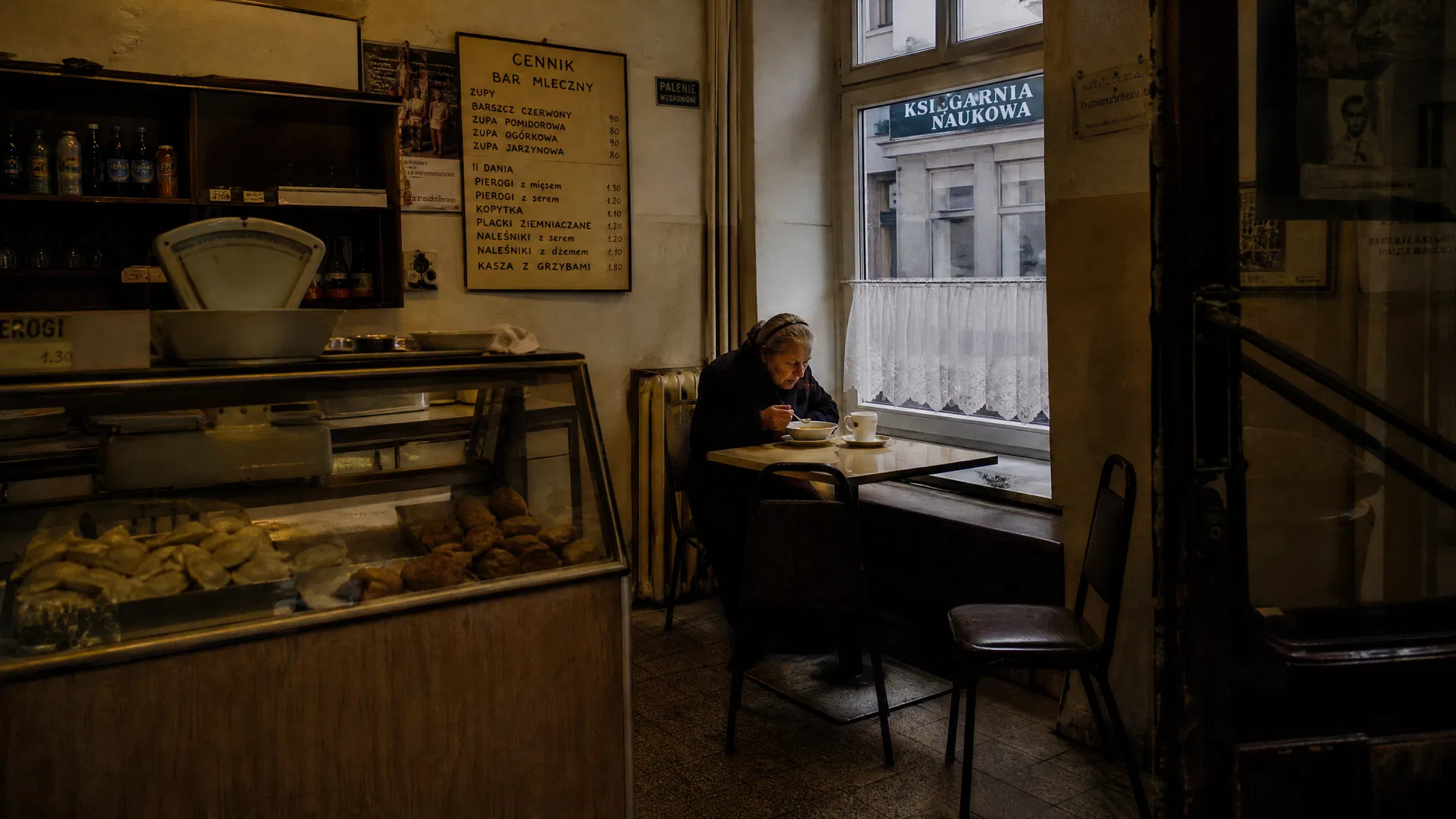
The term "milk bar" — bar mleczny in Polish — sounds like a 1950s American soda fountain. The reality is something more specific and more interesting: a government-subsidized canteen that has been feeding Poles of every social class for the better part of a century, and that currently serves a three-course meal for approximately the price of a coffee elsewhere in Europe.
The milk bar predates communism. It grew in popularity in the 1950s as Poland dealt with post-war destruction and economic collapse, when getting inexpensive, nourishing meals to the population was a political necessity. At their peak, there were an estimated 70,000 milk bars across the country. Today the number is a fraction of that, and the ones that remain are navigating a genuine existential crisis: the cooks are aging out, culinary school graduates have no interest in the wages, and government subsidies are a political football in local elections. Kraków's milk bar funding became a campaign issue in recent local elections — politicians assumed the primary users were people on food assistance; the reality is that students, office workers, retirees, and tourists all queue at the same counter.
What you eat at a milk bar is not fancy. The menu is essentially the same at every establishment: żurek (sour rye soup with kielbasa and hard-boiled egg), barszcz czerwony (hot beet soup), pierogi in their various forms, kopytka (hoof-shaped potato dumplings that function as Polish gnocchi), placki ziemniaczane (potato pancakes), naleśniki (blintzes, usually with apple filling), and kluski leniwe — "lazy dumplings," pasta strips served with melted butter, breadcrumbs, and sugar. The sugar is not an accident. Post-war Poland had shortages of almost everything except sugar, and the saying that circulated through milk bars — "sugar makes you stronger" — became embedded in the cooking. The sweetness you taste in milk bar food is a historical artifact.
The best milk bars in Kraków are not in the Old Town. Bar Mleczny Północny (Osiedle Teatralne 11) is in Nowa Huta, the communist-era model neighborhood built around a steel mill, where a local food writer once described crying over a plate of pierogi ruskie because they reminded him of his grandmother's cooking. The pierogi at Północny — stuffed with twaróg (smoky cow's cheese) and sprinkled with chopped fried bacon — are the benchmark against which every other pierogi in the city should be measured. Bar Mleczny Centralny (Osiedle Centrum C 1), also in Nowa Huta, serves breakfast: bułka z pastą jajeczną i kakao, half a bread roll with chopped hard-boiled egg, mayo, and onion, accompanied by a cup of hot cocoa. The cocoa is not whimsy — coffee shortages during the communist era made cocoa the default milk bar breakfast drink, and it stayed. Bar Mleczny Krakus (Bolesława Limanowskiego 16), near the Jewish Ghetto Memorial, is one of the few milk bars with an English menu and serves barszcz czerwony z uszkami year-round — hot beet soup with tiny mushroom-filled dumplings that are traditionally only eaten on Christmas Eve. Getting that dish in July is a minor miracle.
The milk bar is not a tourist attraction. It is a functioning institution that happens to be open to anyone who walks in and points at something on the menu. The pointing is acceptable. Nobody will judge you for it.
The Pierogi Taxonomy Nobody Told You About
The outside world knows one pierogi: the ruskie, stuffed with potato and cheese, boiled and served with sour cream or fried onion. This is approximately like knowing one type of pasta. The actual taxonomy is considerably more interesting, and understanding it changes what you order.
Pierogi ruskie are the most famous and the most misunderstood. The "ruskie" does not mean Russian — it derives from "Rus," the historical region of Red Ruthenia that now straddles western Ukraine and southeastern Poland. Some Poles, in response to the Russian invasion of Ukraine, have taken to calling them "pierogi ukraiński" in protest. The filling is twaróg (a fresh, slightly tangy cow's cheese) mixed with mashed potato and fried onion. The texture should be soft and slightly chewy, the filling dense but not heavy. A bad version is gluey. A good version at Bar Mleczny Północny is, by local consensus, metaphysical.
Pierogi z kapustą i grzybami — sauerkraut and wild mushroom — are the Christmas Eve pierogi, eaten during Wigilia, the Polish Christmas Eve supper. They are earthier and more complex than the ruskie, the mushroom flavor intensified by the fermented cabbage. Finding them outside of December is possible but requires knowing where to look.
Uszka — "little ears" — are the miniature version, thumb-sized dumplings filled with mushroom and served floating in barszcz czerwony. The name refers to their shape: pinched at the top into a small point that does, in fact, resemble an ear. These are the dumplings in the Christmas Eve beet soup. Bar Mleczny Krakus serves them year-round.
Kopytka — "little hooves" — are not technically pierogi at all. They are made from potato-based dough, shaped into hoof-like ovals, and served with melted butter. The texture is closer to gnocchi than to a dumpling. A local food guide will call them "Polish gnocchi" for the benefit of Italian visitors. The name is more accurate than it sounds.
Kluski leniwe — "lazy dumplings" — are even further from the pierogi family: pasta strips made from twaróg and flour, served with melted butter, breadcrumbs, and sugar. The "lazy" refers to the fact that they require no filling, no pinching, no shaping beyond cutting the dough into strips. They are the milk bar equivalent of comfort food at its most direct.
Pierogi z owocami — fruit pierogi, filled with blueberries or strawberries, served with sour cream and sugar — are the sweet version that most visitors never encounter because they appear on menus only in summer when the fruit is in season. They are also the version that most clearly demonstrates what Polish food actually is when it is not performing for an audience: seasonal, simple, and considerably more delicate than its reputation suggests.
The Kraków 4-Day Travel Guide covers the full food itinerary across four days, including which milk bars to hit on which mornings and how to structure a pierogi crawl across the Old Town and Kazimierz. The Kraków 3-Day City Break Guide maps the most efficient route through the food highlights for a shorter visit.
Kazimierz: The Jewish-Polish Culinary Revival
Kazimierz was Kraków's Jewish quarter for five centuries before the Second World War. The community that built it — one of the largest and most culturally significant Jewish communities in Europe — was almost entirely destroyed. What remained was a neighborhood of empty synagogues, abandoned courtyards, and buildings that had outlasted the people who built them.
The revival that has happened in Kazimierz over the past three decades is complicated and contested. Some of it is straightforward gentrification. Some of it is tourism built on tragedy. But some of it is something more specific and more interesting: a genuine attempt to reconstruct and serve the food that was cooked in these streets before the war, made by people — some Jewish, some not — who understand that food is one of the few ways a culture can be partially recovered from catastrophe.
Cheder Cafe (Józefa 36) operates out of a former synagogue and serves an Israeli-inspired breakfast that has become one of the most specific and unreplicable dining experiences in the city. The Finjan coffee — dark, rich, brewed with cardamom and brown sugar — is not available anywhere else in Kraków. The fresh pita with labneh and beet pesto arrives on a wooden board. The pastries change weekly. In the evenings, the space hosts lectures, concerts, and Judaica film screenings organized by the Jewish Culture Festival. The atmosphere is calm and bookish in the mornings, charged and communal at night.
Hevre (Beera Meiselsa 18) occupies a former prayer house and has retained the building's original frescoes and antique chandeliers while becoming, depending on the hour, either Kazimierz's most atmospheric restaurant or its most energetic club. The menu revolves around Galician-Jewish dishes — duck sandwiches on potato rolls, inventive takes on traditional preparations — and the bar pours unpasteurised Pilsner Urquell straight from the tank, a detail that sounds minor until you taste the difference. On weekend nights, the space transforms completely: the tables clear, the DJs arrive, and the prayer house becomes something its original builders could not have imagined.
Klezmer Hois (Szeroka 6) is the most historically weighted of the Kazimierz restaurants. It was cofounded by Leopold Kozłowski-Kleinmann, the last klezmer musician of Galicia, and occupies what was once a mikvah on Szeroka Street. The guest list over the years has included Steven Spielberg, Roman Polański, and Czesław Miłosz. The chicken kneidlach — matzah balls in dill sauce — and the goose pipkes are the dishes to order. Live klezmer concerts begin every evening at 8 PM. The music is not background noise; it is the point.
Ariel (Szeroka 18) is the most established of the Kazimierz restaurants and the most straightforward: carp, herring with onions and cream, roast goose with cherries, chicken-liver-stuffed goose necks, Slivovitz. The private Judaic art collection housed in the restaurant is the only one of its kind in Kraków. The dining rooms, with their antique lamps and eclectic paintings, feel like a set from a film about pre-war Jewish life — which is, in a sense, exactly what they are.
The food in Kazimierz is not a museum exhibit. It is cooked and served and eaten by people who have made a deliberate choice to keep it alive. Whether that constitutes authentic cultural recovery or something more complicated is a question the neighborhood itself is still working out. The food, in the meantime, is excellent.
The Street Food You Eat Standing Up at Midnight
No account of Kraków food is complete without Plac Nowy and the zapiekanka. Plac Nowy is the circular market square at the heart of Kazimierz, and the zapiekanka is the thing you eat there: an open-faced baguette, toasted, topped with mushrooms and melted cheese, finished with ketchup or a sharp mustard sauce. It costs almost nothing. It is available from the circular kiosk in the center of the square at any hour. It is, by a significant margin, the most Kraków thing you can eat, and it is eaten standing up, usually after midnight, usually with a Żywiec beer from one of the surrounding bars.
The zapiekanka is not on any food guide's list of sophisticated dining experiences. It is not meant to be. It is the food that Kraków eats when it is not performing for visitors, which is precisely why it belongs in this post.
The Pączki Question
Pączki — Polish doughnuts — are the subject of more tourist disappointment than almost any other Polish food. The version available in most bakeries and cafés is a competent, unremarkable fried dough ball filled with rose jam or custard. The version available at Michałek (Krupnicza 20) is something else entirely: filled with rose petal jam made from actual rose petals, fried to a specific golden color, dusted with powdered sugar and a strip of candied orange peel. The difference between the two is the difference between a gas station croissant and a proper one. Michałek is a five-minute walk from the Rynek Główny. There is no reason to eat the other version.
The New Polish Kitchen
The milk bars and the pierogi taxonomy and the Kazimierz revival are the foundation. But Kraków also has a generation of chefs who have grown up with that foundation and are doing something more ambitious with it.
Karakter (Krupnicza 6) is the restaurant that locals mention first when asked for a recommendation that isn't a tourist trap. The cuisine is creative Polish — traditional ingredients and techniques applied with precision and imagination — served in a room that is neither pretentious nor casual but occupies the specific register of a place that knows exactly what it is. The full tasting menu is the way to eat here. The wine list is serious. The prices are, by the standards of comparable restaurants in Paris or London, almost embarrassingly reasonable.
Bottiglieria 1881 (Bocheńska 5) holds a Michelin star and is the most technically accomplished restaurant in the city. It is not a Polish food restaurant in any traditional sense — the cuisine is European with Polish inflections — but it represents the ceiling of what Kraków's food scene has become. A reservation requires planning.
Glonojad (Plac Matejki 2) is the vegetarian milk bar alternative that has built a devoted following among Cracovians who want the milk bar format — affordable, unpretentious, filling — without the meat. The soups are excellent. The potato dishes are excellent. It is the proof that the milk bar concept is not inherently tied to its communist-era origins.
Planning Your Kraków Food Trip
Kraków is one of the most affordable cities in Europe for food. A full meal at a milk bar costs less than a coffee at a Viennese café. A dinner at Karakter — three courses, wine — costs less than a mid-range meal in most Western European capitals. The food budget that would last two days in Paris lasts a week in Kraków.
The practical logistics: the Old Town and Kazimierz are walkable from each other (about 15 minutes on foot). The milk bars in Nowa Huta require a tram ride — roughly 20 minutes from the city center — but the journey is worth making at least once, both for the food and for the architecture of the neighborhood itself.
For families traveling to Poland, the Kraków Family Adventure Guide covers the food options that work with children, including which milk bars have the most accessible menus and how to navigate the Kazimierz food scene with kids. For travelers extending beyond Kraków, the Warsaw 3-Day Couples Guide and the Warsaw 4-Day City Guide cover the capital's food scene, which is different in character — more international, more expensive, more recently rebuilt — but equally worth understanding. The Wrocław Couples Guide and the Gdańsk Couples Guide round out a Poland food itinerary that would take the reputation argument apart at every stop.
What to Eat in Kraków: A Practical Reference
Milk Bars (Bar Mleczny)
- Bar Mleczny Północny — Osiedle Teatralne 11, Nowa Huta. Best pierogi ruskie in the city.
- Bar Mleczny Centralny — Osiedle Centrum C 1, Nowa Huta. Breakfast: cocoa and egg roll.
- Bar Mleczny Krakus — Bolesława Limanowskiego 16. Year-round barszcz z uszkami.
- Bar Mleczny Żaczek — Czarnowiejska 75. Student crowd, kopytka z masłem.
Kazimierz
- Cheder Cafe — Józefa 36. Israeli-inspired breakfast, Finjan coffee, evening events.
- Hevre — Beera Meiselsa 18. Galician-Jewish menu, unpasteurised Pilsner Urquell, weekend club.
- Klezmer Hois — Szeroka 6. Traditional Galician Jewish food, live klezmer at 8 PM.
- Ariel — Szeroka 18. Roast goose, carp, Slivovitz, private Judaic art collection.
Street Food
- Plac Nowy — Kazimierz. Zapiekanka from the circular kiosk. Any hour.
Pączki
- Michałek — Krupnicza 20. Rose petal filling. No substitutes.
New Polish Kitchen
- Karakter — Krupnicza 6. Creative Polish cuisine. Full tasting menu.
- Bottiglieria 1881 — Bocheńska 5. Michelin star. Book ahead.
- Glonojad — Plac Matejki 2. Vegetarian milk bar alternative.
The reputation problem is real. It was built on real experiences of real food that was genuinely not very good. But it was built on the wrong food, served in the wrong places, by people who had learned to give visitors what they expected rather than what the country actually produces. Kraków is where you find out what Poland actually tastes like. It is, by most measures, considerably better than advertised.