Iceland in Winter vs. Summer: Which Season Actually Wins?
Destination: Iceland
Category: Destination Guides
Iceland in Winter vs. Summer: Which Season Actually Wins?
The Northern Lights crowd and the midnight sun crowd have been arguing about this for years. Here's the honest breakdown — what each season actually delivers, what it costs you, and how to decide which version of Iceland you're ready for.
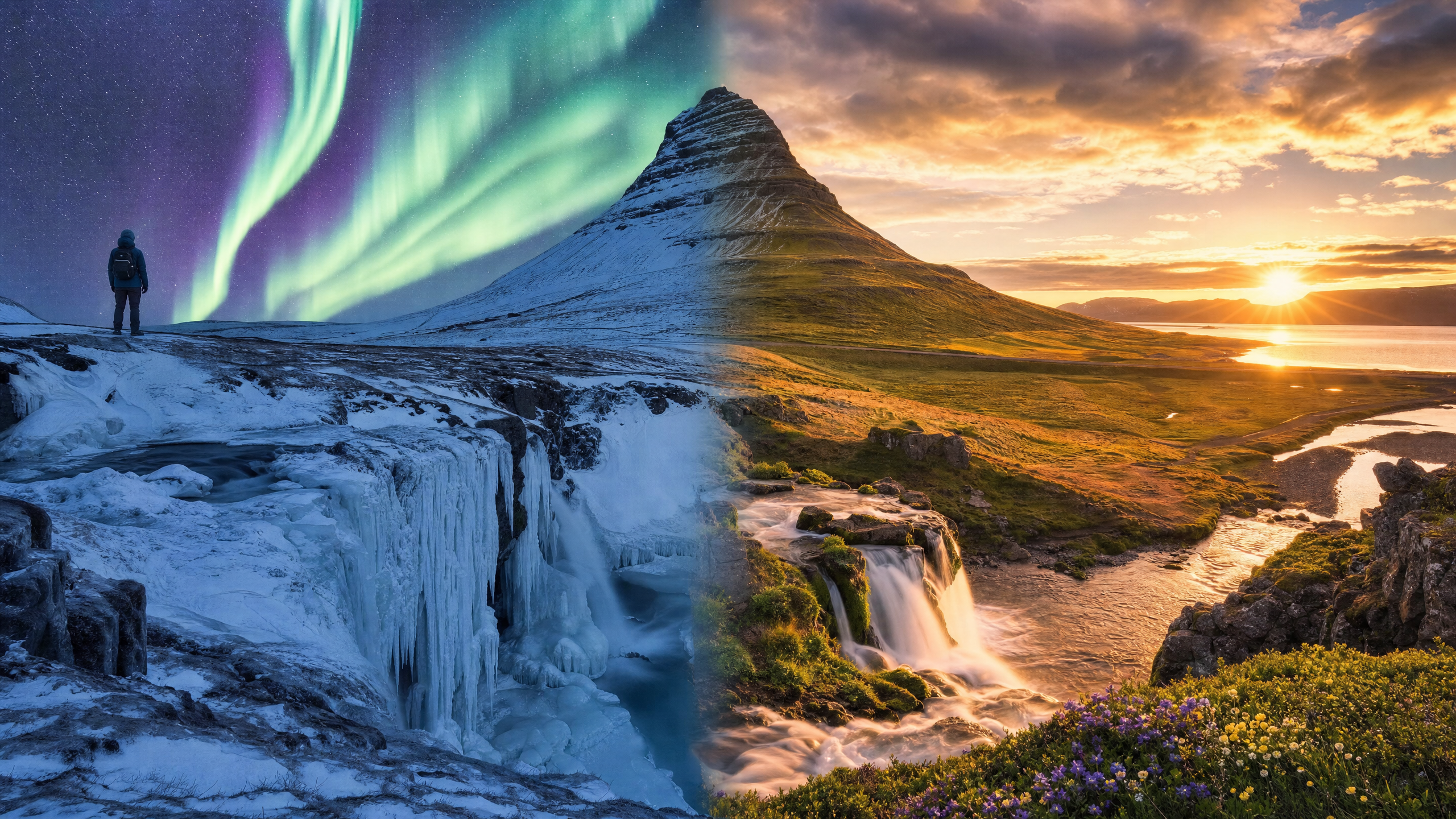
Iceland doesn't do moderation. In winter, the sun barely clears the horizon before retreating, the landscape turns monochrome and volcanic, and the sky occasionally erupts in green fire. In summer, the sun refuses to set at all, the lupine fields bloom purple across lava fields, and puffin colonies crowd the sea cliffs while waterfalls run at their most powerful.
These are not two versions of the same destination. They are two different countries sharing the same geography, and choosing between them is one of the most consequential travel decisions you can make for a single trip.
This guide doesn't hedge. It tells you exactly what each season delivers, where it falls short, what it costs, and which one is right for the specific kind of traveler you are.
The Fundamental Divide
Iceland sits at 65 degrees north latitude — just below the Arctic Circle — which means the difference between its seasons is more extreme than almost anywhere else travelers commonly visit. The sun angle, day length, temperature, road accessibility, and wildlife calendar all shift dramatically between June and January.
Summer (June–August): 20–24 hours of daylight. Temperatures 10–15°C (50–60°F). All roads open, including the F-roads into the interior highlands. Puffins, Arctic terns, and seabirds in abundance. Waterfalls at maximum flow. Lupine fields in bloom. No Northern Lights.
Winter (November–March): 4–6 hours of daylight. Temperatures -5 to 5°C (23–41°F). Interior F-roads closed. Ice caves accessible. Northern Lights visible on clear nights. Snow-covered landscapes. Fewer tourists, lower prices.
Shoulder seasons (April–May, September–October): The transition periods that offer elements of both — and are increasingly cited by experienced Iceland travelers as the best windows of all.
The Case for Iceland in Winter
The Northern Lights Are Real — But So Is the Catch
The aurora borealis is the primary reason most people choose winter Iceland, and the experience, when it happens, is genuinely transformative. Standing in a snow-covered lava field at 11pm watching green curtains of light ripple across the sky is the kind of moment that recalibrates your sense of what's possible in the natural world.
The catch: the Northern Lights are not guaranteed. They require three simultaneous conditions — solar activity (the Kp index), clear skies, and darkness. Iceland's winter weather is notoriously unpredictable, with cloud cover being the most common obstacle. Many travelers spend 5–7 nights in Iceland in winter and see the lights once, briefly. Some see them multiple times. Some don't see them at all.
The practical implication: don't build an entire trip around a single night of aurora viewing. Build a trip that would be excellent without the lights, and treat the aurora as a bonus. The winter landscape — black lava fields under snow, frozen waterfalls, steaming geothermal vents against grey skies — is extraordinary on its own terms.
Where to maximize your aurora chances: Get away from Reykjavík's light pollution. The Snæfellsnes Peninsula, the Westfjords, and the area around Vík on the South Coast are all significantly darker than the capital. Download the Aurora Forecast app (Veðurstofa Íslands) and check it obsessively. When the forecast is good and the skies clear, be outside.
For a Reykjavík-based winter trip with day excursions: → Reykjavík 3-Day Iceland Itinerary
Ice Caves: The Winter-Only Experience
The ice caves inside Vatnajökull glacier — the largest glacier in Europe — are only accessible from November through March, when temperatures are cold enough to keep the ice stable. These are not tourist constructions; they are natural formations created by meltwater carving channels through ancient glacial ice, and the blue light that filters through the ice above you is one of the most otherworldly visual experiences available anywhere on earth.
The caves change every year. Some years produce vast cathedral-like chambers; others yield narrower, more intimate tunnels. No two visits are the same, and no photograph fully captures the quality of the light.
Access requires a certified glacier guide — the ice is dynamic and dangerous without expertise. Tours typically depart from Jökulsárlón glacier lagoon, which is itself one of Iceland's most spectacular sights: a lagoon filled with icebergs calved from Vatnajökull, some the size of houses, drifting slowly toward the sea. In winter, the lagoon is quieter than in summer, and the icebergs are often dusted with snow.
The Solitude Factor
Iceland in winter is a fundamentally different social experience than Iceland in summer. The tourist infrastructure is present — the Golden Circle runs year-round, the Blue Lagoon is open, Reykjavík's restaurant scene is fully operational — but the crowds are dramatically thinner.
The Seljalandsfoss waterfall, which in July requires navigating hundreds of other visitors on the path behind the falls, is in January a place where you might be alone with the ice formations and the sound of water. The Golden Circle's Geysir geothermal area, which in August is a shoulder-to-shoulder spectacle, is in February a steaming, alien landscape with room to breathe.
For travelers who find crowds genuinely diminishing to the travel experience, winter Iceland is not a compromise — it's the preferred version.
What Winter Costs You
Daylight. In December, Reykjavík gets approximately 4 hours of usable daylight. This is not a minor inconvenience — it fundamentally shapes what you can do and when. Road trips require careful planning: you'll be driving in darkness for much of the day. Waterfalls and landscapes are best seen in the brief window of golden-hour light that winter provides, which is beautiful but brief.
Road access. The F-roads — the unpaved highland routes that connect Iceland's most remote interior — are closed from October through May or June. This means the Landmannalaugar geothermal highlands, the Þórsmörk valley, and the Kjölur route are inaccessible in winter. The Ring Road (Route 1) remains open year-round but can be affected by storms and ice. Always check road.is before driving.
Weather unpredictability. Iceland's winter weather is genuinely severe. Storms can arrive with little warning, closing roads and making outdoor activities impossible for 24–48 hours. Build buffer days into any winter itinerary. A 7-day trip with no flexibility is a gamble; a 7-day trip with one or two unscheduled days is a reasonable plan.
The Case for Iceland in Summer
The Midnight Sun: Disorienting, Magnificent, Addictive
The midnight sun is the summer equivalent of the Northern Lights — an atmospheric phenomenon that sounds like a gimmick until you experience it, and then becomes the thing you tell people about for years.
In June and early July, the sun in Iceland does not set. It dips toward the horizon around midnight, turns the sky amber and gold, and then begins rising again. The quality of light at 11pm is extraordinary — long, warm, horizontal, the kind of light that photographers spend their careers chasing. The landscape glows. The waterfalls catch the light at angles that don't exist at noon.
The practical challenge: sleep. Your body's circadian rhythm is tied to darkness, and Iceland in summer provides none. Bring a sleep mask. Accept that you'll stay up later than you planned, because the light at midnight is genuinely too beautiful to sleep through. This is not a bug; it's the feature.
The Highlands: Iceland's Best-Kept Secret
The interior highlands of Iceland — accessible only from June through September via F-roads — are one of the most extraordinary landscapes on earth and one of the least visited. The Landmannalaugar geothermal area features rhyolite mountains in shades of red, orange, yellow, and green that look like a fever dream. The Þórsmörk valley is a green oasis surrounded by glaciers and volcanic ridges. The Kjölur route crosses the interior plateau between Hofsjökull and Langjökull glaciers, passing through landscapes that feel genuinely prehistoric.
These places require a 4WD vehicle with high clearance — the F-roads involve river crossings and rough terrain that standard rental cars cannot handle. But for travelers willing to make the logistical commitment, the highlands are the version of Iceland that most visitors never see, and the version that experienced Iceland travelers return for.
For a Ring Road adventure that includes highland access: → Iceland Ring Road 7-Day Adventure Guide | Iceland Ring Road 12-Day Itinerary with Westfjords
Wildlife: Puffins, Whales, and the Arctic Summer
Iceland in summer is one of the world's great wildlife destinations, and this fact is consistently underplayed in travel content that focuses on the geological spectacle.
Puffins arrive in Iceland from April through August to breed, congregating in enormous colonies on sea cliffs around the country. The Westman Islands (Vestmannaeyjar) host the largest Atlantic puffin colony in the world — approximately 10 million birds. The Látrabjarg cliffs in the Westfjords are accessible by road and allow you to stand within feet of puffins that have no fear of humans. The Borgarfjörður Eystri area in East Iceland is another exceptional puffin site, less visited than the Westfjords and correspondingly more atmospheric.
Humpback and minke whales are present in Icelandic waters year-round, but summer brings them closer to shore and makes whale watching tours significantly more productive. Húsavík, in North Iceland, is considered the whale watching capital of Europe — the bay's nutrient-rich waters attract humpbacks reliably from May through October, and the boats are small enough to provide genuinely intimate encounters.
Arctic terns are the most aggressive wildlife you'll encounter in Iceland — these small seabirds dive-bomb anyone who comes near their nests with genuine commitment, and their nesting areas (often right beside roads and paths) are marked with warning signs. They are also extraordinary fliers, and their presence is a reminder that Iceland sits at the edge of the Arctic, where the rules of the natural world are different.
The Waterfalls at Full Volume
Iceland's waterfalls are spectacular year-round, but summer brings them to their maximum power as snowmelt and rainfall combine to push water volumes to their peak. Skógafoss, Seljalandsfoss, Gullfoss, Dynjandi in the Westfjords — all of these are more powerful and more dramatic in summer than at any other time of year.
Seljalandsfoss is unique: a path runs behind the waterfall, allowing you to walk through the curtain of water and look out through it at the landscape beyond. In winter, this path is closed due to ice. In summer, it's wet, slippery, and one of the most memorable 10-minute walks in Iceland.
Dynjandi — the "jewel of the Westfjords" — is a series of seven cascading waterfalls that together form a shape like a bridal veil. It's a 2-hour drive from the main Ring Road, which means most visitors never see it. In summer, the road is open and the falls are at full power. This is the kind of place that makes you understand why Iceland inspires the travel obsession it does.
What Summer Costs You
Crowds. Iceland's tourism has grown dramatically over the past decade, and summer is when the full weight of that growth is felt. The Golden Circle in July is busy. The Blue Lagoon requires advance booking weeks ahead. Jökulsárlón glacier lagoon has tour buses. Skógafoss has queues for the staircase to the top.
This doesn't ruin the experience, but it changes it. The solitude that Iceland's landscape seems to promise is harder to find in summer, particularly on the South Coast between Reykjavík and Vík, which is the most heavily trafficked stretch of road in the country.
Price. Summer is peak season, and prices reflect it. Accommodation in Reykjavík in July costs significantly more than in January. Car rental prices spike. Tours book out. If budget is a constraint, summer Iceland requires more advance planning and more financial commitment.
The Shoulder Seasons: The Argument for April–May and September–October
Experienced Iceland travelers increasingly point to the shoulder seasons as the best windows, and the argument is compelling.
April and May offer the transition from winter to summer: the days are lengthening rapidly (gaining 5–7 minutes of daylight per day in April), the landscape is still dramatic with snow on the mountains, the waterfalls are running at high volume from snowmelt, and the crowds haven't arrived. Puffins begin returning in late April. The F-roads are still closed, but the Ring Road and most secondary routes are open. Prices are mid-range.
September and October offer the reverse transition: summer crowds have departed, the Northern Lights become visible again (September nights are dark enough for aurora viewing from around the 20th onward), the autumn colors appear on the hillsides, and the waterfalls are still running strongly. The F-roads are still open in September, giving you highland access combined with the possibility of Northern Lights — a combination that doesn't exist in any other window.
September is arguably the single best month to visit Iceland for travelers who want to maximize their options: highlands accessible, Northern Lights possible, crowds thin, prices reasonable, and the landscape at its most varied and dramatic.
For an adventure-focused trip in shoulder season: → Iceland 7-Day Adventure & Nature Guide
For Reykjavík as a base with day trips: → Reykjavík 4-Day Adventure Guide
The Practical Comparison
| Factor | Winter (Nov–Mar) | Summer (Jun–Aug) | Shoulder (Apr–May, Sep–Oct) |
|---|---|---|---|
| Northern Lights | Possible on clear nights | Not visible | Sep–Oct: possible |
| Midnight Sun | No | Yes (Jun–Jul) | Partial (Apr–May, Aug) |
| Ice Caves | Yes (Nov–Mar) | No | No |
| F-Road Highlands | Closed | Open (Jun–Sep) | Sep: open; Apr–May: closed |
| Puffins | No | Yes (May–Aug) | Apr–May: arriving; Sep: departing |
| Crowds | Low | High | Medium |
| Prices | Low–Mid | High | Mid |
| Daylight hours | 4–6 hours | 20–24 hours | 10–18 hours (increasing/decreasing) |
| Waterfalls | Partially frozen | Maximum flow | High flow |
| Road conditions | Variable, storms possible | Generally good | Generally good |
The Honest Verdict
Choose winter if: The Northern Lights are a genuine priority (not just a nice-to-have), you want ice caves, you prefer solitude over spectacle, and you're comfortable with limited daylight and weather variability. Winter Iceland rewards travelers who are flexible, patient, and genuinely interested in the landscape on its own terms rather than as a backdrop for activities.
Choose summer if: You want to drive the Ring Road in full, access the highlands, see puffins and whales, experience the midnight sun, and have the most activity options available. Summer Iceland is the more accessible, more forgiving, and more comprehensively beautiful version of the country — at the cost of crowds and price.
Choose September if: You want the best of both worlds. The Northern Lights are returning, the highlands are still open, the crowds have thinned, and the autumn light on Iceland's volcanic landscape is extraordinary. September is the month that experienced Iceland travelers often cite as their favorite, and it's consistently underbooked relative to its quality.
What Nobody Tells You: The Real Iceland Regardless of Season
There are things about Iceland that are true in January and July alike, and they're worth knowing before you go.
The wind is the variable nobody prepares for. Iceland's weather is defined less by temperature than by wind. A 5°C day with 80km/h winds is a genuinely difficult experience. A -5°C day with calm air is manageable and often beautiful. Check wind forecasts alongside temperature forecasts. The Vedur.is app is the authoritative source.
The Blue Lagoon is not Iceland's best geothermal experience. It's the most famous, the most accessible, and the most expensive. The Secret Lagoon near Flúðir, the Myvatn Nature Baths in North Iceland, and the Krauma baths near Reykholt are all less crowded, less expensive, and more atmospherically Icelandic. The Blue Lagoon is worth doing once — it's genuinely beautiful and the silica mud is legitimately good for your skin — but it shouldn't be the centerpiece of your trip.
The Ring Road takes longer than you think. The full Ring Road (Route 1) is approximately 1,332 kilometers. Driving it in 7 days is possible but leaves almost no time for detours, hikes, or spontaneity. 10–14 days is the more honest minimum for a Ring Road trip that includes the Westfjords and the highlights of each region.
The food has gotten genuinely good. Iceland's restaurant scene — particularly in Reykjavík — has transformed over the past decade. The Icelandic lamb is among the best in the world (the sheep roam free on highland grasses and Arctic herbs). The skyr is not yogurt, it's a cultured dairy product with a different texture and a higher protein content. The hot dogs at Bæjarins Beztu Pylsur in Reykjavík are, inexplicably, one of the most satisfying things you'll eat in the country. The langoustine from the Westfjords and East Iceland is world-class — sweet, fresh, and almost criminally underpriced compared to what the same ingredient costs in Paris or London.
Driving in Iceland requires more respect than most rental car companies convey. The roads are not uniformly maintained, and conditions change rapidly. Gravel roads require slower speeds — the loose stones can crack windshields and damage tires, and most rental car insurance doesn't cover gravel damage unless you specifically add it. River crossings on F-roads require assessing current depth and flow before entering — people drive into rivers that are too deep every year. The rule is simple: if you're not certain, don't cross. There will always be another route or another day.
The Northern Lights forecast is not a guarantee. The Kp index measures solar activity on a scale of 0–9. In Iceland, you generally need a Kp of 3 or higher for visible aurora at lower latitudes, but the cloud cover variable is equally important and harder to predict. The most reliable strategy is to stay in Iceland for at least 5–7 nights, monitor the forecast nightly, and be willing to drive away from cloud cover when the forecast is good. The aurora can appear and disappear in minutes, or it can dance for hours — there's no predicting the duration, only the probability.
Planning Your Iceland Trip: Start Here
The guides below cover Iceland's main travel corridors and trip styles — from a long weekend in Reykjavík to a full Ring Road expedition with the Westfjords. Use them as your framework, then customize with the seasonal considerations above.
For the full Ring Road experience:
For adventure and nature focus:
For Reykjavík-based trips:
Built by travelers, for travelers — Your Next Adventure Starts Here.