Hoi An Is What Happens When Four Civilizations All Decide the Same Town Is the Best Place on Earth to Do Business.
Destination: Hoi An, Vietnam
Category: destination
The town had four different names because four different civilizations named it. The Vietnamese called it Hoai Pho. The Japanese merchants who built their quarter on the north bank of the Thu Bon River called it Faifo — a phonetic approximation of the Vietnamese name, filtered through Japanese mouths. The Portuguese and Dutch traders who arrived in the 16th century wrote "Faifo" on their nautical charts and meant it as a compliment: this is the place where things happen. The Chinese merchants from Fujian, Guangdong, Hainan, and Chaozhou provinces called it Pho Hoi, which means something like "the commercial street by the water." Four names. Four civilizations. One conclusion.
That conclusion — that this particular bend in the Thu Bon River, 30 kilometers south of Da Nang, was the best place in Southeast Asia to do business — is the reason Hoi An looks the way it does today. The yellow-walled buildings, the covered wooden bridge, the assembly halls, the lanterns, the food that cannot be reproduced anywhere else on earth: none of it is decorative. All of it is the physical residue of commerce. The beauty is what happens when merchants from four continents spend 400 years competing to build the most impressive structures, maintain the most useful relationships, and produce the most distinctive goods in a single small town.
You can understand Hoi An as a UNESCO World Heritage Site, as Vietnam's most photogenic town, as the place where you get clothes made and eat cao lau and release paper lanterns into the river. All of that is accurate. But it misses the argument. The argument is that Hoi An is not beautiful because someone decided to make it beautiful. It is beautiful because it was useful — and then, when it stopped being useful, it was too poor to demolish and rebuild.
That last part is important. In the 19th century, the Thu Bon River silted up. The large merchant ships could no longer reach the port. Da Nang, 30 kilometers north, took over as the region's commercial center. Hoi An became a backwater. The grand merchant houses were not torn down and replaced with concrete because there was no money to tear them down and replace them. The Japanese covered bridge was not demolished because no one needed the land it sat on. The assembly halls of the Chinese merchant guilds were not converted into apartment blocks because there were no developers interested in the site. UNESCO inscribed Hoi An in 1999 specifically because the town had avoided modernization — and the reason it had avoided modernization was that it had been economically irrelevant for 150 years. The beauty is a consequence of poverty. The poverty is a consequence of geography. The geography is a consequence of silt.
This is the town you are walking through.
The Architecture Is a Map of Who Was Here
The Old Town of Hoi An is small enough to walk end-to-end in fifteen minutes. In those fifteen minutes, you pass through four centuries of merchant architecture, and if you know what you are looking at, every building tells you something specific about who built it and why.
The Japanese Covered Bridge — Chùa Cầu, the Pagoda Bridge — was constructed around 1593 to connect the Japanese merchant quarter on the north bank of the canal with the Chinese quarter on the south. It is the only remaining Japanese-built structure in Vietnam. The bridge was not built as a monument. It was built as a practical connector between two merchant communities who needed to trade with each other but preferred to live separately. The covered roof was not decorative — it was shelter from the monsoon rain for merchants crossing between quarters. The small Taoist temple built into the middle of the bridge is dedicated to Trấn Vũ, the god of weather and protector of the town, because the merchants who built the bridge understood that their livelihood depended on the weather.
The legend attached to the bridge is specific: it was built to pin down Namazu, a giant catfish in Japanese mythology believed to live beneath the earth and cause earthquakes by thrashing its tail. The bridge, according to the legend, was positioned over the monster's spine. The statues of monkeys at one end and dogs at the other represent the lunar years in which construction began and was completed. The legend is not incidental folklore. It is a record of the anxieties of merchants who had crossed the Pacific to build a life in a foreign town and needed the earth to stay still.
The five Chinese assembly halls — Fujian, Cantonese, Hainan, Chaozhou, and the combined All-Chinese Assembly Hall — are the most direct evidence of how the Chinese merchant communities organized themselves. Each hall was built by a specific regional group as a place of worship, community governance, and commercial coordination. The Fujian Assembly Hall (built 1697, dedicated to Thien Hau, the goddess of the sea and protector of sailors) is the largest and most ornate, because the Fujian merchants were the most numerous and the most commercially dominant. The Hainan Assembly Hall was built as a memorial to 108 Hainanese merchants who were killed by Vietnamese soldiers in 1851 after being mistaken for pirates. The assembly halls are not tourist attractions that happen to be old. They are the physical records of specific communities, specific tragedies, and specific commercial relationships.
The merchant houses — Tan Ky House (built late 18th century, seven generations of the same family), Phung Hung House (built 1780, still inhabited by the eighth generation of the original family) — are architecturally hybrid in a way that is unique to Hoi An. The roof is Japanese. The interior columns are Chinese. The ground-floor layout is Vietnamese. The buildings are not confused. They are the physical record of merchants who dealt with Japanese, Chinese, and Vietnamese customers every day and built their homes to signal fluency in all three cultures simultaneously.
The Food That Cannot Leave
Cao lau is the dish that explains Hoi An better than any building. It is a noodle dish — thick, slightly starchy rice noodles, sliced char siu pork, crispy croutons made from the same dough as the noodles, fresh herbs, a small amount of broth — that is eaten in Hoi An and only in Hoi An. Not in Hanoi. Not in Ho Chi Minh City. Not in Da Nang, 30 kilometers away. The dish exists in one town because the noodles require two ingredients that cannot be sourced anywhere else: water from the Ba Le well, a 10th-century Cham well in the back streets of the Old Town, and ash from a specific tree that grows on the Cham Islands, 13 kilometers offshore.
The Ba Le well is not on the tourist map. It is in a residential neighborhood behind the Old Town, square-shaped, concrete-sided, with Day-Glo green moss on the bricks. The water is alkaline in a specific way that affects the chemistry of the rice flour. The ash from the Cham Islands trees is used to treat the noodles during processing, giving them their distinctive texture — coarser on the outside, slightly starchy in the center, unlike any other noodle in Vietnam. The combination of these two local ingredients produces a noodle that cannot be replicated elsewhere. Cookbook versions exist. They are reportedly off. The texture never matches.
One family has held the cao lau noodle recipe for four generations. They have never shared it. The owner of Trung Bac restaurant — which has been serving cao lau for over 100 years — was asked by a food writer if he could watch the family make the noodles. "Absolutely not," he said. "No one watches." The restaurants in Hoi An that serve cao lau do not make the noodles themselves. They receive deliveries from the family workshop. This is why cao lau tastes consistent across the town: the source is the same.
White rose dumplings — banh bao banh vac — are the second dish that cannot leave. Translucent rice-flour dumplings stuffed with seasoned shrimp or pork, pleated by hand into a shape that resembles a white rose, served at room temperature with crispy fried shallots and a soy-fish sauce dip. Two extended families on Hai Ba Trung street have been making them for four generations. The recipe has never been written down. The restaurants in Hoi An that serve white rose dumplings do not make them in their kitchens. They receive deliveries twice a day from the two family workshops. White Rose Restaurant at 533 Hai Ba Trung is the original — owned and run by one of the two families, with the workshop visible from the dining room. A plate is 80,000 VND. Order a plate of white rose dumplings alongside cao lau and crispy fried wontons — the classic Hoi An trio, available at every family restaurant for around 220,000 VND total — and you have eaten the three dishes that define the town's culinary identity.
Com ga Hoi An — Hoi An chicken rice — is the third dish specific to the town. Different from Hainanese chicken rice in its use of turmeric-yellow rice and a specific herb blend. Ba Buoi restaurant at 22 Phan Chu Trinh is the most cited by locals. The dish is not on the tourist circuit in the same way as cao lau and white rose dumplings, which is exactly why it is worth finding.
The Bridge Between Two Worlds
The Japanese Covered Bridge is the most photographed structure in Hoi An, which means most visitors photograph it and move on. The photograph does not capture what the bridge actually is: the physical evidence of a moment in the 16th century when Japanese and Chinese merchants decided to build a connection between their separate quarters, and then built a temple inside the connection to protect it.
The bridge is 18 meters long. It crosses a small canal that once separated the Japanese merchant quarter from the Chinese quarter. The Japanese community in Hoi An was substantial in the late 16th and early 17th centuries — large enough to maintain its own quarter, its own customs, and its own architecture. The bridge was the daily crossing point between two of the most commercially important communities in Southeast Asia at the time. The merchants who crossed it every morning were conducting transactions that connected Japan, China, Vietnam, and the European trading empires in a single supply chain.
The Japanese community in Hoi An largely disappeared after 1635, when the Tokugawa shogunate issued the Sakoku edicts closing Japan to foreign trade and prohibiting Japanese nationals from living abroad. The merchants who had built the bridge, the houses, and the commercial relationships were ordered home or were stranded. The bridge remained. The Chinese merchants who stayed expanded their presence. The Vietnamese community grew. The town continued. The bridge became the symbol of a community that had built it and then been forced to leave.
The Night the Town Goes Dark
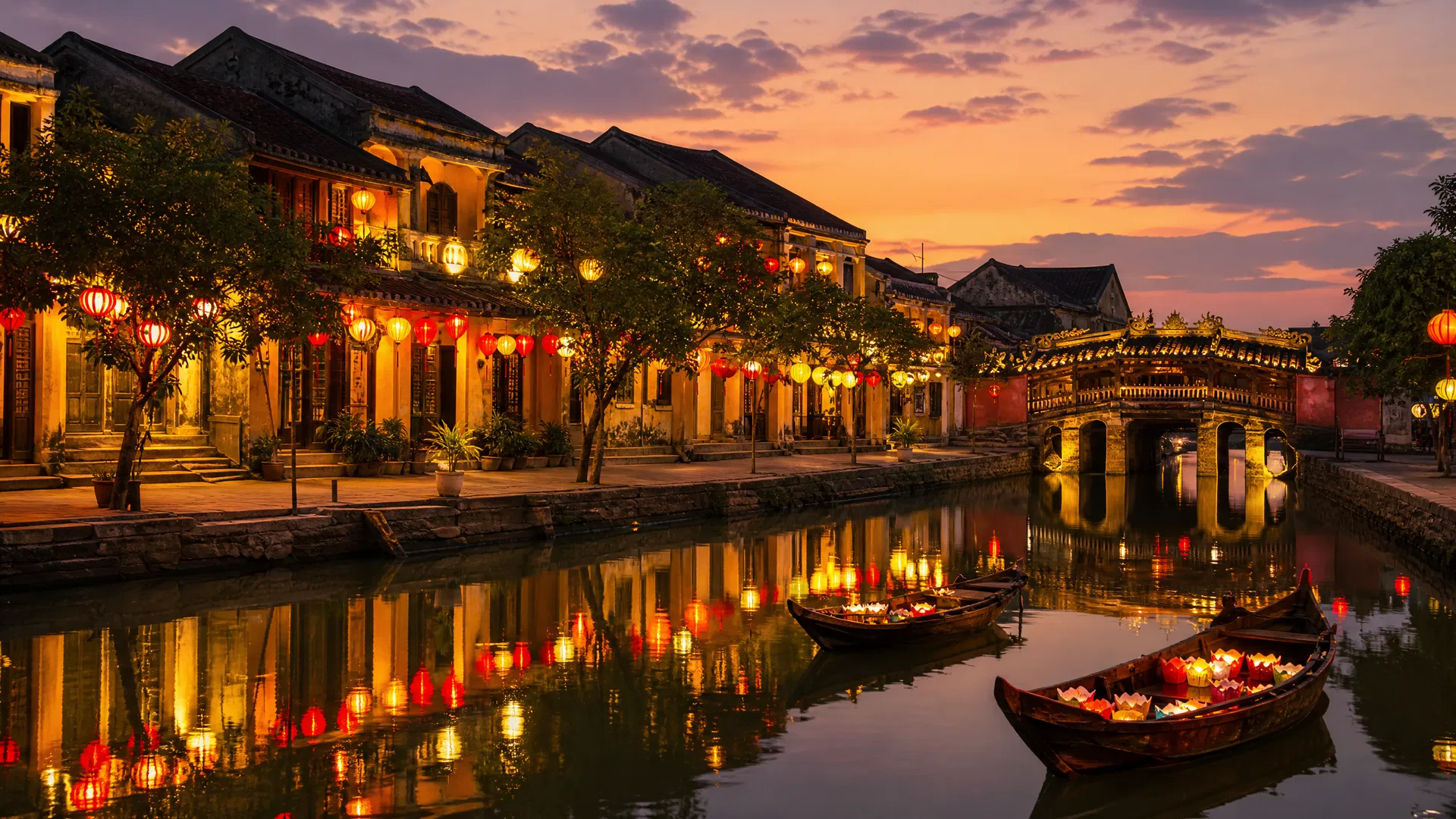
On the 14th day of every lunar month, the electricity in Hoi An's Ancient Town is switched off. The streets are lit by paper lanterns — silk and bamboo, in red and yellow and blue and green — hung from every building, every doorway, every bridge. The Thu Bon River is covered in floating candles, small paper boats carrying flames downstream. The town looks, for those hours, exactly as it looked in the 17th century.
The Full Moon Festival is not a performance for tourists. It is a Buddhist observance — the 14th night of the lunar month is one of the most sacred times in the Buddhist calendar — that Hoi An has maintained for centuries. The lanterns are not decorative. They are offerings. The floating candles are prayers. The fact that tourists now crowd the riverbank to watch is a consequence of the festival's beauty, not its purpose.
The practical information: the festival runs from approximately 6pm to 10pm. The Ancient Town is closed to motorbikes. The streets are crowded. The best position is on the Thu Bon River itself — rent a small boat for 50,000 to 100,000 VND and watch the lanterns from the water. The second-best position is the Japanese Covered Bridge, which is lit from below and reflected in the canal. Arrive before 6pm to find a position before the crowds arrive.
The Tailors and the Side Streets
Hoi An has more than 500 tailor shops. This number is both the opportunity and the problem. The tourist streets — Tran Phu, Le Loi, Nguyen Thai Hoc — are lined with shops that have learned to produce fast, cheap garments for travelers who want something made in 24 hours. The quality varies significantly, and the 24-hour turnaround is a warning sign rather than a selling point.
The tailors worth finding are not on the main tourist streets. They are on the side streets and in the residential neighborhoods adjacent to the Old Town. The two most consistently cited by long-term residents and repeat visitors are Yaly Couture at 47 Nguyen Thai Hoc — larger, more organized, better for complex garments — and A Dong Silk at 40 Le Loi. Both require a minimum of 48 hours for a fitting and final adjustments. Budget 48 to 72 hours minimum. Plan a fitting on day one, a check fitting on day two, and pickup on day three. The price range for a custom suit is $100 to $200 USD depending on fabric. A custom dress is $40 to $80 USD. The fabric quality matters more than the shop name — feel the fabric before you commit.
Tra Que and the Herb Villages
Three kilometers north of the Old Town, the Tra Que herb village supplies most of the fresh herbs used in Hoi An's restaurants. The specific herbs in cao lau — the Vietnamese mint, the bean sprouts, the fresh coriander — come from here. The specific herbs in white rose dumplings come from here. The village is the agricultural infrastructure that makes the food possible.
The bicycle ride from the Old Town to Tra Que takes 20 minutes through rice paddies and vegetable gardens. The village runs cooking classes that begin with a walk through the herb gardens and end with a meal of the dishes you have just learned to make. The connection between the garden and the dish is direct and verifiable.
When to Go and How Long to Stay
Hoi An has two distinct seasons. February to August is dry and increasingly hot — March to May is the sweet spot, with temperatures in the mid-20s Celsius and low humidity. September to January is the wet season, with October and November bringing the heaviest rainfall and occasional flooding in the Ancient Town. The flooding is not a reason to avoid October and November — the town has been flooding for centuries and continues to function — but it is a reason to pack accordingly and to book accommodation on higher ground.
Three days is the minimum for Hoi An done properly. Four days is better. Five days allows for a day trip to My Son Sanctuary (the Cham temple complex 40 kilometers west, a UNESCO site in its own right) and a full day at An Bang Beach (5 kilometers east, significantly less crowded than Cua Dai Beach). The Ancient Town itself requires two full days: one for the architecture and assembly halls, one for the food and the market.
The Ancient Town ticket costs 120,000 VND and covers five attractions from a list that includes the assembly halls, the merchant houses, the Japanese Covered Bridge interior, and the museums. The ticket is required for the interiors. The streets, the bridge exterior, and the market are free.
Planning Your Hoi An Trip
Hoi An is most commonly reached via Da Nang, 30 kilometers north — Da Nang International Airport has direct connections from most major Asian hubs and is a 45-minute taxi or Grab ride from the Old Town. The train from Hanoi takes 16 to 18 hours; the train from Ho Chi Minh City takes 17 to 19 hours. Both are worth considering if you are traveling the length of Vietnam and want to see the countryside.
For couples, the Hoi An 5-day couples guide builds the full itinerary around the Old Town, the Full Moon Festival timing, and the beach days at An Bang. The 3-day couples guide is the tighter version for shorter trips. Solo travelers will find the Hoi An solo guide covers the cycling routes, the cooking class options, and the best single-traveler restaurants in detail. For food-focused trips, the Hoi An food guide maps the full culinary circuit — cao lau, white rose dumplings, com ga, banh mi Phuong, and the morning market — across four days.
If you are building a longer Vietnam itinerary, the Vietnam 5-day country guide positions Hoi An within the north-to-south route. The Da Nang connection is covered in the Da Nang couples guide for travelers who want to split time between the two cities.
The Residue
The merchants are gone. The Japanese community was ordered home in 1635. The Dutch trading empire collapsed. The Portuguese moved their attention elsewhere. The Chinese merchant guilds gradually integrated into the Vietnamese population over generations. The Thu Bon River silted up. The ships stopped coming. The town became a backwater.
What they left behind is the town you are walking through. The assembly halls where they worshipped and governed. The merchant houses where they lived and traded. The bridge they built to connect their separate worlds. The food they brought with them and that became so entangled with the local water and the local ash that it can no longer leave. The lanterns they hung on feast days, which are still hung on the 14th of every lunar month, lit by the same light, carried downstream on the same river.
Hoi An is what happens when four civilizations all decide the same town is the best place on earth to do business. The commerce is over. The residue is extraordinary.