Hanoi Doesn't Perform for You. It Just Continues Being Itself.
Destination: Hanoi, Vietnam
Category: Destination Guides
There is a moment, somewhere in the first hour in Hanoi, when you stop trying to understand the traffic and simply step into it. The motorbikes don't stop for you. They don't speed up either. They flow around you the way water moves around a stone, and if you stand still and let it happen, you get across the street. This is not a metaphor for Hanoi. It is the operating principle of the entire city.
Hanoi has been occupied by the Chinese for a thousand years, colonized by the French for eighty, bombed by the Americans for a decade, and shaped by every single one of those forces — and it has outlasted all of them. The French built wide boulevards and neoclassical government buildings, and Hanoi absorbed them into its identity without becoming French. The Americans dropped more tonnage on North Vietnam than was used in all of World War II, and Hanoi rebuilt. The city does not perform resilience. It simply continues. That quality — the refusal to be defined by anyone else's agenda — is what you feel from the first hour, and it is what stays with you long after you leave.
Understanding this is the only way to understand why Hanoi feels so different from Bangkok, Singapore, or Ho Chi Minh City. Those cities have, in various ways, decided what they want to be for visitors. Hanoi hasn't made that decision, because it doesn't need to. It already knows what it is.
The Layers Are Still There
Most cities bury their history. Hanoi wears it in the street grid.
The Old Quarter — 36 streets, each named for the guild that once operated there — is one of the oldest continuously inhabited urban neighborhoods in Southeast Asia. Hang Bac means Silver Street. Hang Gai means Silk Street. Hang Dao means Dye Street. The names are a thousand years old and most of the streets still sell what they always sold, though the silk shops now cater to tourists and the silver shops have expanded into jewelry. Walk far enough down any of these streets and you will find yourself in a courtyard that was a temple before the French arrived and is still a temple now, with incense burning and offerings laid out and motorbikes parked three deep outside.
The French Quarter sits just south of the Old Quarter, and the transition is disorienting in the best possible way. The streets widen. The buildings grow taller and more ornate. The Opera House — modeled on the Paris Opéra Garnier, completed in 1911 — sits at the end of a broad boulevard as if it was always meant to be there, which it was, just not for Vietnamese people. The French built it for themselves. The Vietnamese took it back in 1945 when the Viet Minh announced the August Revolution from its balcony. The building is still standing. The French are not.
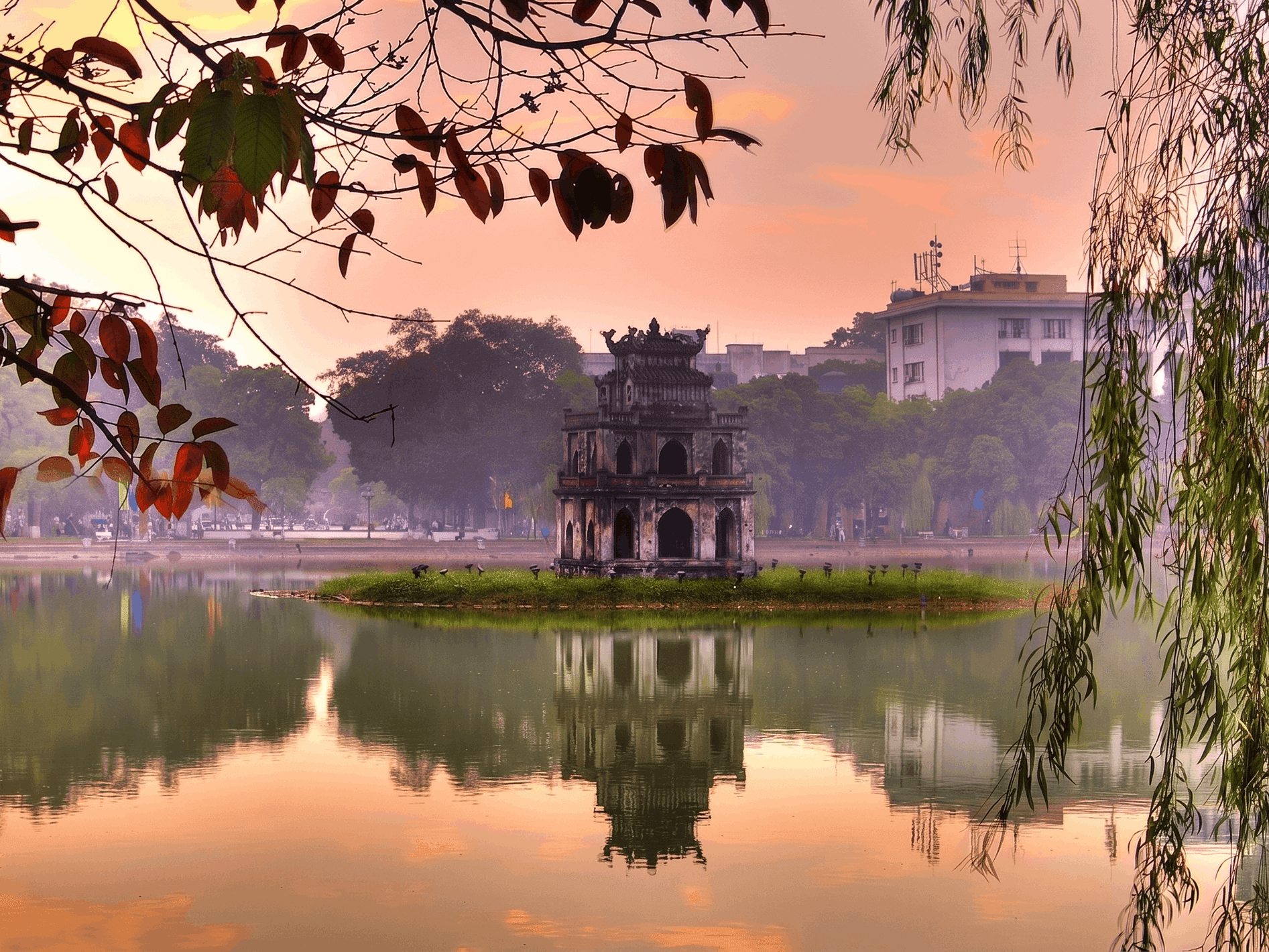
Hoan Kiem Lake sits at the center of all of this — a small lake in the middle of a city of eight million people, with a red wooden bridge leading to a small temple on a tiny island. At 6am, before the heat arrives, the lake is ringed with elderly Vietnamese doing tai chi and badminton and a form of shuttlecock-kicking that has no Western equivalent. By 8am, the tourists arrive. By noon, the heat makes the whole thing shimmer. Come at dawn if you want to understand what the lake is actually for.
Hoa Lo Prison: One Building, Two Stories of Oppression
There is no better single place in Hanoi to understand the city's layered history than Hoa Lo Prison, and most visitors spend forty-five minutes there and leave thinking they've seen a Vietnam War museum. They've missed the first half of the story.
The French built Hoa Lo in 1896 as Maison Centrale — a maximum-security prison for Vietnamese political prisoners. The name means "fiery furnace" in Vietnamese, a reference to the street that was previously known for making earthen cooking stoves. The French used it to hold, torture, and execute Vietnamese revolutionaries fighting for independence. The conditions were deliberately brutal. Prisoners were kept in leg irons. The guillotine was used. The Vietnamese called it Hoa Lo because the name was already there, and because naming something after a cooking stove is a form of defiance.
Then the Americans arrived. During the Vietnam War, Hoa Lo became the prison where American pilots shot down over North Vietnam were held. American POW Robert Shumaker gave it the name "Hanoi Hilton" — a piece of dark humor that stuck. John McCain was held here after his A-4 Skyhawk was shot down over Truc Bach Lake in 1967. He was held for five and a half years.
The museum presents both stories, though not with equal weight — the Vietnamese section is extensive, the American POW section is smaller and framed through a Vietnamese lens. This is not an accident and it is not dishonesty. It is a reminder that the same building contains two completely different experiences of oppression, and that the story you know depends entirely on which side of the wall you were on. Spend at least ninety minutes here. Read everything.
The Food Is Not Comfort Food. It Is History.
Pho in Hanoi is not the same as pho in Ho Chi Minh City, and this distinction matters more than most food writing acknowledges. Northern pho — pho Bac — has a clearer, less sweet broth. The noodles are wider. The garnishes are minimal: a few sprigs of green onion, some sliced chili, a squeeze of lime if you ask. There is no bean sprout pile, no hoisin sauce, no sriracha on the table. The broth is the point, and the broth takes twelve hours to make, and if you add too many condiments you are, in the Hanoian view, missing the point.
The best pho in Hanoi is a matter of genuine civic debate, but Pho Gia Truyen on Bat Dan Street — a narrow shophouse that has been serving the same recipe since 1955 — is the place that Hanoians themselves cite most often. The line forms before 7am. The restaurant closes when the broth runs out, which is usually before noon. Order the pho bo chin (well-done beef) and eat it standing up if necessary.
Bun cha is the other essential Hanoi dish, and it has a specific address attached to it now: Bun Cha Huong Lien, 24 Le Van Huu, south of the Old Quarter. This is where Barack Obama and Anthony Bourdain ate in 2016, and the restaurant has preserved the table and the menu item — "Combo Obama," grilled pork patties and noodles with a side of fried spring rolls — as a permanent fixture. The meal costs about $3. The line is worth it.
But the most Hanoi-specific food experience is the one that most visitors overlook entirely: ca phe trung, egg coffee. Nguyen Giang invented it in the 1940s when he was working as a bartender at the Sofitel Metropole — then the most luxurious hotel in Hanoi — during a period when dairy milk was scarce. He whipped egg yolk with sugar and condensed milk into a thick, custard-like foam and poured it over strong Vietnamese drip coffee. The result is something between a dessert and a beverage, served warm in a small ceramic cup that sits in a bowl of hot water to keep it at temperature. Cafe Giang, on Hang Gai Street in the Old Quarter, is still run by his family. The original recipe has not changed. Sit upstairs by the window and drink it slowly.
Tay Ho: The City That Exists for Locals
Most visitors to Hanoi never make it to Tay Ho — West Lake — which is a significant oversight. The lake is the largest in Hanoi, a few kilometers northwest of the Old Quarter, and the neighborhood that surrounds it is where the city's most interesting contemporary life happens.
Tay Ho has the highest concentration of expats in Hanoi, which has produced a café culture that is genuinely excellent rather than tourist-facing. The streets around the lake are lined with independent coffee shops that serve Vietnamese drip coffee alongside pour-overs and cold brew, with the kind of attention to sourcing and preparation that would not be out of place in Melbourne or Portland. This is not a coincidence — many of the café owners trained abroad or are second-generation Vietnamese-Americans who returned. The coffee here is some of the best in Southeast Asia.
Quan Thanh Temple, at the southern end of the lake, is one of the four sacred temples that were built to protect Hanoi in the eleventh century. It is dedicated to Tran Vu, the god of the north, and contains a four-ton bronze statue that dates to 1677. Arrive before 8am and you will have it almost entirely to yourself. Tran Quoc Pagoda, on a small island connected to the lake's eastern shore by a causeway, is the oldest Buddhist pagoda in Hanoi — founded in the sixth century, rebuilt in the seventeenth. The bodhi tree in the courtyard was grown from a cutting of the tree under which the Buddha is said to have achieved enlightenment, gifted to Vietnam by India in 1959.
Ha Long Bay: The Landscape Hanoi Has Always Been Oriented Toward
Hanoi is not a coastal city, but it has always been oriented toward Ha Long Bay — three hours east by road, a UNESCO World Heritage Site since 1994, and one of the most photographed landscapes on earth. The bay contains approximately 1,600 limestone karst islands rising from emerald water, most of them uninhabited, many of them hollow with caves that have been used as shelter for thousands of years.
The problem with Ha Long Bay is that it has been loved nearly to death by tourism. The most popular overnight cruises pack hundreds of boats into the same section of the bay, and the experience can feel more like a floating hotel district than a natural wonder. The solution is to book a cruise that goes to Lan Ha Bay — the southern section, technically part of Cat Ba Island's jurisdiction rather than Ha Long Bay proper — which has the same landscape with a fraction of the boat traffic. Two nights is the minimum to actually experience the bay rather than just photograph it.
The best reason to go is the kayaking. Paddling through a sea cave at low tide, into a hidden lagoon surrounded by karst walls with no other boats in sight, is the kind of experience that makes the three-hour bus ride entirely worthwhile. Go in October or November, when the weather is clearest and the summer crowds have thinned.
The Practical Argument for Hanoi Over Ho Chi Minh City
This is not a competition, but it is a real choice that most first-time visitors to Vietnam face, and the honest answer is that they are different countries within the same country.
Ho Chi Minh City (Saigon) is faster, louder, more international, more commercially developed, and more immediately legible to Western visitors. It is easier to navigate, easier to find English speakers, and easier to feel oriented within a few hours. It is also, in the view of many long-term Vietnam travelers, less distinctly Vietnamese — the French colonial layer is thinner, the American influence is more visible, and the pace of development has smoothed over some of the texture.
Hanoi is slower, more bureaucratic, more traditional in its social codes, and more demanding of patience. The Old Quarter is genuinely disorienting for the first day. The traffic is not a performance of chaos — it is actual chaos that operates according to rules you have to learn by doing. The food is less sweet, the hospitality is more reserved, and the city takes longer to reveal itself.
The reward for that patience is a city that feels like it belongs to itself. Hanoi is not performing for you. It is not trying to be Bangkok or Singapore or a version of somewhere else. It is a thousand-year-old capital that has been occupied, bombed, rebuilt, and occupied again, and it is still, unmistakably, Hanoi. That is the rarest thing a city can be.
Long Bien Bridge and the Market That Runs at Midnight
Long Bien Bridge is one of the oldest bridges in Vietnam — a cantilever steel structure designed by the Eiffel company and completed in 1903, stretching nearly two kilometers across the Red River. During the Vietnam War it was bombed repeatedly by American aircraft and rebuilt repeatedly by Vietnamese workers, and the repaired sections are still visible in the bridge's asymmetrical silhouette: the original French ironwork alternating with the rougher, heavier Vietnamese repairs. The bridge is still in use, carrying pedestrians, cyclists, and motorbikes across the river to the Long Bien district on the far bank.
At the Hanoi end of the bridge, beneath the approach ramp, is Long Bien Market — one of the largest wholesale food markets in northern Vietnam. It operates from approximately midnight to 4am, when the trucks arrive from the countryside with vegetables, fruit, fish, and meat for distribution to the city's restaurants and street vendors. By the time the city wakes up, the market has already done its work and most of the vendors have gone home. The market is not a tourist attraction. There are no signs in English. The stalls are lit by bare bulbs and the ground is wet and the air smells of fish and diesel and crushed leaves. It is also one of the most alive places in Hanoi, and arriving at 1am to watch the city's food supply being sorted and distributed is the kind of experience that makes you understand a city differently.
If you go — and you should go at least once — take a motorbike taxi from the Old Quarter. Wear shoes you don't mind getting wet. Don't get in the way of the porters.
The French Quarter and the Architecture of Occupation
The French arrived in Vietnam in the 1880s and spent the next seventy years building a version of France in the tropics. In Hanoi, this meant wide boulevards lined with tamarind trees, neoclassical government buildings faced in yellow stucco, and a residential quarter of villas with shuttered windows and tiled roofs designed to manage the heat. The French Quarter — roughly the area between Hoan Kiem Lake and the railway line — is the most intact example of French colonial urban planning in Southeast Asia, and walking through it produces a specific kind of cognitive dissonance: the architecture is unmistakably French, but the life happening in and around it is unmistakably Vietnamese.
The Sofitel Legend Metropole Hanoi, on Ngo Quyen Street, is the most historically significant hotel in Vietnam. Built in 1901, it has hosted Graham Greene, Charlie Chaplin, Joan Baez, and Jane Fonda, among others. During the Vietnam War, American bombs fell close enough to the hotel that guests sheltered in a bunker beneath the courtyard — the bunker was rediscovered during renovation work in 2011 and is now open for tours. The hotel is expensive to stay in and worth having a drink at regardless.
The Vietnam Museum of Ethnology, in the Cau Giay district west of the Old Quarter, is the best museum in Hanoi and one of the best ethnographic museums in Southeast Asia. It documents the 54 officially recognized ethnic groups of Vietnam through objects, photographs, and full-scale reconstructions of traditional houses from different regions. The outdoor section contains a stilt house from the Black Thai people, a communal house from the Bahnar people, and a water puppet theater. Allow three hours.
Getting the Timing Right
Hanoi has two distinct seasons and one deeply unpleasant transitional period. The cool, dry season runs from October through April — this is when the city is at its most pleasant, with temperatures between 15°C and 25°C, low humidity, and the kind of clear light that makes the Old Quarter look like a film set. October and November are the best months: the summer crowds have thinned, the weather is reliable, and Ha Long Bay is at its clearest.
The hot, wet season runs from May through September. The heat is serious — 35°C with high humidity — and the afternoon thunderstorms are dramatic and frequent. The city is still entirely functional in summer, and the prices are lower and the tourist numbers are down, but the experience of walking the Old Quarter at noon in July is genuinely uncomfortable. If you go in summer, plan your outdoor activities for early morning and late evening.
The transitional period between the dry and wet seasons — roughly February through April — brings a phenomenon called nồng nặc, a combination of drizzle, fog, and humidity that locals call "the sticky season." The visibility is low, the air feels damp, and the light is flat. It is not dangerous or unpleasant in any serious way, but it is worth knowing about if you are planning to photograph the city.
Tet — the Vietnamese Lunar New Year — falls in late January or early February and transforms Hanoi entirely. The city empties as people return to their home provinces, and then fills back up with flowers, lights, and the specific energy of a city celebrating its most important holiday. The Old Quarter is decorated with peach blossoms and kumquat trees. Hoan Kiem Lake is ringed with lights. If you can time your visit to overlap with the week before Tet, you will see a version of Hanoi that most visitors never encounter.
Plan Your Hanoi Trip
The guides below cover every way to experience Hanoi — from the street food circuit to the solo traveler's route through the Old Quarter to the family itinerary that balances history with Ha Long Bay.
- Hanoi 4-Day Food Guide: Pho, Bun Cha & Street Food
- Hanoi 5-Day Solo Guide: Old Quarter Chaos & Ha Long Bay
- Hanoi 4-Day Couples Guide: Romantic & Cultural Journey
- Hanoi 5-Day Family Guide: Kids, History & Ha Long Bay
- Hanoi 4-Day Budget Guide: $20/Day in the Old Quarter
- Hanoi & Ha Long Bay 5-Day Itinerary: Old Quarter + Cruise
What Hanoi Asks of You
Hanoi is not a city that rewards passive tourism. It rewards curiosity, patience, and a willingness to be confused for longer than is comfortable. The Old Quarter is genuinely disorienting for the first day — the streets are narrow, the addresses don't follow a logical sequence, and the maps don't always match the reality on the ground. This is not a design flaw. It is the result of a street grid that predates the concept of standardized addressing by several centuries.
The reward for persisting through the confusion is a city that reveals itself incrementally. The courtyard temple you find by accident on the third day. The woman who has been selling the same banh mi from the same cart on the same corner for thirty years and whose sandwich is better than anything you have eaten in a restaurant. The moment when you realize that the traffic — which seemed like pure chaos on day one — has a logic to it, and that you have learned to read it without noticing.
Hanoi is one of the few cities in the world where the experience of being a visitor improves significantly with each day you stay. Most cities reveal their best things quickly. Hanoi holds them back, and gives them to you slowly, and the ones it gives you last are the ones you remember longest.
There is a practical side to this as well. Hanoi is one of the most affordable capital cities in Asia. A bowl of pho costs less than a dollar at a street stall. A room in a good guesthouse in the Old Quarter costs $25 to $40 a night. A motorbike taxi across the city costs less than a coffee in London. The city's affordability is not a consolation prize for its difficulty — it is a feature that makes it possible to stay long enough to actually understand it. Budget travelers can live well here for $30 a day. Mid-range travelers can eat at excellent restaurants, stay in comfortable hotels, and take day trips to Ha Long Bay for $80 to $100 a day. The city rewards longer stays, and longer stays are financially accessible in a way that is rare for a capital city of this historical and cultural significance.
The other practical argument for Hanoi is the airport. Noi Bai International Airport is one of the best-connected airports in Southeast Asia, with direct flights to major hubs across Asia, Europe, and the Middle East. Vietnam Airlines, VietJet, and Bamboo Airways all operate extensive domestic networks, making Hanoi an excellent base for exploring northern Vietnam — Sapa, Ninh Binh, Ha Long Bay, and the Ha Giang Loop are all accessible by domestic flight or overnight train. The overnight train to Hue and Da Nang, which runs along the coast through some of the most dramatic scenery in the country, is one of the great train journeys in Asia and costs approximately $20 in a soft sleeper berth.