Half Dome at Dawn, Waterfalls in May, and the Valley That Rewires Your Brain: The Complete Yosemite Guide
Destination: Yosemite National Park, California, USA
Category: destination
There is a moment that happens to almost everyone on their first drive into Yosemite Valley. You come through the Wawona Tunnel, and then the tunnel ends, and suddenly — with no warning — the entire world opens up. El Capitan on your left, Bridalveil Fall cascading down the granite wall on your right, Half Dome sitting in the distance like something a child drew when asked to picture a mountain. The car in front of you has stopped in the middle of the road. The car behind you has stopped too. Nobody honks. Everyone just stares.
That moment — that specific, involuntary, full-body stop — is why Yosemite receives more than four million visitors a year. It is also, paradoxically, the reason so many of those visitors leave feeling like they missed something. They saw the valley. They photographed the valley. They drove through the valley, walked the paved loop, ate a sandwich on a rock, and drove home. And somewhere in the back of their minds, they knew they had barely scratched the surface of a place that covers 1,169 square miles of California's Sierra Nevada, holds some of the oldest living trees on Earth, and contains waterfalls that would be considered national landmarks in any other country.
This guide is for the people who want to do it right. Not the Instagram version, not the two-hour drive-through version — the version where you understand what you're looking at, when to be where, how the permit system actually works, and why the single best thing you can do in Yosemite has nothing to do with hiking at all.
What Yosemite Actually Is (And Why Most People Only See 1% of It)
Yosemite Valley — the seven-mile stretch of flat glacial floor flanked by those iconic granite walls — represents roughly one percent of the park's total area. One percent. And yet it receives the vast majority of visitors, the majority of photographs, and the majority of the park's traffic, noise, and frustration.
The other 99 percent of the park includes Tuolumne Meadows, a high-alpine subalpine meadow at 8,600 feet that feels like a completely different planet. It includes the Hetch Hetchy Reservoir, a valley that John Muir called equal in grandeur to Yosemite Valley itself, and which was controversially dammed in 1923 — a decision that still sparks debate among conservationists today. It includes the Mariposa Grove, home to more than 500 giant sequoias including the Grizzly Giant, a tree that was already 2,700 years old when the Roman Empire was at its peak. It includes the Clark Range, the Cathedral Range, and hundreds of miles of wilderness trails that see a fraction of the foot traffic of the Valley Loop.
Understanding this geography is the first step toward planning a trip that actually delivers on Yosemite's promise. The valley is spectacular — it deserves every superlative ever written about it — but treating it as the entire park is like visiting New York City and only seeing Times Square.
The Permit System: Demystified
Here is the honest truth about Yosemite's entry system in 2026: no reservation is required to enter the park. This changed after the COVID-era timed entry system was phased out. You pay the entrance fee ($35 per vehicle, valid for seven days), and you drive in. The park entrance fee is available at the gate or in advance at recreation.gov.
What does require advance planning:
Lodging: Yosemite Valley Lodge, The Ahwahnee (one of the great historic hotels of the American West), Curry Village, and Housekeeping Camp all book out months in advance, particularly for summer weekends. Reservations open 366 days in advance at recreation.gov and are gone within minutes for peak dates. Set an alarm.
Camping: Valley campgrounds — particularly Upper Pines, Lower Pines, and North Pines — are among the most sought-after campsites in the country. The same 366-day advance booking rule applies. If you miss the initial release, check for cancellations obsessively in the two weeks before your trip. People cancel constantly.
Half Dome Permits: This is where the system gets genuinely complicated, and where most first-timers get burned. Hiking the cables section of Half Dome — the final 400 feet of near-vertical granite that requires gripping steel cables bolted into the rock — requires a permit when the cables are up (typically late May through mid-October). There are two ways to get one: the preseason lottery (applications open in March for the entire season) and the daily lottery (applications open two days before your intended hike date at 12:01 AM). The daily lottery is your best realistic shot if you didn't plan months ahead. Apply at recreation.gov, set your alarm for midnight, and understand that even then, odds are not in your favor on peak dates. The hike itself is 14-16 miles round trip with 4,800 feet of elevation gain. It is not a casual undertaking.
Wilderness Permits: Required for any overnight backcountry camping. Available via reservation (60% of permits) or walk-up lottery (40% of permits, available the day before at the wilderness center). If you want to backpack the High Sierra Loop or camp at the base of Half Dome, plan well ahead.
The practical takeaway: for a standard visit where you're staying in a hotel or Airbnb outside the park (Mariposa, El Portal, Groveland, and Oakhurst are all solid options), you can show up with no advance reservations beyond lodging. For camping, Half Dome, or backcountry, plan months ahead.
When to Go: The Honest Breakdown
Every season in Yosemite is genuinely different, and the "best" time depends entirely on what you're after.
April and May are, by most measures, the finest weeks in the park's calendar. Snowmelt feeds the waterfalls to their absolute peak — Yosemite Falls, Bridalveil Fall, Vernal Fall, Nevada Fall, and Ribbon Fall (the tallest single-drop waterfall in North America at 1,612 feet) are all running at full force. The valley floor is carpeted in wildflowers. The crowds haven't yet reached their summer peak. Temperatures are mild — cool mornings, warm afternoons, cold nights. The one caveat: some high-elevation roads, including Tioga Road (the route to Tuolumne Meadows), may still be closed due to snow. Check road conditions at nps.gov/yose before you go.
June through August is peak season in every sense. The waterfalls begin to diminish as snowpack depletes — by late August, Yosemite Falls is often reduced to a trickle. Tioga Road is open, making Tuolumne Meadows accessible. The weather is reliably warm and dry. The crowds are at their absolute maximum, particularly on weekends. If you visit in summer, arrive before 8 AM or after 5 PM to avoid the worst of the valley traffic. The free Valley Shuttle system is your friend — park once and ride everywhere.
September and October represent Yosemite's second golden window. The summer crowds thin dramatically after Labor Day. The light turns golden and low. The high country is still accessible before the first snows close Tioga Road (typically late October or November). Fall color in the valley — black oaks turning amber and gold against the grey granite — is genuinely stunning and almost entirely overlooked by the travel press. This is arguably the best time to visit for photographers.
November through March brings snow, solitude, and a version of Yosemite that most people never see. The valley in winter — Half Dome dusted with snow, the Merced River running cold and clear, the crowds reduced to a fraction of summer numbers — is extraordinary. Badger Pass Ski Area opens in December. Roads are occasionally closed due to snow. The Ahwahnee's holiday dining events are legendary. If you can handle cold and uncertainty, winter Yosemite is one of the great underrated American travel experiences.
The Valley: How to Actually Experience It
Most visitors arrive in the valley, park at Yosemite Village, walk to Mirror Lake, photograph Half Dome, and leave. Here is a better approach.
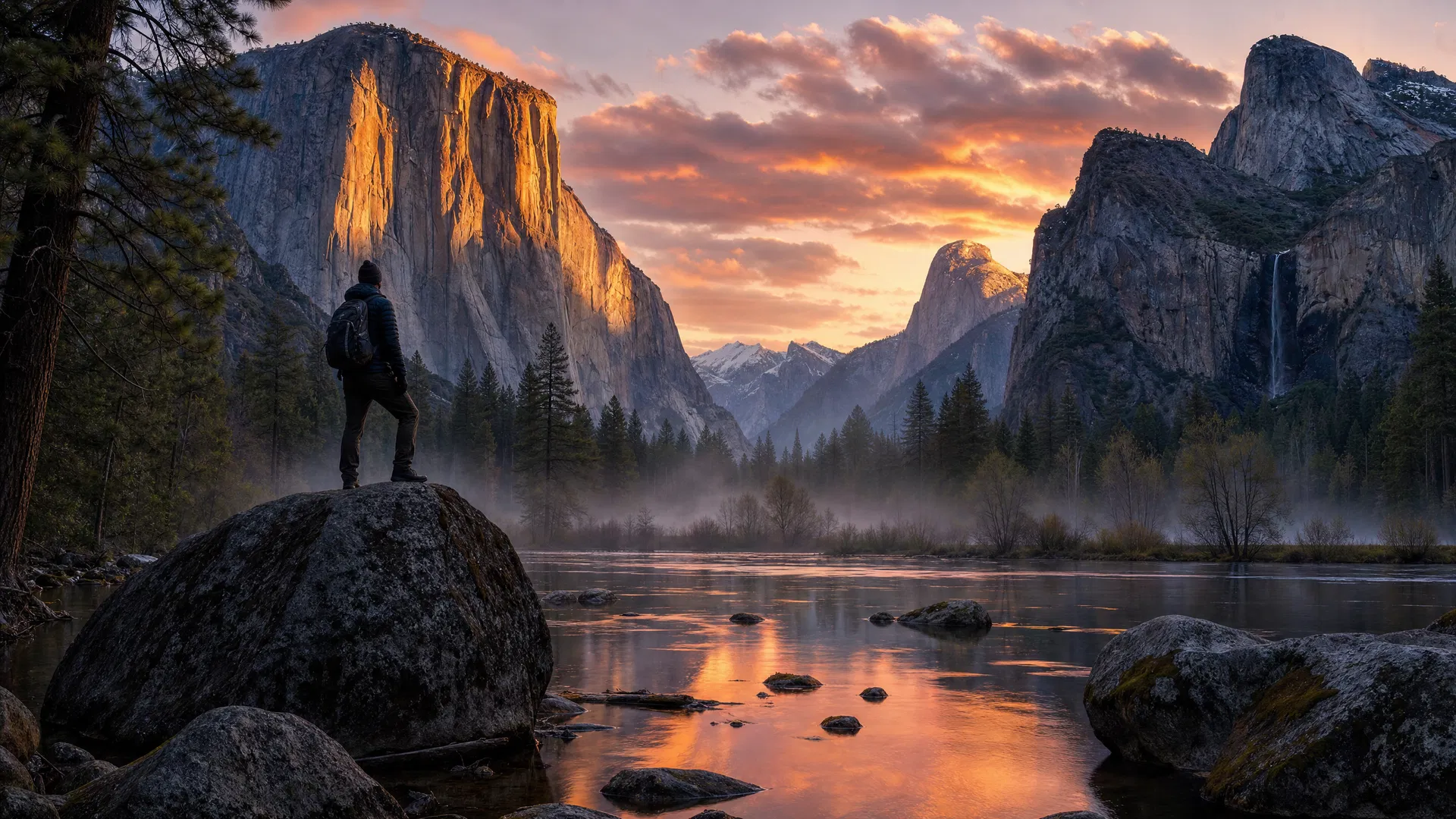
Wake up at 4:30 AM. This is not a suggestion. The valley floor in the hour before sunrise — when the light is pink and low, the mist is still on the Merced River, and the only sounds are birdsong and the distant rumble of waterfalls — is the most beautiful version of Yosemite that exists. Valley View, the pullout just past the Pohono Bridge on Northside Drive, offers the classic El Capitan-Merced River composition. Cook's Meadow offers the Half Dome reflection shot. Both are empty at 5 AM. Both are packed by 9 AM.
Walk, don't drive. The Valley Loop Trail is a 13-mile paved path that circles the entire valley floor. You don't have to walk all of it — even a two-mile stretch along the Merced River between Yosemite Village and Curry Village puts you in direct contact with the landscape in a way that driving never does. Rent a bike from Curry Village or Yosemite Valley Lodge and cover more ground.
Spend time at the base of El Capitan. Most visitors photograph El Cap from Valley View and move on. Walk to the meadow at its base and lie on your back looking straight up at 3,000 feet of vertical granite. If you're there between May and October, there's a reasonable chance you'll see climbers — tiny dots of color inching up the wall. The first ascent of El Capitan's Nose route took 47 days in 1958. Alex Honnold free-soloed it (no ropes) in 3 hours and 56 minutes in 2017. Both facts become viscerally comprehensible when you're lying in that meadow.
Do the Mist Trail. Of all the hikes in Yosemite Valley, the Mist Trail to Vernal Fall is the one that most reliably delivers a transformative experience regardless of fitness level. The 3-mile round trip to the top of Vernal Fall gains 1,000 feet of elevation — steep, but manageable. In spring, the trail passes so close to the waterfall that you get genuinely soaked. The roar of 317 feet of water falling into a granite pool is something your body remembers long after your mind forgets the details. Extend to Nevada Fall (another 1.5 miles and 900 feet) if your legs have it in them.
Glacier Point at sunset. The view from Glacier Point — 3,200 feet above the valley floor, looking directly at Half Dome with the entire high country spread behind it — is one of the great panoramic views in North America. The drive up Glacier Point Road (open late May through November) takes about 45 minutes from the valley. Arrive two hours before sunset, find a spot on the railing, and watch the light change. The valley below turns gold, then orange, then purple. Half Dome catches the last light and glows. This is the photograph that ends up on walls.
Beyond the Valley: Where Yosemite Gets Quiet
Tuolumne Meadows sits at 8,600 feet along Tioga Road (Highway 120), roughly 55 miles from the valley by road. The landscape is completely different — open subalpine meadows, granite domes, the Tuolumne River running cold and clear, the Cathedral Range rising in the distance. The crowds are a fraction of the valley's. The hiking is world-class: Cathedral Lakes (7 miles round trip, 1,000 feet elevation gain) delivers a high-alpine lake with a cathedral-shaped peak reflected in its surface. Lembert Dome (2.8 miles, 850 feet) offers a scramble up a granite dome with 360-degree views of the meadow and the high country. The Tuolumne Meadows Lodge, a cluster of canvas tent cabins, is one of the most atmospheric places to sleep in the entire Sierra Nevada.
The Mariposa Grove is located near the park's south entrance, about 35 miles from the valley. The grove contains 500 giant sequoias, including the Grizzly Giant — at roughly 2,700 years old, one of the oldest living things on Earth. The Fallen Monarch, a sequoia that fell centuries ago and is large enough to walk through, gives you a sense of scale that photographs cannot convey. The grove is best visited early morning before the tour buses arrive, or in the off-season when the sequoias stand in snow.
Hetch Hetchy is the park's most overlooked corner and, for a certain kind of traveler, its most interesting. The reservoir — created by the O'Shaughnessy Dam, which flooded a valley that John Muir spent the last years of his life fighting to protect — sits in the park's northwest corner, about 40 miles from the valley. The Wapama Falls Trail (5 miles round trip) leads to two waterfalls that cascade directly into the reservoir. The area sees a fraction of the valley's traffic. The history, the controversy, and the landscape make it worth the detour.
The Food and Lodging Reality
Let's be honest: Yosemite's in-park dining is functional rather than exceptional. The Village Grill Deck serves burgers and sandwiches. Curry Village has pizza and bar food. The Ahwahnee Dining Room is genuinely excellent — a grand Arts and Crafts hall with a menu that has evolved considerably from its historic roots — but requires reservations and a willingness to dress appropriately for dinner. For the best meal of your Yosemite trip, drive to Mariposa (45 minutes from the valley) and eat at Charles Street Dinner House, a local institution that has been serving the gateway community since 1978.
For lodging, the hierarchy is clear. The Ahwahnee is the crown jewel — a 1927 National Historic Landmark with stone fireplaces, stained glass, and a dining room that has hosted every US president since Herbert Hoover. Book a year in advance for peak dates. Yosemite Valley Lodge is the practical choice — comfortable, well-located, with a good bar and easy access to valley trailheads. Curry Village (officially Half Dome Village) offers canvas tent cabins and standard rooms at lower price points. Outside the park, the Rush Creek Lodge in Groveland is the best gateway property — a beautifully designed resort with a pool, a good restaurant, and a genuine sense of place.
The Practical Details That Actually Matter
The shuttle system is your best friend. The free Valley Shuttle runs year-round between all major valley destinations. Parking in the valley is genuinely limited and genuinely frustrating. Park at the Yosemite Valley Lodge or the Day Use Parking areas near Yosemite Village, and ride the shuttle everywhere else. This single decision will improve your trip more than any other.
Cell service is essentially nonexistent in most of the park. Download offline maps (Google Maps, Gaia GPS, or the NPS app) before you arrive. Download the park map PDF. Write down the phone numbers you might need. This is not the place to rely on real-time navigation.
Bear boxes are mandatory. Yosemite's black bear population is healthy, intelligent, and extremely experienced at getting into cars, coolers, and tents. Every campsite has a bear box — use it for all food, toiletries, and anything with a scent. Leaving food in your car is a federal violation and will result in a fine. More importantly, it contributes to bears becoming food-conditioned, which ultimately leads to their euthanasia. Take this seriously.
Altitude matters. Yosemite Valley sits at 4,000 feet. Tuolumne Meadows is at 8,600 feet. If you're coming from sea level, give yourself a day to acclimatize before attempting strenuous hikes at elevation. Drink more water than you think you need. The combination of altitude, dry air, and physical exertion dehydrates you faster than you expect.
The best weather window is narrow. Late September and early October offer the best combination of good weather, reduced crowds, open high-country roads, and fall color. Book this window as far in advance as possible.
Planning Your Yosemite Trip with Ask Leif
The complexity of planning a Yosemite trip — the permit system, the seasonal logistics, the question of where to stay and what to prioritize — is exactly the kind of problem that benefits from a structured itinerary. Whether you're bringing the family for a first national park experience, planning a solo photography trip, or organizing a couples escape into the high country, the guides below represent the most detailed, experience-tested Yosemite itineraries available:
The Yosemite First-Timer's 7-Day Guide is built for people who have never been and want to see everything that matters — the valley, the waterfalls, Glacier Point, Tuolumne Meadows, and the Mariposa Grove — without the overwhelm of trying to figure out the logistics from scratch.
For families navigating the park with children, the Yosemite Family Adventure: 5-Day Itinerary with Kids maps out a trip that balances the iconic experiences with the practical realities of traveling with younger hikers — shorter trails, accessible viewpoints, and the kind of moments that become the stories kids tell for the rest of their lives.
The Yosemite Solo & Couples Adventure: 5-Day Iconic Hikes & Photography Guide is built around the park's best photographic opportunities and most rewarding hikes — Half Dome (with permit strategy), Cathedral Lakes, the Mist Trail, and Glacier Point at golden hour.
And for those who want a comprehensive, day-by-day framework that covers the full range of the park's experiences, the Yosemite in 5 Days: Waterfalls, Half Dome, and the Valley That Changes Everything is the most complete single-resource itinerary in the collection.
The Thing Nobody Tells You About Yosemite
Here is the truth that doesn't make it into the travel guides: Yosemite is not a place you see. It's a place you feel. The granite walls are too large to fully perceive. The waterfalls are too loud to think clearly near. The sequoias are too old to comprehend. The valley at dawn, with the mist on the river and the light just beginning to touch the top of El Capitan, produces a specific kind of silence in people — the silence that happens when the brain stops narrating and just receives.
That silence is what people are actually chasing when they plan a Yosemite trip. The photographs are a side effect. The hikes are a delivery mechanism. What people want — what they remember years later, what they describe to friends who haven't been — is that moment of genuine awe. The moment when the scale of the place overwhelms the scale of whatever was worrying you before you arrived.
It happens at Glacier Point when the light goes golden. It happens at the top of Vernal Fall when you're soaked and breathing hard and the valley is spread out below you. It happens at 5 AM in Cook's Meadow when Half Dome is reflected in the Merced River and you are, for a few minutes, the only person in the world who can see it.
Plan the logistics. Book the lodging. Get the permits. And then, when you're actually there — put the phone down for a few minutes and let the place do what it does.
It will.