The Cities Where Solo Travel Stops Being Something You Do and Starts Being Something You Are
Destination: Global
Category: Travel Tips
The Cities Where Solo Travel Stops Being Something You Do and Starts Being Something You Are
By Ask Leif | First Solo Trip | 6 Cities Across 3 Continents
There is a specific moment that every serial solo traveler remembers. It doesn't happen at the airport, or at check-in, or at the first landmark. It happens on the second or third day, usually in the middle of something ordinary — a coffee at a counter, a walk through a neighborhood that wasn't in the guidebook, a conversation with someone whose name you won't remember but whose observation about the city you'll carry for years. The anxiety that arrived with you has quietly left. In its place is something harder to name: the specific sensation of being exactly where you are, without the mediation of companions, without the negotiation of group consensus, without the performance of enjoyment for someone else's benefit. You are simply present. And the city is simply there.
That moment is not produced by safety. It is not produced by ease. It is not produced by the presence of other solo travelers at a hostel bar. It is produced by the specific character of the city you chose — its social architecture, its relationship with solitude, its particular way of receiving a person who arrives alone and stays that way. The cities on this list were chosen because they produce that moment faster, more reliably, and more completely than any other cities in the world. Not because they are the safest cities for solo travelers — safety is the floor, not the ceiling. Not because they are the easiest cities to navigate alone — ease produces comfort, not transformation.
These cities are here because something about their specific character produces the precise conditions in which a person traveling alone for the first time discovers that solo travel is not the absence of companionship. It is the presence of something better.
A note on what doesn't appear here: Amsterdam is not on this list. It is the most recommended first solo trip city in Europe, and the recommendation is understandable — English is universal, the cycling infrastructure is excellent, the social culture is liberal. But Amsterdam optimizes for convenience rather than transformation. The city is easy to navigate alone. It does not produce the threshold experience. London is not on this list either — it has its own place in the AskLeif library, and its specific challenge for first-time solo travelers (the scale, the cost, the particular English social reserve) works against rather than for the thesis. London rewards experienced solo travelers. The cities on this list convert first-timers. Bali is not on this list because Bali's co-working and yoga community makes meeting other solo travelers trivially easy — and the thesis is not about meeting other solo travelers. It is about the specific discovery that solo travel is not the absence of companionship. Cities that make meeting other travelers too easy short-circuit that discovery.
Lisbon: The City That Already Understands What You're Doing There
Lisbon is the correct first solo trip city in Europe for a reason that no competitor post has articulated. It is not just safe and navigable — it is culturally aligned with the emotional register of solo travel in a way that no other European capital is. The Portuguese concept of saudade — the specific longing that is Lisbon's emotional signature — is not sadness. It is the specific condition of being fully present to an experience while simultaneously aware of its impermanence. That is exactly what solo travel feels like. A first-time solo traveler in Lisbon is not a person who couldn't find a companion. They are a person in the correct emotional relationship with the city.
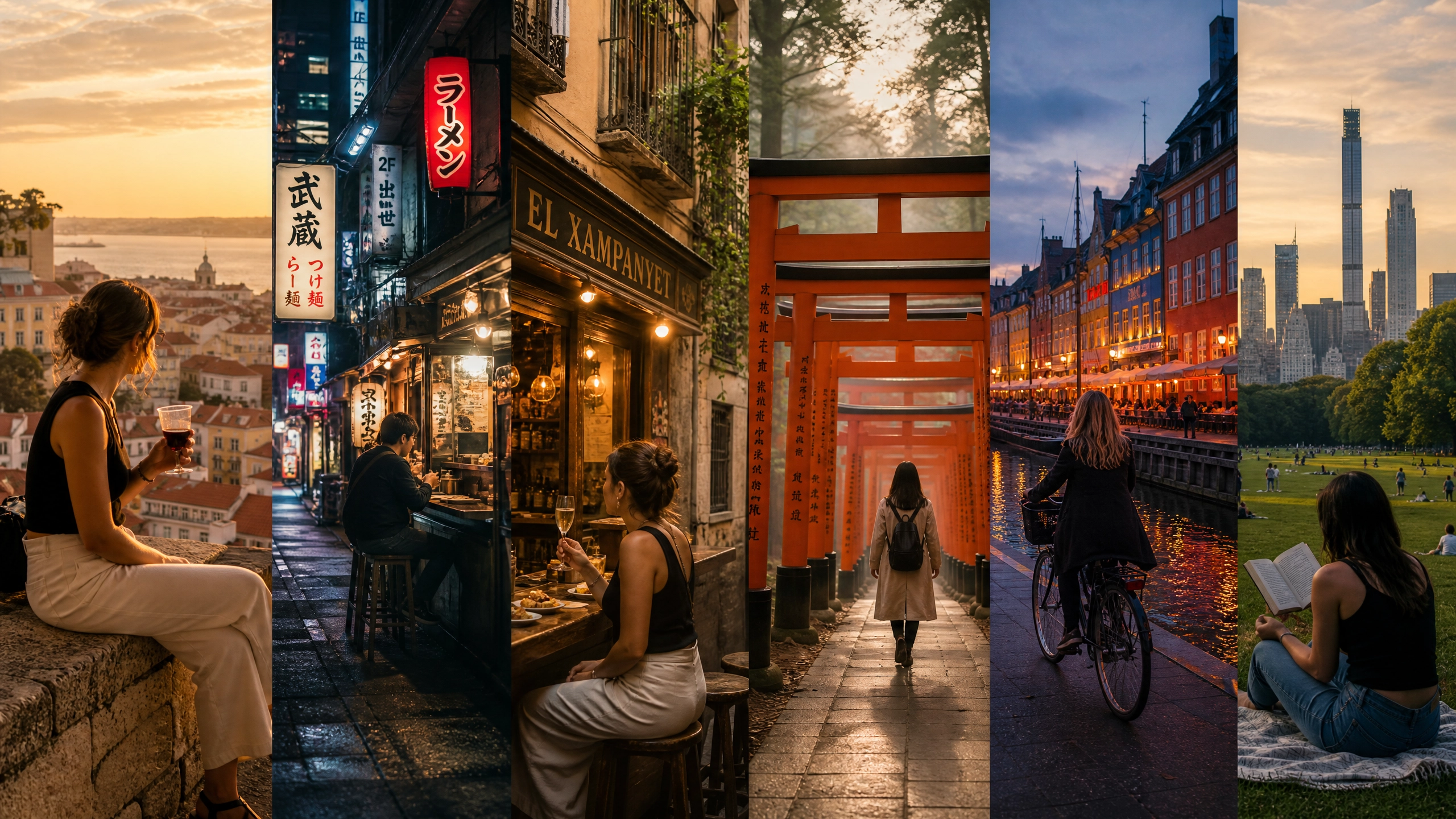
The miradouros are the most immediate proof. The Miradouro da Graça at 6pm is not a tourist viewpoint — it is a neighborhood gathering place where the residents of the Graça district bring wine in plastic cups and sit on the stone walls watching the light change over the Tagus. A solo traveler who arrives at that hour is not conspicuous. They are simply another person who came to watch the light. The specific social culture of the Lisbon miradouros is that conversation between strangers is initiated by the shared experience of the view rather than by social obligation — and a solo traveler at a miradouro is more likely to have a genuine conversation with a local than a couple is, because couples signal completion while a solo traveler signals availability for connection.
The café culture extends this logic. At A Brasileira on Rua Garrett in Chiado, Fernando Pessoa's bronze statue sits at an outdoor table — and sitting alone at that café is the historically correct way to use the space. The poet who gave Lisbon its literary identity spent his life sitting alone in cafés, writing. A solo traveler at A Brasileira is not a person without companions. They are a person in the correct relationship with the space. In the Alfama, the neighborhood pastelarias operate differently: the residents conduct their social lives at the counter rather than at tables, and a solo traveler who takes a counter seat at a neighborhood pastelaria at 8am is immediately part of the rhythm of the neighborhood rather than a tourist observing it from a table.
The LxFactory Sunday market rewards solo travel in a specific way that group travel doesn't: every vendor conversation is one-on-one rather than mediated by group consensus. You stop when you want to stop. You ask what you want to ask. The vendor answers you rather than performing for a group. The Alfama night walk — after 10pm, when the residential character of the neighborhood reasserts itself over the tourist infrastructure — produces the specific experience of hearing fado from a ground-floor apartment that is not a performance but a neighbor practicing. That sound, heard alone, is the correct introduction to what Lisbon is.
For the full Lisbon solo experience, the Lisbon solo travel guide covers the neighborhood sequence, the miradouro timing, and the specific café culture in detail.
Tokyo: Where Lisbon Gives You Permission to Feel, Tokyo Gives You Permission to Be
Where Lisbon aligns emotionally with the solo traveler, Tokyo does something structurally different: it removes the social explanation requirement entirely. Lisbon understands why you're alone. Tokyo doesn't need to understand — it has built a city in which being alone in public is simply the default mode of existing rather than a social statement requiring justification.
Tokyo is the correct first solo trip city in Asia for a reason that goes beyond its safety record or its English-language signage. At 14 million people, it is the largest city in the world, and it operates on a specific social contract: you do not impose on others, and others do not impose on you. For a first-time solo traveler who fears the social judgment of being alone in public — the restaurant host's pitying look, the waiter's "just one?" — Tokyo eliminates the fear at the source. There is no social judgment because there is no social expectation of companionship in the first place.
The Ichiran ramen system is the most complete expression of this. Each diner sits in an individual wooden booth separated from the server by a bamboo curtain. The order form — broth strength, noodle firmness, richness level, garlic quantity — is completed in writing before any food arrives. The system was not designed for antisocial people. It was designed for people who want to focus entirely on the ramen without the social performance that eating in public usually requires. A first-time solo traveler who eats at Ichiran on their first night in Tokyo understands immediately that the city has thought about their experience in advance.
Golden Gai in Shinjuku is the counter-argument to the idea that Tokyo is isolating. The alley contains approximately 200 tiny bars, each seating between five and eight people. The small format produces immediate conversation — not because the bars are designed for socializing in the Western sense, but because five people in a room the size of a large closet sharing the same bartender cannot avoid becoming briefly acquainted. The bars that welcome first-time visitors are identifiable by English-language signage or by the word "welcome" on a chalkboard outside. The members-only establishments are not signed in English and do not need to be sought out.
The Yanaka neighborhood provides the specific Tokyo experience that no mainstream guide adequately describes: a neighborhood that survived both the 1923 Kanto earthquake and the 1945 firebombing intact, its wooden shotengai shopping street and its cemetery with the graves of the last Tokugawa shogun still in place. The dawn walk through Yanaka — when the neighborhood cats are most active and the shopkeepers are setting up for the day — is the specific Tokyo experience that produces the threshold moment for solo travelers who arrived expecting modernity and found something older and quieter underneath it.
The Tokyo solo travel guide covers the neighborhood sequence and the specific timing for each experience.
Barcelona: Where Tokyo Permits Solitude, Barcelona Converts It
Where Tokyo gives the solo traveler structural permission to be alone in public, Barcelona does something different: it makes being alone the path of least resistance toward not being alone. This is not the same as saying Barcelona is easy to meet people in. It is saying that Barcelona's specific social infrastructure makes accidental community the default outcome of ordinary activities rather than the result of deliberate social effort.
The tapas bar counter is the mechanism. El Xampanyet on Carrer de Montcada in El Born has been serving house-made cava and anchovies since 1929. The counter seating places solo travelers in immediate proximity to the bar's regulars — the neighborhood residents who have been coming here for decades, who know the owner by name, who will tell you without being asked that the house cava is better than anything on the wine list and that the anchovies come from L'Escala and that you should try the boquerones before the anchovies because the order matters. A solo traveler at El Xampanyet's counter is not a tourist at a bar. They are a person at a counter where conversation is the default activity rather than the exception.
The Barceloneta beach social geography rewards solo travel in a specific way. The section of beach between the W Hotel and the Barceloneta neighborhood — away from the tourist beach infrastructure concentrated near the Barceloneta metro — is where the local resident beach culture is most concentrated. La Cova Fumada, the bar that invented the bomba (a deep-fried meat ball that is Barceloneta's most specific local food), does not advertise, does not have a website, and is only known to people who have been told about it by someone who already knows. A solo traveler who finds it has been told by someone. That transaction — the local who tells you about the place that doesn't advertise — is the specific social experience that Barcelona produces for solo travelers who are paying attention.
The Gràcia neighborhood on a Thursday evening is the most reliable way to experience Barcelona as a city rather than a tourist destination. The neighborhood's plaça culture assigns each square a different social character: Plaça del Sol for the young professional crowd with their cañas and their laptops, Plaça de la Vila de Gràcia for families with children running between the café tables, Plaça de la Virreina for the older residents who have been sitting in the same chairs since before the tourists discovered the neighborhood. Walking between the squares on a Thursday evening — when the weekend tourist infrastructure hasn't yet arrived — is the specific experience of a city conducting its own life rather than performing for visitors.
The Barcelona solo travel guide covers the neighborhood sequence and the specific timing for each experience. For the food dimension, the Barcelona food guide covers El Xampanyet, La Cova Fumada, and the specific market culture in detail.
Kyoto: Where Barcelona Produces Community, Kyoto Produces Purpose
Where Barcelona converts solitude into accidental community, Kyoto does something that no other city on this list does: it gives solo travel a purpose that group travel cannot fulfill. The specific Kyoto experiences that are not just equally good solo but specifically better solo are the argument for why Kyoto belongs on a first solo trip list rather than a second or third.
Fushimi Inari at 5am is the most complete proof. The thousands of torii gates that line the mountain trail are one of the most photographed sites in Japan — and during daylight hours, the experience of walking through them is mediated by the crowd, by the selfie stops, by the group consensus about how long to stay at each landing. At 5am, the mountain is empty. The specific quality of attention that solo travel produces — the ability to stop when you want to stop, to sit on a stone step for twenty minutes watching the light change through the orange gates without anyone waiting for you — is the correct quality of attention for this experience. The upper mountain section, beyond the first summit where 90% of visitors turn back, is completely empty even during peak tourist season. The solo traveler who continues finds a mountain trail in silence, with views over Kyoto's rooftops, with no one else present. That experience is not available to group travelers. It requires the specific freedom of being alone.
The Philosopher's Path — the two-kilometer canal walk connecting Ginkaku-ji to Nanzen-ji — was named after the philosopher Nishida Kitaro, who walked it daily as a contemplative practice. The path was designed for the pace of reflection that solo travel allows. A solo traveler on the Philosopher's Path is not a tourist walking between two temples. They are a person doing what the path was built for. The specific canal culture — the cherry trees in spring, the moss in autumn, the specific sound of the water against the stone — is content that requires individual attention rather than group consensus about what to notice.
Nishiki Market, Kyoto's covered food market, produces a specific solo travel experience: the vendors who engage solo visitors in conversation about the food because the solo visitor without a group to manage has the time and the attention to actually listen. The tofu shop that has been operating since the 17th century, the pickled vegetable vendor who will explain the difference between the three types of Kyoto pickles if you ask, the dashi shop where the owner will let you taste three different stocks before you decide — these conversations are available to solo travelers because solo travelers are not managing group logistics while they happen.
The Kyoto solo travel guide covers the dawn temple timing, the Philosopher's Path sequence, and the Nishiki Market vendor culture. For travelers combining Kyoto with Tokyo, the Osaka-Kyoto 7-day combo guide covers the full Japan solo travel arc.
Copenhagen: Where Kyoto Purposes Solitude, Copenhagen Normalizes It
Where Kyoto gives solo travel a purpose, Copenhagen does something quieter and equally important: it removes the social anxiety that most first-time solo travelers carry with them from home. Denmark has the highest rate of people living alone in the world, and it has built a social infrastructure around solitude that has no equivalent in any other country at this income level. The specific Copenhagen practices — the hygge culture, the solo café protocol, the specific Danish social permission to be alone in public without anyone wondering why — produce a city where the first-time solo traveler's primary anxiety simply doesn't exist as a cultural phenomenon.
Café Nørreport, near the central station, has been operating since 1976. Its specific candle-lit interior at 4pm in winter — the low light, the wooden tables, the smell of cardamom — is the most complete expression of hygge available in any single room in Copenhagen. The Danish solo café protocol is this: you arrive with a book, you order a coffee and a piece of cardamom cake, you stay for three hours, and no one suggests you should free the table. This is not a policy. It is a cultural norm. The café is designed for exactly this use. A first-time solo traveler who spends a winter afternoon at Café Nørreport with a book understands immediately that the social judgment they feared — the "just one?" — is not a feature of this city.
Torvehallerne, the covered food market on Israels Plads, is the specific Copenhagen food experience that rewards solo travel. The Saturday morning market — when both halls are at peak operation, the smørrebrød counter at Hallernes Smørrebrød is serving open sandwiches to a queue of Copenhagen residents, and the coffee roasters and cheese vendors and fresh pasta stalls are conducting their business in Danish — is the specific experience of a city feeding itself rather than performing for tourists. A solo traveler at the smørrebrød counter, eating a plate of herring and rye bread while standing, is participating in the correct use of the space.
The Assistens Cemetery in Nørrebro is the specific Copenhagen experience that no mainstream guide adequately describes: a cemetery where Hans Christian Andersen and Søren Kierkegaard are buried, and where Copenhagen residents use the grounds as a park for reading, cycling, and picnicking. A solo traveler sitting in this cemetery with a book is not being conspicuously alone. They are participating in a Copenhagen civic tradition. The Louisiana Museum of Modern Art, 35 kilometers north of the city on the Øresund coast, is the specific day-trip that rewards solo travel: the S-train journey is itself a pleasure, the combination of indoor galleries and outdoor sculpture garden requires individual pace rather than group consensus, and the specific view of the Øresund from the sculpture garden — Sweden visible across the water — is the kind of experience that solo travel was made for.
The Copenhagen solo travel guide covers the café culture, the market timing, and the Louisiana day-trip in detail. The Copenhagen budget guide addresses the cost reality of one of Europe's most expensive cities.
New York City: Where Copenhagen Normalizes Solitude, New York Surrounds It
Where Copenhagen normalizes being alone by making it culturally unremarkable, New York does something more overwhelming and equally effective: it surrounds the solo traveler with so much life that the absence of companions becomes irrelevant. New York City belongs on a first solo trip list for a reason that contradicts most travel advice — it is one of the most overwhelming cities in the world, and it is on this list because of that overwhelmingness rather than despite it.
The specific New York experience of being alone in a city of 8 million people and discovering that aloneness is not loneliness — that the city's density produces a specific kind of company that doesn't require introduction or maintenance — is the most complete expression of what solo travel is for. A first-time solo traveler in New York discovers that the city doesn't require them to perform sociability. It provides a specific backdrop of humanity so rich and so varied that being alone in front of it is its own form of connection.
The Momofuku Noodle Bar on First Avenue is the specific New York solo dining experience that proves the thesis. The counter seating was designed for solo diners, and the proximity to the open kitchen produces conversation with the chefs — not because the chefs are required to be friendly but because the counter format makes conversation the natural outcome of proximity. New York's counter dining culture is more developed and more socially normalized than any other American city because Manhattan's real estate economics made the table-for-one financially unviable and the counter-for-one financially necessary. The solo diner at a New York counter is not an anomaly. They are the intended customer.
The Sheep Meadow in Central Park on a Tuesday afternoon in September — when the summer tourist infrastructure has thinned and the meadow is occupied by the New York residents who use it as their neighborhood park — is the specific experience of a city that doesn't know you're a tourist. The Ramble, the designed wilderness in the center of the park, produces a genuine sense of solitude within the most densely populated urban park in the world: the winding paths, the bird-watchers with their binoculars, the specific sound of the city disappearing behind the tree line. A solo traveler in the Ramble is not in New York. They are in a forest that happens to be surrounded by New York.
The Metropolitan Museum of Art's Thursday evening extended hours — the museum stays open until 9pm — produce the most interesting museum-going demographic in New York: people who came alone after work rather than tourist groups. Gallery 911, containing the Temple of Dendur, at 7pm: the specific evening light through the glass facade produces an experience that the daytime tourist crowds prevent. A first-time solo traveler who walks into that gallery at 7pm on a Thursday and finds it nearly empty has found the specific New York experience that the city reserves for people who know when to arrive.
The Brooklyn Bridge to DUMBO to the Brooklyn Heights Promenade walk — the most complete introduction to New York's relationship with its own geography available to a solo traveler on foot — is the specific experience of understanding why New York is the way it is. The bridge itself, the view of Manhattan from the Brooklyn side, the specific moment when the skyline resolves into something comprehensible from a distance — these are experiences that solo travel produces in their correct form because they require individual attention rather than group consensus about what to notice.
The New York City 7-day itinerary covers the full city arc for solo travelers with time. For travelers on a tighter budget, the New York City budget guide addresses the cost reality of one of the world's most expensive cities.
Planning Your First Solo Trip: Which City Matches Your Specific Anxiety
The most useful planning framework for a first solo trip is not "which city is safest" or "which city is cheapest." It is "which city addresses my specific anxiety about traveling alone." Every first-time solo traveler has one primary fear. The city you choose should be the one that dismantles that fear most directly.
If your fear is social judgment — the "just one?" moment, the restaurant host's look, the sense that being alone in public requires explanation: Copenhagen is your city. The Danish social contract makes your fear literally unavailable. No one will wonder why you're alone because being alone in public is the default mode of existing in Denmark.
If your fear is loneliness — the sense that solo travel will feel like a lesser version of group travel: Barcelona is your city. The city's social infrastructure makes accidental community the default outcome of ordinary activities. You will not be alone for long in Barcelona unless you choose to be.
If your fear is being unable to navigate a foreign city: Tokyo is your city. The city's infrastructure — the signage, the transit system, the konbini culture that allows every transaction to occur without verbal interaction — is the most navigable urban system in the world for a traveler who doesn't speak the language.
If your fear is that solo travel won't feel meaningful — that it will be a series of activities without the depth that comes from sharing experiences: Kyoto is your city. The city's specific experiences are not just equally good solo — they are specifically better solo. Fushimi Inari at dawn, the Philosopher's Path, the Nishiki Market vendor conversations — these require the quality of attention that solo travel produces.
If your fear is that you'll feel emotionally unmoored — that being alone in a foreign city will feel isolating rather than liberating: Lisbon is your city. The city's cultural alignment with the emotional register of solo travel — the saudade, the miradouro culture, the café tradition — means that your emotional state is not an anomaly in Lisbon. It is the correct relationship with the city.
If your fear is that solo travel won't feel real — that it will feel like a simulation of travel rather than the genuine article: New York is your city. The city's overwhelming reality — 8 million people conducting their lives in your immediate vicinity — makes the simulation impossible. You cannot feel like a tourist in New York because New York doesn't have the bandwidth to treat you like one.
Trip length: Each of these cities rewards a minimum of four days for a first solo trip — enough time for the initial anxiety to resolve and the threshold experience to arrive. Lisbon and Kyoto reward longer stays; the cities reveal themselves slowly to solo travelers who are paying attention. Tokyo and New York reward longer stays for different reasons: both cities have more layers than any single trip can exhaust.
Combining cities: The Japan combination — Tokyo followed by Kyoto — is the most complete first solo trip in Asia. The two cities prove something together that neither proves alone: that solo travel can be structurally supported (Tokyo) and purposefully rewarding (Kyoto) simultaneously. For Europe, Lisbon followed by Barcelona covers the emotional arc from alignment to conversion — from a city that understands what you're doing there to a city that produces community from it.
For travelers ready to plan their first solo trip, the Lisbon solo guide, the Tokyo solo guide, the Barcelona solo guide, the Kyoto solo guide, the Copenhagen solo guide, and the New York City itinerary each cover the specific logistics, neighborhoods, and timing for their respective cities.
The threshold moment — the specific second or third day when the initial anxiety gives way to something better — is not a universal experience. It is produced by specific cities under specific conditions. Not every city produces it. Not every trip produces it. But the cities on this list produce it more reliably, more completely, and more permanently than any others.
Lisbon understands. Tokyo permits. Barcelona converts. Kyoto purposes. Copenhagen normalizes. New York surrounds.
Six verbs. Six different answers to the same question. The question is not "where should I go for my first solo trip?" The question is "which city will make me into someone who can't stop?"
Ready to plan your first solo trip? The Lisbon 4-day solo guide and the Tokyo 5-day solo guide are the two most complete starting points in the AskLeif library. For the Japan arc, the Kyoto 5-day solo guide covers the full Kyoto solo experience. For Europe, the Copenhagen 3-day solo guide and the Barcelona 4-day solo guide cover the two most different European first solo trip propositions.