Every Other City Has a History. Jerusalem Is One.
Destination: Jerusalem, Israel
Category: Destination Guides
You step through Jaffa Gate and within thirty seconds you are inside an argument that has been running for three thousand years. Not a metaphorical argument. An actual one, conducted in stone and prayer and competing calls to worship and the smell of cardamom coffee and the sound of a muezzin and a church bell and a shofar, sometimes simultaneously, never resolved.
Walk two hundred meters east from the gate and you are in the Muslim Quarter, where the call to prayer from the Dome of the Rock rolls down the alleyways at a volume that is not asking for your attention — it is simply claiming it. Walk two hundred meters south and you are in the Jewish Quarter, where on Friday afternoon the whole neighborhood is moving with a purposeful quiet, families carrying challah and wine, the streets emptying as the sun drops toward the Judean Hills. The distance between these two worlds is the length of a city block. The distance between the centuries they represent is incalculable. And yet here they are, side by side, in the same square kilometer of stone, conducting their separate eternities within earshot of each other.
Every other city has a history. Jerusalem is one. The past here is not behind you — it is underfoot, overhead, and in every argument happening around you right now. You don't visit Jerusalem the way you visit Paris or Tokyo or Buenos Aires, arriving with a list and working through it. You arrive in Jerusalem and Jerusalem happens to you. The city doesn't ask you to understand it. It asks you to survive it. And then, if you let it, it changes you anyway.
The One Square Kilometer
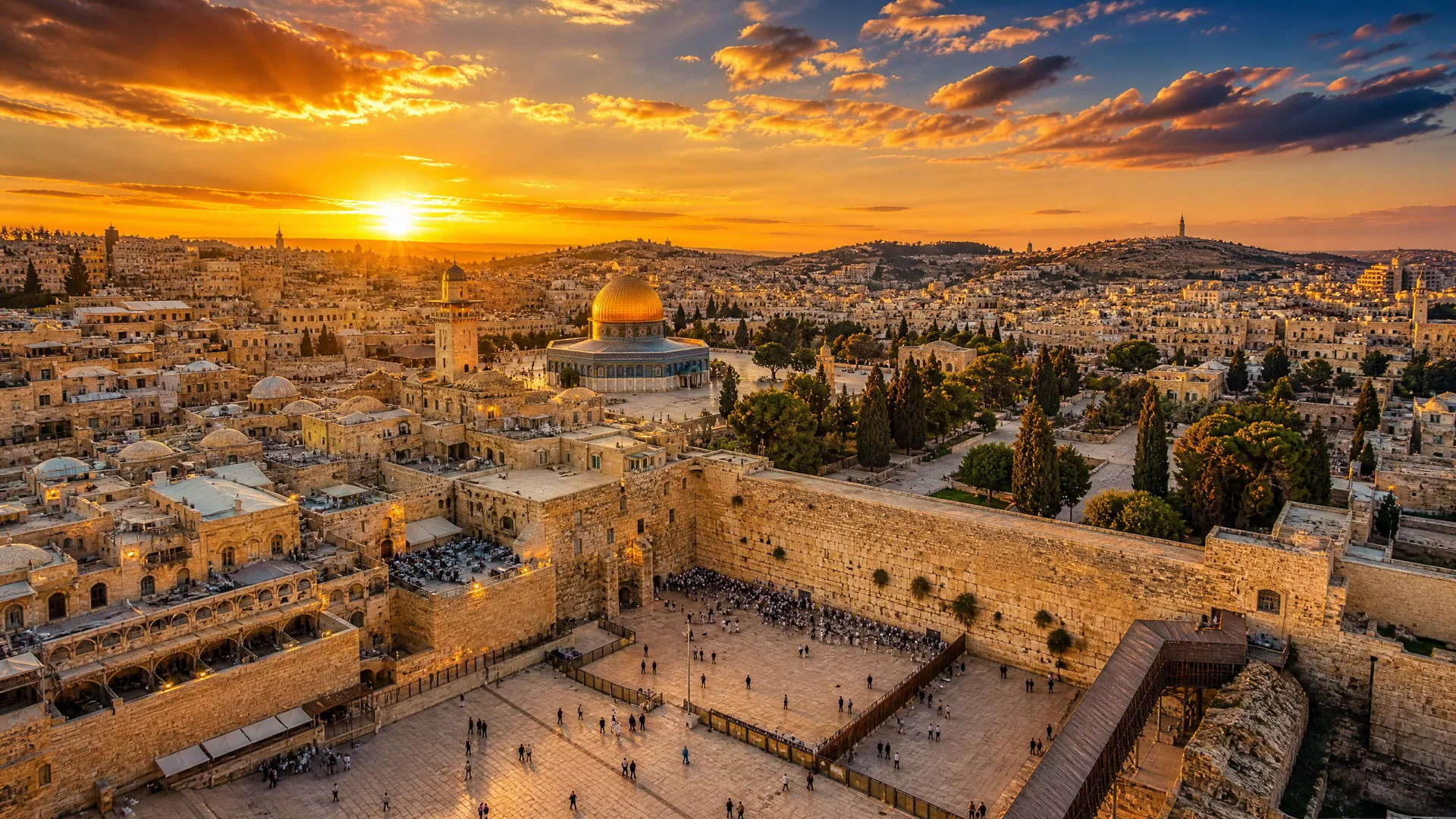
The Old City of Jerusalem is approximately 0.9 square kilometers. You can walk its perimeter in under an hour. In that perimeter are four quarters — Jewish, Muslim, Christian, Armenian — each operating on its own internal logic, its own calendar, its own relationship to the stones beneath it. The Western Wall. The Church of the Holy Sepulchre. The Dome of the Rock. The Via Dolorosa. The Armenian genocide memorial. All of it within a space smaller than most airport terminals.
This compression is the defining fact of Jerusalem and the thing that no photograph or travel article has ever adequately conveyed. The photographs show you the individual monuments. They don't show you what it feels like to stand at a crossroads where the Jewish Quarter meets the Muslim Quarter meets the Christian Quarter and understand, physically, in your body, that these three civilizations are not taking turns — they are simultaneous. They have always been simultaneous. The city was built on top of itself, each century adding a layer, and the result is a place where you are never standing in one era. You are always standing in several at once.
The Old City's four quarters are not tourist zones with clear boundaries and interpretive signage. They are living neighborhoods. People are born here, grow up here, argue here, cook dinner here. The Muslim Quarter's covered souk runs from Damascus Gate to the Temple Mount and smells of spices and fresh bread and diesel from the delivery carts that navigate the same alleys that Crusaders walked. The Jewish Quarter was almost entirely destroyed in 1948 and rebuilt after 1967, which means its stones are new but its foundations are ancient — you can see the Roman-era Cardo, the main street of Byzantine Jerusalem, excavated and preserved beneath the modern street level. The Christian Quarter contains the Church of the Holy Sepulchre, which is administered jointly by six different Christian denominations who have been arguing about the arrangement since the 7th century and show no signs of stopping.
And then there is the Armenian Quarter.
The Armenian Quarter's Silence
The Armenian Quarter is the smallest of the four, home to approximately two thousand people, and it is the one that most visitors walk through without stopping. This is a mistake of the first order.
The Armenians arrived in Jerusalem in the 4th century AD, when Armenia became the first nation to adopt Christianity as its state religion. They have been here continuously ever since — through Byzantine rule, Arab conquest, Crusader occupation, Ottoman control, British mandate, Jordanian administration, Israeli sovereignty. Every empire that has held Jerusalem has found the Armenians already there, and every empire has eventually left while the Armenians remained. The community's survival is itself an argument about what Jerusalem is: a place where the claim of continuous presence is the only claim that ultimately matters.
The quarter is entered through a gate on the Armenian Patriarchate Road and immediately the atmosphere changes. The alleys are quieter. The stone is darker. There are fewer tourists and fewer vendors and more of a sense that you have walked into a neighborhood that is not performing itself for your benefit. The Armenian Museum inside the compound documents the 1915 genocide with a directness that is unusual in a city where every historical claim is contested — the Armenians lost 1.5 million people and they are not interested in euphemism about it.
The crown of the quarter is St. James Cathedral, built in the 12th century on the site where, according to tradition, the apostle James was beheaded. The cathedral is not open for general visiting. It opens for approximately thirty minutes each afternoon for vespers — arrive at the gate on Armenian Patriarchate Road around 3:00 PM and wait. When the gate opens, you walk into one of the most extraordinary interiors in Jerusalem: low candlelight, hanging oil lamps, the smell of incense that has been accumulating in the stone for eight centuries, and a choir singing in a language that almost no one outside the community speaks. Most tourists never get in because they don't know to wait. The ones who do get in rarely forget it.
On the Via Dolorosa, just inside the Christian Quarter near the Fourth Station, the Balian family has been making Armenian ceramic tiles since the early 20th century. The blue-and-white floral patterns are immediately recognizable — they appear on the street signs throughout the Old City, commissioned by the British Mandate authorities in the 1920s. The workshop is still operating. You can watch the tiles being painted by hand.
The Via Dolorosa, Read Correctly
The Via Dolorosa — the Way of Suffering, the route Jesus walked to the crucifixion — is one of the most walked streets in the world and one of the most misread. Most visitors experience it as a pilgrimage route, moving station to station with a guide or a group, focused on the theological significance of each stop. This is a valid way to walk it. It is not the only way.
Walk the Via Dolorosa slowly, without a guide, and pay attention to what is actually there. The street passes through the Muslim Quarter for most of its length. The shops selling religious souvenirs are run by Palestinian Muslim families who have been in this business for generations. The pilgrims buying crucifixes from Muslim shopkeepers, the shopkeepers who know the stations of the cross better than most Christians because they have been answering questions about them for decades — this is Jerusalem in miniature. The sacred and the commercial and the mundane, inseparable.
Partway along the Via Dolorosa, on the corner near the Fourth Station, is the Austrian Hospice. It was built in 1863 as a guesthouse for Austrian pilgrims and it has been operating continuously ever since. The building is a piece of Habsburg Vienna dropped into the middle of the Old City — high ceilings, formal portraits, a garden courtyard with wrought-iron furniture. The café serves Viennese coffee and apple strudel. The rooftop costs 5 NIS to access and gives you one of the best views in the Old City: the Dome of the Rock to the south, the Church of the Holy Sepulchre dome to the west, the minarets and bell towers competing for the skyline in every direction. Almost no mainstream travel guide mentions the Austrian Hospice. Almost everyone who finds it on their own considers it the best discovery of their trip.
What the Western Wall Tunnels Actually Show You
Most visitors to the Western Wall see the surface: the exposed section of the retaining wall of the Second Temple Mount, the plaza divided by gender, the notes pressed into the cracks in the stone. This is significant. It is also approximately one-sixth of the actual wall.
The Western Wall Tunnels run beneath the Muslim Quarter for the full length of the Temple Mount — nearly 500 meters — and they reveal something that the surface plaza cannot: the sheer scale of what Herod built in the 1st century BC. The largest stone in the tunnel weighs an estimated 570 tons. It was quarried, transported, and placed without machinery of any kind, and it has not moved in two thousand years. Standing next to it in the tunnel, underground, with the weight of the Muslim Quarter above you and the weight of the centuries around you, is one of the genuinely vertiginous experiences available in Jerusalem — the sensation of the city's layers pressing down from above.
The tunnels require advance booking and run guided tours throughout the day. Book at least a week ahead in high season. The tour takes approximately 75 minutes and ends near the Via Dolorosa, which means you emerge from two thousand years underground directly into the living street. The Jerusalem 3-Day Culture & History Itinerary sequences the tunnels on Day 1 morning for exactly this reason — the emergence into the Old City after the tunnel tour resets how you see everything above ground for the rest of the trip.
Mahane Yehuda: The Market That Changes Twice a Day
Jerusalem is not only the Old City. This is the mistake that most first-time visitors make: they spend three days inside the walls and leave believing they have seen Jerusalem. They have seen one Jerusalem. The city outside the walls is a different place entirely, and it is the place where Jerusalem actually lives.
Mahane Yehuda — the Shuk — is the market that every guide mentions and almost none describe accurately. The daytime version is real: two covered alleys and dozens of side streets packed with produce stalls, spice vendors, bakeries, fish counters, cheese shops, the smell of fresh-baked ka'ak and roasting coffee and the particular sweetness of overripe figs in August. It is loud and crowded and the vendors are not interested in your hesitation. Buy something or move.
But the daytime Shuk is not the version that will stay with you.
On Friday afternoon, in the two hours before Shabbat begins at sundown, Mahane Yehuda transforms into something that has no equivalent anywhere else in the world. Every family in Jerusalem that is observing Shabbat is buying for it right now, which means the market is operating at a frequency of collective urgency that is almost physical. The vendors are moving faster. The prices are dropping because what doesn't sell today won't sell until Saturday night. The challah is coming out of the ovens in continuous waves. The wine is stacked at the entrances. The noise is extraordinary. And underneath the noise, if you pay attention, is something that feels less like commerce and more like a city preparing for something it has been preparing for every week for thousands of years.
After sundown on Friday, the market closes. The stalls pull down their shutters. The streets empty. Jerusalem goes quiet in a way that no other city of 900,000 people goes quiet — not dead, but held, like a breath.
Then, after Shabbat ends on Saturday night, Mahane Yehuda transforms again. The produce stalls are still shuttered, but the bars that operate from inside the old market structures open their doors. Hasadna, which occupies a former warehouse in the heart of the market, fills with a crowd that is young and loud and entirely at home in the contradiction of a nightclub inside a market that was selling eggplants twelve hours ago. The Machneyuda restaurant — the flagship of the Machneyuda Group, the culinary empire that has defined Jerusalem's modern food scene — runs a tasting menu that is one of the best meals in the Middle East, in a room that looks like a very good party. The Jerusalem that most tourists never find is the one that exists on Saturday night in the Shuk.
East Jerusalem and the Hummus Question
Every serious conversation about Jerusalem eventually arrives at hummus, and every serious conversation about hummus in Jerusalem eventually arrives at the same question: which side of the city makes it better?
The answer, among the people who have eaten their way through both sides, is usually the same: Acramawi, on Sultan Suleiman Street in East Jerusalem, directly across from Damascus Gate. The restaurant is not in any top-five Google result for Jerusalem hummus. It is not in most guidebooks. It is a Palestinian-run institution that has been serving the same recipe for decades, and the hummus — warm, dense, topped with whole chickpeas and a pool of olive oil and a shake of paprika — is the version that people who have eaten hummus in both Tel Aviv and Jerusalem tend to describe as the one they think about afterward. (The Tel Aviv Food & Culture Guide covers the other side of that argument in detail, if you want to settle it for yourself.)
Sultan Suleiman Street itself is worth the walk. The Damascus Gate — the main entrance to the Muslim Quarter, the most architecturally elaborate of the Old City's gates — is best seen from the street-level plaza below it, where the steps function as an informal gathering place for East Jerusalem's Palestinian community. On Friday mornings, vendors spread their goods on the steps and the surrounding pavement: vegetables, secondhand clothing, household goods, the particular commerce of a neighborhood that operates on its own schedule. The Rockefeller Archaeological Museum, a short walk east on Sultan Suleiman, is one of the best and least-visited museums in Jerusalem — a beautiful 1930s building with an extraordinary collection of artifacts from the region's excavations, and almost no crowds.
The Ramparts Walk
For 18 NIS, you can walk the top of the Old City walls for approximately 1.5 hours. Most guides mention this. Almost none explain which section is worth doing.
The northern section, from Damascus Gate to Lions' Gate, gives you views over East Jerusalem and the Muslim Quarter. It is fine. The southern section — from Jaffa Gate to the Dung Gate, along the top of the walls that separate the Armenian Quarter from the Jewish Quarter — is the one that changes how you understand the Old City.
From the top of the southern wall, you look down into the Armenian Quarter on one side and the Jewish Quarter on the other. You see the rooftops, the courtyards, the satellite dishes and solar water heaters and laundry lines that exist in the private spaces between the buildings — the living infrastructure of a neighborhood that is also a historical monument. You see how close the quarters are to each other. You see how completely separate their internal lives are. And you understand, from above, what is impossible to understand from the street: that the Old City is not one place. It is four places that happen to share a wall.
When to Go
Jerusalem is a year-round destination with a clear hierarchy of seasons. Spring — March through May — is the best time: temperatures between 15 and 25 degrees Celsius, the hills around the city green from the winter rains, the tourist crowds present but not overwhelming. Autumn — September through November — is the second-best window, with similar temperatures and the added dimension of the Jewish High Holidays in September and October, which transforms the city in ways that are worth experiencing even if you are not Jewish.
Summer (June through August) is hot and crowded. The Old City in August, with temperatures above 35 degrees and the cobblestones radiating heat from below, is a physically demanding experience. Go early in the morning, rest in the afternoon, and accept that the city will extract a toll.
Winter is underrated. December through February brings cold nights and occasional rain, but also dramatically fewer tourists, lower hotel prices, and the particular quality of Jerusalem stone in grey winter light, which is different from and arguably more beautiful than the same stone in summer sun.
The one timing consideration that overrides all others: Shabbat. If you are in Jerusalem on a Friday, do not treat Shabbat as a logistical problem to be managed. Treat it as the main event. The Friday afternoon market, the Friday evening quiet, the Saturday morning when the Old City belongs almost entirely to worshippers and the few tourists who woke up early enough — these are the Jerusalem that most visitors miss entirely.
Getting Around
The Old City is on foot, entirely. The alleys are too narrow for vehicles and the hills are too steep for anything but walking. Wear shoes with grip. The cobblestones are polished smooth by centuries of foot traffic and become genuinely dangerous when wet.
Outside the Old City, Jerusalem has a modern light rail that runs from the western neighborhoods through the city center to the Damascus Gate area. It costs a few shekels, runs frequently, and is used by everyone: ultra-Orthodox families, Arab residents, secular students, soldiers in uniform, tourists with rolling suitcases. A single ride on the Jerusalem light rail is one of the more sociologically interesting experiences available in the city — a cross-section of a society that is rarely in the same space at the same time, sharing a tram car in a silence that is not unfriendly but is very much aware of itself.
Taxis and rideshares are available and useful for getting to Yad Vashem, Ein Karem, and other destinations outside the light rail's range. Renting a car in Jerusalem is not recommended — parking is nearly impossible and the Old City is inaccessible by vehicle anyway.
Planning Your Jerusalem Trip
Jerusalem rewards time. Three days is the minimum to move through the Old City without feeling like you're running. Five days allows you to add Yad Vashem, a day at the Dead Sea and Masada, and the neighborhoods outside the walls. A week lets you slow down enough to actually be in the city rather than processing it.
The question most visitors ask — how do I structure the days? — is the one that most guidebooks answer badly, because the answer depends entirely on what you're there for. A first-time visitor who wants to understand the Old City needs a different sequence than a returning visitor who already knows the monuments and wants to find the living city. Someone traveling with family needs different pacing than someone traveling alone.
The Jerusalem 3-Day Culture & History Itinerary on AskLeif is built for exactly this — a day-by-day structure that moves through the Old City's quarters in the right sequence, accounts for the physical demands of the cobblestones and the heat, and builds in the specific timing (Western Wall Tunnels in the morning, Armenian Quarter in the afternoon for vespers, Mahane Yehuda on Friday) that makes the difference between a good visit and a transformative one. If you're planning a first trip, start there.
Many visitors pair Jerusalem with Tel Aviv — they are 60 kilometers apart and connected by frequent buses and shared taxis. The contrast is one of the most interesting in travel: the ancient and the modern, the religious and the secular, the stone city and the beach city, existing in the same small country. The Tel Aviv City Guide covers the Bauhaus architecture, the beaches, and the food scene that makes Tel Aviv one of the most compelling cities in the Middle East. For couples making the Jerusalem-Tel Aviv circuit, the Tel Aviv Couples Guide is the itinerary that gets the most out of both cities without feeling rushed.
The honest planning advice: do not try to do everything. Jerusalem is a city that punishes the itinerary that is too full. The moments that stay with you — the vespers at St. James, the rooftop at the Austrian Hospice, the Friday afternoon market — are the ones that happen when you are not rushing to the next thing. Build in time to sit. Build in time to get lost. Build in time to be in Jerusalem rather than moving through it.
There is a moment that happens to almost everyone who spends real time in Jerusalem. It usually occurs on the second or third day, somewhere in the Old City, when the accumulated weight of the place — the layers of claim and counter-claim, the prayers in three languages, the centuries of blood and belief compressed into the stones beneath your feet — becomes not overwhelming but clarifying. You stop trying to understand it. You stop trying to organize it into a narrative that makes sense. You simply stand in it.
This is what Jerusalem does. It is the only city on earth where the past is not a museum exhibit or a heritage trail or a footnote to the present. It is the present. The argument that began three thousand years ago is still being conducted, in real time, in the same square kilometer of stone, by the descendants of the people who started it. You are not a spectator. You are, for however long you stay, a witness.
Every other city has a history. Jerusalem is one. And once you've been inside it, every other city feels slightly less real.