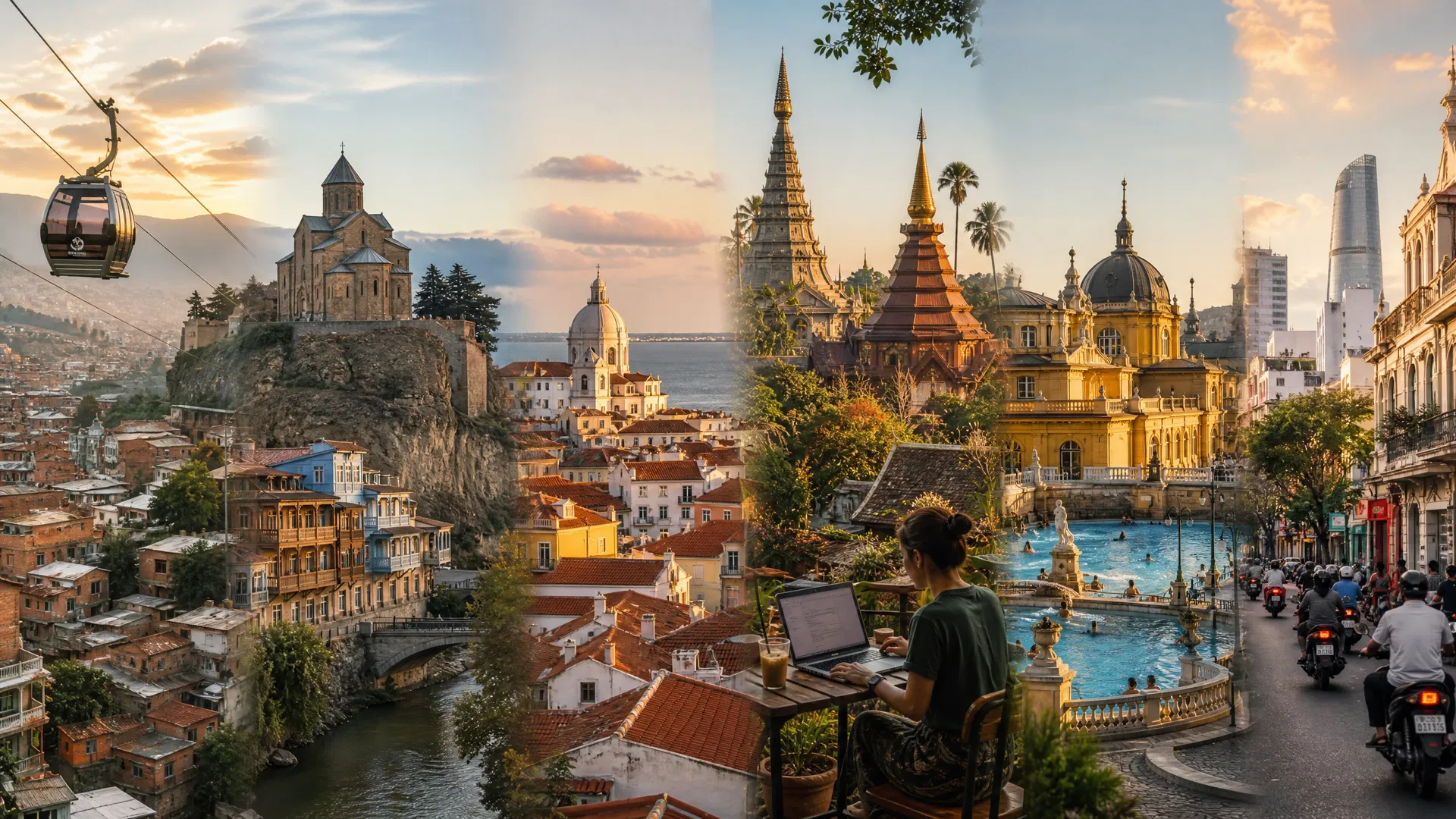
The Digital Nomad Cities That Weren't Designed for Digital Nomads.
Destination: Multiple
Category: Variant
There is a specific moment that happens to digital nomads who have been moving for long enough. You are sitting in a co-working space in Canggu, or Chiang Mai's Nimman Road, or Lisbon's Pink Street area, and you realize that the café you are in looks almost identical to the café you were in three cities ago. The same exposed concrete, the same pour-over coffee, the same playlist, the same demographic at every table. The infrastructure is excellent. The WiFi is fast. The community is warm. And something is missing.
What is missing is the city.
The cities that have been optimized for digital nomads have, in the process of optimization, replaced their own character with the nomad infrastructure. Canggu is the most complete example — a Balinese village that has been so thoroughly redesigned for the international remote work community that the Balinese village is no longer the primary experience. The smoothie bowls are excellent. The sunset ceremonies are real. The co-working infrastructure is among the most complete on earth. And the city that existed before the optimization is visible only in fragments, in the rice paddies that haven't yet been converted to villa compounds, in the ceremonies that happen at dawn before the nomads wake up.
The cities on this list were not designed for digital nomads. They were designed for their own residents — for the Medellín professional class that takes the metro to work, for the Tbilisi wine merchants who have been fermenting qvevri wine in the same clay pots for 8,000 years, for the Budapest architects who drink coffee in the same ruin bars that tourists photograph. The digital nomad who arrives in these cities does not find an infrastructure built for them. They find a city that is doing something more interesting — being itself — and the specific quality of that experience is what no co-working directory has figured out how to measure.
This is not a post about WiFi speeds. It is a post about what happens when you stay long enough to stop being a visitor.
Why Bali Isn't on This List (And Why That's the Point)
Bali is not on this list because Bali is the thesis, not the destination. The entire argument of this post is structured around what the cities here offer that Bali specifically cannot — and that argument requires naming Bali directly rather than quietly excluding it.
Bali is a genuinely extraordinary place. The Balinese Hindu culture is among the most visually and spiritually rich in the world. The food is excellent. The landscape is beautiful. The cost of living is low. The digital nomad infrastructure in Canggu and Ubud is among the most developed on earth. None of this is in dispute.
The problem is not Bali. The problem is what Bali has become for the digital nomad community — the default answer to a question that deserves more interesting answers. When Bali becomes the baseline, every other city gets evaluated against it: does it have the co-working spaces? Does it have the community? Does it have the cost structure? These are the wrong questions. The right question is: does it have the specific quality of life available to someone who stays long enough to stop being a nomad?
Bangkok is not on this list for a different reason. Bangkok is an excellent digital nomad city — the infrastructure is among the most developed in Asia, the cost is low, the food is extraordinary, and the transport system is one of the best in Southeast Asia. Bangkok doesn't appear here because the Bangkok digital nomad experience is primarily infrastructure-based. You can work productively in Bangkok. The cities on this list are cities where you can become a resident.
Prague is not on this list because the Prague digital nomad community has not developed the specific integration with the local city that Tbilisi, Medellín, and Budapest have produced. Prague is beautiful. Prague is functional. Prague is a city where digital nomads visit. The cities on this list are cities where digital nomads stay.
Medellín, Colombia — The City That Figured Out How to Welcome Without Optimizing
Medellín has the digital nomad infrastructure. The co-working spaces are excellent, the internet is fast, the cost of living is among the lowest of any Latin American city with genuine urban sophistication, and the Colombia Digital Nomad Visa — introduced in 2022 — allows remote workers earning more than $684 per month to live and work legally in Colombia for up to two years. The infrastructure argument for Medellín is not in dispute.
The competitive gap is the specific Medellín that digital nomads access when they make one decision that most nomads don't: they move to Laureles instead of El Poblado.
El Poblado is Medellín's international nomad neighborhood. It has the rooftop pools and the English-speaking bars and the co-working spaces on every corner and the Parque Lleras social circuit that functions as the nomad community's living room. It is excellent. It is also, increasingly, a neighborhood that exists for people like you rather than for the city that surrounds it.
Laureles is where Medellín's professional class actually lives. The neighborhood is fifteen minutes from El Poblado by metro and operates at a completely different register — the cafés are full of Colombian architects and engineers and teachers rather than international remote workers, the restaurants serve bandeja paisa to people who grew up eating bandeja paisa, and the Parque El Poblado social geography is local-facing in a way that Parque Lleras, 400 meters away, is not. The digital nomad who moves to Laureles does not find a worse version of El Poblado. They find a different city.
Atomhouse in Laureles is the co-working space where the local tech community and serious remote workers actually go. Selina El Poblado is the tourist-facing option. The two communities rarely overlap despite being fifteen minutes apart. This is not a criticism of either — it is the most precise description of what Medellín offers the digital nomad who is willing to make the choice.
The eternal spring climate — 24 degrees Celsius average year-round at 1,500 meters altitude, no air conditioning required, no heating required, the specific microclimate variation between El Centro and El Poblado that produces a three-degree temperature difference across the city's elevation range — is the infrastructure argument that no co-working directory lists because it doesn't fit in a spreadsheet. Medellín is the only major Latin American city where you never need to think about the weather. That is worth more than fast WiFi.
Cost snapshot (2026): One-bedroom apartment in Laureles: $500–700/month. Co-working day pass (Atomhouse): $10–15. Full lunch at a local restaurant: $4–6. Monthly budget for a comfortable life: $1,200–1,800.
AskLeif guides: Medellín 4-Day Urban Transformation Itinerary | Medellín Food & Culture Guide | Medellín Budget Travel Guide
Tbilisi, Georgia — The City That Charges Almost Nothing and Gives Almost Everything
In 2021, Georgia formalized what had been informally true for years: citizens of 95 countries can live and work in Georgia for up to 365 days per year with no visa required. No application. No income threshold. No bureaucratic process. You arrive, and you can stay for a year.
The cost of living in Tbilisi is among the lowest of any European-adjacent capital city. A one-bedroom apartment in the old town — the Abanotubani district with the carved wooden balconies and the sulfur bath houses and the Metekhi Church on the cliff above the Kura River — costs $300–500 per month. A full meal at a Georgian restaurant: $8. A bottle of natural wine from the Kakheti region, the oldest wine-producing region on earth: $6. A private room at the Chreli-Abano sulfur bath house on Abano Street, which has been operating since the nineteenth century and which is the correct digital nomad decompression activity in Tbilisi: $15.
Fabrika is the co-working complex that defines the Tbilisi digital nomad experience. A repurposed Soviet sewing factory in the Chugureti district, it contains co-working spaces, independent cafés, a Sunday market in the courtyard, and the specific community of Georgian tech entrepreneurs and international remote workers who have made it the city's creative hub. The Sunday market is not a tourist market — it is where the Tbilisi creative community sells ceramics and wine and vintage Soviet objects to each other, and the digital nomad who shows up on a Sunday morning finds a community that was not assembled for them.
The Vera neighborhood is where the digital nomad community has made its own. Not the old town — the old town is for atmosphere and for the sulfur baths and for the specific experience of walking through a city that looks like nowhere else on earth — but Vera, with its Soviet-era apartment buildings and independent café culture, is where the community lives. The natural wine bar circuit that functions as informal co-working space in the evening — the specific bars where the wine culture and the tech community overlap — is the Tbilisi social infrastructure that has no equivalent in any other digital nomad city.
The Georgian natural wine culture is not a tourist amenity. It is 8,000 years old, it is practiced by people who learned it from their grandparents, and the digital nomad who stays long enough to understand it finds themselves in possession of a social currency that opens doors in Tbilisi that no co-working membership can open.
Cost snapshot (2026): One-bedroom apartment in Vera: $350–550/month. Co-working day pass (Fabrika): $8–12. Full Georgian meal with wine: $10–15. Monthly budget for a comfortable life: $900–1,400.
AskLeif guides: Tbilisi 4-Day Itinerary | Tbilisi Food & Wine Guide
Lisbon, Portugal — The European Capital That Still Has Room
Lisbon has been extensively documented as a digital nomad destination. The Portugal D8 Digital Nomad Visa — introduced in October 2022, requiring proof of income of approximately €3,040 per month (four times the Portuguese minimum wage) — is among the most straightforward digital nomad visa processes in Europe. The NHR tax regime provides a flat 20% income tax rate for the first ten years of Portuguese residency. The culture is extraordinary. The weather is among the best in Europe. The food is excellent. The cost, relative to other Western European capitals, is still manageable in 2026 even after the post-gentrification price increases that have made the city less affordable than it was in 2019.
The competitive gap is not arguing for Lisbon's qualities — those are well established. The competitive gap is the specific Lisbon that digital nomads access when they stay long enough to stop being tourists.
Mouraria is that Lisbon. The neighborhood that has become the city's most interesting creative district for the local tech community is not the Baixa tourist circuit or the Time Out Market or the tram 28 route that every travel guide photographs. It is Mouraria — the historically Moorish neighborhood on the hill below the São Jorge Castle, the neighborhood that the Lisbon startup ecosystem has made its own, the neighborhood where the co-working spaces serve the Portuguese professional community rather than the international nomad circuit.
The LxFactory distinction matters in the same way. The Time Out Market is the tourist-facing version of Lisbon's food culture. LxFactory — the industrial complex in Alcântara that has been converted into studios and co-working spaces and restaurants and a bookshop and a café where the community spills over into informal working sessions on Tuesday lunchtimes when the food trucks in the courtyard attract the local creative community rather than tourists — is the resident-facing version. The digital nomad who goes to LxFactory on a Tuesday finds a different city than the one who goes to Time Out Market on a Saturday.
The specific neighborhoods where the cost-to-quality ratio still works for digital nomads on moderate incomes in 2026: Mouraria, Intendente, Arroios, and Marvila — the eastern neighborhoods that the gentrification wave has not yet fully reached, where a one-bedroom apartment costs $900–1,200 per month rather than the $1,500–2,000 that Príncipe Real and Chiado now command.
Cost snapshot (2026): One-bedroom apartment in Mouraria/Arroios: $900–1,200/month. Co-working day pass (Second Home Lisboa): $20–25. Full lunch at a local tasca: $10–14. Monthly budget for a comfortable life: $2,000–2,800.
AskLeif guides: Lisbon 5-Day Travel Guide | Lisbon Budget Travel Guide | Lisbon Food Guide | Lisbon Solo Travel Guide
Chiang Mai, Thailand — The Exception That Proves the Rule
Chiang Mai was designed for digital nomads. This is the honest acknowledgment that the title of this post requires. The specific infrastructure that Chiang Mai developed in the early 2010s — the density of co-working spaces, the established nomad community, the combination of Thai food culture and Northern Thai cultural depth, the cost structure that makes a comfortable life possible at $1,000–1,500 per month — was built deliberately, iteratively, over a decade of refinement. Chiang Mai is the only city on this list that was optimized for the nomad experience.
It appears here because ten years of iteration has produced something more interesting than the original optimization.
The Chiang Mai co-working hierarchy is the most refined in Southeast Asia. CAMP at Maya Mall is the original digital nomad café institution — the place where the culture began, where the buy-one-drink-and-sit-for-four-hours norm was established in 2012 and has been maintained ever since. Punspace Nimman is the professional co-working standard. These are the tourist-facing options, and they are excellent.
Santitham is where the Chiang Mai that wasn't designed for nomads lives. The neighborhood north of the Old City moat, where the Thai residential character has been preserved because the co-working infrastructure arrived later and more gently, where the morning market on Nimmanhaemin Road sells khao tom to Thai families rather than smoothie bowls to remote workers, where the emerging nomad infrastructure has been built around the neighborhood rather than replacing it — this is the Chiang Mai that the decade of iteration has produced. The nomad who moves to Santitham finds a city that is genuinely Thai in a way that Nimman, with its international coffee shops and English-language menus, is not.
The Northern Thai food culture is the competitive gap that most Chiang Mai content misses. The khao soi — the Northern Thai curry noodle soup that is the city's signature dish, available at Khao Soi Khun Yai on Charoen Rat Road for less than $2 — is not the same as the tourist-facing Thai food that Bali's Canggu presents as representative of regional cuisine. The sai oua sausage, the Warorot market dawn food culture, the specific Northern Thai food that the Thai residents of Chiang Mai eat rather than the food that the international community has made its own — this is the city that ten years of iteration has preserved.
The Thailand LTR Visa — introduced in 2022, requiring proof of income of $80,000 per year or $40,000 per year with specific asset thresholds — is the formal option. The established Chiang Mai nomad community has refined the border run culture into the most efficient visa extension system in Southeast Asia for those who don't qualify for the LTR.
Cost snapshot (2026): One-bedroom apartment in Santitham: $300–500/month. Co-working day pass (Punspace): $8–12. Full khao soi at a local restaurant: $2. Monthly budget for a comfortable life: $1,000–1,500.
Budapest, Hungary — The Most Rational City in Europe
Budapest is in the European Union. It operates on Central European Time, which aligns with most European business hours. It has a public transport system that makes car ownership unnecessary — the metro, tram, and bus network covers the entire city for a monthly pass that costs less than €30. It has a food and nightlife culture that consistently ranks among the best in Central Europe. And it costs approximately 40% less than Vienna, 50% less than Amsterdam, and 60% less than London for an equivalent lifestyle.
This is the most specific geographic and economic argument available for any European digital nomad city. The Budapest proposition is not that it is the most exciting city in Europe. It is that it is the most rational one.
The Hungary White Card digital nomad visa — introduced in 2022, less well-known than Portugal's D8 despite being easier to qualify for, requiring proof of income of approximately $2,000 per month — allows remote workers to live and work legally in Hungary for up to two years. The application process is straightforward and can be completed through the Hungarian consulate in most countries.
Loffice in the 6th district is the most established professional co-working space in Budapest. The Impact Hub Budapest serves the social enterprise community. But the most interesting co-working infrastructure in Budapest is not in a dedicated co-working space — it is in the ruin bars of District VII.
Szimpla Kert is Budapest's most famous ruin bar. The evening experience — the labyrinthine rooms, the mismatched furniture, the outdoor courtyard, the specific atmosphere of a city that has converted its ruins into its most distinctive cultural asset — is what most travelers associate with Budapest's nightlife. The daytime experience is completely different. Szimpla opens at 9 AM, serves coffee, and functions as a co-working space for the local creative community until the evening crowd arrives. The digital nomad who shows up at 10 AM on a Tuesday finds a quiet, atmospheric workspace that costs the price of a coffee and has no equivalent in any other European city.
The Hold utca market — the Belvárosi market in the 5th district, where the local professional community shops for lunch ingredients rather than the Great Market Hall on Vámház körút where tourists photograph paprika — is the correct introduction to Hungarian food culture for the digital nomad who stays long enough to cook. A flat white at the café next door costs less than €2. The WiFi is universally available.
Cost snapshot (2026): One-bedroom apartment in District VI/VII: $600–900/month. Co-working day pass (Loffice): $12–18. Full lunch at a local étterem: $6–9. Monthly budget for a comfortable life: $1,400–2,000.
AskLeif guides: Budapest 4-Day Itinerary | Budapest Family Guide
Ho Chi Minh City, Vietnam — The City That Rewards the Digital Nomad Who Goes Deeper
Ho Chi Minh City has two names. The official name — Ho Chi Minh City — is what the infrastructure operates under: the airport code, the government documents, the street signs. The actual name — Saigon — is what the residents use. The city never agreed to be renamed in 1975, and the persistence of the old name is the most precise description of what the city is: a place with its own identity that has survived every attempt to redefine it from the outside.
The digital nomad who stays for a week experiences the co-working spaces and the rooftop bars and the District 1 tourist circuit. The digital nomad who stays for three months experiences Saigon.
The co-working geography matters. District 1 has the tourist-facing infrastructure — the Dreamplex chain, the international nomad standard, the English-language menus and the rooftop pools. District 3 has the local professional co-working community — the Toong co-working chain, the Vietnamese professional standard, the spaces where the local tech community works rather than the international nomad circuit. The two communities rarely overlap despite being in the same city. The digital nomad who chooses District 3 over District 1 makes the same choice as the digital nomad who chooses Laureles over El Poblado in Medellín — they choose the city over the infrastructure.
Thảo Điền in District 2 is the expatriate and nomad neighborhood across the Saigon River from District 1. The specific co-working spaces, the café culture, the community that has developed there — more integrated with the local Vietnamese professional class than the District 1 nomad circuit — is the Saigon that the digital nomad who stays long enough finds. The Thảo Điền market on Saturday morning, where the Vietnamese and international communities overlap in a way that the District 1 tourist circuit doesn't produce, is the correct introduction to the neighborhood.
The Vietnam 90-day e-visa — introduced in 2023, renewable, available to most nationalities through an online process — is the most straightforward entry option. The established Ho Chi Minh City nomad community has developed a sophisticated visa extension culture similar to Chiang Mai's for those who want to stay longer.
The food is the competitive gap. The bánh mì cart on Huỳnh Thúc Kháng Street that has been serving the same recipe since 1975 is not the tourist-facing bánh mì that appears in every travel guide. The cơm tấm — broken rice with grilled pork, a fried egg, and pickled vegetables, available at every street corner for less than $2 — is the correct digital nomad lunch rather than the tourist-facing pho circuit. The city's food culture is the most specific and most differentiated in Southeast Asia, and the digital nomad who learns to navigate it finds a social infrastructure that has no equivalent in any other city on this list.
Cost snapshot (2026): One-bedroom apartment in District 3/Thảo Điền: $500–800/month. Co-working day pass (Toong): $8–12. Cơm tấm lunch at a local restaurant: $2. Monthly budget for a comfortable life: $1,000–1,600.
AskLeif guides: Ho Chi Minh City 4-Day Itinerary | Ho Chi Minh City Family Guide
How to Choose: A Nomad Profile Framework
The six cities on this list are not interchangeable. They are making different arguments about what the post-Bali digital nomad experience looks like, and the right city depends on which argument matches your specific situation.
If you need European timezone alignment: Budapest or Lisbon. Budapest for the cost argument — EU timezone, EU infrastructure, non-EU pricing. Lisbon for the culture argument — the most desirable quality of life available in Western Europe at a price that still works for remote workers on moderate incomes.
If you need maximum cost efficiency: Tbilisi or Chiang Mai. Tbilisi for the European-adjacent experience at Southeast Asian prices — $900–1,400 per month for a comfortable life in a city with 8,000 years of culture. Chiang Mai for the most refined digital nomad infrastructure in Southeast Asia at a cost that has not increased significantly in a decade.
If you need Latin American timezone alignment: Medellín. The only city on this list in the Americas, operating on Colombia Standard Time (UTC-5), which aligns with US East Coast business hours. The eternal spring climate and the Laureles integration argument make it the strongest Latin American digital nomad city.
If you want the deepest cultural immersion: Tbilisi or Ho Chi Minh City. Tbilisi for the specific intersection of European and Asian influences that produces a city that feels genuinely unlike anywhere else. Ho Chi Minh City for the specific depth of Vietnamese urban culture that rewards the nomad who stays long enough to understand the difference between the city's two names.
Visa eligibility matters: Check the specific requirements before committing. The Georgia 365-day visa-free policy covers 95 countries. The Portugal D8 requires €3,040/month income. The Hungary White Card requires approximately $2,000/month. The Colombia Digital Nomad Visa requires $684/month. The Vietnam 90-day e-visa is available to most nationalities. The Thailand LTR Visa requires $80,000/year income or specific asset thresholds.
| City | Monthly Budget | Timezone | Visa | Best For |
|---|---|---|---|---|
| Medellín | $1,200–1,800 | UTC-5 | Digital Nomad Visa ($684/mo) | Americas timezone, eternal spring, local integration |
| Tbilisi | $900–1,400 | UTC+4 | Visa-free 365 days (95 countries) | Maximum cost efficiency, cultural depth |
| Lisbon | $2,000–2,800 | UTC+0/+1 | D8 Visa (€3,040/mo) | European lifestyle, NHR tax regime |
| Chiang Mai | $1,000–1,500 | UTC+7 | LTR Visa or border run | Most refined nomad infrastructure, Northern Thai culture |
| Budapest | $1,400–2,000 | UTC+1/+2 | White Card ($2,000/mo) | EU timezone, EU infrastructure, non-EU pricing |
| Ho Chi Minh City | $1,000–1,600 | UTC+7 | 90-day e-visa (renewable) | Southeast Asia, deepest cultural immersion |
The Planning Section
The cities on this list are not weekend destinations. The argument this post makes — that the best digital nomad cities are the ones where you stop being a nomad — requires staying long enough to test it. The minimum meaningful stay is one month. The stay that actually produces the transition from tourist to resident is three months.
For Medellín: start in El Poblado to understand the infrastructure, then move to Laureles. The Medellín urban transformation guide covers the city's comeback story and the specific neighborhoods that make it work. The Medellín $25/day budget breakdown has the specific cost structure for living rather than visiting.
For Tbilisi: arrive in the old town, spend the first week understanding the geography, then move to Vera. The Tbilisi city and culture itinerary covers the sulfur baths, Fabrika, and the wine culture that defines the city. The Tbilisi khinkali and natural wine guide covers the specific restaurants and wine bars that function as the city's social infrastructure.
For Lisbon: the Lisbon complete 5-day guide covers the city's essential geography. The Lisbon solo traveler itinerary is the most useful starting point for digital nomads arriving alone. The Lisbon €55/day budget guide has the specific 2026 cost structure for the neighborhoods where the cost-to-quality ratio still works.
For Budapest: the Budapest ruin bar and thermal bath itinerary covers the ruin bars, the thermal baths, and the specific Districts that define the city's character.
For Ho Chi Minh City: the Saigon 4-day city itinerary covers the essential geography. Arrive in District 1, understand the tourist circuit, then move to District 3 or Thảo Điền.
What These Cities Have in Common
Medellín integrates. Tbilisi liberates. Lisbon legitimizes. Chiang Mai perfects. Budapest rationalizes. Ho Chi Minh City deepens.
Six cities. Six different arguments about what the post-Bali digital nomad experience looks like. Each irreplaceable by any other city on this list. None of them designed for you. All of them better for it.
The digital nomad who has done Bali — who has sat in the Canggu co-working spaces and eaten the smoothie bowls and attended the sunset ceremonies — arrives at a specific question: what's next? The cities on this list are the answer to that question. Not because they have better WiFi or cheaper apartments or more favorable visa regimes, though several of them do. But because they were built for their own residents, and the experience of living in a city that was built for someone else — and finding that you belong there anyway — is the specific thing that turns a digital nomad into a person who lives somewhere.
Ready to plan your move? The Medellín guide, Tbilisi guide, Lisbon guide, Budapest guide, and Ho Chi Minh City guide are the starting points. The rest you find by staying.