Da Nang Is Two Cities. Most Travelers Only Find One.
Destination: Da Nang, Vietnam
Category: destination
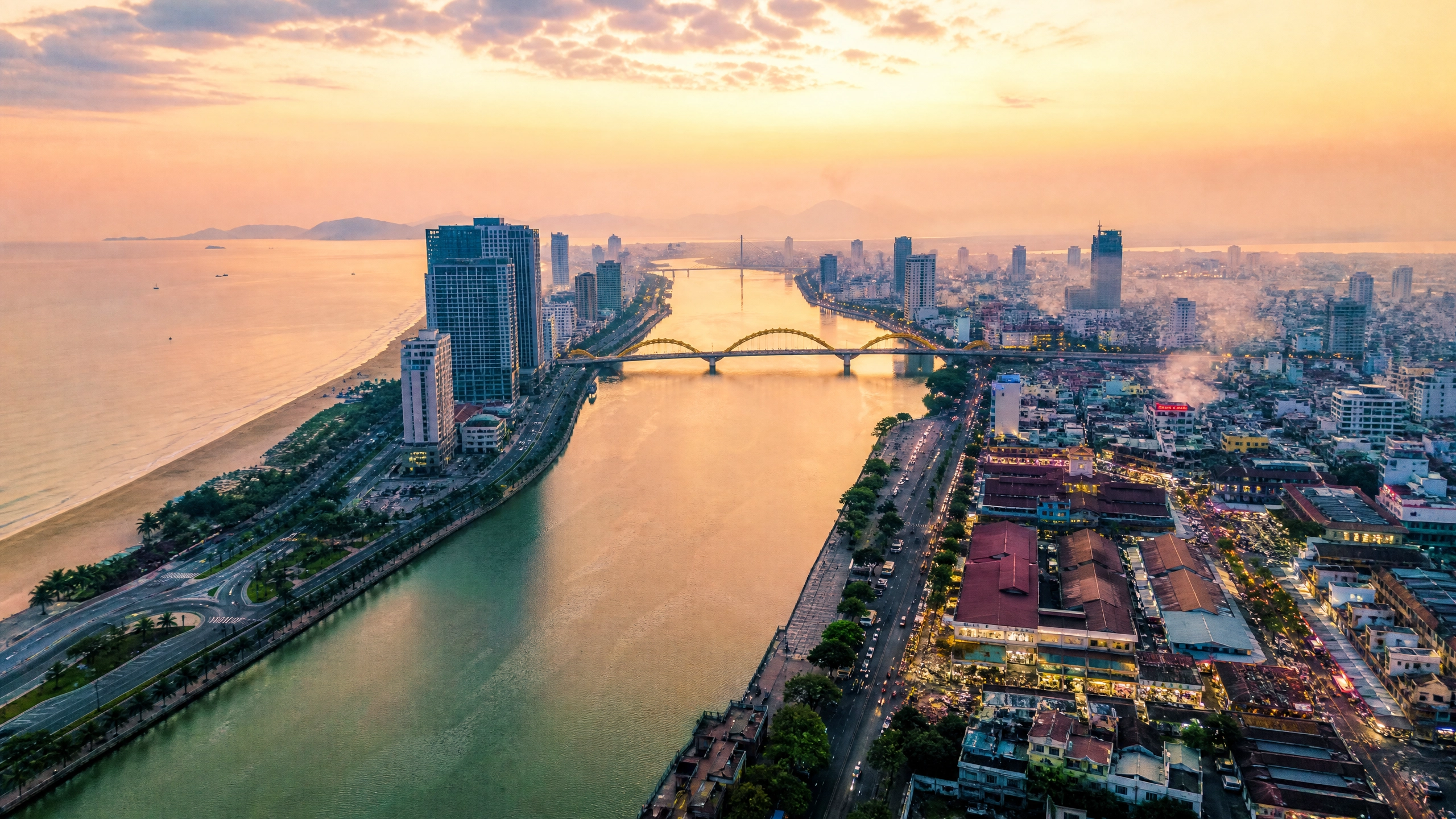
You cross the Han River at six in the morning and the city changes. Not gradually — immediately. The beach side, where you slept, where the hotels stack up along My Khe and the coffee shops open at seven and the menus are in English and Russian and Korean, that city stays behind you. The city you cross into has different sounds. Motorbikes moving faster. Markets already open, already loud. Women in conical hats carrying baskets on shoulder poles. The smell of something frying in a wok that you don't have a name for yet. You are still in Da Nang. You are somewhere else entirely.
This is the thing about Da Nang that no travel guide will tell you, because most travel guides are written by people who stayed on the beach side and called it a trip. Da Nang is not one city with a beach and a downtown. It is two cities that happen to share a river. The Han River runs north to south through the middle of the city, and on either bank, a completely different version of Da Nang is waiting. The beach side — My Khe, An Thuong, the long strip of white sand facing the South China Sea — is the Da Nang that Instagram built. The city side — Hai Chau district, Bach Dang Road, Cho Con market, Le Hong Phong Street — is the Da Nang that has existed for centuries and continues to exist regardless of whether any tourist ever crosses the bridge to find it.
Most tourists cross the Han River exactly once: on Saturday night, to watch the Dragon Bridge breathe fire and shoot water at 9 PM. They photograph it, they cross back, they go to bed. They have been to Da Nang. They have found one of the two cities.
The argument this post is making is simple: the river is always there, and crossing it in both directions, daily, is the entire trip.
The River That Divides (and What Lives on Each Bank)
The Han River is not a metaphor. It is a physical fact about Da Nang that determines almost everything about how a visitor experiences the city. Six bridges cross it — the Dragon Bridge is the most photographed, the Han River Bridge rotates 90 degrees to let ships through, the Thuan Phuoc suspension bridge glows at night — but the bridges are not the point. The point is what you find when you get to the other side.
On the east bank, the beach side: My Khe Beach runs for roughly 30 kilometers of white sand, and the strip of streets behind it — An Thuong in particular — has become one of the most concentrated expat and digital nomad zones in Southeast Asia. The coffee shops have fast WiFi and pour-over menus. The restaurants serve everything from banh mi to wood-fired pizza. The hotels range from $11-a-night apartments to the InterContinental Sun Peninsula Resort, which is technically on Son Tra Peninsula but belongs spiritually to this world. This is a genuinely good place to stay. The beach is real, the waves are real, the sunrise at My Khe at 5:30 AM — when Vietnamese locals arrive in force for swimming and Tai Chi while the tourists are still asleep — is one of the more quietly extraordinary things you can witness in Central Vietnam. The beach side is not fake. It is simply not the whole city.
On the west bank, the city side: Hai Chau district is the administrative and commercial heart of Da Nang, and it operates on a different frequency. Bach Dang Road runs along the riverfront and is where locals eat in the evenings — not tourists, locals, on plastic chairs, at stalls that have been in the same spot for decades. Cho Con market, which every local will tell you is better than the tourist-facing Cho Han market on the east bank, is a covered market with endless food stalls selling fresh produce, dried seafood, and prepared dishes at prices that have nothing to do with the exchange rate calculation most visitors are running in their heads. Le Hong Phong Street, in the heart of Hai Chau, is the street that expats who have actually lived in Da Nang for years call their favorite — dense with local restaurants and cafés that have no English menus and no reason to acquire one.
The city side is where Da Nang's history lives. It is where the Museum of Cham Sculpture sits. It is where the best mi quang in the city is served. It is where you find the Da Nang that existed before the hotels arrived.
What the Cham Left Behind
The Museum of Cham Sculpture on Trung Nu Vuong Street is the most important museum in Vietnam that most visitors to Vietnam never visit. This is not an exaggeration. The museum holds the world's largest collection of Cham sculpture — more than 2,000 artifacts, 12 of which are designated national treasures — spanning the 7th through 15th centuries, when the Champa Kingdom controlled Central Vietnam. The Tra Kieu altar. The Uma relief. Statues of Shiva and Tara carved from sandstone with a precision that still reads as impossible when you're standing in front of them. The collection was assembled by French archaeologists beginning in the late 19th century and has been housed in this building — designed in a hybrid French-Cham architectural style — since 1919.
The reason this matters for understanding Da Nang is that the Champa Kingdom is the context for everything else in Central Vietnam. The Hai Van Pass, which every travel guide describes as a scenic mountain road made famous by Top Gear, was for centuries the actual border between Champa and the Vietnamese kingdom of Dai Viet to the north. When you ride the pass — and you should, on a manual motorbike, because the views from the summit looking south toward Da Nang and north toward Hue are the kind that make you pull over and sit with them — you are crossing an ancient political boundary. The pass is not just scenery. It is the seam between two civilizations, and the museum on the west bank of the Han River is where you understand what was on the southern side of that seam.
My Son Sanctuary, the Champa temple complex about 70 kilometers southwest of Da Nang, is a UNESCO World Heritage Site and a half-day trip from the city. But My Son is the ruins. The museum is where the art went. If you visit My Son without first visiting the Cham Museum, you are seeing the container without the contents.
One more thing about the museum that no travel guide mentions: it is almost never crowded. You can spend two hours in front of the Uma relief without another visitor in the room. In a country where the most significant historical sites are often overwhelmed with tour groups, this is remarkable. The museum opens at 7 AM. Go early, go on a weekday, and you will have the Champa Kingdom essentially to yourself.
The Dish That Tells You Where You Are
If you order pho in Da Nang, the restaurant will serve it to you. But you will have to look for it. Mi quang is everywhere — on every corner of the city side, at every market stall, in every local café — and pho is the dish you have to seek out. This is the clearest possible signal that you are in Central Vietnam and not in Hanoi or Ho Chi Minh City, and it is a signal that most first-time visitors miss entirely because they arrive with pho as their mental model of Vietnamese food.
Mi quang is a rice noodle dish from Quang Nam Province, and Da Nang has claimed it as its own. The noodles are wide and flat, dyed yellow with turmeric, and served in a small amount of rich broth — not the clear, fragrant broth of pho but a concentrated, almost sauce-like reduction of shrimp, pork, or fish. The bowl comes with fresh herbs, banana flower, peanuts, and toasted sesame rice crackers that you crumble in at the end. It is served for breakfast, lunch, and dinner. It is served at 6 AM by women who have been making it since before you were born.
The Michelin Guide has found three spots in Da Nang worth naming. Mì Quảng 1A at 1A Hai Phong Street in Hai Chau I Ward is the most famous — a no-frills room with ribbon noodles in golden broth, the "special" version combining pork, shrimp, and a hard-boiled egg. It is Michelin Recommended, which means inspectors went back more than once. Mỳ Quảng Sứa Hồng Vân at 59 Le Hong Phong Street — the street the expats who actually live here call their favorite — holds a Bib Gourmand, the Michelin designation for exceptional value. It opens at 6 AM and closes at 1 PM, and the variation to order is the jellyfish: springy, briny, served in a shrimp-infused broth with a warm orange-red hue that looks like sunset in a bowl. Nu Đồ Kitchen at 11/1 Luu Quang Thuan Street is a family operation — the owner's parents sold mi quang before her, and the menu serves four versions in traditional bamboo baskets, with the snakehead fish variation carrying a turmeric aroma that stays with you. All three of these restaurants are on the city side of the Han River. None of them are in the top five Google results for Da Nang food.
The other dish worth knowing is bun cha ca — a fish cake noodle soup specific to Da Nang, served in a clear broth with tomatoes and dill in a way that reads as almost Mediterranean until you taste it and understand that it is entirely its own thing. The version at the stalls along Bach Dang Road on the riverfront is the version locals eat. Sit on a plastic chair, order by pointing, pay in cash. This is the food culture of the west bank, and it is the reason the people who have lived in Da Nang for years tell you that the best food is on the river side.
Cho Con market — Con Market, not the Han Market that most tourist maps highlight — is the place to understand what the city side eats. The Han Market has a small food court and souvenir stalls aimed at visitors. Cho Con has endless rows of fresh produce, dried seafood, and prepared food at prices that are genuinely local. The market opens early and is at its best before 9 AM. Bring cash. Bring patience for the scale of it. Leave with things you didn't know you wanted.
The Mountain With Monkeys
Son Tra Peninsula is the forested headland at the northern end of Da Nang's coastline, and it is the third city — neither the beach side nor the city side, but its own world. The 6,400-acre nature reserve rises steeply from the water, and at its highest point, the Lady Buddha statue stands 67 meters tall on a white lotus base, visible from almost anywhere on the Da Nang coastline. The statue is the reason most tourists come to Son Tra. It is not the reason to come to Son Tra.
The reason to come to Son Tra is the red-shanked douc langur. The douc is a critically endangered primate found in only a few pockets of Laos and two isolated populations in Vietnam, the largest of which — approximately 2,000 individuals — lives on Son Tra Peninsula. They are, by any objective measure, among the most visually extraordinary animals on earth: maroon "stockings" from ankle to knee, white forearms, a gray torso, a golden face framed by white cheek patches. National Geographic described them as "costumed apes," which undersells the strangeness of seeing one in a treetop twenty meters above you. They spend their entire lives in the forest canopy, eating young leaves and flowers, and they are not naturally curious about humans, which means they are not habituated and not performing.
GreenViet, the Da Nang-based conservation nonprofit that has been protecting the Son Tra douc population since 2014, runs daily morning tours. The organization's development director, Hoang Van Chuong, has been tracking the population for years — the 2017 census counted 1,300 individuals; a 2023 survey found more than 2,000, suggesting the protection efforts are working. The tours are the right way to see the doucs: guided, ethical, timed for the morning hours when the animals are most active. When GreenViet started its outreach programs, local officials told researchers that the primates in the photos "are in Africa, not here." Now, Da Nang hotels display douc photographs in their lobbies. The city has claimed the animal as its own.
One practical note that no travel guide mentions: if you plan to explore Son Tra Peninsula by motorbike — which is the best way to see it — you need a manual or semi-automatic bike. Automatic scooters are turned away at the peninsula entrance. The hills are steep enough that this rule exists for a reason. Rent accordingly, or book a guided tour that handles transportation.
Past Lady Buddha, continuing along the peninsula loop road, the city disappears. You are in jungle, with the South China Sea below you on both sides. The Red-shanked Doucs are in the canopy. The military base that shares the peninsula with the nature reserve means certain roads are closed, but the loop that remains open is enough. This is the part of Da Nang that developers tried to build resorts on in 2016. Campaigners collected 10,000 signatures — an unusual act of public opposition in Vietnam — and the project was scrapped. The reason Son Tra is still intact is because the monkeys are there.
The Beach Side (Honestly)
My Khe Beach is genuinely good. This is worth stating plainly, because the honest version of Da Nang requires acknowledging that the beach side has real things to offer before explaining what it misses. The beach runs for kilometers, the sand is white, the water is warm from April through August, and the sunrise — when Vietnamese locals arrive in force at 5:30 AM for swimming and Tai Chi while the hotels are still quiet — is something you will not forget. Lounge chairs and umbrellas rent for less than two dollars. Lifeguards monitor the swimming sections. The waves in the shoulder seasons are good enough for beginner surfing lessons; Go Surfing Vietnam on My An Beach runs lessons for around $40.
Ba Na Hills is the thing you need to understand before you go. It is a French-themed resort and amusement park built on a mountain 1,400 meters above sea level, accessible by cable car, and it contains the Golden Bridge — the one held up by two enormous stone hands that has been photographed approximately 400 million times. The cable car ride is genuinely impressive. The views from the summit, when the clouds cooperate, are extraordinary. The park itself is a French village built in Vietnam in the 21st century, which is either delightful or dissonant depending on your tolerance for theme parks. Go with accurate expectations and you will have a good day. Go expecting something authentically Vietnamese and you will be confused. It is spectacular and it is not Vietnam, and both of those things are true simultaneously.
At the foot of the Marble Mountains — Ngu Hanh Son, the five karst formations named for the five elements: metal, water, wood, fire, earth — Non Nuoc Stone Carving Village has been producing marble sculptures for 400 years. Family workshops line the road, and artisans are working when you arrive: chiseling, grinding, polishing. The craft was designated a Vietnam national intangible cultural heritage. The Marble Mountains themselves contain cave temples and pagodas built into the limestone, and the climb to the summit of Thuy Son (the water mountain) takes about 30 minutes and ends with a view of the coastline that explains why this stretch of Central Vietnam has been considered significant for centuries. The stone carving village at the base is the part that almost no travel guide covers, and it is the part that makes the visit feel like something other than a checkbox.
When to Go and How to Move
The dry season in Da Nang runs roughly from February through August, with the peak beach months being May through August when temperatures reach 35°C and the sea is calm and warm. The shoulder months of February, March, and April are cooler and less crowded, and the light in March is the kind that photographers plan trips around. September through November is typhoon season — heavy rain, occasional flooding, and the kind of grey skies that make the beach side feel purposeless. If you are going for the beach, go between February and August. If you are going for the city side, the Cham Museum, the food, and the doucs, the weather matters less.
Getting around Da Nang is straightforward. Grab — the Southeast Asian ride-hailing app — is reliable, cheap, and the right choice for most journeys within the city. A Grab car from the beach side to the city side costs around $3 to $5. For Son Tra Peninsula, either book a guided tour or rent a manual motorbike — and confirm it is manual before you leave the rental shop, because the automatic will be turned away at the peninsula gate. The Han River bridges are the connective tissue of the city; learn which bridge is closest to where you're going and you will stop thinking of the river as a barrier.
Hoi An is 30 kilometers south, a 40-minute Grab ride, and worth a full day. The Hoi An food guide covers the specific dishes and markets that make it worth the trip. Hue is 100 kilometers north, reachable by train or by riding the Hai Van Pass — the train goes through the mountain, the motorbike goes over it, and the motorbike is the right answer. For a broader sense of how Da Nang fits into a Vietnam itinerary, the Vietnam 5-day country guide maps the north-to-south logic.
Planning the Trip
Three days is the minimum to find both cities. Five days is the right amount. Seven days is what you need if you want to do Hue and Hoi An as day trips and still give Da Nang itself the attention it deserves.
A three-day structure: Day one on the city side — the Cham Museum in the morning, Cho Con market at noon, Bach Dang Road in the evening. Day two on the beach side — My Khe at sunrise, Marble Mountains and Non Nuoc Stone Carving Village in the late morning, Ba Na Hills in the afternoon if you want it. Day three on Son Tra — GreenViet douc tour at dawn, the peninsula loop by motorbike, Lady Buddha, back to the city side for mi quang at Mỳ Quảng Sứa Hồng Vân before it closes at 1 PM.
The Da Nang couples guide builds this into a specific three-day itinerary with accommodation recommendations and timing. For solo travelers, the Hoi An solo guide is the natural companion — Hoi An is close enough to treat as a fourth day from Da Nang, and the two cities together cover the full range of Central Vietnam's appeal. If you're building a longer Vietnam trip, the Hanoi solo guide and the Ho Chi Minh City solo guide are the bookends.
The AskLeif itinerary generator will build the day-by-day structure around your specific dates, travel style, and pace — including the timing details that make the difference between a good day and a great one. The Cham Museum at 7 AM before the tour groups arrive is a different experience than the Cham Museum at 11 AM. The douc tour at dawn is the only time the animals are reliably visible. These are the details that a generic itinerary misses and a personalized one doesn't.
The Closing
You will cross the Han River more times than you expect. You will cross it to eat. You will cross it to see the museum. You will cross it at night to watch the Dragon Bridge do its thing and then cross back because the food is better on the other side. At some point — maybe on the third day, maybe on the first — you will stop thinking of the river as a division and start thinking of it as the reason the city works. Two completely different versions of the same place, held together by six bridges and the fact that the Han River is not wide enough to make either side feel far from the other.
Most cities ask you to choose a neighborhood and stay in it. Da Nang asks you to cross the river. The travelers who do it find a city that is twice as interesting as the one they were told to expect. The travelers who don't go home having seen the beach and the Dragon Bridge and the Golden Bridge hands, and they are not wrong about what they saw. They just found one of the two cities.
The river is always there.