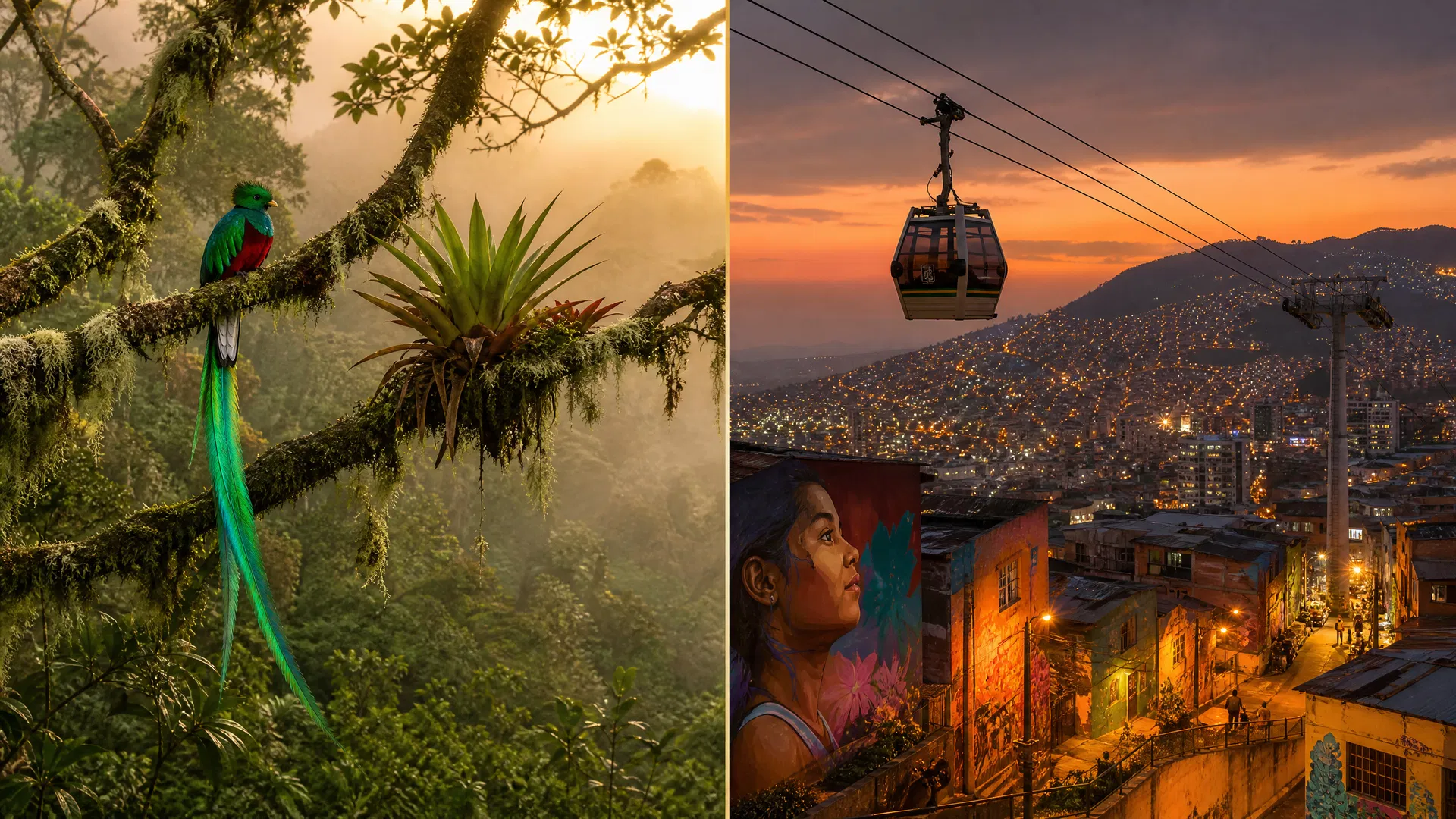
Costa Rica vs Colombia: One Country Chose Its Future. The Other Fought for It.
Destination: Costa Rica & Colombia
Category: comparison
The question comes up on every Latin America travel forum, in every hostel common room, in every conversation between someone who has been to one and someone who is deciding between them. Costa Rica or Colombia? And the answer that comes back, almost universally, is: Costa Rica for nature, Colombia for cities. Go to Costa Rica if you want beaches and wildlife and eco-lodges. Go to Colombia if you want Cartagena's old city and Medellín's transformation story and Bogotá's Gold Museum.
That answer is accurate. It is also completely wrong as a framework for making the decision.
The correct framing is not about which country has better specific attractions. It is about two fundamentally different relationships between a country and its own reinvention. Costa Rica abolished its military on December 1, 1948, and redirected that budget toward education and environmental protection — and the specific consequence of that specific decision is visible in every cloud forest, every sea turtle nesting beach, and every community-owned ecotourism cooperative that constitutes the Costa Rica experience. Colombia survived the specific decade of cartel violence that made it the most dangerous country in the Western Hemisphere and emerged as the most surprising travel destination in the Americas — and the specific consequence of that specific survival is visible in the civic pride of Medellín, the street art of Bogotá, and the warmth of a country that understands exactly what it means to be misunderstood.
Costa Rica versus Colombia is a question about which reinvention story you want to inhabit. The country that chose its future deliberately. Or the country that fought its way to one.
Identity: What Each Country's Reinvention Actually Produced
On December 1, 1948, José Figueres Ferrer — the Costa Rican farmer-turned-revolutionary who had just won a brief civil war — walked into the Cuartel Bellavista military barracks in San José, took a sledgehammer, and struck the wall. He was abolishing the army. Not reducing it. Not reforming it. Abolishing it entirely, constitutionally, permanently. The specific reason: Figueres had calculated that a military had produced the specific conditions for the civil war he had just won, and that removing it was the specific prevention of future coups. The military budget — roughly 7% of GDP at the time — was redirected to education and environmental protection.
The specific consequences of that specific decision are visible everywhere in Costa Rica today. The 99% literacy rate. The 26% of national territory protected as national park or biological reserve — the highest percentage of any country on earth. The hydroelectric and geothermal infrastructure that generates over 99% of the country's electricity from renewable sources, including a period between 2015 and 2019 when Costa Rica ran on 100% renewable electricity for stretches exceeding 300 consecutive days. The ecotourism economy that has made Costa Rica the most visited country in Central America, built not on beach resorts but on the specific biodiversity that the specific protected areas produced.
Costa Rica is not a nature destination that happens to have good governance. It is a governance experiment that produced a nature destination as its most visible output. Understanding that the cloud forests and the sea turtle beaches and the sloth sanctuaries are the direct consequence of a specific political decision made in 1948 is the prerequisite for understanding what makes Costa Rica specifically extraordinary rather than generically beautiful.
Colombia's reinvention is the most dramatic national transformation available in any travel destination because the specific baseline it transformed from is the most extreme available. The specific Pablo Escobar era — the 1989–1993 period when Medellín recorded a homicide rate of 381 per 100,000 people, the highest of any city in the world at the time — produced a specific civic trauma that Medellín has spent thirty years processing into something extraordinary. The specific cable car system in the specific comunas that were once the most violent neighborhoods in the city. The specific library network built in the specific marginalized barrios as the most deliberate available argument that culture can replace what violence destroyed. The specific Urban Land Institute award that Medellín received in 2013 as the most innovative city in the world — beating out New York and Tel Aviv. By 2023, the homicide rate had fallen to approximately 17 per 100,000. The math of that transformation is staggering.
Colombia's warmth — the specific paisas of Medellín, the specific costeños of Cartagena, the specific rolos of Bogotá — is not generic Latin American hospitality. It is the specific warmth of a people who understand exactly what it means to have been written off by the world and to have survived anyway. You feel it differently when you know what it cost.
Nature: The Biodiversity Argument Nobody Makes Correctly
The standard comparison frames Costa Rica as the nature destination and Colombia as the city destination. This framing is wrong in a specific and important way: Colombia is the most biodiverse country on earth by total species count, and the comparison between the two countries' natural environments is not Costa Rica versus nothing. It is managed extraordinary versus unmanaged extraordinary.
Costa Rica contains approximately 6% of the world's biodiversity in 0.03% of the world's land area — the specific consequence of the specific geography of the Central American isthmus that connects North and South America and has functioned as a biological corridor for species migration for the 3 million years since the Isthmus of Panama formed and connected the two continents. The specific result: 900 bird species (more than the entire continental United States), four species of sea turtle nesting on Costa Rican beaches, jaguar and tapir and scarlet macaw in the Osa Peninsula — which National Geographic has described as the most biologically intense place on earth — and the cloud forest ecosystem of Monteverde that contains the resplendent quetzal, the iridescent-tailed bird sacred to the Mesoamerican civilizations that preceded the Spanish conquest.
The Osa Peninsula's Corcovado National Park requires a licensed guide for all visitors — not as a bureaucratic inconvenience but as a genuine conservation measure for the most biologically rich national park in the Americas. The correct access point is Drake Bay, reached by small plane or boat, which means the most extraordinary section of Costa Rica is also the hardest to reach. That difficulty is not incidental. It is the consequence of the 1948 decision.
Colombia's nature operates at a different scale entirely. More bird species than any other country on earth — 1,900 species, more than twice the United States total. More orchid species than any country on earth — 4,270 species, which is why the orchid is Colombia's national flower rather than a marketing choice. The Amazon, the Andes, the Caribbean coast, the Pacific coast, and the Llanos grasslands all within the same national border. The Caño Cristales river in the Llanos, which turns specific shades of red and pink and yellow from July through November when the Macarenia clavigera plant blooms on the river bed — a river so visually extraordinary that it was closed to tourism from 2004 to 2009 due to FARC activity, and whose reopening is one of the most specific available measures of Colombia's security transformation.
The difference between the two countries' nature is not quality. It is access and management. Costa Rica's natural environments are the most accessible and the most managed in Latin America — the specific reason they are simultaneously the best entry point for first-time Latin America nature travelers and the most criticized by experienced travelers who want the unmanaged version. Colombia's natural environments are less managed and less marketed — the specific consequence of the security situation that limited adventure tourism development for thirty years and that has produced the specific opportunity of a country with extraordinary natural infrastructure and a fraction of the visitors it deserves.
Cities: San José's Honesty vs. Colombia's Three Arguments
Where Costa Rica's identity is built on what exists outside its cities, Colombia's identity is built on what its cities have become. The contrast is not a flaw in either country. It is the thesis made architectural.
San José is the most honest capital city in Central America — honest in the specific sense that it makes no pretense of being a destination in itself and no apology for being a functional, livable, unremarkable access point for everything extraordinary that exists outside it. The Mercado Central has been feeding the city since 1880 and remains the best place to eat gallo pinto and drink café chorreado for less than three dollars. The Barrio Escalante neighborhood is the most interesting neighborhood for contemporary Costa Rican food and culture — the specific block of Calle 33 between Avenidas 9 and 11 that has become the city's best restaurant street without becoming a tourist attraction. The Museo del Jade contains the largest collection of pre-Columbian jade in the Americas, which most Costa Rica travelers never visit because they arrive on a Tuesday and leave for Arenal on a Wednesday.
The honest Costa Rica city reality: the cities are not why you go to Costa Rica. The country is why you go to Costa Rica. San José is the airport and the first night and the departure point. Everything that makes Costa Rica specific happens outside it. This is not a criticism. It is a description of a country that made a deliberate choice about what to invest in.
Colombia's cities are the best argument for Colombia over Costa Rica for the traveler who wants urban culture alongside natural beauty — and the three major cities are so different from each other that visiting all three constitutes a complete argument for what Colombia actually is.
Bogotá sits at 2,600 meters above sea level and operates at a pace and an intellectual intensity that reflects its altitude and its history as a colonial administrative center. The Candelaria colonial quarter is the correct starting point — the specific Calle del Embudo, the specific Plaza de Bolívar, the specific Iglesia de San Francisco that dates to 1557. The Gold Museum contains the largest collection of pre-Columbian gold in the world, including the Muisca raft — the specific El Dorado artifact, a 20-centimeter gold figurine depicting a Muisca chief on a raft surrounded by attendants, which is the specific object that generated the specific El Dorado legend that sent the specific Spanish conquistadors into the specific Amazon for two centuries looking for a city of gold that did not exist. The ciclovía closes 120 kilometers of city streets to cars every Sunday — not as a special event but as a standing weekly institution that has been running since 1974.
Medellín is the reinvention city, and the Medellín 4-Day Itinerary is the most efficient way to understand what the transformation actually produced on the ground. The cable car system connecting the comunas to the city center is not a tourist attraction. It is a commuting infrastructure that was built specifically in the neighborhoods where the violence was worst, as the most deliberate available argument that mobility is a prerequisite for economic participation. The Laureles neighborhood — not El Poblado, which is where most tourists stay — is where Medellín actually lives: the specific Avenida El Poblado restaurants that serve bandeja paisa to office workers at lunch, the specific Parque de El Poblado that is actually in Laureles and not in El Poblado despite the name, the specific Saturday morning flea market on Avenida 33 that has been running since before the cable cars existed.
Cartagena is simultaneously the most beautiful city in Colombia and the most tourist-facing, and the specific reason the specific Getsemaní neighborhood outside the walled old city is more interesting and more honest than the specific old city inside the walls. The old city is extraordinary — the specific Castillo San Felipe de Barajas, the specific Plaza de los Coches, the specific Sofitel Legend Santa Clara hotel that was a convent in 1621 — but it has been so thoroughly consumed by tourism that the experience of walking it is the experience of being in a museum rather than a city. Getsemaní, where the street art covers every wall and the residents have been fighting gentrification since the old city became a UNESCO site, is where Cartagena actually is. The Cartagena 5-Day Itinerary builds the trip around both — the old city for context, Getsemaní for the city itself.
Adventure: The Managed Version and the Unmanaged One
Costa Rica invented the specific adventure tourism category. The zip-line through cloud forest canopy was invented in Costa Rica in the Monteverde Cloud Forest Reserve in the 1970s by the biologist Donald Perry, who needed a method of accessing the forest canopy for scientific research and inadvertently created the tourism industry that has since been replicated in 60 countries. The white water rafting on the Pacuare River — rated one of the top five rafting rivers in the world — runs through a canyon whose walls are covered in primary rainforest that has been protected specifically because the rafting community successfully opposed the dam that would have flooded the canyon. The Arenal & La Fortuna Adventure Guide covers the volcano hiking, the hot springs, and the hanging bridges that constitute the most accessible adventure itinerary in Central America.
Costa Rica's adventure is the most managed and the most accessible in Latin America. That is simultaneously its greatest strength and its most common criticism. The zip-lines are safe. The guides are licensed. The national parks have entrance fees and visitor limits. The infrastructure exists because the 1948 decision produced the funding to build it. The traveler who wants adventure with the friction removed will find no better destination in the hemisphere.
Colombia's adventure is the most diverse available in Latin America because the specific geographic variety of the country produces the specific adventure variety. Paragliding above the Chicamocha Canyon — the second largest canyon in the world, 227 kilometers long and 2,000 meters deep, accessible from the colonial town of Barichara. Diving on the Providencia Island coral reef — the third largest barrier reef in the Western Hemisphere, 90 kilometers off the Caribbean coast, with visibility that regularly exceeds 30 meters. Mountaineering on the Nevado del Ruiz, the 5,321-meter volcano whose 1985 eruption killed 23,000 people and whose summit is still accessible by guided climb.
And then there is Ciudad Perdida. The Lost City of the Tairona civilization, built between the 9th and 14th centuries and older than Machu Picchu by 650 years, is accessible only by a four-day jungle trek from the El Mamey trailhead outside Santa Marta. The 44-kilometer round trip crosses the ancestral land of the Kogi and Wiwa indigenous communities, whose presence on the trail — the specific Kogi mamos in their white robes, the specific Wiwa women weaving mochilas at the river crossings — is the most specific available encounter with a living pre-Columbian culture in South America. The trek can only be done with licensed tour operators from Santa Marta agencies. The site was closed to tourism from 2003 to 2005 due to guerrilla activity. Its reopening is another specific measure of Colombia's transformation.
Colombia's adventure is less managed and less marketed than Costa Rica's — the specific consequence of the security situation that limited adventure tourism development for thirty years and that has produced the specific opportunity of a country with extraordinary adventure infrastructure and the specific fraction of the visitors that the infrastructure deserves.
The Safety Reality in 2026
Costa Rica's safety reputation is its most overused tourism marketing tool and its most consequential practical reality. The specific facts: Costa Rica is the safest country in Central America by every available metric, has no military by constitutional choice, and has been peaceful since the 1948 civil war. The specific honest safety reality in 2026: petty theft in specific San José neighborhoods and specific tourist areas is the primary concern, and the Caribbean coast — the Limón province, the Cahuita National Park, the Manzanillo Wildlife Refuge — has a higher crime rate than the Pacific coast that the tourism board doesn't emphasize. This matters because the Caribbean coast contains some of the most biodiverse marine environments in Costa Rica and receives a fraction of the tourists of the Pacific side precisely because the marketing doesn't push it.
Costa Rica's safety is real and produces the specific consequence of being the most accessible first-time Latin America destination. The backpacker circuit, the senior traveler circuit, and the family travel circuit all converge on Costa Rica because the safety threshold for all three is the most easily met available in the region.
Colombia's safety transformation is the most dramatic available in any major travel destination and the most misunderstood by travelers still operating on the 1993 mental model. The specific facts in 2026: Bogotá, Medellín, Cartagena, and the coffee region are as safe as any comparable Latin American city for the informed traveler who takes the specific precautions that any major city requires. The specific areas that remain genuinely dangerous — the Pacific coast coca-growing regions, the Venezuelan border areas, the remaining FARC dissident zones — are not on any tourist itinerary and require the active effort to reach that most travelers would never make.
The specific Colombia safety practice that matters most: use InDrive or Cabify rather than street taxis in all Colombian cities. The express kidnapping known as the paseo millonario — where a street taxi driver picks up a passenger and drives them to an ATM — is the specific crime that the Colombian tourism board has specifically worked to eliminate through app-based transport promotion. In El Poblado in Medellín and the old city in Cartagena, street taxis are fine. In Bogotá and in neighborhoods outside the tourist circuit, the app is the correct choice. This is not a theoretical concern. It is a specific practical instruction that separates a good Colombia trip from a bad one.
Planning: How to Choose, How to Combine
The decision between Costa Rica and Colombia is ultimately a decision about what kind of traveler you are in this specific moment of your life.
Costa Rica is right for you if you want the most managed and most accessible version of extraordinary nature available in Latin America. If you want a first-time Latin America destination that removes the specific friction of language barriers, safety concerns, and logistical complexity. If you want to inhabit the consequence of a specific political decision — to understand that the cloud forests and the sea turtles and the sloths are the direct output of choosing education and environment over military spending. The Costa Rica 7-Day Solo Adventure Guide builds the trip around the specific regions that deliver the thesis: Arenal for the volcano and the hot springs, Manuel Antonio for the Pacific coast wildlife, Monteverde for the cloud forest and the zip-lines.
Colombia is right for you if you want to inhabit a reinvention story rather than observe a nature destination. If you want three cities that are each more interesting than the capital cities of most countries. If you want the most surprising travel experience available in the Western Hemisphere — the experience of arriving expecting one country and finding another entirely. The Medellín Food & Culture Guide, the Bogotá 4-Day Deep Dive, and the Colombia Coffee Region Guide each cover a distinct dimension of what Colombia actually is. The Cartagena 4-Day Couples Guide covers the Caribbean coast dimension.
Both right for you if you have four weeks: fly into San José, spend ten days going deep into one region rather than attempting the entire country, fly to Bogotá, spend two weeks moving between Bogotá, Medellín, and Cartagena. Come back understanding why Latin America is the most underrated travel region in the world for the specific traveler who has been going to Europe every year and wondering why it doesn't move them the same way it used to.
The AskLeif itinerary generator builds either trip — or both — around your specific dates, budget, and travel style, accounting for the seasonal conditions, the specific regional variations within each country, and the specific experiences that are worth the planning they require.
Budget reality: Costa Rica is the most expensive country in Central America and costs roughly the same as a mid-range European destination. Colombia is significantly cheaper — Medellín and Bogotá are among the most affordable major cities in South America for the dollar or euro traveler, and the coffee region is cheaper still. If budget is a primary constraint, Colombia is the stronger choice. If accessibility and infrastructure are the primary constraint, Costa Rica is.
The Honest Answer: Costa Rica or Colombia?
The honest answer is that the question is wrong. Not because both are equally good — they are not equally good for every traveler — but because the comparison that matters is not between the destinations. It is between the two versions of yourself that each destination produces.
Costa Rica produces the version of you that understands what a deliberate choice looks like at national scale. You stand in the Corcovado and you understand that the jaguar in front of you exists because a man took a sledgehammer to a barracks wall in 1948 and redirected the money. You float on the Pacuare and you understand that the primary rainforest on the canyon walls exists because the people who built the rafting industry fought a dam. You watch the leatherback sea turtles come ashore at Tortuguero at 2am and you understand that they come because the specific beach is protected and the specific protection was chosen. Costa Rica is a country where the consequences of specific choices are visible and traceable and present. That is not a common thing in the world.
Colombia produces the version of you that understands what survival looks like at national scale. You ride the cable car in Medellín and you understand that the specific comunas below you were the specific neighborhoods where the specific violence was worst and that the cable car was built there specifically because the people who built it understood that the worst places are where the argument for something better needs to be made most loudly. You walk through Getsemaní and you understand that the street art is not decoration — it is the specific visual language of a neighborhood that has been through something and is still here. You talk to a paisa in a Medellín coffee shop and you understand that the warmth is not generic. It is the specific warmth of someone who knows exactly what their city used to be and is proud of what it became.
Both countries are extraordinary. The choice between them is a choice about which kind of extraordinary you need right now.
Costa Rica chose. Colombia fought. Costa Rica protected. Colombia rebuilt. Costa Rica managed. Colombia surprised.
Six verbs. Two countries. One question that is finally being answered correctly.