Bogotá Rewired My Brain — Here's What Nobody Tells You Before You Go
Destination: Bogotá, Colombia
Category: Destination Guides
Bogotá Rewired My Brain — Here's What Nobody Tells You Before You Go
I arrived in Bogotá with the wrong idea of it.
Most people do. The wrong idea has been circulating for decades, assembled from news footage and crime statistics and the particular way that certain cities get frozen in the global imagination at their worst moment and never quite thaw. Bogotá's worst moment was the 1990s, and the city has spent the thirty years since then doing something extraordinary: rebuilding itself from the inside out, block by block, institution by institution, until it became one of the most genuinely surprising cities on earth — a place that rewards the traveller who shows up without assumptions with an experience that is difficult to describe and impossible to forget.
Here is what I can tell you now, having been there: Bogotá is the kind of city that changes the way you think about cities. It is the kind of place that makes you question every preconception you had about South America, about Colombia, about what a capital city at 2,600 metres above sea level in the middle of the Andes can be. It is the kind of city that you arrive in cautiously and leave from with a specific, physical ache of wanting to return.
This is the guide I wish I had before I went. Not the cautious one. The honest one.
The City That Reinvented Itself
To understand Bogotá today, you need to understand what it was and what it chose to become.
In the early 1990s, Bogotá was genuinely dangerous — one of the most violent cities in the world, paralysed by cartel violence, political instability, and a municipal government that had essentially stopped functioning. The streets of La Candelaria were not a tourist destination. They were a place where people kept their heads down and moved quickly.
Then something happened. A series of mayors — most famously Antanas Mockus, a mathematician and philosopher who served two terms and governed through the radical idea that civic culture could be changed through creativity rather than force — began transforming the city. Mockus hired mimes to replace traffic police. He introduced a "thumbs up, thumbs down" card system for pedestrians to signal approval or disapproval of each other's behaviour. He appeared on television in a Superman costume. He reduced traffic fatalities by 50% and homicide rates by 70% during his tenure, not through enforcement but through the audacious belief that people would behave better if they were reminded, creatively and persistently, that they were part of a community.
The transformation continued under subsequent mayors. The TransMilenio bus rapid transit system was built. The Ciclovía — a weekly closure of 120 kilometres of city streets to car traffic, opening them to cyclists, walkers, and rollerbladers — became a permanent institution. Libraries were built in the poorest neighbourhoods. The cable car system connected hillside comunas to the city below. Public space was reclaimed, cleaned, and made genuinely public.
The result is a city that is still rough in places, still complex, still carrying the weight of its history — but also one of the most intellectually alive, culturally vibrant, and genuinely exciting urban environments in the world. Bogotá did not become safe by becoming sanitised. It became safe by becoming itself, more fully and more confidently than it had ever been before.
The Altitude: The First Thing to Respect
Bogotá sits at 2,625 metres above sea level. This is not a detail. This is a fact that will shape your first two days in the city whether you plan for it or not.
At this altitude, the air contains roughly 25% less oxygen than at sea level. For most visitors, this means fatigue, mild headaches, and a general sense of moving through the world at slightly reduced capacity. For some, it means genuine altitude sickness — nausea, dizziness, difficulty sleeping. The symptoms typically peak in the first 24–48 hours and resolve as your body acclimatises, but they are real and they are worth planning around.
The practical advice is simple: arrive and rest. Do not plan a full day of activity on your first day. Drink more water than you think you need. Avoid alcohol for the first 24 hours — it dehydrates you faster at altitude and amplifies the symptoms. Eat lightly. Walk slowly. The city will still be there tomorrow, and you will enjoy it considerably more once your body has adjusted.
Coca tea — aguapanela con coca — is the traditional Andean remedy, available everywhere and genuinely effective at easing the transition. It is made from coca leaves (not cocaine — the alkaloid concentration in tea is negligible) and has been used in the Andes for thousands of years for exactly this purpose. Drink it. It works.
Once you are acclimatised, the altitude becomes an asset rather than a liability. The air is cool and clear. The light at this elevation has a particular quality — sharp and bright, with colours that seem more saturated than at sea level. The sky above Bogotá on a clear day is a blue so deep it looks almost artificial.
La Candelaria: The Heart of Everything
Every city has a neighbourhood that contains its entire history in concentrated form. In Bogotá, that neighbourhood is La Candelaria.
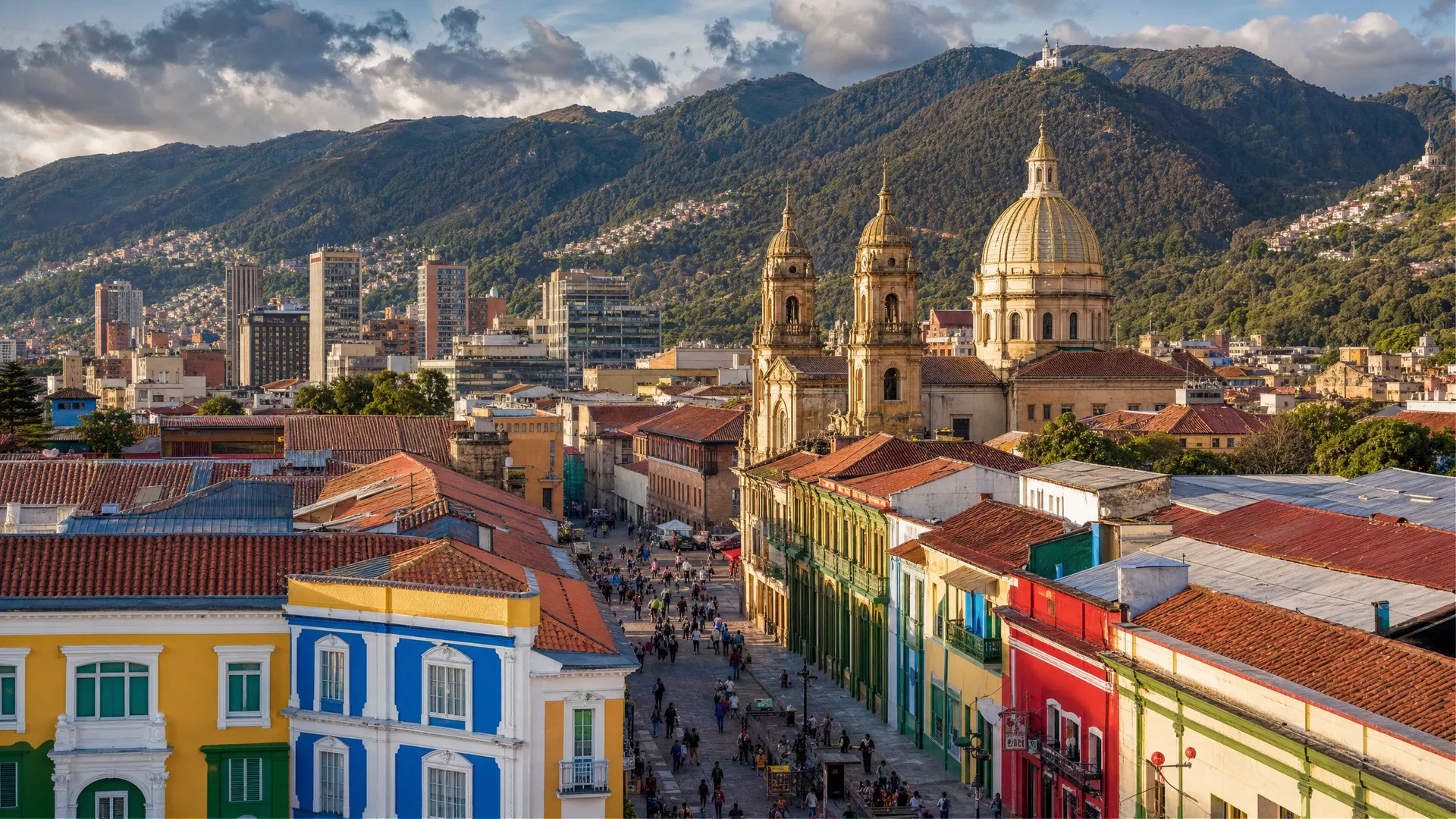
The historic centre of the city, La Candelaria is a grid of cobblestone streets and colonial buildings that has been continuously inhabited since the Spanish founded the city here in 1538. The architecture ranges from 16th-century churches to Republican-era mansions to the kind of colourful painted facades that have made this neighbourhood one of the most photographed in South America. The street art is extraordinary — not the tagging-and-tags variety, but genuine murals of museum quality, covering entire building facades with images that range from pre-Columbian mythology to contemporary political commentary.
The Plaza de Bolívar is the city's central square and its emotional core. The bronze equestrian statue of Simón Bolívar that gives the square its name has been here since 1846, and the buildings that surround it — the Cathedral Primada, the Capitolio Nacional, the Palacio de Justicia, the Liévano Palace — represent four centuries of Colombian institutional life. Sit on the steps of the cathedral in the afternoon and watch the square: the school groups, the pigeons, the vendors selling chontaduro (a palm fruit eaten with salt and honey), the politicians emerging from the Capitolio, the tourists photographing everything. The Plaza de Bolívar is not a museum. It is a living room.
The Museo del Oro — the Gold Museum — is one of the great museums of the world, and it is not hyperbole to say so. The collection contains more than 55,000 pieces of pre-Columbian gold work, assembled from cultures across Colombia over centuries: the Muisca, the Zenú, the Tairona, the Quimbaya. The craftsmanship is staggering — intricate filigree work, cast figures of extraordinary detail, ceremonial objects whose purpose and meaning are explained with scholarship and care. The museum's centrepiece is the Sala Dorada, a darkened circular room where the entire collection of gold pieces is illuminated simultaneously, and the effect is genuinely overwhelming. Allow at least two hours. Allow more if you can.
The Botero Museum is free, which seems impossible given what it contains. Fernando Botero, Colombia's most famous artist, donated 123 of his own works and 85 works from his personal collection — Picasso, Monet, Dalí, Bacon — to the Banco de la República, which opened them to the public at no charge. Botero's signature style — the voluminous, rounded figures that make everything from a fruit bowl to a military dictator look simultaneously monumental and absurd — is an acquired taste, but the collection is so generous and the space so well designed that even visitors who arrive sceptical tend to leave converted.
The Food: A Cuisine That Deserves More Credit Than It Gets
Colombian food has an image problem in the wider world. It is not considered a prestige cuisine in the way that Peruvian or Mexican food has become. This is a mistake, and Bogotá is the place where the mistake becomes most apparent.
Bandeja paisa is the national dish, and it is an argument for the proposition that abundance is a virtue: a platter containing red beans, white rice, ground beef, chicharrón (fried pork belly), a fried egg, sweet plantain, black pudding, and an arepa. It is enormous. It is delicious. It is the kind of meal that requires no activity for the remainder of the day and no apology for that.
Ajiaco is the soup that Bogotá considers its own: a thick, hearty broth made with three varieties of potato (including the tiny papa criolla, a yellow potato native to the Colombian highlands), chicken, corn on the cob, and guasca — an herb that grows wild in the Andes and gives the soup its distinctive, slightly earthy flavour. Ajiaco is served with cream, capers, and avocado on the side, and it is the correct meal to eat on a cool Bogotá evening when the clouds have come down over the mountains and the city is wrapped in that particular grey-green light that makes it look like a city from a novel.
Empanadas are everywhere, and the quality varies enormously. The best ones are made with a corn dough that is slightly crispy on the outside and yielding within, filled with a mixture of potato and beef or chicken, and served with ají — a fresh salsa of tomato, onion, and chilli that is the Colombian equivalent of hot sauce and is present on every table in every restaurant in the country. The worst ones are the ones you buy from a bag at a petrol station. The best ones are the ones you buy from a woman with a cart on a street corner in La Candelaria at 11 PM, when the nightlife is in full swing and the empanadas have been frying continuously for six hours and are at the absolute peak of their powers.
Chocolate santafereño is the traditional Bogotá breakfast: a cup of thick hot chocolate served with pan de bono (a cheese bread made with tapioca flour) and a slice of white cheese. The ritual is to break the cheese into the chocolate and eat the softened pieces with a spoon. It sounds strange. It is one of the most comforting things you will ever eat.
The restaurant scene in Bogotá has exploded in the past decade. The Zona Rosa and Parque 93 areas of the Chapinero and Chicó neighbourhoods contain some of the best restaurants in South America: Leo (chef Leonor Espinosa's flagship, which has appeared on the World's 50 Best list and offers a tasting menu built entirely around Colombian ingredients and techniques), Criterion (French-influenced fine dining that has been the city's most reliable special-occasion restaurant for twenty years), and Harry Sasson (the kind of grand, theatrical restaurant that makes you feel like you are eating in a city that takes itself seriously, which Bogotá absolutely does).
For something less formal, the neighbourhood of La Macarena — a small grid of streets between La Candelaria and the Parque Nacional — has the highest concentration of interesting independent restaurants in the city. Small, personal, often chef-owned, serving food that ranges from traditional Colombian to Japanese-Colombian fusion to wood-fired pizza made by a Neapolitan who moved to Bogotá in 2015 and never left.
The Neighbourhoods: A City of Villages
Bogotá is enormous — it has a population of approximately 8 million people and covers an area of 1,775 square kilometres — but it is experienced as a collection of distinct neighbourhoods, each with its own character and its own pace.
Chapinero is the neighbourhood that contains the city's most concentrated nightlife, its most visible LGBTQ+ community, and some of its best independent restaurants and bars. The Zona Rosa, in the northern part of Chapinero, is where the money goes to eat and drink — a grid of streets lined with restaurants, cocktail bars, and clubs that operate until 4 AM on weekends. The southern part of Chapinero, around the Parque de los Hippies, is older, scruffier, and more interesting: vintage clothing shops, independent bookstores, coffee shops where the Wi-Fi is good and the music is carefully chosen.
Usaquén is the neighbourhood that Bogotanos go to on Sunday mornings. A former municipality that was absorbed into the city in the 1950s, Usaquén has retained its village character — a central plaza surrounded by colonial buildings, a Sunday flea market that fills the surrounding streets with antiques, crafts, and street food, and a collection of restaurants that are among the best in the city. The Sunday market is genuinely excellent: less tourist-oriented than the markets in La Candelaria, more focused on the kind of Colombian craft and design that you actually want to bring home.
La Macarena has been mentioned for its restaurants, but it deserves more. This is the neighbourhood where Bogotá's artists and intellectuals live, where the galleries are, where the independent cinema operates, where the bookshops are the kind that have cats and no particular interest in selling you anything quickly. It borders the Parque Nacional, one of the city's great green spaces, and the combination of park, neighbourhood, and the Cerros Orientales rising behind it creates a setting that is, on a clear day, genuinely beautiful.
Teusaquillo is the neighbourhood that architecture lovers should not miss. Built in the 1920s and 1930s, it is a collection of Republican-era mansions and Art Deco apartment buildings that represent Bogotá at its most formally ambitious — a city that was, at that moment, trying very hard to look like a European capital and succeeding in ways that are still visible in the facades and the tree-lined streets.
The Ciclovía: The Best Thing a City Has Ever Done
Every Sunday and public holiday, from 7 AM to 2 PM, Bogotá closes 120 kilometres of its main roads to car traffic. The streets are taken over by cyclists, joggers, rollerbladers, families pushing prams, elderly couples walking hand in hand, and children on bicycles who have never had this much space before and are making the most of it.
The Ciclovía is not a special event. It is not a festival. It is a weekly institution that has been running since 1974, and it is the single most important thing Bogotá has done to define its character as a city. On Ciclovía days, the city belongs to its people in a way that is rare and precious and worth experiencing even if you have no particular interest in cycling.
The route runs through the major arteries of the city — Carrera Séptima, Carrera 11, Avenida El Dorado — and connects the major parks and neighbourhoods. Bicycle rentals are available at multiple points along the route. The atmosphere is festive without being forced: vendors selling obleas (thin wafer sandwiches filled with arequipe, the Colombian caramel) and fresh fruit, musicians playing in the parks, aerobics classes happening spontaneously on street corners.
If you are in Bogotá on a Sunday, the Ciclovía is not optional. It is the most honest expression of what the city has become.
Monserrate: The Mountain Above the City
The Cerros Orientales — the Eastern Hills — form the eastern boundary of Bogotá, a wall of green rising abruptly from the urban grid. The highest accessible point is Monserrate, at 3,152 metres, topped by a white church that has been a pilgrimage site since the 17th century and is visible from almost everywhere in the city.
You can reach Monserrate by cable car, by funicular, or on foot via a steep trail that takes approximately 90 minutes and is lined with vendors selling chontaduro and obleas and religious items. The hike is popular with Bogotanos on weekend mornings, and the trail has a particular atmosphere — part pilgrimage, part exercise route, part social occasion — that is unlike anything else in the city.
The view from the top is the best view of Bogotá available, and it is extraordinary: the city spread across the savanna below you, stretching south and west for what seems like forever, the mountains rising on the horizon, the Andes visible in every direction. On a clear day, you can see the snow-capped peak of Nevado del Ruiz, 130 kilometres to the west. On most days, the clouds are doing something interesting, and the light is doing something interesting in response to the clouds, and the city below is doing something interesting in response to all of it.
Safety: The Honest Conversation
Bogotá is not a dangerous city in the way it once was. The homicide rate has fallen by more than 80% since the early 1990s. The tourist areas — La Candelaria, Chapinero, Usaquén, Zona Rosa, La Macarena — are genuinely safe for visitors who exercise the same common sense they would apply in any large city.
The honest advice: do not carry your passport unnecessarily (leave it in the hotel safe and carry a photocopy). Do not use your phone on the street in unfamiliar neighbourhoods. Do not take unofficial taxis — use the InDriver or Cabify apps, which are safer and cheaper than street taxis. Do not go to the south of the city (south of La Candelaria) without a local guide. Do not let the altitude and the thin air make you less alert than you would otherwise be.
The areas south of La Candelaria — Ciudad Bolívar, Kennedy, Bosa — are not tourist areas and should not be treated as such. They are working-class neighbourhoods with their own culture and their own character, but they are not places where a visitor without local knowledge should wander independently.
Within the tourist circuit, Bogotá is safe, welcoming, and genuinely hospitable. Colombians are among the warmest and most generous people you will encounter anywhere in the world, and the pride they take in their city — the pride that comes from knowing what it was and seeing what it has become — is something you will feel in every interaction.
The Day Trips: Getting Out of the City
Bogotá is a base as much as a destination, and the surrounding region offers day trips that are among the best in South America.
Zipaquirá is 49 kilometres north of Bogotá and home to the Salt Cathedral — a Roman Catholic church built inside a salt mine 200 metres underground. The cathedral was carved from the salt rock by miners who began building a shrine in the 1930s and completed the current structure in 1995. It is one of the most extraordinary spaces in Colombia: a series of tunnels and chambers leading to a vast underground nave, lit with coloured lights that reflect off the salt walls, with a 16-metre cross carved from the rock at the far end. It is simultaneously a religious site, an engineering marvel, and a genuinely strange and beautiful place.
Villa de Leyva is a colonial town three hours from Bogotá that has been declared a national monument and preserved almost entirely intact. The central plaza — the Plaza Mayor, one of the largest in Colombia — is paved with cobblestones and surrounded by whitewashed colonial buildings. The town has no traffic lights, no chain restaurants, and a population of approximately 15,000 people who have made their peace with being one of the most beautiful places in their country. The surrounding countryside offers hiking, fossil hunting (the area is rich in marine fossils from when this was an inland sea), and visits to the Pozos Azules — a series of mineral pools whose colour shifts between turquoise and deep blue depending on the light.
The Coffee Region — the Eje Cafetero — is a five-hour drive from Bogotá and a world away in every other sense: lush green hills covered in coffee plants, colonial towns painted in bright colours, the kind of landscape that makes you understand why Colombia produces some of the finest coffee in the world. Salento, the most visited town in the region, is a base for hiking in the Valle de Cocora — a valley of impossibly tall wax palms, Colombia's national tree, that rise 60 metres from the cloud forest floor and look like something from a Dr. Seuss illustration.
The Itineraries: Where to Start
The guides in our Bogotá library cover every way of experiencing the city. If you are visiting for the first time, the Bogotá First-Timer: 3-Day Cultural Immersion is the most complete introduction to the city — La Candelaria, the Gold Museum, Monserrate, the Ciclovía, and the food markets, structured to give you the full picture without overwhelming you.
For those who want to go deeper into the food culture, the 4-Day Culinary Journey Through Colombia's Capital is the guide that treats Bogotá as the serious food city it has become — from the market stalls of La Paloquemao to the tasting menus of the Zona Rosa, with everything in between.
Travelling on a budget? The Bogotá on a Budget: 4-Day Itinerary for $30/Day proves that the city's best experiences — the museums, the Ciclovía, the street food, the hiking — are almost entirely free or very cheap.
For families, the Bogota Family Adventure: 4-Day Itinerary for Kids & Parents balances the city's cultural depth with the practical realities of travelling with children — interactive museums, parks, and the kind of experiences that make kids feel like they are genuinely exploring rather than being dragged through history.
And for couples, the Bogota for Couples: A Romantic 4-Day Itinerary finds the city's most intimate and beautiful corners — the rooftop bars with mountain views, the candlelit restaurants in La Macarena, the Sunday morning Ciclovía ride that ends with breakfast in Usaquén.
The Thing Nobody Tells You
The thing nobody tells you about Bogotá is that you will leave it feeling like you have been somewhere that most of the world has not yet discovered. Not because it is remote or obscure — it is a capital city of 8 million people, with a major international airport and a sophisticated infrastructure — but because the global travel conversation has not yet caught up with what the city has become.
The travellers who are going to Bogotá right now are the ones who will be telling everyone else about it in five years. They are the ones who will be saying, with the particular satisfaction of people who got somewhere early: I was there when it was still a secret.
It is not going to be a secret for much longer. The restaurants are too good, the museums are too extraordinary, the landscape is too dramatic, and the people are too warm for the word to stay contained much longer. The Lonely Planet has already noticed. The New York Times has already noticed. The chefs and the architects and the design world have already noticed.
Go now. Go before the prices catch up with the quality. Go before the boutique hotels multiply and the neighbourhood restaurants get replaced by international chains. Go while the city is still in the process of becoming what it is going to be — because a city in the process of becoming is the most exciting kind of city there is.
And when you are ready to build the itinerary that does Bogotá justice, Ask Leif is where you start.