The Best Wellness Destinations Do Not Promise a New You. They Give You Back Your Attention.
Destination: Global
Category: comparison
Most wellness travel sells an improved future self. The arrival ritual is familiar: a robe, a treatment menu, a schedule built in quarter-hour increments, a polished promise that three or five or seven days will return a person to their life visibly lighter. The best places for yoga and wellness make a quieter promise: they give a person somewhere real to put their attention. There is nothing wrong with a good massage or a committed teacher. The problem begins when the program becomes the whole story. It asks a destination to provide a backdrop, then mistakes the backdrop for the reason the body finally lets go.
The best places for yoga and wellness work in the opposite direction. Before a class begins, before a therapist asks a question, before a meal is placed in front of you, the place has already altered the terms of your attention. A river gives the morning a shape. A village calendar interrupts the urge to optimize. Heat rises from the ground and makes bathing a civic habit rather than a purchase. A medical tradition asks for diagnosis before it offers treatment. The change begins before anyone calls it a transformation.
The best wellness destinations are the places where practice is already embedded in the place itself: its river, ritual, geology, medicine, weather, or daily rhythm does the first work before a program begins. That standard is deliberately strict. It rules out destinations with excellent spas but no deeper relationship between their landscape and their practice. It chooses six places that each make a different case for attention: Rishikesh offers origins, Ubud offers integration, Iceland offers geology, Kerala offers preservation, the Azores offer accumulation, and Chiang Mai offers teaching.
That is also why the predictable omissions matter. Sedona has a powerful landscape and a large spiritual-tourism economy, but its wellness proposition is largely built around an imported vortex vocabulary. Tulum has cenotes, jungle, and an arresting visual language, but much of its current wellness economy packages the appearance of practice for the camera. Sri Lanka has serious Ayurvedic and meditation traditions; it belongs in a dedicated argument of its own. For this particular list, Kerala makes the more focused case for a living, clinician-led Ayurvedic tradition.
The Best Places for Yoga and Wellness Begin Before the First Class
A useful test is simple: remove the retreat timetable. Does the place still ask something more intelligent of your body than a luxury hotel could? These six do. Their practices live in the streets, the water, the meals, the dawn rituals, and the pace at which a day becomes possible. A visitor can take a formal program in any of them. The deeper opportunity is to let the program become secondary.
Rishikesh: Where Yoga Still Has a River Beneath It
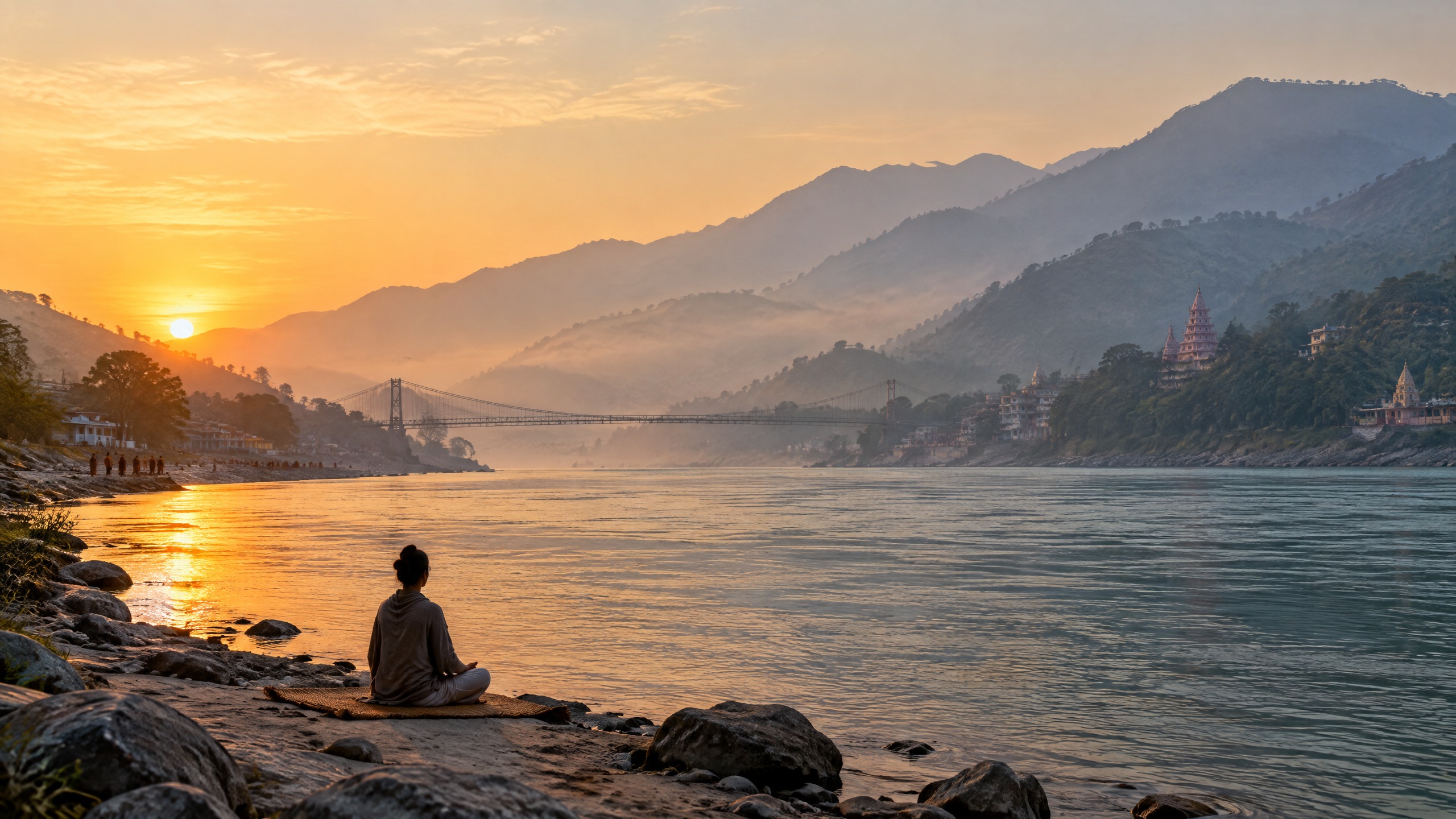
Rishikesh belongs here because yoga’s relationship with the body began in this landscape long before it became a global wellness industry. The city sits where the Ganges leaves the Himalayan foothills and starts its long southward life across northern India. That geography is not decorative. It gives the day a discipline: river mist in the morning, the footbridge crossings, pilgrims moving toward temple courtyards, the sound of bells carrying over water at dusk. The physical setting refuses the sealed, climate-controlled version of yoga that many travelers know elsewhere.
Rishikesh has been commercialized, and pretending otherwise would make the city less legible. Teacher-training schools line the hillsides; yoga studios advertise toward international visitors; the Beatles’ 1968 stay at Maharishi Mahesh Yogi’s ashram still casts a long shadow. But the city’s importance does not depend on that history. It depends on the fact that yoga here remains adjacent to a larger spiritual and social life that does not need wellness tourism to justify itself. A serious traveler can see the difference by treating the river as the beginning of the day rather than the view from a mat.
The evening Ganga Aarti at Parmarth Niketan is the clearest example. Go for the ceremony, not for a content opportunity. As ashram residents, pilgrims, and visiting families gather along the water, the river becomes an object of gratitude rather than scenery. The floating lamps at dusk hold more meaning when they are watched from the edge of a ritual already in progress. Triveni Ghat has its own energy, but Parmarth’s ceremony makes the relationship between the city, the river, and the people who return to it daily easier to understand.
The other useful corrective is to walk. The road and forest route toward Neelkanth Mahadev turns wellness from an indoor claim into a day of effort, altitude, weather, and recovery. A traveler does not need to complete a teacher-training course to understand why Rishikesh matters; an early practice, a long climb, a simple meal, and an evening by the Ganges will do more than an itinerary full of branded add-ons. Varanasi is an essential river city, but it makes a different spiritual argument. Rishikesh is irreplaceable here because it is the geographic and cultural source point for the practice itself.
That distinction should change how a traveler behaves. It means choosing a school by the depth of its teaching and the clarity of its lineage, not by the number of photographs in its room gallery. It means letting a difficult morning on the trail count as part of the practice rather than treating it as an interruption to the practice. It also means being modest about what can be understood on a short visit. Rishikesh does not owe a visitor an awakening. It offers something more durable: evidence that yoga was never meant to be separated from breath, landscape, obligation, and the shared riverbank where a day begins.
Guide page status: Rishikesh has no published AskLeif guide yet. This is the authorized single pending-guide exception for this post; no unrelated Indian guide is substituted.
Ubud: Where Wellbeing Is a Village System, Not a Retreat Product
Where Rishikesh holds yoga at its source, Ubud shows what happens when a village carries an entire philosophy of balance through ordinary life. The strongest reason to come is not the density of studios. It is the Balinese idea of Tri Hita Karana: wellbeing through a workable relationship with the divine, with other people, and with the natural world. It is visible in daily offerings, temple calendars, irrigation systems, family compounds, and the rice landscapes that still organize the area outside the central streets.
That does not absolve Ubud of its contradictions. The town is crowded at peak hours. Many offerings have been turned into visitor products. There is a version of Bali that can make a traveler feel as though every inward-looking act needs a booking page. The answer is not to reject the place because its reputation preceded you. It is to choose the hours and locations in which the older rhythm is still allowed to lead.
Start before sunrise on the Campuhan Ridge Walk, when the path above the river confluence belongs more to walkers and local morning routines than to the day’s traffic. The rice and jungle valleys do not deliver a lesson. They lower the volume. That is the point. Later, Tirta Empul requires more care. The melukat purification ritual is a living Hindu practice, not a prop. Arrive early, observe the local families who have come to pray, follow temple guidance, dress appropriately, and do not turn a cleansing rite into a performance of personal reinvention.
The clearest version of Ubud’s argument occurs during Nyepi, Bali’s Day of Silence. For twenty-four hours, the island’s normal mechanics stop: lights are reduced, travel is restricted, work pauses, and public noise drops away. A visitor cannot manufacture that level of quiet with a phone-lockbox package. It is collective, culturally specific, and therefore much more demanding. A Bali relaxation and culture itinerary is useful for building enough unhurried time around Ubud, while this ten-day Bali itinerary helps keep the trip from collapsing into a rush between beach towns. Canggu may offer more polished wellness infrastructure; Ubud earns its place because the village logic that attracted the industry is still present beneath it.
The respectful version of Ubud is therefore less about collecting cleansing rituals than about seeing how they belong to a larger order. Learn when temple dress and behavior matter. Give offerings and prayer their own meaning rather than borrowing them for a mood board. Eat in a way that leaves time to sit still afterward. The result can feel less efficient than a tightly booked retreat, which is exactly why it works. Ubud’s most useful lesson is that balance is not an event on the calendar. It is a way of arranging the day so that no one practice has to carry the whole burden of making a life feel whole.
Iceland: Where the Earth Makes the First Treatment
If Ubud makes wellness a social grammar, Iceland makes it a geological fact. The country sits on the Mid-Atlantic Ridge, and its volcanic heat rises close enough to the surface to shape how people bathe, socialize, warm homes, and move through winter. The relevant question in Iceland is not which spa has the most elaborate menu. It is what it means to live in a place where hot water comes from the ground and an outdoor soak can be part of ordinary civic life.
The Blue Lagoon can be pleasant, especially for a first visit, but it is not the whole Icelandic story. The more revealing experience is a neighborhood sundlaug—a public swimming pool—and its heitir pottar, the hot pots where residents linger and talk. Sundhöllin in central Reykjavík, Vesturbæjarlaug near the harbor, and Laugardalslaug farther east each show the same principle: warmth is social infrastructure. No one is required to arrive changed. You rinse, enter the water, sit in the cold air, and participate in the slow public habit of being there.
The Secret Lagoon at Flúðir offers a different version of the same truth. Its pool is supplied by the geothermal system around it, with steam and small bubbling features making the source impossible to forget. The luxury is not an escape from the environment. It is exposure to it on terms the body understands: hot water, cold air, mineral smell, a slower pulse. Winter heightens that contrast. In January darkness, a soak can be both sensory and practical; the possibility of aurora above the steam remains a bonus rather than the assignment.
It helps to keep bathing out of the reward category. A hot pot is not simply what happens after a productive hike, nor is it a checkpoint between a drive and dinner. In Iceland, the pause is the activity. Leave enough daylight and enough margin to arrive without trying to maximize the pool visit. Shower properly, follow the posted norms, and stay long enough for the first rush of temperature contrast to become conversation or silence. The lesson is almost anti-programmatic: relief does not need to be earned by exhaustion before it is allowed to count.
Iceland deserves longer than an airport transfer and a lagoon reservation. This seven-day Iceland adventure guide gives the geothermal experience a larger landscape context, and a Reykjavík three-day itinerary makes room for the public-pool culture that luxury itineraries often miss. Finland has its sauna tradition and Norway has dramatic water, but Iceland belongs here because the heat itself is a visible force of the land, not an amenity added to it.
Kerala: Where Wellness Starts With a Physician, Not a Menu
Where Iceland leaves the body in the care of water and weather, Kerala places it back in the hands of a medical tradition that has spent centuries refining its own terms. Ayurveda is often compressed into oils, herbal teas, and a comforting visual vocabulary of brass bowls and warm towels. In Kerala, at its most serious, it is a system of diagnosis, diet, rest, treatment, and timing. The distinction matters because it shifts the traveler from consumer to patient—or, at minimum, from buyer to participant in a practice that asks questions before it offers a solution.
The word Ayurveda is often translated as the science of life. That breadth is precisely why a weekend version can be misleading. A real Panchakarma course is not a decorative three-day cleanse. It requires consultation, preparation, a commitment long enough for the sequence to have meaning, and a willingness to let the schedule be governed by the treatment rather than by a sightseeing list. Fourteen days is a more honest minimum for a full therapeutic program; shorter resort offerings may be restorative, but they should not borrow the authority of a clinical protocol they cannot replicate.
Kerala’s long Ayurvedic lineage is also tied to institutions and practitioners, not an abstract tradition floating above the state. Vaidyaratnam Oushadhasala near Thrissur is one of the names that helps explain the seriousness of medicine-making in this part of India. The best question to ask a clinic is not whether its rooms look tranquil. Ask who conducts the consultation, what training informs the recommendation, how treatment duration is determined, and whether the itinerary permits rest after it.
Then leave the clinic long enough to understand Kerala’s other form of care: the backwaters. A few nights moving slowly through the Alleppey waterways on a traditional kettuvallam can establish the precondition that any treatment claims to seek—less hurry, less noise, more sleep, and the return of an unbroken hour. This seven-day Kerala backwaters guide is the natural framework for combining a responsible wellness stay with the water-bound pace that gives it room to work. Sri Lanka also holds rich Ayurvedic and meditation traditions, but Kerala is the stronger inclusion here because its physician-led, historically sustained medical culture gives the post its clearest argument for discernment over wellness theater.
The Azores: Where Wellness Was Never Marketed Into Existence
If Kerala preserves a practice through expertise, the Azores accumulate wellbeing through a landscape that was never designed to sell it. On São Miguel, crater lakes, hydrangea-lined roads, thermal springs, and the Atlantic’s shifting weather create a kind of enforced proportion. The island does not reward frantic coverage. It rewards a traveler who stays long enough for the weather to become information rather than an inconvenience.
Furnas is the center of that argument. In the valley, volcanic heat is legible in the ground, in the mineral smell near the caldeiras, in the thermal water, and even in cozido, the stew slow-cooked underground by the earth’s heat. That integration matters. A thermal soak feels different when the same geology is making lunch, fogging the air, and changing the soil beneath your feet. At Poça da Dona Beija, the warm pools offer an evening rhythm; at Terra Nostra, the iron-rich thermal water turns bathing into part of a larger garden landscape rather than an isolated treatment.
Movement belongs in the argument too. Kayaking on Sete Cidades’ paired lakes puts the body inside a volcanic crater instead of looking at one from a viewpoint, and the changing color of the water and sky makes attention unavoidable. On Pico, a responsibly run whale-watching outing can produce the kind of scale reset that no breathing exercise needs to imitate. The islands’ relationship with cetaceans must be approached with operators that follow observation rules; awe is less valuable if it becomes pressure on the animal.
Use the Azores five-day adventure guide as a foundation, then resist the instinct to make the islands a checklist. Madeira has warmer resort ease and mainland Portugal has elegant spa towns, but the Azores belong here because the volcanic landscape, the water, and the island pace form one unplanned system. Nothing needs to be branded as wellness for the body to recognize it.
Chiang Mai: Where Practice Becomes a Skill You Can Learn
Where the Azores let landscape set the pace, Chiang Mai makes wellness a discipline that can be taught, practiced, and carried through daily life. The city’s strongest case is Thai massage—not the abbreviated oil treatment marketed along every tourist street, but the assisted, rhythmic form rooted in lines of energy, breath, pressure, and movement. A skilled session has an intelligence closer to guided stretching than to passive indulgence. It asks the body to participate.
Chiang Mai is useful because the tradition remains accessible in a city where temples, markets, studios, schools, and local routines still overlap. The Old Medicine Hospital on Wualai Road has long offered more serious instruction than the rapid courses built for tourists. A five- or ten-day course does not turn a visitor into a master, but it can make the difference between receiving a practice as a service and learning enough to see what a trained practitioner is doing. The quality of the question changes: not “which massage is cheapest?” but “what lineage and training support this work?”
Doi Suthep makes the same point in another register. Climb the 306 steps early, before the buses turn the temple into an attraction, and the physical effort arrives alongside the sound of morning chanting and a view across the Chiang Mai valley. For a more formal commitment, the vipassana centers outside the city make silence, early waking, and repetition the actual program. That is not a gentle resort diversion, and it should not be approached as one. It is a practice that asks for consent, time, and a genuine willingness to be without the usual escape routes.
This Chiang Mai five-day itinerary creates a balanced first structure; the food, temples, and sanctuary guide makes it easier to keep the city’s ritual and culinary life in view; and a Chiang Mai solo guide fits travelers who want the space to set their own pace. Bangkok has exceptional practitioners and polished hotels, but Chiang Mai is the better wellness destination because the city gives a traveler access to learning, temple rhythm, and everyday northern Thai life in the same day.
How to Choose the Best Places for Yoga and Wellness Without Choosing a Product
Choose Rishikesh if the question is origins. It suits travelers who want a practice grounded in river life, Himalayan proximity, and a city where spiritual seeking has a public shape. Allow at least five nights, preferably longer if a genuine teacher-training or walking component is part of the plan. It is not the place for a perfectly controlled retreat experience; its power is in the friction between a visitor’s expectations and a living pilgrimage city.
Choose Ubud when you need a softer re-entry into rhythm. Seven nights gives enough time to move beyond the central streets, wake early, attend a temple respectfully, and absorb the village’s relationship with land and ceremony. It offers the broadest range of stays, from modest homestays to high-end retreats. The real budget decision is whether you can afford time; cramming Ubud into two days turns its best argument into traffic.
Choose Iceland when your body responds to contrast: cold air and hot water, darkness and steam, long drives and long soaks. A week is the right minimum if the trip includes both Reykjavík and the south or west. Iceland costs more than the other destinations on this list, especially for food, lodging, and transport, but neighborhood pools are one of the most democratic parts of the experience.
Choose Kerala when you want care that asks for commitment. A proper Ayurvedic stay should leave room for consultation and recovery, so ten to fourteen nights is more sensible than a quick treatment package. It can range from simple traditional clinics to much more expensive properties; credibility should guide the selection more than aesthetics. Pair it with backwater time only after deciding how much of the trip is for treatment and how much is for travel.
Choose the Azores when the objective is nervous-system quiet without formal instruction. Five to seven days on São Miguel offers thermal water, crater walks, and weather changes that make a schedule feel less important. It is mid-range by Western European standards, particularly outside peak summer. Combine it with Lisbon only if you can preserve enough island time for the slower rhythm to take hold.
Choose Chiang Mai when you want to learn rather than merely receive. Five to eight days can accommodate Thai massage instruction, temple mornings, food, movement, and a meditation component without forcing any of it. It is the most accessible destination on the list for a longer independent stay. It also combines well with Bangkok only if the traveler treats them as two different chapters: Bangkok for velocity, Chiang Mai for practice.
If the decision still feels unclear, begin with the kind of attention you have lost. Rishikesh restores reverence. Ubud restores relationship. Iceland restores sensation. Kerala restores discernment. The Azores restore proportion. Chiang Mai restores craft. An itinerary should create enough empty space for that choice to become real, not fill every hour in the name of wellbeing.
The Wellness Destinations That Give Attention Back
The point of a wellness trip is not to return home carrying proof that you improved yourself. The useful version changes the conditions under which you can notice your own life again. That is why these places do not substitute for one another.
Rishikesh originates. Ubud integrates. Iceland geologizes. Kerala preserves. The Azores accumulate. Chiang Mai teaches.
Each verb names a different way a place can interrupt the machinery of self-optimization. The river, the village, the heat, the physician, the crater, and the teacher all make the same quiet offer: stop asking what the program can do to you. Pay attention to what the place has been doing, patiently and long before you arrived.