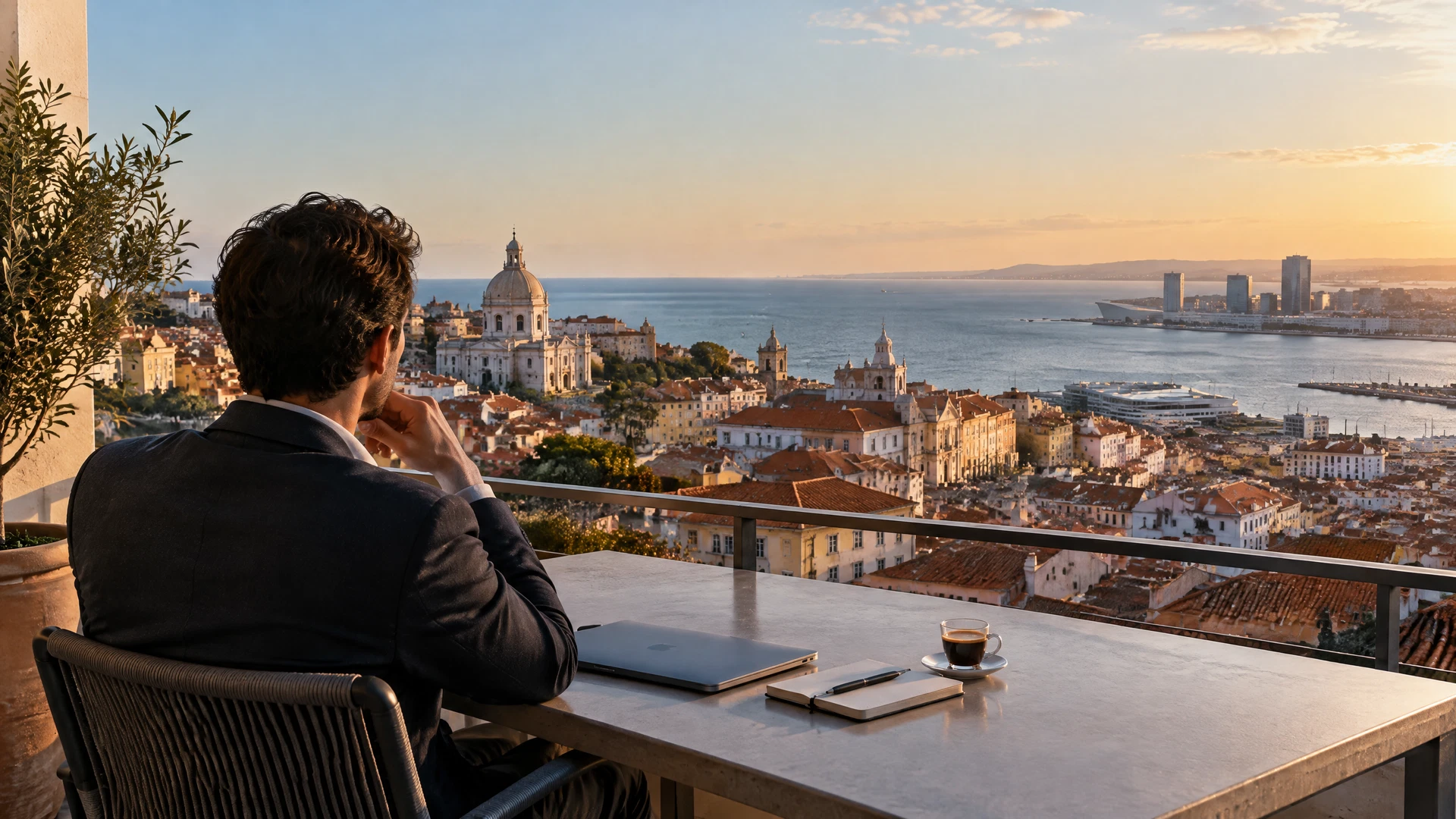
Where Remote Workers Go When They Want a Life, Not Just Better Wi-Fi.
Destination: Global
Category: comparison
The usual answer to best cities for remote workers is an exercise in subtraction. Find stable internet. Find a desk. Find a visa, a reasonable rent, a coffee shop with enough plugs. Then call the city a success because nothing prevented the laptop from opening. It is a strangely low bar for a decision that can redraw the entire shape of a working life.
Remote work has made a more consequential question available. If your work can happen somewhere other than the place where your company happens to be headquartered, then the point is not merely to transfer the same schedule into better weather. The point is to choose a city that develops a particular professional self: more committed, more energized, more alert, more exacting, more complete, more protective of the hours after work.
That is why these six cities belong together. Lisbon gives legal legitimacy to the worker ready to commit. Medellín gives energy to the worker who needs to feel a city in motion. Tbilisi gives useful friction to the worker whose best thinking begins when the surroundings stop confirming every assumption. Chiang Mai gives infrastructure maturity to the worker who values a reliable working system. Barcelona gives permission to refuse the false choice between career and place. Cape Town gives back the afternoon to the worker whose colleagues are an ocean away.
None of those promises can be swapped cleanly. A lower monthly budget does not substitute for a visa framework that lets someone settle with confidence. A beach does not substitute for an innovation district where local builders are doing serious work. A co-working membership does not substitute for a time zone that returns three usable hours to the day. The professional value of a city is more specific than the availability of a desk.
The cities below are therefore not ranked. They are matched. Each is evidence for a different answer to the question behind every remote-work move: who are you trying to become when your work is no longer bound to the office?
Best Cities for Remote Workers Who Need Lisbon to Legitimize the Decision
Lisbon legitimizes the remote worker who is ready to stop treating a mobile career as an extended experiment. Its appeal begins with light, hills, tiled facades, and a river that makes even a weekday walk feel unusually spacious. Its deeper value is bureaucratic and professional: Portugal has spent years building pathways for people whose income originates beyond its borders, and the result is a city where the question of whether you are allowed to build a life can be answered with more seriousness than in most of Western Europe.
The D8 visa matters because it changes the emotional posture of the move. It is not a beachside perk or a clever workaround. For qualifying applicants, it is a residency route built around remote income, documentation, and the ability to establish an ordinary legal life. Portugal’s tax picture deserves the same adult attention. The old NHR regime has been reworked, and anyone considering residency needs current professional advice rather than an internet promise about a flat rate. The point is not to sell Lisbon as a tax trick. It is to recognize that a worker who wants to make a durable decision can begin with a country that has tried to give that decision a legal frame.
The city then makes the commitment livable. Work at Second Home in Mercado da Ribeira and the former market hall keeps the workday connected to an actual part of Lisbon rather than a sealed-off office floor. Walk through LxFactory after a morning of calls and you move through an old industrial complex that became a working neighborhood, not a resort set. In Príncipe Real, a few hours between the Jardim da Praça das Flores and the small cafés around Rua Dom Pedro V can feel like a regular weekday with an expanded horizon. That is the useful promise: Lisbon does not ask someone to pretend they are on vacation while working. It gives work a setting that makes residence feel possible.
A five-day Lisbon travel guide is a good introduction to the city’s different elevations, from Alfama and Belém to the routes that make a weekend outside the apartment count. The Lisbon food itinerary adds the equally important after-work register: petiscos, natural wine, counter meals, and the ordinary pleasure of knowing that dinner can extend without destroying the next morning.
Lisbon belongs here instead of Berlin because Berlin’s professional ecosystem is already an obvious answer and its administrative complexity can become the story of the move. Lisbon’s argument is more particular. It offers a worker who is ready to commit a foundation before it offers a lifestyle. The seriousness comes first; the Atlantic light is what makes the seriousness feel less like sacrifice.
Medellín Energizes the Worker Who Needs a City With Something at Stake
Where Lisbon gives the remote worker a legal foundation, Medellín energizes the worker who needs to feel that the city around the desk is still becoming itself. This is not a claim about novelty. Medellín’s power comes from the opposite: the city’s reinvention has required sustained public work, neighborhood knowledge, technical ambition, and an unusually visible belief that the future can be built rather than awaited.
Ruta N, in the north of the city, is the cleanest professional expression of that belief. It is an innovation district, but reducing it to a cluster of startups misses the point. The district sits inside a city that has used mobility, libraries, schools, public spaces, and civic design as arguments about who a city belongs to. A remote worker based only around El Poblado can find easy routines, English menus, and a ready-made international social circuit. A worker who spends time around Ruta N, Laureles, or the small business life of Envigado encounters a different proposition: local people building the place in which they live.
Medellín’s climate makes that encounter operationally useful. The temperate air is not a decorative fact; it changes the workday. A morning call can be followed by an outdoor lunch without the forced refuge of coastal heat or high-altitude cold. In Envigado, south of El Poblado, local residential patterns still set the pace more visibly than they do in the city’s most visitor-heavy blocks. Its streets make room for grocery runs, neighborhood bakeries, and ordinary errands that prevent remote work from becoming a sequence of screens and delivery apps.
The city’s public transport makes its own case. Ride the Metrocable and it becomes clear that it is not merely an elevated view for outsiders; it is an infrastructure decision that connected steep hillside communities to the rest of the city. Spend an afternoon at the Museo Casa de la Memoria, then return to a café where people are discussing a new company, a family business, or a local election, and Medellín’s civic energy stops being a slogan. It becomes the atmosphere in which work is done.
For the first route through the city, use this four-day Medellín itinerary, then let the Medellín food and culture guide direct the evenings toward Antioquian cooking and neighborhood tables rather than a generic international circuit. Those details matter because a remote base becomes credible only when the hours outside work carry the same specificity as the hours inside it.
Medellín is here instead of a purpose-built business district because the professional identity it serves is the worker who is energized by participation, not insulation. The city asks you to notice what residents have built and why. That request can sharpen the work as much as any productivity app, because it makes the remote day feel connected to a living civic story.
Tbilisi Liberates the Worker Whose Best Thinking Requires Productive Friction
Where Medellín gives the worker a city in active conversation with its future, Tbilisi liberates the worker who produces better work when the surroundings refuse to become familiar too quickly. It is one of the rare remote bases where the practical ease and the cultural disorientation can coexist without cancelling one another. The city is affordable enough to permit time, but foreign enough to keep time from becoming automatic.
Fabrika is often the first reference point, and it should be understood correctly. The converted Soviet sewing factory supplies desks, courtyards, studios, cafés, and a rotating mix of Georgian founders and international workers. It is useful because it provides entry into a community. It is not the reason to choose Tbilisi. The reason is what happens when you leave its gates and walk through Sololaki, past carved wooden balconies and steep lanes that make the geometry of the city feel improvised rather than engineered for you.
Georgia’s relationship with food changes the workweek too. A long lunch is not a failure of efficiency when khinkali, mtsvadi, and a bottle from Kakheti can become the setting for a serious conversation. The supra is the larger lesson. When a local colleague or new acquaintance invites you to a Georgian feast, the toasts are structured, extended, personal, and often unexpectedly philosophical. The evening does not offer content to consume. It asks you to participate in a ritual of attention. For a worker accustomed to extracting everything through a calendar invite, that can restore a useful sense of proportion.
The same is true of the city’s relationship with time. Sit in a café near Rustaveli after a demanding morning and the expectation to turn over the table quickly is lower than in many Western business districts. Take the funicular toward Mtatsminda as the workday ends and Tbilisi opens into roofs, hills, and the curve of the Kura River. The city does not make productivity effortless. It makes the worker decide which parts of efficiency are habits and which are genuinely necessary.
Use the four-day Tbilisi itinerary for the city’s first geography, then keep the Tbilisi food and wine guide close for khinkali houses, natural-wine bars, and the culinary language through which the city often explains itself. A remote worker needs both maps: the one that keeps the days coherent and the one that lets them be interrupted for the right reasons.
Tbilisi belongs here instead of a smoother, more familiar European base because its professional gift is friction. It gives the culture-maximalist a working life in which the walk home, the dinner invitation, the alphabet on the sign, and the pace of the room repeatedly ask for more attention. That attention can become part of the person’s work, not a distraction from it.
Chiang Mai Perfects the Workday for the Infrastructure Pragmatist
Where Tbilisi makes the worker earn a new rhythm, Chiang Mai perfects the workday for the professional who values maturity, repetition, and systems that have had time to improve. Some remote workers do their best work when every logistical question becomes a puzzle. Others need the opposite: a city where the desk, food, transport, service culture, and community knowledge have already been tested by years of ordinary use.
Chiang Mai has that accumulated knowledge. In Nimman, Punspace has long made room for focused work, while CAMP at Maya is a familiar example of how a city can build studying, working, meals, and air-conditioned refuge into the same daily pattern. The relevant point is not that either space is famous. It is that a decade of residents and remote professionals has taught the city what a dependable workday requires: a backup connection, a quiet corner, food that arrives without ceremony, and a short distance between concentration and release.
The more interesting decision now is often Santitham rather than Nimman. Nimman remains convenient and dense with work-ready cafés, but its popularity can make the neighborhood feel like a default setting. Santitham offers a more residential register: local noodle shops, quieter streets, and a daily rhythm that is less dependent on being seen. The difference matters for someone who is staying long enough to create a real routine. The best infrastructure is the kind that eventually becomes invisible.
That invisibility lets Chiang Mai’s actual character enter. Go to Warorot Market early, when the food stalls are serving people beginning their day rather than feeding a curated appetite. Spend an evening at Wat Umong, where the temple grounds hold a different kind of quiet from a co-working booth. Build an occasional day around Doi Suthep or the forest roads beyond the city, not as a reward for finishing work but as a way of preventing the workweek from becoming geographically small.
The five-day Chiang Mai itinerary gives the necessary outward map—temples, elephant ethics, Doi Inthanon, and the city’s first structure. The Chiang Mai solo guide is especially useful for the practical daily rhythms around cafés, neighborhoods, and working independently. Together, they make clear why Chiang Mai is the infrastructure pragmatist’s choice: the city has spent years learning how to carry a remote workday without making the day the only thing there is.
Chiang Mai earns this place instead of a newer Southeast Asian hub because maturity cannot be faked. It has the refined ecosystem the practical worker needs, while Santitham, markets, temples, and mountain edges keep that ecosystem from becoming a sealed professional bubble. The city does not ask you to admire the system. It lets you rely on it.
Barcelona Refuses the False Choice Between Work and a Full City
Where Chiang Mai makes the working system disappear, Barcelona refuses the remote worker’s false choice between serious professional life and a physically extraordinary city. Many remote workers treat a demanding career and a rich daily setting as competing claims on the same day. Barcelona suggests that, in the right city, they are the same decision.
The 22@ district in Poblenou is central to that argument. The neighborhood’s industrial conversion created a genuine concentration of technology, design, research, and business work near streets that still hold the trace of factories and workshops. A day can begin in a professional room near Glòries, move through the grid of Eixample, and end by the Mediterranean without any of it requiring an escape from the life you are trying to build. The city’s density does not make the work smaller; it gives it better edges.
Barcelona’s Spanish digital-nomad visa pathway adds a formal route for qualifying remote workers, but the stronger case is the city’s simultaneity. In Gràcia, cafés around Plaça de la Virreina and the streets toward Joanic create a neighborhood work rhythm that remains attached to local daily life. At lunch, the question can be whether to stay for a menú del día, walk toward the Modernist blocks, or keep a meeting short enough to reach the beach before dark. Those choices are not frivolous. They are evidence that the professional self does not have to be built in a neutral landscape.
The city also expects standards. Barcelona’s creative, architectural, and startup scenes can be stimulating precisely because the city has more going on than any one newcomer’s work calendar. The markets, galleries, football conversations, design studios, and late dinners create a sense that your career is one current in a larger civic flow. A remote worker who needs to feel professionally serious without being professionally consumed can find a useful model here.
A seven-day Barcelona city guide gives enough range to understand how architecture, neighborhood life, markets, and coastline connect. The Barcelona food guide is the better companion for the daily reward structure: the meals and addresses that make it possible to close the laptop without making the evening feel like an afterthought.
Barcelona is here instead of Berlin because its core promise is not merely an established startup ecosystem. It is the refusal to separate the professional city from the lived city. 22@ and the beach are not in tension. They make the same claim: your work can be ambitious, and the rest of the day can remain fully inhabited.
Cape Town Rewards the Worker Who Can Give Europe Their Morning
Where Barcelona refuses the false choice inside the workday, Cape Town rewards the remote worker whose time-zone alignment lets the workday end before the city has spent its best light. This is the place for the European-facing professional who understands that the clock can be a geographic advantage. A schedule built around Central European colleagues can leave Cape Town’s afternoon open while the mountain, coast, harbor, and wine country are still available.
For many Europe-based teams, Cape Town’s UTC+2 position makes a working overlap unusually workable. The exact hours depend on daylight saving time and the employer’s schedule, so it should be planned rather than romanticized. But the larger pattern holds: an early, concentrated morning can finish with enough day left to take the cableway when Table Mountain is clear, walk the Sea Point Promenade, or leave the city for the Cape Peninsula. The value is not reduced working hours. It is a better division between focused effort and the part of the day that proves why the location matters.
Workshop17 at the V&A Waterfront is a useful marker of that proposition. It gives a serious work environment within sight of the harbor and mountain, and the surrounding area makes a short break feel like part of the city rather than a lap around an office block. De Waterkant is another intelligent base: close to the Waterfront, connected to cafés and services, and within walking distance of the colored facades of Bo-Kaap. The neighborhood is not a stage set; it has a living Cape Malay history that deserves more attention than a quick photograph on the way to a meeting.
The afternoon possibilities are unusually substantive. Go to Boulders Beach when the penguins and coastline are the point, not an accessory to a city break. Drive to Stellenbosch when the work week needs an evening among vineyards, Cape Dutch buildings, and a landscape that changes the scale of the day. On another afternoon, take the road through Chapman’s Peak only when conditions and daylight support it, then let the coast provide the decompression that no indoor amenity can reproduce.
The Cape Town solo itinerary is useful for honest neighborhood and safety-oriented planning; it treats a productive base as something that must be chosen with care. The Cape Town and Garden Route guide shows how to extend the city into a wider South African route when the calendar has enough room. The point is not to convert every afternoon into an achievement. It is to know that the day can end in a place that restores perspective.
Cape Town belongs here instead of Dubai because the professional benefit is not a tax structure or a polished service environment. It is time-zone reward. For the worker who can give Europe their morning, the Southern Hemisphere can return the afternoon to a city with genuine scale, weather, texture, and room to think.
Why Bali, Berlin, and Dubai Do Not Make This List
Bali has reliable internet, a large remote-work community, and a long record of making arrival easy. It is excluded because the remote-work experience there can too easily become the whole environment: the same work clubs, the same wellness routines, the same international script repeated until the island becomes scenery behind a familiar schedule. This list asks for a city that develops a specific professional identity, not one that makes mobility frictionless.
Berlin has the professional credibility, cultural density, and startup depth to appear on almost any remote-work list. It is excluded because that answer has already been thoroughly documented. Lisbon’s legal foundation and Barcelona’s simultaneity make sharper European arguments for this framework. They tell a worker something more precise about the self they can build.
Dubai offers a remote-work visa, high-functioning infrastructure, and an attractive tax conversation. It is excluded because the financial incentive can become the principal argument. Remove that incentive and the professional identity becomes less clear. Cape Town, by contrast, makes a time-zone proposition that changes the structure of the workday itself.
How to Choose Among the Best Cities for Remote Workers
Choose Lisbon if commitment is the problem you are trying to solve. Its strength is the combination of legal pathways, a European capital’s professional networks, and a city rhythm that makes long-term residence feel credible. Choose Medellín if you want your work to sit inside a city whose civic energy is palpable, provided you give the neighborhood decision the seriousness it deserves. Choose Tbilisi if you want a place that unsettles routine and gives culture enough weight to alter the way you spend an evening.
Choose Chiang Mai if your highest priority is a dependable daily work system: fast routines, known co-working options, inexpensive local meals, and infrastructure that has had time to learn from its users. Choose Barcelona if your work benefits from a creative and technical city where the office, the street, the gallery, and the sea remain close enough to influence one another. Choose Cape Town if time-zone overlap gives you back early afternoons and you are prepared to plan the city with the safety, seasonality, and distance it deserves.
| City | Professional identity | Best initial stay | Practical question to answer first |
|---|---|---|---|
| Lisbon | The committed professional | 1–3 months | Do your visa and tax circumstances support a durable move? |
| Medellín | The civic-energy seeker | 4–8 weeks | Which neighborhood gives you a locally rooted daily routine? |
| Tbilisi | The culture-maximalist | 1–3 months | Are you willing to let unfamiliarity change your habits? |
| Chiang Mai | The infrastructure pragmatist | 1–3 months | Do you want Nimman’s convenience or Santitham’s slower daily texture? |
| Barcelona | The lifestyle integrator | 1–3 months | Does your budget support a full city rather than a temporary escape? |
| Cape Town | The time-zone aligner | 4–8 weeks | Does your meeting schedule leave enough afternoon to use the city well? |
Do not treat these destinations as interchangeable monthly rentals. The legal conditions in Lisbon, Georgia, Thailand, Spain, and South Africa must be checked against the current rules that apply to your nationality, employer, income, and tax residence. That is not a disclaimer; it is part of the professional identity this article is defending. A serious move begins with the paperwork before it begins with the neighborhood.
If the city is clear but the working week is not, Leif can build an itinerary around the actual constraints: a call-heavy morning, a visa appointment, a quiet Monday, a client dinner, the first free Cape Town afternoon, or a Saturday that needs to recover the parts of a city the laptop postponed. The strongest remote-work move does not turn a place into a backdrop. It gives the place enough room to change the shape of the week.
Lisbon legitimizes. Medellín energizes. Tbilisi liberates. Chiang Mai perfects. Barcelona refuses. Cape Town rewards.
Those are not six ways to avoid an office. They are six professional selves made visible by geography. The right city will not complete the work for you. It will make the work feel connected to a life you recognize as your own.