Barcelona and Madrid Are Both in Spain. Only One of Them Is Spain.
Destination: Barcelona & Madrid, Spain
Category: comparison
Every comparison post about Barcelona and Madrid starts in the same place. Beach versus museums. Gaudí versus Goya. Mediterranean light versus Castilian grandeur. The posts are not wrong, exactly — those differences are real — but they are describing the surface of a much deeper argument. The actual question is not which city has better attractions. It is which version of Spain you want to inhabit for a week, and that question only makes sense once you understand that Barcelona and Madrid have been having a specific, unresolved, centuries-old disagreement about what Spain is and whether Barcelona is part of it.
That is the lens through which everything else in this comparison becomes legible. The architecture, the food, the nightlife, the beach — all of it is downstream of the identity question. Get the identity question right and the rest of the comparison writes itself.
The short version: Madrid is Spain. Barcelona is Catalonia, which is in Spain, and would prefer to be having a different conversation entirely.
This post is not going to tell you which city is better. It is going to tell you what each city actually is, so you can make the right decision for the trip you are actually trying to take.
The Identity Question: What Each City Is Actually Arguing
Madrid became the capital of Spain in 1561, when Philip II moved the court there from Toledo. The choice was not based on Madrid's importance — Seville was the wealthiest city in the empire, Toledo was the religious center, Salamanca was the intellectual center. Philip chose Madrid because it was geographically central and symbolically neutral. No city had a stronger claim on it than any other. Madrid was the capital because Spain needed a capital, and Madrid was the place that belonged to everyone equally because it had not yet belonged to anyone specifically.
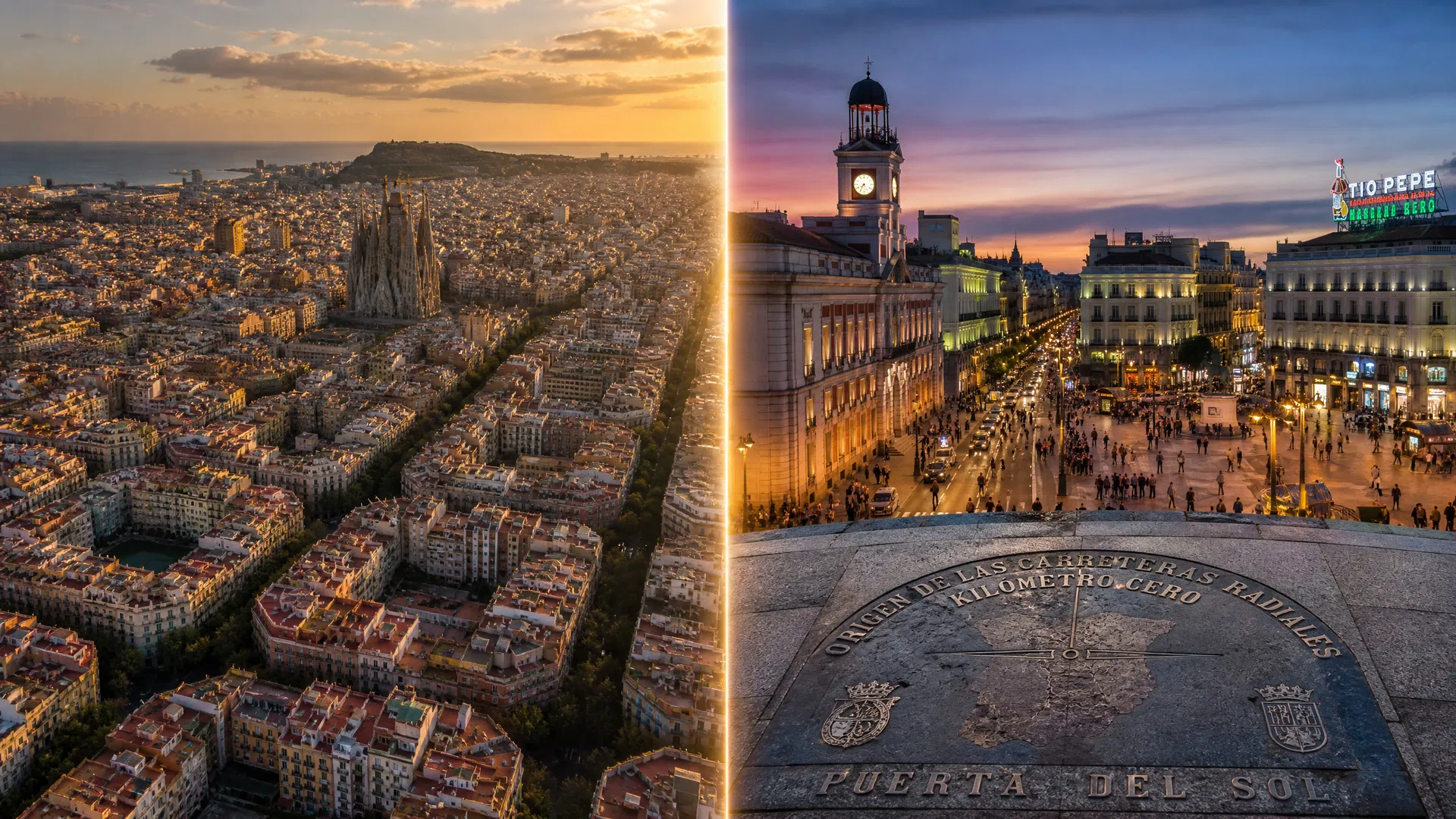
That logic has defined Madrid ever since. Stand at the Puerta del Sol and look down at the stone slab embedded in the pavement: Kilómetro Cero, the point from which every national road distance in Spain is measured. Every highway in the country radiates outward from this spot. Madrid is not arguing that it is the center of Spain. It simply is the center of Spain, in the most literal, cartographic sense possible.
Barcelona's relationship with Spain is more complicated, and more interesting. Catalonia — the autonomous community of which Barcelona is the capital — has been arguing about its relationship with Spain since at least the 17th century, when the Catalan Revolt of 1640 attempted to separate from the Spanish crown and align with France. The argument has never fully resolved. In 2017, the Catalan government held an independence referendum that the Spanish government declared illegal, sent police to suppress, and subsequently prosecuted. The president of the Generalitat, Carles Puigdemont, fled to Belgium rather than face arrest. The case is still working its way through European courts.
Walk through the Gràcia neighborhood on a Sunday morning and you will see the argument made visible. Estelada independence flags hang from apartment balconies — not in the tourist center, but in the residential streets where people actually live. In the Plaça de la Vila de Gràcia, groups gather to perform the sardana, the Catalan circle dance that has been a symbol of Catalan national identity since the 19th century. It is not a folk performance for tourists. It is a political act performed by people who consider themselves Catalan first and Spanish second, if at all.
The 1983 Llei de Normalització Lingüística — the Catalan Language Normalization Law — made Catalan co-official with Spanish in Catalonia and mandated that street signs be in Catalan. Walk through Barcelona and you will notice: the street signs say Carrer not Calle, Passeig not Paseo. The language is not a detail. It is the argument, made visible on every corner.
Understanding this does not mean you need to have a position on Catalan independence to enjoy Barcelona. It means that when you walk through the Eixample and see the Palau de la Música Catalana, you understand what you are looking at. That concert hall was built between 1905 and 1908 not by the Spanish government, not by the Catalan government, but by the Orfeó Català — a choral society founded in 1891 as part of the Catalan cultural renaissance. A choir built its own palace. That is the kind of city Barcelona is.
The Architecture: Two Different Visions of What a City Should Be
The Eixample — Barcelona's 19th-century grid expansion — is the most politically loaded urban planning project in Spanish history. In 1854, the medieval walls that had constrained Barcelona for centuries were finally demolished. The Catalan bourgeoisie, flush with industrial wealth from the textile trade, commissioned the engineer Ildefons Cerdà to design the expansion. Cerdà coined the word urbanisme — urbanism — as a new science, and his 1859 plan was a statement of intent: this was a city designing itself on its own terms, not waiting for the Spanish state to tell it what to do.
The octagonal blocks with chamfered corners — the feature that makes the Eixample instantly recognizable from above — were not an aesthetic choice. They were an engineering solution to ventilation, light, and traffic visibility at intersections. Cerdà's original plan called for interior gardens in every block, accessible to all residents. The gardens were mostly built over by the late 19th century as the bourgeoisie discovered that interior space was more profitable than public greenery. But the chamfered corners remain, and they remain because they were solving a problem, not performing an identity.
The Palau de la Música Catalana, designed by Lluís Domènech i Montaner and completed in 1908, is the most concentrated expression of Catalan Modernisme in a single building. The exterior is covered in mosaics, sculptures, and stained glass that tell the story of Catalan music and culture. The interior concert hall has a stained-glass skylight that floods the space with colored light during afternoon performances. It is a UNESCO World Heritage Site. It was built by a choir. The Sagrada Família, still under construction after 143 years, is the other end of the same argument: a city that is still making its case, still building the thing that will prove what it is.
Madrid's architectural legacy is different in kind, not just in scale. The Royal Palace — the Palacio Real — is the largest functioning royal palace in Western Europe by floor area: 135,000 square meters, 3,418 rooms, built to demonstrate that the Spanish crown's capital was the equal of Versailles. The Plaza Mayor, completed in 1619, was designed as the ceremonial center of the Spanish Empire — bullfights, public executions, royal proclamations, and the auto-da-fé of the Inquisition all took place in the same square. The Gran Vía, built between 1910 and 1929, was Madrid's answer to Haussmann's Paris: a broad boulevard cut through the medieval city to announce that the capital was a modern European metropolis.
The Paseo del Prado cultural axis — the Prado, the Thyssen-Bornemisza, and the Reina Sofía, all within a fifteen-minute walk of each other — was not an accident of geography. It was a deliberate 19th-century political project to concentrate Spain's cultural patrimony in the capital, asserting Madrid's primacy over every other city in the country. The Prado alone holds Velázquez's Las Meninas, Goya's Saturn Devouring His Son, Bosch's Garden of Earthly Delights, and Rogier van der Weyden's Descent from the Cross. The Reina Sofía holds Picasso's Guernica, which Picasso refused to allow into Spain until Franco was dead and democracy was restored. It arrived in Madrid in 1981. The building that holds it was a hospital. The city repurposed a hospital to hold the most important painting of the 20th century. That is also the kind of city Madrid is.
The Food: Two Completely Different Culinary Arguments
The simplest way to understand the food difference between Barcelona and Madrid is a single dish that does not travel between them. Not because it can't be made elsewhere — the ingredients are available everywhere — but because it would be a category error to serve it in Madrid, in the same way it would be a category error to serve a bocadillo de calamares in a Barcelona restaurant that takes itself seriously.
Pa amb tomàquet — bread rubbed with a cut tomato, drizzled with olive oil, finished with salt — is the foundational food of Catalan cuisine. It is served at every meal, in every restaurant, in every home in Barcelona. It is not a recipe. It is a gesture. The bread is toasted until the surface is rough enough to shred the tomato. The tomato is a specific variety — tomàquet de penjar, hanging tomato — that has more flesh and less water than a standard tomato. The olive oil is Catalan. The salt is coarse. The whole thing takes thirty seconds and tastes like the reason olive oil exists.
You will not find pa amb tomàquet in Madrid. Not because Madrid restaurants don't know about it, but because it is not what Madrid eats. Madrid eats pan con tomate — a similar preparation, but softer, less specific, less insistent about its own identity. The difference between the two is the difference between the two cities: Barcelona's version knows exactly what it is and will not compromise. Madrid's version is more relaxed about the whole thing.
The Madrid food that has no equivalent in Barcelona is the bocadillo de calamares — a fried calamari sandwich on a crusty roll, served with nothing else, eaten standing at a bar near the Plaza Mayor. Bar La Campana, established in 1885, is the canonical address. The correct time to arrive is 11am, when the oil is at its hottest and the bread is freshest from the morning delivery. The sandwich costs around €3.50. It is not a tourist food. It is the food that Madrileños eat before lunch, between meetings, on their way somewhere else. It is specifically, irreducibly Madrid — a city that invented a sandwich out of a fish that doesn't live anywhere near it, because the capital of an empire can import whatever it needs.
For Sunday afternoon in Barcelona, the correct ritual is vermut at Bar Calders on the Pasaje Pere Calders in the Sant Antoni neighborhood. The bar opens at 11am on Sundays and fills by 1pm with a mix of neighborhood residents, young professionals, and the occasional tourist who has figured out that the real Barcelona is not on the Ramblas. The house vermut is served with an anchovy and an olive. The terrace is small. The conversation is loud. This is the food culture that exists beneath the tourist restaurant circuit — the one that doesn't need to advertise because everyone who needs to know about it already does.
For the serious food argument, Barcelona's claim rests partly on proximity to the Costa Brava, where Ferran Adrià's El Bulli operated until 2011 and changed the global understanding of what food could be. The influence is still visible in the serious restaurants of the Eixample and El Born. Madrid's claim rests on the cocido madrileño — the most elaborate single-pot stew in the Spanish culinary canon, a three-course meal served from a single pot — and on the density of serious restaurants per square kilometer in the Malasaña and Chueca neighborhoods.
The Nightlife: Two Cities, Two Completely Different Clocks
The movida madrileña — the cultural explosion that followed Franco's death in 1975 — is the most important thing that happened in Spanish popular culture in the 20th century, and it happened in Madrid, not Barcelona. This is not an accident. Madrid was the city that had been most suppressed under Franco, because Madrid was the capital, the symbolic center of the regime's Spain. When Franco died, Madrid had the most to release.
Sala El Sol opened in Malasaña in 1979, four years after Franco's death. Alaska, Nacha Pop, and Radio Futura played there in the early 1980s. Pedro Almodóvar made his first films in this neighborhood during this period. The movida was not a music scene. It was a city discovering that it was allowed to be itself again — loud, late, strange, sexual, political, alive. The energy of that moment is still present in Malasaña, which remains the most interesting neighborhood in Madrid for contemporary culture, restaurant openings, and the specific Madrid phenomenon of staying out until 5am on a Tuesday for no particular reason.
Madrid nightlife peaks between 3am and 6am. This is not a stereotype. The clubs do not fill until after 2am. The conversations do not start until midnight. The dinner reservation is at 10pm, which means you are leaving the restaurant at midnight, which means the night has not yet begun. This schedule is not performed for tourists. It is the actual rhythm of the city, and it has been since before anyone alive today was born.
Barcelona's nightlife is excellent and operates on a more European schedule — bars close around 2am in the residential neighborhoods, clubs in the Port Olímpic area run later. The difference is not quality but character. Barcelona's nightlife is more international, more design-conscious, more aware of being observed. Madrid's nightlife is more local, more chaotic, more committed to the idea that the night is its own justification.
The Beach Question: What It Actually Means
The beach is the most frequently cited advantage in Barcelona's favor, and it is also the most misunderstood thing about Barcelona.
The Barceloneta neighborhood — the narrow grid of streets between the old city and the sea — was, until the 1992 Olympics, an industrial and working-class fishing community. The waterfront was a working port. The beach, such as it existed, was not a tourist destination. The 1992 Olympics urban renewal project demolished the industrial waterfront, relocated residents, and built the beach infrastructure, the Port Olímpic marina, and the Olympic Village that now houses thousands of apartments. The beach that makes Barcelona famous is a feature the city added to itself in four years, for a specific international event, at the cost of a neighborhood that had existed for 250 years.
This is not an argument against the beach. The beach is beautiful. Swimming in the Mediterranean in October is one of the better experiences available to a human being. But the beach is not what Barcelona is. It is something Barcelona did to itself, and the Barceloneta residents who remain have a complicated relationship with the transformation that brought international attention and neighborhood displacement simultaneously.
Madrid has no beach. It is 340 kilometers from the nearest coast. This is simply true, and it is not a disadvantage in the way that the comparison posts suggest, because Madrid was never trying to be a beach city. What Madrid has instead is the Parque del Retiro — 350 hectares of park in the center of the city, with a rowing lake, a Crystal Palace that is the most beautiful glass structure in Spain, and a rose garden that blooms in May and June. It also has the terracita culture: the specific Madrid practice of sitting outside at a café table after 10pm, when the summer heat finally breaks, drinking a cold beer and talking until the street empties. This is not a substitute for a beach. It is a different thing entirely, and it is specifically, irreducibly Madrid.
The Honest Answer: How to Actually Choose
The comparison posts will tell you to choose based on your interests: art lovers go to Madrid, beach lovers go to Barcelona. This is not wrong, but it is not the right frame.
The right frame is: which version of Spain do you want to inhabit?
If you want the Spain that is the center of everything — the Spain that Philip II chose as his capital because it belonged to everyone, the Spain where the distances are measured from a stone slab in a square, the Spain where Velázquez and Goya and Picasso are all in the same city — go to Madrid. Madrid is Spain in the way that Paris is France: not because it is the only version, but because it is the version that decided it was the version and built the institutions to prove it.
If you want the Spain that is arguing with that version — the Spain that has its own language and its own dance and its own architecture and its own food and its own flag and its own unresolved question about whether it wants to be Spain at all — go to Barcelona. Barcelona is one of the most interesting cities in Europe not despite the argument it is having with Spain but because of it. The tension between Catalan identity and Spanish identity has produced architecture, food, culture, and political drama that you will not find anywhere else.
The best answer, if you have ten days, is both. The Renfe AVE high-speed train covers the 621 kilometers between Barcelona Sants and Madrid Atocha in 2 hours and 30 minutes, for around €50–80 depending on when you book. Take the train. Spend five days in each city. Eat the pa amb tomàquet in Barcelona and the bocadillo de calamares in Madrid. Stand at Kilómetro Cero and then stand in the Plaça de la Vila de Gràcia on a Sunday morning. The contrast will tell you more about Spain than any comparison post, including this one.
If you only have five days and you must choose: ask yourself whether you are more interested in a city that knows exactly what it is, or a city that is still arguing about it. Both are extraordinary. The argument is the point.
Planning Your Trip
For Barcelona, the AskLeif Barcelona couples guide covers five days with the right balance of Gaudí architecture, Eixample neighborhood exploration, and El Born food culture. The Barcelona solo itinerary is structured for independent travelers who want to move between neighborhoods without a fixed schedule. If food is the primary motivation, the Barcelona food guide covers the Sant Antoni vermut circuit, the serious Eixample restaurants, and the Boqueria alternatives in detail. For families, the Barcelona family guide handles the Sagrada Família and Park Güell logistics without the crowds.
For Madrid, the Madrid solo guide is built around the Prado-first morning, the Malasaña afternoon, and the late dinner rhythm that makes Madrid work. The Madrid couples guide covers the Retiro morning, the Barrio de las Letras afternoon, and the specific restaurants in Chueca that justify the 10pm reservation. The Madrid food guide covers the bocadillo de calamares timing, the cocido madrileño addresses, and the Mercado de San Antón versus Mercado de San Miguel question. For families, the Madrid family guide handles the Prado with children and the Retiro rowing lake logistics.
When to go: Both cities are best in May–June and September–October. July and August in Madrid are genuinely brutal — 38°C is not unusual, and the city empties as residents leave for the coast. Barcelona in August is crowded beyond what the infrastructure was designed to handle. Spring and autumn are when both cities are most themselves.
Getting between them: The AVE from Barcelona Sants to Madrid Atocha runs approximately 30 times per day. Book at least a week in advance for the best prices. The journey is 2 hours 30 minutes. Flying is not faster once you account for airport time, and the train deposits you in the center of each city.
The Thing the Comparison Misses
Every Barcelona vs Madrid comparison post ends with a verdict. This one will not, because the question does not have a verdict. It has two answers, and the right one depends on what you are looking for.
What the comparison posts consistently miss is that the tension between these two cities is not a problem to be resolved. It is the most interesting thing about Spain. A country that contains both Madrid — the city that is the center of the argument — and Barcelona — the city that is having a different argument entirely — is a more complicated and more interesting country than the comparison posts suggest. The architecture, the food, the language, the politics, the nightlife: all of it is downstream of the same unresolved question about what Spain is and who gets to answer it.
You do not need to have a position on Catalan independence to appreciate Barcelona. You do not need to be a monarchist to appreciate Madrid. You need to understand that when you walk through either city, you are walking through a place that has been making a specific argument for a very long time, and the argument is still being made, and the argument is the reason the city is worth visiting.
Both cities are extraordinary. The argument between them is the most interesting thing about both of them. Go to both if you can. If you can only go to one, choose based on which argument you want to be inside for a week. Either way, you will not regret it.
What you will regret is choosing based on the beach.