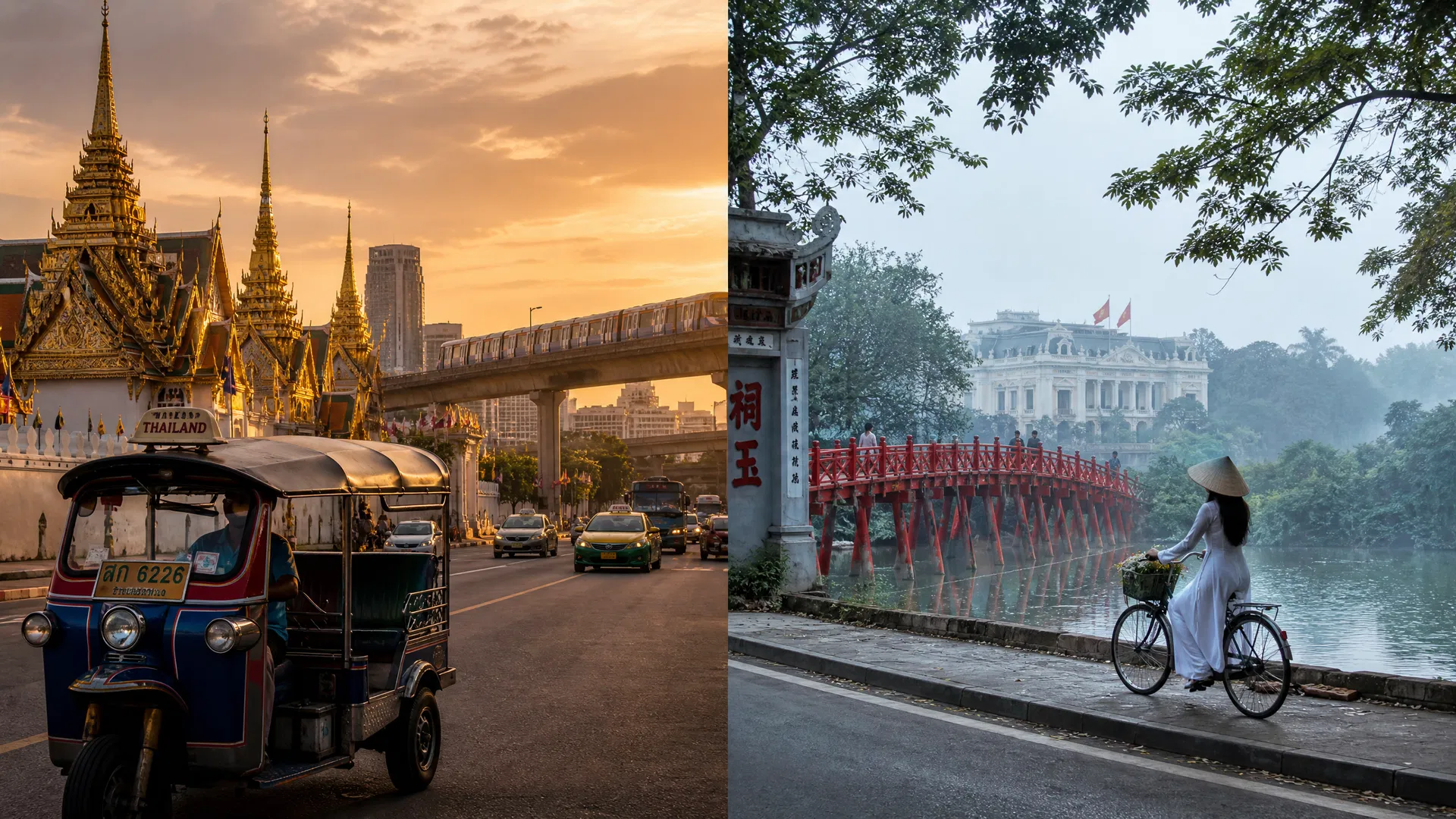
Bangkok vs Hanoi: One City Absorbed Everything. The Other Resisted It.
Destination: Bangkok & Hanoi
Category: comparison
There is a question that comes up on every Southeast Asia itinerary, usually somewhere around the third week of planning, when the flights are starting to look complicated and the budget is starting to look real: Bangkok or Hanoi?
The standard answer is both, which is correct but not particularly useful. The more interesting answer is that Bangkok and Hanoi are not two versions of the same thing. They are two cities that faced nearly identical pressures — Chinese imperial dominance, French colonial ambition, American military force, and the relentless homogenizing pressure of global tourism — and made fundamentally opposite decisions about what to do with all of it. Bangkok absorbed. Hanoi resisted. Both strategies worked. The result is two cities that feel more different from each other than either feels from anywhere else in the world.
Understanding that difference is not just an interesting historical footnote. It is the only way to understand what you are actually choosing between when you choose between them.
Bangkok: The City That Made Absorption a Strategy
Bangkok has never been colonized. This is not an accident. While every other major city in Southeast Asia was being claimed by European powers in the nineteenth century — Saigon by the French, Rangoon by the British, Jakarta by the Dutch — Bangkok was doing something more sophisticated than resisting. It was absorbing.
The Chakri dynasty, which has ruled Thailand since 1782, understood something that most of its neighbors did not: the way to survive foreign pressure is not to fight it but to take it in, transform it, and make it yours. When Rama I established Bangkok as the new capital in 1782, one of his first acts was to relocate the Teochew Chinese community from the site of the new Grand Palace to a district downstream along the Chao Phraya River. That district became Yaowarat — today the largest Chinatown in Southeast Asia, home to 50,000 people, and one of the most extraordinary street food corridors on earth. The Chinese were not expelled. They were absorbed. Within two generations, they were Thai-Chinese, not Chinese-in-Thailand. The distinction matters: Yaowarat is not a foreign enclave in Bangkok. It is Bangkok.
The same logic applies to Pad Thai, which is not as Thai as it seems. In 1942, Field Marshal Plaek Phibunsongkhram — Thailand's wartime prime minister — faced a rice shortage and a nationalist agenda simultaneously. His solution was to create a new national dish: stir-fried rice noodles with egg, bean sprouts, and dried shrimp, built on a Chinese culinary foundation but rebranded as definitively, officially Thai. The dish was promoted through government campaigns, sold from state-sponsored street carts, and taught in schools. Pad Thai is nationalist propaganda that became one of the greatest street foods in human history. Bangkok absorbed a Chinese noodle tradition and made it the symbol of Thai identity.
Walk through the Grand Palace complex and you see the same pattern at architectural scale. The spires are Khmer. The ceramic tile decorations are Chinese. The neoclassical elements are European. The spirit houses outside every building in the city are animist. The Buddhism that ties it all together absorbed Brahmin ritual and Hindu cosmology without replacing either. Bangkok is not a city that chose one identity. It is a city that chose all of them, and the result is an energy that is unlike anywhere else — simultaneously ancient and relentlessly modern, overwhelmingly complex and somehow navigable, a city that has been absorbing the world for 240 years and has not run out of appetite yet.
The absorption strategy has one more dimension that most visitors miss: Bangkok's relationship with its own past. The city does not preserve the old and the new in separate districts, the way Paris separates the Marais from La Défense. It layers them. The Wat Pho reclining Buddha — 46 meters long, 15 meters high, its feet inlaid with 108 auspicious signs in mother-of-pearl — sits inside a temple complex that has been absorbing additions since 1832, and the BTS Skytrain runs overhead while the monks walk through the courtyard below. The spirit houses outside every building in the city are animist tradition absorbed into Buddhist practice — not replaced, not relegated to museums, simply absorbed and made part of the daily rhythm. Bangkok does not choose between its histories. It carries all of them simultaneously, and the city's energy comes from that accumulated weight.
The AskLeif Bangkok 5-day solo guide and Bangkok food guide are built around this logic — the city rewards the traveler who follows the absorption, who moves from the Grand Palace to Yaowarat to the rooftop bars of Silom and understands that these are not separate Bangkoks but the same one. Where Bangkok absorbed and transformed, Hanoi did something harder: it refused.
Hanoi: The City That Made Resistance a Strategy
Where Bangkok absorbed the Chinese and made them Thai, Hanoi expelled the Chinese and built a lake legend around the expulsion.
In 1428, after a decade of guerrilla warfare against the Chinese Ming dynasty, the Vietnamese general Le Loi finally drove the occupiers out. According to the legend that Hanoi has been telling ever since, a golden turtle rose from the lake at the center of the city and reclaimed the magic sword that Le Loi had used to win the war. The lake was renamed Ho Hoan Kiem — the Lake of the Restored Sword. Today, the vermilion Huc Bridge (built 1865, 26 wooden pillars, still the same red) leads to the Ngoc Son Temple on an island in the middle of the lake, and the turtle legend is carved into the temple walls. The resistance is literally encoded in the geography of the city.
This was not a one-time event. It was a pattern. Hanoi has been occupied by the Chinese for a thousand years, colonized by the French for eighty, and bombed by the Americans for a decade. Each time, the city absorbed the physical evidence of the occupation — the French boulevards, the neoclassical Opera House (1911, a replica of the Paris Opéra Comique), the Metropole Hotel (1901, still the finest address in the city) — while refusing to become what the occupier wanted it to become. The French built Hanoi as a showcase of colonial modernity. The Vietnamese used it as the capital of their resistance. On September 2, 1945, Ho Chi Minh stood in Ba Dinh Square — the same square where Chinese, French, and Japanese authorities had all previously claimed sovereignty — and read a Declaration of Independence that opened by quoting Thomas Jefferson. The resistance made explicit, on the exact ground where every previous occupier had stood.
Walk through the Old Quarter today and you are walking through the same city that the Ly dynasty organized in the eleventh century. The 36 guild streets — Hang Bac (Silver Street), Hang Gai (Silk Street), Hang Dao (Dye Street), Hang Buom (Sail Street), Hang Ma (Paper Votive Offerings Street) — were named for the trades that operated there a thousand years ago, and most of them still sell what they always sold. The French tried to modernize this neighborhood. The Americans bombed the bridges around it. The tourists arrived in the 1990s and set up souvenir shops on the edges. The Old Quarter absorbed all of it and remained itself.
The French Quarter is the most visible evidence of this quality. The Opera House (1911, a near-exact replica of the Paris Opéra Comique), the Metropole Hotel (1901, still the finest address in the city, where Graham Greene wrote parts of The Quiet American in room 214), St. Joseph's Cathedral (1886, neo-Gothic, built on the site of a pagoda the French demolished) — all of it is still standing, still beautiful, and still French in its bones. But the French are gone. The buildings remain as evidence of an occupation that failed to take. After independence in 1954, the Vietnamese government did not tear them down. They kept them, because the buildings had become Vietnamese — absorbed into the city's identity the same way the Old Quarter had absorbed every previous attempt to change it. The Metropole still serves afternoon tea. The Opera House still stages performances. The cathedral still holds Mass. The resistance won, and it was generous enough in victory to keep what was worth keeping.
The AskLeif Hanoi solo guide and Hanoi food guide are built around this quality — the city reveals itself to travelers who understand that the resistance is not hostility but self-possession.
The Food Argument
Bangkok's food culture is the most direct expression of its absorption strategy. The city has taken every culinary tradition it has encountered — Chinese, Indian, Malay, Portuguese, Japanese, and now global — and transformed each one into something distinctly Thai. The result is not fusion in the modern sense, which implies compromise. It is transformation: the source material is absorbed and something new emerges that could only have come from Bangkok.
The street food corridor along Yaowarat Road after dark is the best single argument for this thesis. The Chinese-Thai families who have been cooking here for generations serve dishes that are neither Chinese nor Thai in any pure sense — they are Yaowarat, which is its own thing. The roast duck vendors, the seafood stalls, the dim sum shops that open at 5am: all of it is Bangkok absorbing and transforming, producing food that you cannot find anywhere else because it came from nowhere else.
The morning market at Or Tor Kor, adjacent to Chatuchak, is the other end of the absorption argument: a covered fresh market where the Thai-Chinese vendors sell produce and prepared foods that represent five centuries of culinary cross-pollination, where the durian sellers and the mango sticky rice vendors and the boat noodle stalls all operate within the same building under the same fluorescent lights, and the result is the most concentrated expression of what Bangkok's food culture actually is when you remove the tourist-facing layer.
The Bangkok couples guide covers the specific Yaowarat timing — arrive after 8pm when the street stalls open and the neon comes on, and the Bangkok budget guide maps the best value-per-baht corridor in the city.
Hanoi's food culture is the resistance made edible. Bún chả — grilled pork patties with vermicelli noodles, fresh herbs, and dipping broth — has been made the same way in Hanoi for centuries. In May 2016, Barack Obama sat down at Bún Chả Hương Liên, 24 Le Van Huu, on plastic stools with Anthony Bourdain and ate a $6 meal. The restaurant now has a glass case around the table where they sat, a framed photograph on the wall, and a menu that still costs $6. Hanoi's response to becoming famous was to preserve the table and keep cooking. That is the resistance in miniature.
Egg coffee — cà phê trứng — was invented in 1946 by Nguyen Van Giang, a bartender at the Sofitel Metropole Hotel, during the French War. Fresh milk was almost impossible to find. His solution was to whip egg yolk with condensed milk and fold it into strong Vietnamese coffee, creating a drink that is simultaneously a wartime improvisation and one of the most extraordinary things you can put in your mouth. Cafe Giang, at 39 Nguyen Huu Huan in the Old Quarter, is still run by his son, Nguyen Van Do. The recipe has not changed. The price is approximately 30,000 dong — about $1.20. The resistance, again, made into something you can drink.
The phở argument belongs here too. Hanoi phở — clear broth, flat rice noodles, thin slices of beef, a small plate of herbs on the side — is not the same dish as the phở served in Ho Chi Minh City, which is sweeter, more complex, more accommodating of additions. Hanoi phở is the original, and it is the original because Hanoi has not changed it. The recipe is the resistance: the city decided what phở was, and it has not been persuaded to become anything else. Phở Gia Truyen at 49 Bat Dan opens at 6am and sells out by 10am. The queue starts at 5:45. The broth has been cooking since the night before. This is what the resistance tastes like.
The Hanoi couples guide covers the specific Cafe Giang timing (go at 8am when the light comes through the narrow windows) and the Hanoi budget guide maps the full bún chả and phở circuit.
The Architecture Argument
Bangkok's architecture is the absorption thesis made visible at city scale. The Grand Palace complex, begun in 1782, contains Khmer prang towers, Chinese ceramic roof decorations, European neoclassical colonnades, and Thai gilded spires — all in the same compound, all coexisting without apparent contradiction. Wat Pho, the oldest and largest temple complex in Bangkok, houses a reclining Buddha 46 meters long and 15 meters high, its feet inlaid with 108 auspicious signs in mother-of-pearl. The temple was built in 1832 and has been absorbing additions ever since. The BTS Skytrain runs overhead. The tuk-tuks circle below. The monks walk through it all.
The modern city has the same quality at larger scale. The Silom and Sukhumvit districts are global financial and entertainment districts indistinguishable in their infrastructure from Singapore or Hong Kong. The canal neighborhoods — Bang Krachao, Thonburi — are village-scale communities that have been absorbing the city's growth for generations without being consumed by it. Bangkok is simultaneously one of the most modern cities in Asia and one of the most traditional, and it does not experience this as a contradiction.
The Bangkok luxury guide covers the specific rooftop bars and high-design hotels that represent Bangkok's absorption of global luxury culture, and the Bangkok family guide maps the temple circuit that is the best introduction to the absorption thesis for first-time visitors.
Hanoi's architecture is the resistance made visible. The Old Quarter itself is the most complete medieval urban fabric in Southeast Asia. The streets are narrow because they were built for pedestrians and handcarts, not cars. The buildings are tall and thin because the French taxed by street frontage. The guild system that organized the streets a thousand years ago is still legible in the shop signs. Walk down Hang Bac at 7am before the tourists arrive and you are in a city that has been continuously inhabited for a thousand years and has not forgotten what it is.
The Pace Argument
Bangkok moves at the speed of absorption. The city is always in the process of taking something in and transforming it, which means it is always in motion. The BTS Skytrain connects the modern districts at 80 kilometers per hour. The Chao Phraya express boats move through the old city at a pace that feels like the nineteenth century. The street food vendors set up at 6am and pack up at midnight. The rooftop bars open at sunset and close at 2am. Bangkok does not have a single pace. It has all of them simultaneously, and the traveler's job is to find the frequency that matches theirs.
Hanoi moves at the speed of resistance, which is slower and more deliberate. The motorbikes — not cars, never cars in the Old Quarter — create a flow that looks chaotic from the outside and operates by a logic that becomes clear once you stop trying to understand it and simply step into it. The coffee culture is slow by design: Hanoi's café scene is built around sitting for two hours over a single glass of egg coffee or iced Vietnamese coffee, watching the street, not going anywhere. The Old Quarter shuts down earlier than Bangkok. The city does not perform for you. It continues being itself, and you are welcome to watch.
The Honest Answer
The question "Bangkok or Hanoi?" is usually asked by someone who has ten days and is trying to figure out how to allocate them. The honest answer is that you should visit both, and that the order matters more than most people think.
Go to Hanoi first. Hanoi will recalibrate your expectations in a way that makes Bangkok more legible. After three days in the Old Quarter — after the egg coffee and the bún chả and the motorbike traffic and the Hoan Kiem Lake at dawn — you will arrive in Bangkok with a frame of reference that makes the absorption thesis visible. You will see the Yaowarat neon and understand what it means that this is not a Chinatown in the way that New York or San Francisco has a Chinatown. You will see the Grand Palace and understand what it means that the Khmer spires and the Chinese tiles and the European colonnades are all in the same compound. Hanoi teaches you to read Bangkok.
If you only have time for one: Bangkok for first-time visitors to Southeast Asia, because it is more immediately navigable, more infrastructure-rich, and more forgiving of the disorientation that comes with arriving in a new part of the world. Hanoi for travelers who have been to Bangkok before, or who are specifically interested in the question of how a city survives everything that is thrown at it.
The Bangkok 5-day itinerary and the Hanoi 5-day family guide are the best starting points for planning both cities. The Hanoi Ha Long Bay itinerary adds the most extraordinary day trip in Southeast Asia to the Hanoi side of the equation.
Planning: The Practical Version
Getting between them: Bangkok Airways flies direct Bangkok (BKK/DMK) to Hanoi (HAN) in approximately 2 hours. Fares range from $80–150 depending on timing and how far in advance you book. The flight is short enough that it does not require a full day of travel.
Time allocation: Four to five days in each city is the minimum for the absorption/resistance thesis to become legible. Three days in Bangkok is enough to see the major sites; it is not enough to understand the city. Three days in Hanoi is enough to walk the Old Quarter; it is not enough to sit still long enough to feel what the city actually is.
Budget: Bangkok is slightly more expensive than Hanoi at the street level — a bowl of boat noodles costs 50–80 baht ($1.50–2.50) versus a bowl of phở for 40,000–60,000 dong ($1.60–2.40). The difference is negligible. Where Bangkok diverges is at the top end: the luxury hotel and rooftop bar scene in Bangkok is more developed and more expensive than Hanoi's equivalent. Budget travelers will find both cities equally accessible.
Season: Bangkok is best visited November through February, when the heat is manageable and the rain has stopped. Hanoi has a distinct cool season (November through March) when the temperature drops to 15–20°C and the city takes on a different quality — the fog on Hoan Kiem Lake in the morning, the warmth of the egg coffee more necessary than optional. Both cities are worth visiting year-round; the cool season is simply when they are at their most themselves.
The Closing Argument
Bangkok and Hanoi are not two versions of the same city. They are two answers to the same question — what do you do when the world keeps arriving at your door, demanding that you become something else? — and both answers are correct, and both answers produced something that could not have come from anywhere else.
Bangkok absorbed. It took the Chinese and made them Thai. It took a wartime rice shortage and made it a national dish. It took Khmer architecture and French boulevards and Japanese technology and global finance and made them all Bangkok. The city is the most successful absorption machine in human history, and the result is a place of such density and complexity and energy that it rewards every visit differently.
Hanoi resisted. It expelled the Chinese and built a lake legend around the expulsion. It kept the French buildings and expelled the French. It survived the American bombs and rebuilt. It sat down with a president and a chef on plastic stools and charged them $6 and put the table in a glass case and kept cooking. The city is the most successful resistance in human history, and the result is a place of such self-possession and depth that it changes the way you think about what a city can be.
You should go to both. You should go to Hanoi first. And when you arrive in Bangkok after three days in the Old Quarter, you will understand — in a way that no amount of reading can produce — exactly what it means that one city absorbed everything and the other refused.