The Southwest Doesn't Reward the Traveler Who Rushes.
Destination: American Southwest, USA
Category: Travel Guides
The standard American Southwest road trip has been planned the same way for thirty years. You fly into Las Vegas, drive to Zion, spend one night, drive to Bryce, spend one night, drive to Monument Valley, take the photograph, drive to the Grand Canyon, spend one night, drive to Sedona, spend one night, fly home. You have seen six places and understood none of them. You have the photographs. You have the stamps. You have the vague sense that the Southwest was impressive and that you were moving too fast to feel it.
Ten days in the American Southwest is enough time to do it right or enough time to do it wrong. The difference is a single decision made before you book anything: are you building a checklist or building an experience? The checklist version visits more places. The experience version understands fewer places more deeply — and the Southwest, more than almost any landscape on earth, is a place that requires stillness to comprehend. The red rock formations don't reveal themselves to the traveler who arrives at noon and leaves the next morning. They reveal themselves at dawn, at dusk, on the third morning when the light hits differently and you finally understand what you've been looking at.
This itinerary makes a specific argument: five stops, ten days, with the nights distributed by what each place actually needs rather than by what fits neatly into a driving schedule. Three nights in Sedona. Two nights at the Grand Canyon. One night at Monument Valley. Two nights in Zion. Two nights at Bryce Canyon. The route runs north from Phoenix through Arizona and into Utah, exiting through Salt Lake City. It is not the most efficient route. It is the route that works.
Stop 1: Sedona, Arizona — The Landscape That Calibrates Everything
The Southwest doesn't start at the Grand Canyon. It starts in Sedona, where the red rock formations that surround the town are so visually extreme that they immediately establish what the next ten days will be — before the itinerary has to explain anything. Cathedral Rock. Bell Rock. Courthouse Butte. The formations rise from the desert floor in colors that shift from rust to amber to deep crimson depending on the angle of the light, and the first time you see them from the airport road coming in from Phoenix, the instinct is to pull over and stare. Do it. That instinct is correct.
The mistake most visitors make in Sedona is arriving in the afternoon and leaving the next morning. One night in Sedona is one register of the place — the tourist register of Tlaquepaque Arts Village and the Pink Jeep Tours and the vortex sites marked on every map in town. It is real and it is worth experiencing. But Sedona has two other registers that require time to access.
The hiking register opens on the second morning, when you're on the Cathedral Rock trail at 6am and the Red Rock Crossing reflection in Oak Creek below the formation is the most photographed image in Arizona and you have it almost entirely to yourself. The trail is 1.5 miles round trip with a steep scramble at the end — the reward is standing on the saddle between the two spires at dawn with the valley spread below you and the light turning everything the color of fire. The Sedona couples retreat guide sequences this hike with the Boynton Canyon trail for a full day in the backcountry — Boynton Canyon is where the specific vortex site sits off the main trail at a boulder formation that most hikers pass without stopping, and the guide identifies the exact turning point.
The dawn register opens on the third morning, when you've stopped trying to see Sedona and started letting Sedona show you things. The Jordan Road trailhead for the Airport Mesa loop — not the commercial Airport Mesa overlook that appears in every photograph, but the local version that requires a short scramble to a flat rock facing west — is where you watch the sunset on the last evening and understand why people move here. The light on the formations at that hour is not a photograph. It is a physical experience.
Elote Café on Hwy 179 does not take reservations. The line forms before opening. The elote preparation — corn roasted in a cast-iron skillet with lime, cotija, and a specific house chili blend — has been on the menu unchanged since 2004. It is the meal that makes you understand that Sedona is not just a landscape but a place where people have built a life around being surrounded by something extraordinary. Eat there on the second night. The Sedona wellness and spa retreat guide covers the full range of dining and healing experiences for travelers who want to go deeper into what makes Sedona a destination rather than a waypoint.
Nights in Sedona: 3. Drive to Grand Canyon: 2 hours north on US-89.
Stop 2: Grand Canyon, Arizona — The Place That Defeats Description
Where Sedona calibrates the eye to the Southwest's visual vocabulary, the Grand Canyon defeats it entirely. Nothing in the three nights you spent in Sedona — nothing in any previous travel experience — prepares you for the first view of the canyon from the South Rim. The scale is wrong. The brain refuses to process it correctly. The canyon is 277 miles long, up to 18 miles wide, and a mile deep, and the photographs that exist of it are all technically accurate and all completely inadequate. You have to stand there and let it be larger than your ability to comprehend it.
The competitive gap in Grand Canyon content is not finding an alternative to the South Rim. It is arguing for how to experience the South Rim correctly — which means going below the rim rather than standing on it, experiencing dawn rather than midday, and understanding that the Canyon is not a view but a geological argument about time that requires physical engagement to comprehend.
The Bright Angel Trail to Indian Garden is 9 miles round trip with 3,000 feet of elevation change. In spring and fall — the specific windows this itinerary recommends — it is transcendent. The trail descends through geological time: the Kaibab limestone at the rim is 270 million years old; the Vishnu schist at the bottom is 1.7 billion years old. You walk through a billion years of earth history in four and a half miles. The water stations at 1.5 miles and 3 miles make the hike survivable in any season. The Grand Canyon 5-day adventure guide covers the full Bright Angel sequence including the specific turnaround points for different fitness levels and the specific spring and fall windows when the inner canyon temperature is right.
The Mather Point experience at 5am — before the tour buses arrive, before the parking lots fill, before the first ranger program of the day — is a completely different experience from the same viewpoint at 10am. At 5am in October, the canyon fills with shadow and the rim catches the first light and the geological layers reveal themselves in sequence from top to bottom as the sun rises. At 10am it is a parking lot with a view. The Grand Canyon photography guide was built specifically for this — the golden hour sequences, the specific viewpoints that the photography community knows about and most visitors miss, and the Desert View Watchtower at the eastern end of the South Rim that Mary Colter designed in 1932 to look as if it had always been there.
The Kolb Studio at the trailhead of the Bright Angel Trail is the most overlooked building on the rim. Ellsworth and Emery Kolb built a photography studio on the canyon wall in 1904, ran river trips, and Emery lived there until his death in 1976. The studio is now a bookshop and gallery and it is free to enter. Spend twenty minutes there before the hike. It changes what the hike means.
The Grand Canyon family guide covers the South Rim with children — the ranger programs at Mather Amphitheater are free, consistently praised, and almost entirely unattended by the visitors who would benefit most from them. The geology talks run twice daily in season. Attend one.
Nights at Grand Canyon: 2. Drive to Monument Valley: 3 hours east on US-89 and US-163.
Stop 3: Monument Valley, Arizona/Utah — The Landscape America Invented Itself From
Where the Grand Canyon asks you to comprehend geological time, Monument Valley asks you to comprehend something stranger: the experience of standing inside a mythology. John Ford shot seven Westerns here. The Mittens — the two sandstone buttes that rise from the valley floor like a pair of hands — have appeared in more films than any other natural formation in the world. Visiting Monument Valley is not the experience of seeing a landscape. It is the experience of recognizing a landscape you have never visited, because you have seen it in every Western ever made, in every road movie, in every advertisement that needed to communicate something about America and freedom and the open road.
The thesis argument for Monument Valley is that understanding what you're looking at requires understanding what America made of it. The cultural history of the Westerns and the specific Navajo Nation context are as important to the experience as the geology. Monument Valley sits entirely within the Navajo Nation — the largest Native American reservation in the United States — and the valley floor beyond the visitor center requires a Navajo-owned guided tour to access. This is not a bureaucratic inconvenience. It is the correct way to experience the place.
The Monument Valley photography and road trip guide identifies the specific Navajo-owned and operated tour operators whose guides provide cultural context that the self-drive route doesn't — the specific stories about the formations, the Navajo names that predate the Western names, the history of what the valley was before John Ford arrived in 1938. Book one of these tours. The guide covers the specific operators, the pricing, and the timing.
The Wildcat Trail is the only trail in Monument Valley that doesn't require a guide. It is 3.2 miles around the West Mitten Butte and it is best done at dawn — the specific light between 6am and 7am that the photography community knows about and most visitors miss because they arrive at 9am when the tour buses start. The View Hotel is the only hotel inside Monument Valley, built by the Navajo Nation, and the specific room category with direct views of the Mittens from the bed is worth the premium. Book it six months in advance.
One night is the right amount of time for Monument Valley. It is a place of enormous power and very specific experience — the dawn light, the guided tour, the Wildcat Trail, the sunset from the hotel terrace. Two nights would require inventing activities that don't exist. One night, done correctly, is the experience complete.
Nights at Monument Valley: 1. Drive to Zion: 3.5 hours northwest on US-163 and UT-9.
Stop 4: Zion National Park, Utah — The Canyon That Goes Up Instead of Down
The transition from Monument Valley to Zion is the most important transition in this itinerary, because it is where the thesis becomes physically demonstrable. The Grand Canyon is experienced from above — you stand on the rim and look down into geological time. Zion is experienced from below — you walk through the canyon floor and look up at walls that rise 2,000 feet on either side. These are not two similar experiences that overlap. They are two opposite experiences that complete each other. The traveler who does the Grand Canyon and then Zion understands something about canyon geology that neither experience alone provides.
The Angels Landing permit system was implemented in 2022. Permits are required for the final half mile to the summit — the chains section that rises 1,488 feet above the canyon floor. The permit lottery opens four months in advance for the following month. Apply the moment the window opens. The Zion couples adventure guide covers the specific lottery timing and the alternative viewpoints for travelers who don't get a permit — the Canyon Overlook Trail is 1 mile, 163 feet of elevation gain, and the viewpoint at the end looks down the full length of Zion Canyon without requiring a permit or a grueling climb. It is the most underrated hike in the park.
The Narrows is the experience that defines Zion for most visitors who have been there. Starting at the Temple of Sinawava, you wade upstream through the Virgin River as the canyon walls narrow to 20 feet on either side and rise 1,000 feet above you. The specific water level timing matters: late spring and early summer when the snowmelt has subsided but the flow is still right for the full experience. July and August carry flash flood risk and the park service will close the Narrows without warning. October — the window this itinerary recommends — is the correct month. The water is cold, the crowds are manageable, and the light in the slot canyon at midday is extraordinary. The Zion beginner hiker guide covers the Narrows bottom-up route with the specific gear requirements — neoprene socks, canyoneering shoes, a walking stick — that make the difference between a transcendent experience and a miserable one.
The Zion Lodge history is worth knowing before you arrive. The original 1924 lodge burned in 1966. The current structure is a 1990 reconstruction. The specific rocking chairs on the porch that face the Cathedral Rocks at sunset are the best free seat in the park. Sit in them on the second evening. The Zion family guide covers the shuttle system that is the only way to move through the canyon in high season — understanding the shuttle stops before you arrive saves hours of confusion.
Nights in Zion: 2. Drive to Bryce Canyon: 1.5 hours northeast on UT-9 and US-89.
Stop 5: Bryce Canyon National Park, Utah — The Landscape That Has No Reference Point
Where Zion is a landscape of force — the Virgin River cutting through sandstone over millions of years — Bryce Canyon is a landscape of whimsy. The hoodoos that fill the Bryce Amphitheater are irregular columns of red, orange, and white rock formed by freeze-thaw cycles over millions of years, and they exist at Bryce at a concentration and a scale that has no comparison anywhere on earth. The Grand Canyon is geological time made visible. Zion is geological force made walkable. Bryce is geological imagination made literal — a landscape so visually extreme that the first instinct is to believe it was designed rather than formed.
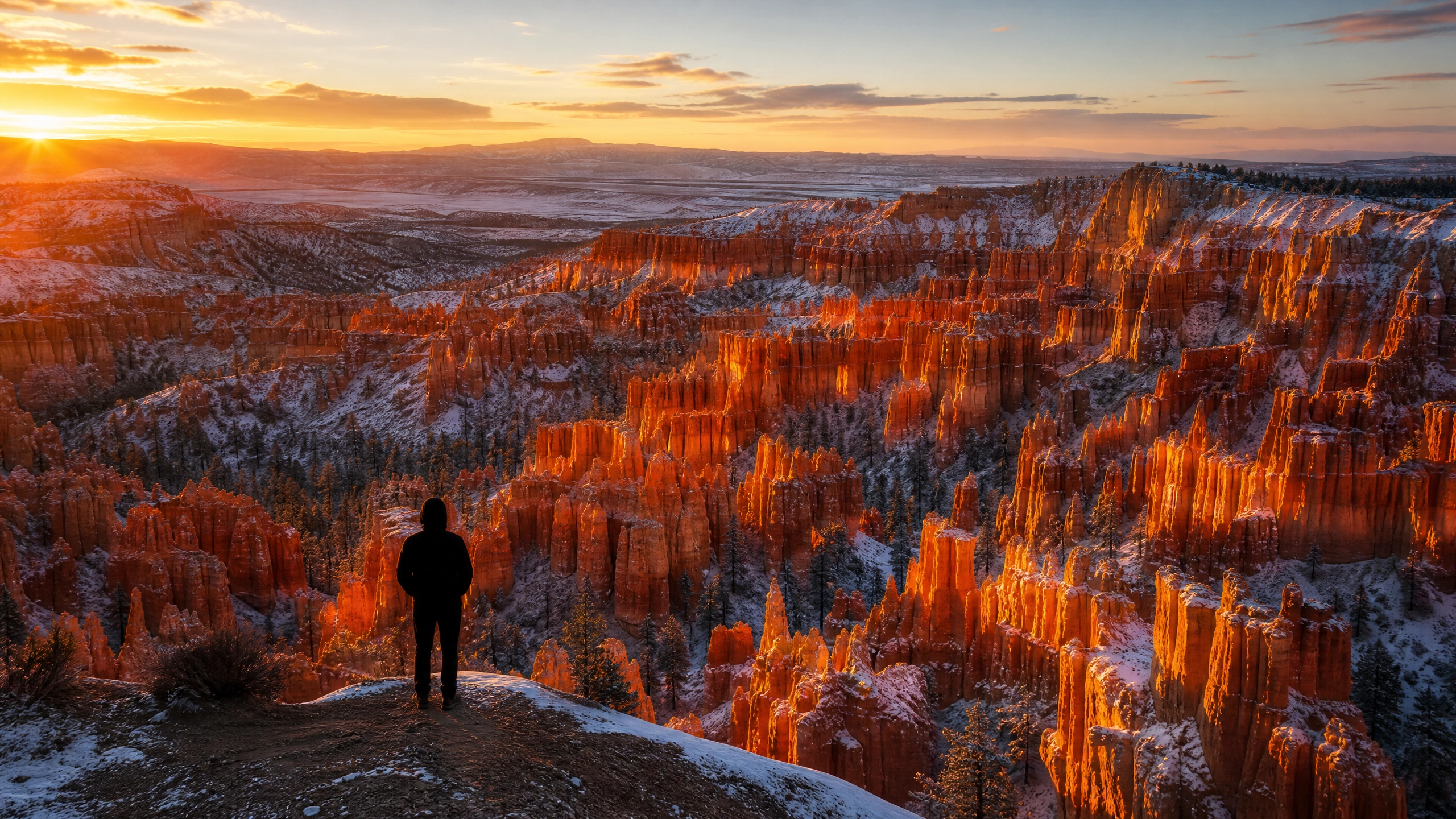
Ending the Southwest itinerary at Bryce is the thesis completed. This is the landscape that requires no previous reference point, that defeats every comparison, that makes the traveler feel that the Southwest has been saving its most extraordinary thing for last. And in a specific two-week window in late October, it does something that no other landscape in the Southwest does: it snows. The first dusting of snow on the hoodoos — white on orange, the formations rising from a thin white floor — is the most photographed image in the park and one of the most visually extreme things the American West produces. Plan for the last week of October if you can.
The Bryce Amphitheater at sunrise from Sunrise Point is the experience that defines the park. Between 6am and 7am in October, the low angle of the light turns the formations every shade of orange and red simultaneously — the hoodoos glow from within, the shadows between them deepen to purple, and the entire amphitheater looks like something that should not exist. Be there before the light arrives. The Bryce Canyon 2-day guide sequences the sunrise at Sunrise Point with the Navajo Loop and Queens Garden combination trail — 2.9 miles, the specific descent into the amphitheater at Wall Street where the canyon narrows to a slot and the hoodoos rise 100 feet on either side. This is the hike that makes Bryce make sense.
The astronomy program at Bryce Canyon is among the most consistently praised experiences in any national park. Bryce has the darkest skies of any national park in the continental United States — the Milky Way is visible to the naked eye on a clear night, and the ranger-led programs on summer and fall evenings use telescopes powerful enough to resolve the rings of Saturn. The Bryce Canyon family guide covers the astronomy program schedule and the specific dates when the programs run in October.
The Bristlecone Pine Trail on the southern rim is a 1-mile loop through the oldest living trees in the Southwest. Bristlecone pines that are 1,700 years old grow at the southern end of the park, away from the amphitheater, and most Bryce visitors never find them because the trailhead requires driving past the main viewpoints to the end of the park road. Go there on the second morning before the amphitheater fills. The trees are older than most civilizations. Standing among them changes the scale of everything that came before on this itinerary.
Nights at Bryce Canyon: 2. Drive to Salt Lake City: 4 hours north on US-89 and I-15.
The Exclusion Argument: Why Antelope Canyon, Arches, and Las Vegas Are Not on This List
Every Southwest road trip itinerary includes Antelope Canyon. This one doesn't, and the reason is specific: Antelope Canyon is one of the most photographed places on earth and requires a guided tour that books out three to six months in advance. Including it on a ten-day itinerary either requires advance planning that defeats the spontaneity this itinerary allows, or produces disappointment when the tours are sold out on arrival. Antelope Canyon deserves its own trip — the Antelope Canyon photography guide builds that trip correctly, with the booking windows, the specific tour operators, and the light shaft timing that makes the photographs possible. Reference it for a dedicated visit.
Arches National Park is extraordinary and deserves its own trip. Adding it to this itinerary requires either rushing Zion and Bryce — reducing two-night stops to one-night stops — or extending the trip beyond ten days. The post argues for depth over breadth. Including Arches would undermine that argument by adding a sixth stop that each gets one day rather than giving the five existing stops the time they deserve. The Arches and Moab road trip guide builds the Arches trip correctly — seven days in canyon country with Canyonlands included, which is the right amount of time for that landscape.
Las Vegas appears as a gateway city on most Southwest itineraries because it has the largest regional airport. This itinerary uses Phoenix as the entry point and exits through Salt Lake City, which produces a more logical geographic route and avoids the tonal whiplash of starting or ending a landscape itinerary in a casino city. The drive from Phoenix to Sedona is two hours through the Sonoran Desert — it is the correct introduction to the Southwest. The drive from Bryce Canyon to Salt Lake City is four hours through the Utah high desert — it is the correct exit.
When to Go, Getting Around, and What to Know
The right window: April through May and September through October. Spring brings wildflowers to the canyon country and manageable temperatures at all five stops. Fall brings the specific light that photographers know about — lower angle, longer shadows, the colors of the formations deepened by the cooler air. Late October adds the possibility of snow at Bryce, which is the most extraordinary visual the Southwest produces. Avoid July and August: the inner canyon at the Grand Canyon reaches 110°F, the Narrows flash flood risk is real, and every park is at maximum capacity.
Getting there: Fly into Phoenix Sky Harbor (PHX) and out of Salt Lake City International (SLC). The one-way car rental is straightforward and the route is entirely driveable. Total driving distance: approximately 900 miles over ten days. Average daily driving: under 100 miles, with the Monument Valley to Zion leg (3.5 hours) being the longest single drive.
Book before you go: The Angels Landing permit lottery opens four months in advance — apply immediately. Phantom Ranch at the Grand Canyon (accessible only by hiking or mule) books a year in advance and is worth attempting for a future trip. The View Hotel at Monument Valley books six months in advance for the Mittens-view rooms. Antelope Canyon tours book three to six months in advance — if you want to add a half-day detour from Monument Valley, book it before the trip.
Budget: Mid-range travelers should budget $250–350 per day including accommodation, food, park fees, and gas. The America the Beautiful annual pass ($80) covers entrance fees at all five stops and pays for itself at the first park. Sedona has the highest accommodation costs of the five stops — the wellness and spa economy has pushed prices up. The Grand Canyon's Bright Angel Lodge and Yavapai Lodge book six months in advance for the best rooms.
Planning Your Southwest Trip with Leif
The permit lottery timing for Angels Landing, the fourteen-month Phantom Ranch booking window, and the seasonal considerations across five parks is exactly the kind of multi-variable planning Leif organizes in 60 seconds. Feed it your travel dates and how many nights you want at each stop, and it builds the day-by-day detail — so you apply for the Angels Landing permit the moment the lottery opens, arrive at Mather Point before the tour buses, and reach Bryce Canyon in the specific late-October window when the snow dusts the hoodoos. The guides below cover each stop in depth — use them alongside Leif or as standalone trip anchors.
- Sedona Couples Retreat: Red Rocks, Spa Days & the Most Romantic Town in the Southwest
- Sedona Wellness & Spa Retreat: 4-Day Vortex Hikes & Healing
- Arizona Desert Road Trip: Sedona, Flagstaff & Grand Canyon 5-Day Adventure
- Grand Canyon 5-Day Adventure: Solo & Couples Hiking, Rafting & Photography
- Grand Canyon Photography Guide: 7 Days of Golden Hour & Hidden Vistas
- Grand Canyon Family Adventure: 4-Day South Rim Itinerary with Kids
- Arizona Desert Loop: 7-Day Road Trip from Phoenix to Grand Canyon
- Flagstaff 4-Day Grand Canyon Gateway & Mountain Town Adventure
- Flagstaff Couples Adventure: 3-Day Grand Canyon, Stargazing & Mountain Escape
- Monument Valley 3-Day Photography & Road Trip: Iconic Landscapes & Navajo Culture
- Zion National Park 4-Day Couples Adventure: Angels Landing, Narrows & Canyon Romance
- Zion National Park 5-Day Solo & Couples Adventure
- Zion National Park Family Adventure: 4-Day Itinerary with Shuttle & Kid-Friendly Trails
- Zion National Park: 7-Day Beginner Hiker's Guide to Confidence-Building Trails
- Bryce Canyon 2-Day Hoodoo Wonder: Stargazing, Thor's Hammer & Mighty 5 Gateway
- Bryce Canyon Family Adventure: 3-Day Hoodoo & Stargazing Itinerary
- Bryce Canyon 4-Day Solo & Couples Adventure: Hoodoos, Stargazing & Mighty 5 Road Trip
The Specific Details
Sedona
- Cathedral Rock trail: Crescent Moon Ranch parking area off Red Rock Loop Road. Arrive by 5:45am for the dawn reflection. $12 day-use fee. The scramble to the saddle is Class 3 — use your hands.
- Elote Café: 771 Hwy 179, Sedona. Opens at 5pm. Line forms by 4:30pm. Cash and card accepted. The elote, the tamales, and the duck carnitas are the three dishes that have been on the menu since 2004.
- Airport Mesa local viewpoint: Jordan Road trailhead, not the commercial overlook. 0.4-mile walk to the flat rock. No fee. Best 45 minutes before sunset.
- Boynton Canyon vortex site: 2.7 miles in on the main trail, look for the large boulder formation on the right. The vortex site is 50 feet off the trail — most hikers pass it without stopping.
Grand Canyon
- Mather Point at dawn: Arrive 45 minutes before sunrise. The East Rim Drive is open to private vehicles year-round. Parking at Mather Point fills by 7am in season.
- Bright Angel Trail: Trailhead at the western end of Grand Canyon Village. Water available at 1.5-mile and 3-mile rest houses (seasonal — confirm before descent). Turn around at Indian Garden (4.5 miles) unless you have camping permits for the bottom.
- Kolb Studio: Open daily 8am–6pm. Free entry. The 1912 film of the Kolb brothers' river trip is shown on loop — it is the first motion picture ever shot in the Grand Canyon.
- Desert View Watchtower: 25 miles east of Grand Canyon Village on Desert View Drive. Mary Colter's 1932 masterwork. The view from the top encompasses the Colorado River, the Painted Desert, and the Navajo Nation. Worth the drive.
Monument Valley
- Navajo-owned guided tours: Navajo Nation Parks requires guided tours for the valley floor. Sacred Monument Tours and Navajo Spirit Tours are the two most consistently recommended Navajo-owned operators. Book online in advance. Half-day tours run 2.5 hours and cover John Ford Point, the Three Sisters, and Artist's Point.
- Wildcat Trail: Trailhead at the visitor center. 3.2 miles, 1.5–2 hours. Dawn start (6am) for the best light on the West Mitten. No guide required.
- The View Hotel: The only hotel inside Monument Valley. Room categories 1 and 2 have direct Mitten views. Book 6 months in advance for October dates. The hotel restaurant serves Navajo tacos — order them.
Zion
- Angels Landing permit: Apply at recreation.gov. The seasonal lottery opens on the 1st of the month four months prior (for October, apply June 1). Day-before permits also available — check at 12am MT the night before your planned hike.
- The Narrows: Temple of Sinawava trailhead, end of Zion Canyon Scenic Drive (shuttle stop 9). Neoprene socks ($20 rental at Zion Outfitter), canyoneering shoes (rental available), and a walking stick are the three items that make the difference. Water level information at the park visitor center daily.
- Canyon Overlook Trail: Trailhead at the east end of the Zion–Mt. Carmel Tunnel. 1 mile round trip, 163 feet elevation gain. No permit required. Best in the morning before the tunnel traffic builds.
- Watchman Campground: Sites 109–118 back up to the Virgin River. The sound of the river at night is the specific thing that makes camping in Zion different from anywhere else. Book 6 months in advance.
Bryce Canyon
- Sunrise Point: Arrive 30 minutes before sunrise. The Bryce Amphitheater Rim Trail connects Sunrise Point to Sunset Point (1 mile) — walk it after the sunrise light fades for the full rim perspective.
- Navajo Loop / Queens Garden combination: Start at Sunset Point, descend the Navajo Loop (Wall Street section), traverse to Queens Garden, ascend to Sunrise Point. 2.9 miles, 521 feet elevation change. The Wall Street narrows are the specific section that makes the hike worth doing — 100-foot hoodoos on both sides, canyon width of 4 feet at the narrowest point.
- Astronomy program: Runs June through September and select October dates. Check the Bryce Canyon astronomy program schedule at nps.gov/brca. The full-moon programs are separate from the dark-sky programs — both are worth attending if dates align.
- Bristlecone Pine Trail: Drive to Rainbow Point (the southern end of the park road, 18 miles from the visitor center). The trailhead is at the parking area. 1-mile loop. The oldest trees are marked with interpretive signs. Go in the morning before the amphitheater crowds arrive.
- Late October snow window: The first significant snowfall at Bryce typically occurs between October 20–November 5. Check the National Weather Service forecast for Bryce Canyon City, Utah (elevation 8,000 feet) in the week before your visit. The snow dusts the hoodoos and melts by midday — the window for the specific photograph is the two hours after sunrise on the morning after a snowfall.
The Itinerary That Doesn't Rush
The Southwest doesn't reward the traveler who rushes. This is not a metaphor. The specific experiences that make the Southwest extraordinary — the Cathedral Rock reflection at 6am, the Grand Canyon at 5am before the tour buses, the Wildcat Trail at Monument Valley at dawn, the Angels Landing chains in the early morning quiet, the Bryce Amphitheater in the first light of a late-October morning with snow on the hoodoos — all of them require arriving before the crowds, staying longer than one night, and trusting that the landscape will show you something on the third morning that it didn't show you on the first.
The itinerary that doesn't rush is not a slower version of the standard itinerary. It is a different itinerary entirely — one that chooses five places over seven, depth over breadth, and the specific experience over the general impression. The traveler who does this trip correctly comes home having understood something about geological time, about the relationship between landscape and mythology, about what the American West actually is beneath the photographs. That understanding is not available to the traveler who spent one night at each stop and drove on.
Ten days. Five stops. The Southwest done right.