Zurich Stripped Its Churches Bare in 1524. It Never Stopped.
Destination: Zurich
Category: destination
Zurich Stripped Its Churches Bare in 1524. It Never Stopped.
You walk into the Grossmünster on a Tuesday morning and the first thing you notice is the absence. No gilded altar. No painted saints watching from the walls. No candles, no incense, no accumulated centuries of Catholic decoration. The windows let in clean Swiss light and the stone is bare and the silence is the kind that doesn't feel empty — it feels deliberate. Like someone made a decision here, once, and the decision has never been reversed.
They did. In January 1524, Huldrych Zwingli stood in this building and ordered the removal of everything. The statues were smashed. The paintings were whitewashed. The organs were dismantled. The gold was melted. Music was banned from worship for decades. Zwingli's argument was theological — God is encountered through the Word, not through spectacle — but the act was something more than theology. It was a city deciding, at the deepest level, what it believed about beauty. That beauty should be earned. That ornament is a kind of lie. That the thing itself, stripped bare, is enough.
Five hundred years later, Zurich is still making that argument. Not in its churches, which are now open to tourists and have long since made peace with their own austerity. But in everything else. In the way the city's streets are clean without being sterile. In the way its people are reserved without being cold. In the way its restaurants are excellent without being theatrical. In the way the lake sits at the end of Bahnhofstrasse — one of the most expensive shopping streets on earth — and the locals walk past the luxury storefronts to swim in it.
Zurich is the city that the travel world has been reading wrong. It doesn't have a single iconic landmark that announces itself the way the Eiffel Tower or the Colosseum does. Most travel guides suggest three days at most. The Reddit consensus is blunt: "It's a great place to live, less so to visit." All of this is true, and all of it misses the point. Zurich is not a city you visit. It is a city you inhabit, briefly, on its own terms. The 1524 stripping is the argument. Everything else in Zurich is the evidence.
How the Grossmünster and the Fraumünster Became the Thesis Made Physical
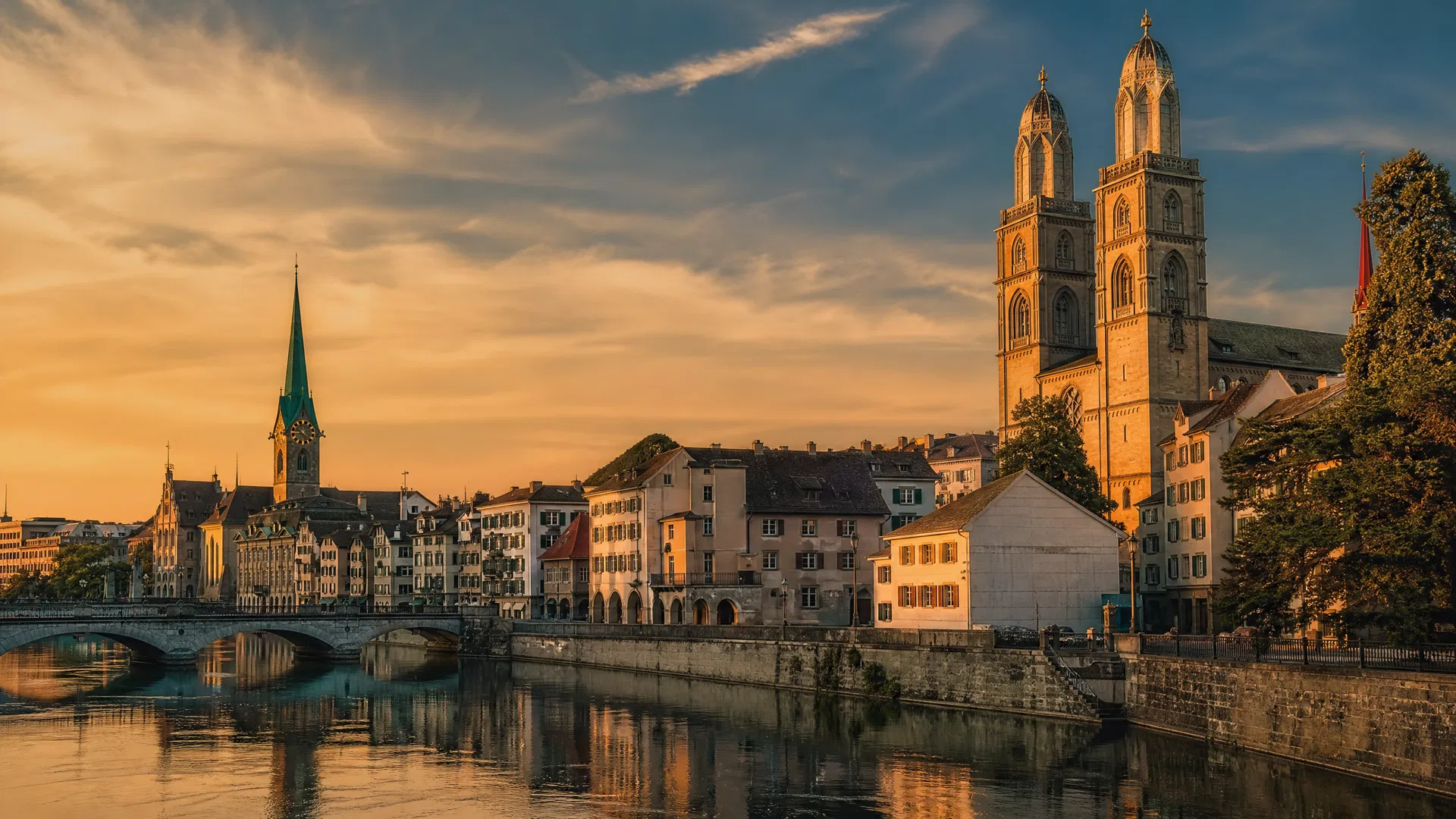
Cross the Münsterbrücke bridge and you have both churches in view simultaneously — the Grossmünster's twin Romanesque towers on your right, the Fraumünster's slender Gothic spire on your left, the Limmat River running between them. They have been facing each other across this water since the ninth century, when Louis the German founded the Fraumünster as a convent for women of the aristocracy. For six hundred years they competed for precedence, for pilgrims, for donations. Then Zwingli arrived at the Grossmünster in 1519 and changed the terms of the argument entirely.
The Fraumünster is the more visually arresting of the two now, and for a reason that Zwingli would have found deeply ironic. In 1970, Marc Chagall installed five stained glass windows in the choir — deep blues and greens and reds depicting scenes from the Old and New Testament in his unmistakable style. The windows are extraordinary. They are also the single most vivid piece of ornamentation in either church, which means that the building Zwingli did not control became the one that kept its capacity for beauty. The building he did control became the argument.
Stand inside the Grossmünster for ten minutes. The whitewashed walls. The unadorned stone. The light coming through plain glass. Most visitors feel a faint disappointment — they came expecting the accumulated grandeur of a medieval church and found a lecture hall. That disappointment is the point. Zwingli wanted you to feel it. He wanted to remove the intermediary between the worshipper and the word, to strip away everything that made religion comfortable and decorative and easy. What remains when you take away the comfort is the thing itself. The Grossmünster is not a beautiful church. It is an honest one.
That honesty is the frequency Zurich operates on. The city does not try to seduce you. It does not arrange itself for photographs. It does not perform. If you arrive expecting Paris — the self-conscious beauty, the city that knows it is being looked at and has spent centuries perfecting the pose — you will be confused and possibly disappointed. If you arrive understanding that Zurich stripped its churches bare in 1524 and has never stopped, you will start to see the city correctly.
The Two Faces of the Old Town
The Altstadt — the old town — sits on both banks of the Limmat and is small enough to walk entirely in an afternoon. The eastern bank, Niederdorf, is the one that tourists find first: cobblestone lanes, guild houses with painted facades, the Grossmünster at one end and the Rathaus at the other. It is genuinely beautiful and genuinely worth your time, but it is also the version of Zurich that has been packaged for consumption. The restaurants in Niederdorf are good. The bars are fine. The souvenir shops are exactly what you'd expect.
The western bank, the Lindenhügel, is quieter and less visited and more itself. The Fraumünster is here, and the Stadthaus, and the Lindenhügel hill itself — a small rise above the river where you can stand and look across at the Grossmünster towers and understand, for the first time, the geometry of the city. The Polybahn funicular runs from the Central tram stop up to the Polyterrasse, a terrace above the ETH Zurich — one of the world's great technical universities — where there is a bar with a view across the rooftops and the lake and, on clear days, the Alps. The Polybahn has been running since 1889. Locals use it to commute. Tourists almost never mention it.
The Niederdorf lane called Spitalgasse has a particular quality in the early evening — the light comes in low from the west and hits the guild house facades at an angle that makes them glow amber, and the cafes put their chairs out, and the city does something it almost never does: it relaxes visibly. This is the window you want. Not the middle of the day when the tour groups are moving through, but the hour before dinner when the city is between its public and private selves.
Sternen Grill, at the corner of Theaterstrasse and Bellevueplatz, has been selling bratwurst from a window since 1963. The sausage is made from veal and pork, grilled over charcoal, served in a bread roll with mustard. It costs less than eight francs. The line at lunch is twenty people deep. Every local knows Sternen Grill. It is the most honest transaction in the Altstadt: a city that charges four hundred francs a night for a hotel room and twenty francs for a coffee will sell you the best sausage of your life for the price of a bus ticket.
What Zurich Actually Eats
The received wisdom about Swiss food is that it is expensive, dairy-heavy, and not particularly interesting beyond raclette and fondue. The received wisdom is half right. Eating in Zurich is expensive — a sit-down lunch at a mid-range restaurant will cost you thirty to forty francs, and dinner at somewhere serious will cost twice that. But the food itself, if you know where to look, is far more interesting than the reputation suggests.
The reason is immigration. Zurich has been absorbing waves of migrants for a century, and each wave has left its food in the city. The Italian community arrived first and is now so embedded that the distinction between Swiss-Italian and Italian-Italian cuisine has blurred entirely. The Turkish community arrived in the 1960s and 70s and has produced restaurants like Bebek on Badenerstrasse 171, where the weekend breakfast menu sets Turkish white cheeses and housemade jam alongside Swiss smoked trout and gipfeli — the Swiss croissant — in a combination that should not work and absolutely does. The Bosnian community has given the city Sarajevska Ćevabdžinica on Freilagerstrasse 1, where the glass cabinets hold platters of borek and clay tureens of beans in red sauce, and the bread is pulled from the oven while you wait. The Ethiopian community has given it Habesha on Schreinerstrasse 64, where the kitfo — minced beef seasoned with spiced butter and mitmita — arrives on injera with a precision that suggests the kitchen has been doing this for decades, because it has.
None of these restaurants appear in the top five Google results for "Zurich food." They are not on Bahnhofstrasse. They are in Kreis 4 and Kreis 5, the districts west of the old town that used to be the working-class and industrial heart of the city and are now its most interesting neighborhoods. If you eat only in Niederdorf, you will eat well. If you eat in Kreis 4 and 5, you will eat like someone who lives here.
The dish that defines Zurich in the way that carbonara defines Rome is Zürcher Geschnetzeltes: thin strips of veal in a cream sauce with white wine and lemon, served on a bed of rösti. It is a dish of extraordinary restraint — no garlic, no herbs beyond parsley, no attempt to complicate what is already perfect. The best version in the city is at Kronenhalle on Rämistrasse 4, a restaurant that opened in 1924 and has never once tried to be fashionable. The dining room walls are hung with original works by Chagall, Picasso, Miró, and Matisse — not reproductions, the originals, acquired by the founder Hulda Zumsteg over decades of feeding artists at cost. The Geschnetzeltes arrives in a copper pan. The rösti is made to order. The bill is substantial and entirely worth it.
The Kronenhalle has a bar adjacent to the dining room, and above the bar is a fumoir — a smoking room — that requires a code to enter. Inside the fumoir there is a telephone. If you dial 911, cocktails are delivered. This detail appears in exactly one travel piece about Zurich. It is the kind of specific, slightly absurd, entirely true thing that makes a city feel like it has a private life.
The Badi Is Not a Suggestion
In summer, Zurich's residents do something that visitors consistently fail to understand: they go swimming. Not on a boat cruise on Lake Zurich, which is a tourist activity. Not at a hotel pool. They go to the Badi — the public bathing facilities that line the lake and the Limmat River — and they swim in the water, and they stay there for hours, and this is how they spend their summer evenings.
The word Badi is short for Badeanstalt, public bathing establishment, and the institution is older than the city's reputation for banking. The Frauenbadi on the lake was built in 1890 as a Moorish-style floating bathhouse — ladies only during swim hours, mixed in the evenings when it becomes a bar serving gin and tonics on the wooden decks above the water. The Seebad Enge, also on the lake, has the same structure: swim in the afternoon, drinks at sunset, the Alps visible on clear evenings across the water.
But the Badi that locals actually love — the one that appears in no mainstream travel content — is the Flussbad Oberer Letten on the Limmat River, about fifteen minutes' walk from the Hauptbahnhof. It is not beautiful in the way the lakeside Badis are beautiful. It has a 400-meter swimming channel cut from the river, a two-meter diving board, graffiti on the walls, music playing from somewhere, and at any given summer afternoon it is full of students, construction workers, office workers who have changed in the lockers, and teenagers who have been coming here since they were children. The current is strong enough that you can float downstream and climb out at the lower exit. Entry is free. The bar sells beer and coffee.
This is the version of Zurich that the travel industry cannot package, because it requires you to participate rather than observe. You cannot take a photograph of the Oberer Letten that captures what it feels like to be in the water on a July evening with the city above you and the Alps somewhere beyond the roofline. You have to be in the water. That is the point. That has always been the point.
The Badi culture is also, in its way, an expression of the same impulse that stripped the Grossmünster bare. The city that removed the ornament from its churches built its summer social life around a river. Not a resort. Not a spectacle. The water itself, and the people in it, and the evening light.
Langstrasse and the Contradiction That Defines the City
Every city has a neighborhood that used to be something else. Langstrasse — the long street that runs through Kreis 4 — used to be Zurich's red-light district. It still has traces of that history in the architecture: the low-lit bars, the narrow doorways, the buildings that were designed for a certain kind of discretion. What it is now is the most interesting street in the city for food and nightlife, and the contrast between what it was and what it is tells you something true about how Zurich changes.
The restaurants on and around Langstrasse are the ones that the city's food writers actually eat at. Thach on Langstrasse serves Thai food of a quality that would be remarkable in Bangkok. Restaurant Ach'i has been feeding the neighborhood for years with a menu that changes daily and a room that is always full. The Volkshaus, a few blocks away on Stauffacherstrasse, is a former workers' hall that is now a concert venue, restaurant, and bar — the kind of place that exists in every European city that has successfully gentrified its industrial past without losing the memory of what it was.
The Kasernenareal, a former military barracks complex at the edge of Kreis 4, is now a cultural center with an outdoor cinema in summer, a flea market on weekends, and a bar that serves until the early morning. The Schiffbau, in Zurich West, is a former shipbuilding yard — ships were built here, on the Limmat, in the nineteenth century — that now houses the Schauspielhaus theater, the Moods Jazz Club, and a restaurant. It opened in 2000 and has been the anchor of Zurich West's cultural identity ever since.
And then there is the Street Parade. Every August, Zurich hosts the world's largest techno party: one million people, two kilometers of lakefront, sound trucks called Love Mobiles, and a level of organized chaos that the Swiss manage with the same precision they bring to train schedules. The Street Parade has been running since 1992, when it began as a demonstration — the full name was the Demonstration for Love, Peace, and Liberty — against the commercialization of club culture. It has been UNESCO intangible cultural heritage since 2017. The banking capital of Europe hosts the world's biggest techno party. That contradiction is not an accident. It is the city being honest about what it contains.
Zwingli stripped the churches bare because he believed that the performance of religion was a distraction from religion itself. The Street Parade strips the city bare — fills it with sound and bodies and the specific kind of joy that comes from a million people deciding simultaneously to stop being reserved — for the same reason. The performance is the point. But only once a year. The rest of the time, Zurich goes back to being Zurich.
Swiss Discretion and Swiss Wealth
The most expensive shopping street in the world is not Fifth Avenue. It is not Bond Street. It is Bahnhofstrasse, the kilometer-long boulevard that runs from the Hauptbahnhof to the lake, lined with the Swiss headquarters of every luxury brand that exists and several that exist only in Switzerland. The rents on Bahnhofstrasse are among the highest per square meter on earth. The street is also, at its lake end, where Zurich residents go to sit on the grass at Bürkliplatz and eat their lunch.
This is the specific texture of Swiss wealth: it is enormous and it is invisible and it coexists, without apparent friction, with a public life that is genuinely egalitarian. The Badi is free. The trams cost the same for everyone. The parks are immaculate and open. The city consistently ranks first or second in global quality-of-life surveys — not because it is the most exciting city in the world, but because it is the most functional. The trains run on time. The streets are clean. The public spaces are maintained with a care that suggests the city believes its residents deserve them.
The discretion is real and it is not unfriendliness. Swiss German — the dialect spoken in Zurich — is a language that takes time to open up, and the people who speak it have the same quality. They do not talk to strangers on the tram. They do not perform warmth for visitors. But they are not cold. They are private, in the way that people who live well-ordered lives tend to be private — not because they have something to hide, but because they have learned that not everything needs to be said out loud.
The wealth is also real, and it is worth being honest about the cost of visiting. A coffee in Zurich costs five to seven francs. A mid-range dinner is forty to sixty francs per person. A hotel room in the center costs three hundred francs and up. These are not prices that can be argued with. What can be said is that the quality of what you get for those prices — the coffee, the food, the hotel, the city itself — is consistently higher than almost anywhere else in Europe. Zurich does not offer value in the conventional sense. It offers quality, which is a different proposition.
When to Go
Summer (June–August) is when Zurich is most itself. The Badi culture is in full operation, the outdoor bars are open, the city's parks fill with people who have nowhere better to be, and the Street Parade arrives in August to remind everyone that this is also the city that invented the world's largest techno party. The days are long — light until ten in the evening — and the lake is cold enough to be refreshing and warm enough to be comfortable. This is the window.
Autumn (September–October) is the second-best time. The Zurich Film Festival runs in late September and early October, bringing the city's cultural life into sharp focus. The wild game menus appear in restaurants — Zur Au and Falkenhof both run seasonal game menus that are worth planning a trip around. The crowds thin after August and the light on the lake in October has a quality that the summer light doesn't.
April brings Sechseläuten, a guild festival that has been running since the sixteenth century. The guilds parade through the city in historical costume, and at six in the evening they burn a large snowman effigy called the Böögg on a bonfire at Sechseläutenplatz. The speed at which the Böögg's head explodes — it is packed with firecrackers — is said to predict the quality of the coming summer. A fast explosion means a good summer. This is not in any mainstream travel guide. It is also completely real and genuinely worth seeing.
Winter (December–February) has the Christmas markets, which are among the best in Europe — the market at the Hauptbahnhof is inside the station itself, under the vast glass roof, and the market at Wienachtsdorf on Bellevueplatz is the one locals actually go to. Fondue season is in full effect. The skiing day trips from Zurich are excellent — the Jungfrau region is two hours by train.
Getting Out of the City
Zurich's greatest asset as a base is the train network. The Hauptbahnhof is the hub of the Swiss rail system, and from it you can reach almost anywhere in the country in under three hours.
The Rhine Falls at Schaffhausen are forty-five minutes north by train — the largest waterfall in Europe, and genuinely impressive in a way that photographs do not capture. The yellow boat tour that goes out to the rock in the middle of the falls is worth the fifteen francs.
Lucerne is an hour southwest and is, by most measures, the more immediately beautiful Swiss city — the covered wooden bridge, the lake, the mountains visible from the old town. If you have one day trip in Switzerland, Lucerne is the one to take.
The Jungfrau region — Interlaken, Grindelwald, the Eiger — is two hours by train and represents the Alps at their most operatic. The Jungfrau Region guide covers the specifics, but the short version is: take the early train, go up to Maennlichen, walk the ridge to Kleine Scheidegg, and come back to Zurich in the evening having seen something that will take several days to fully process.
The Interlaken adventure guide is the right starting point if your Switzerland trip is built around outdoor activity — skydiving, canyoning, paragliding — rather than culture. Interlaken is the base for all of it.
Geneva is three hours by train and is a different Switzerland entirely — French-speaking, international, organized around the lake and the institutions that chose it as their home. The Geneva guide is the place to start if you're considering a Zurich-Geneva split.
Bern, the federal capital, is ninety minutes away and is the most underrated city in Switzerland. The arcaded streets of the old town, the bears in the bear park, the Federal Palace — it is a city that rewards a day trip and punishes the assumption that it is merely a stopover. The Bern guide has the details.
Planning Your Trip
The question most people ask before visiting Zurich is whether it is worth the cost. The honest answer is: it depends on what you are paying for. If you are paying for the kind of travel that is measured in landmarks checked off a list, Zurich is poor value. There is no single sight that justifies the expense. If you are paying for the experience of inhabiting, briefly, one of the most refined and functional cities on earth — for the Badi in July, for the Geschnetzeltes at Kronenhalle, for the Grossmünster at eight in the morning before the tourists arrive, for the view from the Polyterrasse at dusk — then Zurich is not expensive at all. It is exactly what it costs.
The Zurich couples guide is the most direct starting point for building a three-day itinerary — it covers the Altstadt, the lake, the specific restaurants and neighborhoods that reward a short visit. But Zurich is also the kind of city that benefits from a looser approach: a morning with no plan, a tram taken in the wrong direction, a Badi discovered by walking along the Limmat until you find the one that feels right. The city is small enough that getting lost is not a problem. It is large enough that getting lost is interesting.
If you are planning Switzerland as a whole — the Alps, the lakes, the cities — Ask Leif's itinerary builder is the most efficient way to build a trip that uses Zurich as the hub it is designed to be. The rail connections mean that almost any combination of Swiss destinations is possible within a week. The St. Moritz luxury guide is the right reference if the trip tilts toward high-altitude indulgence. The Jungfrau guide is the one for the Alps themselves.
The Closing
There is a moment that happens to most people in Zurich, usually on the second or third day, when the city stops feeling expensive and starts feeling inevitable. You are sitting at a Badi at seven in the evening, or walking back through Niederdorf after dinner, or standing on the Münsterbrücke watching the light change on the Grossmünster towers, and you understand that the city has been here, exactly like this, for five hundred years. That the austerity is not a failure of imagination. That the restraint is not a failure of warmth. That a city can be the best possible version of itself without performing that fact for anyone.
Zwingli stripped the churches bare because he believed that the truth, unornamented, was enough. He was right about the churches. He was right about the city.