Venice Is Dying. Go Anyway. Go Differently.
Destination: Venice, Italy
Category: Destination Guides
Venice Is Dying. Go Anyway. Go Differently.
Let's start with the truth that every other travel article about Venice refuses to say clearly: the city is in genuine trouble. The population has fallen from 175,000 in the 1950s to fewer than 50,000 today. The ground floor apartments that once housed families now house Airbnbs. The shops that once sold vegetables and hardware now sell Murano glass and carnival masks. On peak summer days, 80,000 tourists descend on a city built for a fraction of that number, and the residents who remain — the ones who still take the vaporetto to work, who still buy their bread from the same bakery their parents used, who still speak Venetian dialect to each other in the calli — look at the crowds with an expression that is somewhere between resignation and grief.
You should know this before you go. And then you should go anyway.
Because here is the other truth, the one that the doom-and-gloom articles also fail to say clearly: Venice is still the most extraordinary city ever built by human hands. It is still the only city on earth that exists entirely on water, that has no cars, no motorcycles, no bicycles, no roads in the conventional sense — only canals and footpaths and the sound of water against stone. It is still a city where the light does something to the air that painters have been trying to capture for five centuries and have never quite succeeded. It is still a city where you can turn a corner and find yourself alone in a campo so quiet and so beautiful that you will stand there for a long time, not wanting to move.
The question is not whether to go to Venice. The question is how to go — in a way that gives you the real city rather than the performance of it, in a way that puts money into the hands of the Venetians who are still there rather than the corporations that are hollowing the place out, in a way that earns you the right to say you actually saw Venice rather than just photographed it.
This is that guide.
What Venice Actually Is
Venice was built on 118 small islands in a lagoon in the northern Adriatic, connected by 400 bridges over 150 canals. It was founded by refugees fleeing the Lombard invasions of the Italian mainland in the 5th and 6th centuries, and it grew into one of the most powerful maritime republics in history — a city-state that controlled trade between Europe and the East for centuries, that produced Titian and Tintoretto and Vivaldi and Marco Polo, that built an empire from the Adriatic to Cyprus, and that did all of this from a collection of mudflats that no rational person would have chosen as the foundation for a civilization.
The Venetians chose it precisely because it was irrational. The lagoon was their defense. No army could easily cross it. No cavalry could operate in it. The city was, for centuries, effectively unconquerable, and that security allowed Venice to develop a culture of extraordinary sophistication and ambition. The palaces along the Grand Canal — the Ca' d'Oro, the Ca' Rezzonico, the Palazzo Ducale — were not built to impress visiting dignitaries. They were built because the Venetians had the money, the skill, and the confidence to build them. They were built because Venice, at its peak, was the most cosmopolitan and commercially sophisticated city in the world.
Understanding this history changes how you experience the city. The buildings are not just beautiful — they are evidence of what a small, resourceful, extraordinarily capable community of people can achieve when they are left alone to build something. Venice is the most ambitious urban project in human history, and it has been slowly sinking into the lagoon for five centuries, and it is still standing, and it is still magnificent.
The Grand Canal: The World's Most Beautiful Street
Every visit to Venice begins with the Grand Canal, and it should. Take the vaporetto Line 1 from Piazzale Roma or the train station — not the fast Line 2, but the slow Line 1, which stops at every landing stage and takes 45 minutes to travel the full length of the canal. Sit at the front or the back of the boat, not inside. Watch the palaces slide past. Watch the gondoliers navigate the traffic. Watch the light on the water.
The Grand Canal is 3.8 kilometers long and lined on both sides with palaces built between the 13th and 18th centuries. There is no other street in the world that looks like this. The Ca' d'Oro, with its Gothic tracery, was built in the 1420s and was originally covered in gold leaf (hence the name — Golden House). The Ca' Rezzonico, now a museum of 18th-century Venetian life, is where Robert Browning died in 1889. The Palazzo Grassi and the Punta della Dogana, both now contemporary art museums owned by François Pinault, anchor the southern end of the canal with a combination of Renaissance architecture and world-class modern art that is uniquely Venetian in its audacity.
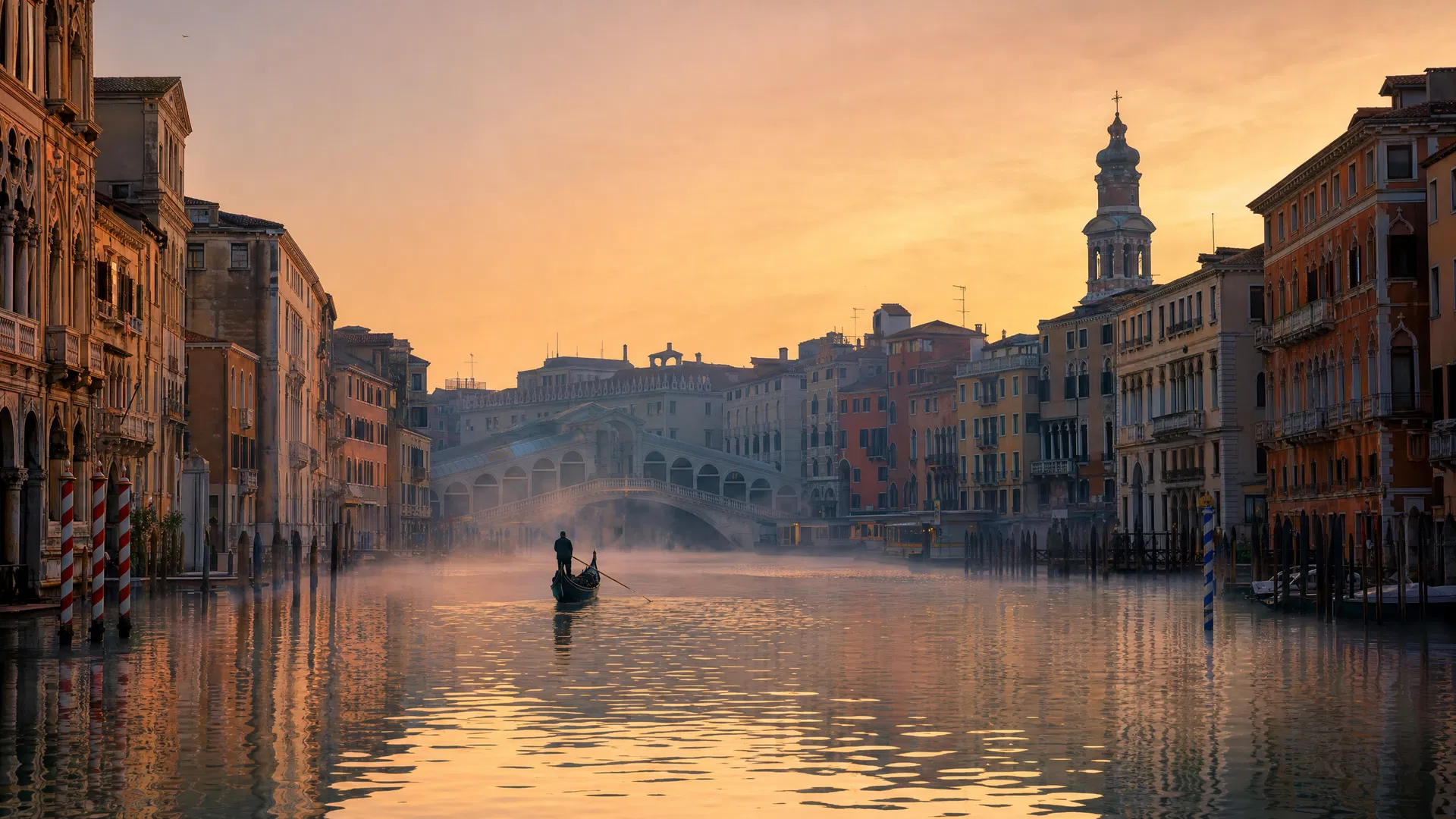
The Rialto Bridge, the oldest and most famous of the four bridges over the Grand Canal, was built in its current form in 1591 and was considered an engineering marvel at the time. The view from the bridge, looking down the canal in either direction, is one of the great urban views in the world. Go early in the morning, before the tourist crowds arrive, and you will have it largely to yourself.
Getting Lost: The Only Way to See Venice
The single most important piece of advice for visiting Venice is also the simplest: get lost. Deliberately, systematically, enthusiastically lost. Put your phone away. Ignore the yellow signs pointing toward San Marco and the Rialto. Walk away from the crowds and into the calli — the narrow alleyways that make up most of Venice's street network — and follow them wherever they go.
Venice is designed to be navigated by feel rather than by map. The city is divided into six sestieri (districts), each with its own character, and the best way to understand the difference between them is to walk through them without a destination. Dorsoduro, on the southern side of the Grand Canal, is the most residential and the most beautiful — its fondamenta (canal-side walkways) are where Venetians actually walk, where the bars are frequented by locals rather than tourists, where the light in the late afternoon is extraordinary. Cannaregio, in the north, contains the original Jewish Ghetto (the word "ghetto" is Venetian in origin, from the iron foundry that once occupied the site) and some of the most authentic neighborhood life in the city. Castello, in the east, is the largest sestiere and the least visited — it contains the Arsenale, the vast shipyard where Venice built the fleet that made it a naval superpower, and the Biennale gardens, where the world's most important contemporary art exhibition has been held since 1895.
The tourists are almost entirely concentrated in a small triangle between San Marco, the Rialto, and the Accademia. Everything outside that triangle is significantly less crowded and significantly more authentic. The further you walk from San Marco, the more Venice you will find.
Piazza San Marco: Go, But Go Prepared
You cannot skip Piazza San Marco. It is the civic heart of Venice, the place where the Republic of Venice displayed its power and its taste for over a thousand years, and it is genuinely extraordinary — the Basilica di San Marco, with its Byzantine mosaics and its five domes, is unlike any other church in Italy; the Campanile, rebuilt in 1912 after the original collapsed, offers the best views in the city; the Palazzo Ducale, the seat of Venetian government for centuries, contains some of the greatest paintings in the world in a building of extraordinary architectural ambition.
But go prepared. In peak season, the queue for the Basilica can be two hours long. Book online in advance — the skip-the-line tickets are worth every euro. Go early in the morning or late in the afternoon when the light is better and the crowds are thinner. And accept that the square itself will be crowded — it is one of the most visited public spaces on earth, and there is no version of visiting Venice that avoids it entirely.
What you can avoid is the trap of spending your entire Venice visit in the San Marco area. The tourists who do this — who arrive, photograph the Basilica, eat an overpriced meal at a café on the square, and leave — have not seen Venice. They have seen the stage set that Venice presents to the world. The real city is everywhere else.
Our Venice City Break guide structures four days in a way that gives San Marco its due while ensuring you spend the majority of your time in the parts of the city that most visitors never reach.
The Food: Eat Like a Venetian
Venetian food is one of the great regional cuisines of Italy, and it is almost entirely invisible to tourists who eat only in the restaurants around San Marco and the Rialto. Those restaurants serve a version of Italian food designed for people who will never come back — expensive, mediocre, and deeply unrepresentative of what Venice actually eats.
What Venice actually eats is cicchetti. These are small snacks — crostini with various toppings, small portions of baccalà mantecato (whipped salt cod), meatballs, fried vegetables, hard-boiled eggs with anchovies — served at bacari, the Venetian version of a wine bar. The cicchetti tradition is the Venetian equivalent of tapas, and it is one of the great eating experiences in Italy. You stand at the bar, you point at what looks good, you drink a small glass of wine (an ombra, traditionally), and you move on to the next bacaro. A full cicchetti crawl through Cannaregio or Dorsoduro is both dinner and entertainment.
The Rialto Market, on the San Polo side of the Rialto Bridge, is one of the great food markets in Italy. It opens at dawn and closes by early afternoon, and it sells the fish, vegetables, and produce that the city's restaurants and home cooks use. The fish section — the Pescheria — is particularly extraordinary, a daily display of Adriatic seafood that includes varieties you will not find anywhere else: moleche (soft-shell crabs, available only in spring and autumn), schie (tiny grey shrimp), moeche (another soft-shell crab, slightly different from moleche), and the lagoon fish that have been eaten in Venice for centuries.
Sarde in saor — sardines marinated with onions, pine nuts, and raisins in a sweet-sour preparation that dates to the medieval spice trade — is the dish that most purely expresses Venice's history as a crossroads of East and West. It is on the menu at every good bacaro and it is unlike anything you will eat anywhere else.
For a complete guide to eating and drinking in Venice — the best bacari, the Rialto Market, the restaurants worth the splurge, and the ones to avoid — our Venice Food & Wine guide is the most thorough resource we have built for any city.
The Islands: Beyond the Main City
The Venetian lagoon contains dozens of islands, and three of them are essential.
Murano is the island where Venetian glassblowers have worked since 1291, when the Republic ordered all the furnaces moved off the main island as a fire precaution. The glassblowing tradition here is extraordinary — the techniques developed in Murano over seven centuries are still in use, and watching a master glassblower work is genuinely mesmerizing. The island also has a glass museum that traces the history of Venetian glass from Roman times to the present. Avoid the tourist-trap showrooms near the vaporetto landing and walk further into the island to find the working studios and the shops that sell pieces made by the artisans themselves.
Burano is the lace-making island, famous for its brightly painted houses — each one a different color, a tradition that fishermen used to identify their homes when returning across the lagoon in fog. The colors are extraordinary: electric blue next to deep red next to acid yellow next to forest green. Burano is genuinely photogenic in a way that is almost unfair, and it is significantly less crowded than the main island. The lace tradition is dying — there are very few practitioners left who can do the real punto in aria (needle lace) — but the island itself is worth the 40-minute vaporetto ride for the colors alone.
Torcello is the oldest settlement in the lagoon, predating Venice itself, and it is now almost entirely abandoned — a ghost island with a magnificent Byzantine cathedral (the Basilica di Santa Maria Assunta, with mosaics that rival those of San Marco), a handful of houses, a restaurant, and almost no tourists. Ernest Hemingway stayed here while writing "Across the River and Into the Trees" and described the island as the most beautiful place he had ever been. The cathedral's Last Judgment mosaic, covering the entire west wall, is one of the great works of Byzantine art in Italy.
Our Venice Solo Traveler guide covers all three islands with specific timing and logistics for making the most of each.
Venice for Every Kind of Traveler
For couples, Venice is the most romantic city in the world — not because of the gondolas (which are expensive and slightly theatrical) but because of the city itself: the candlelit bacari, the quiet campi at night, the sound of water, the extraordinary beauty that is simply everywhere. A gondola ride on the smaller canals away from the Grand Canal, at dusk, is genuinely magical and worth doing once. Our Venice for Couples and Venice for Two: A 4-Day Romantic Escape guides are both built around this experience.
For families, Venice is more manageable than its reputation suggests. Children are captivated by the canals and the boats, the absence of cars is a genuine relief for parents, and the mythology and history of the city is accessible and engaging for older children. Our Venice Family Adventure guide approaches the city through the lens of adventure and discovery rather than art history.
For budget travelers, Venice has a reputation for being expensive that is partly deserved and partly a function of eating and drinking in the wrong places. The cicchetti tradition means you can eat extremely well for very little money if you know where to go. Our Venice on a Budget guide shows how to do the city properly for around €70 a day — including accommodation, food, transport, and entry fees.
When to Go
November through March is the best time to visit Venice, and almost no one does. The city is quiet, the light is extraordinary (the winter mist that settles over the lagoon is the light that Turner and Monet came to paint), the prices are significantly lower, and you will have the calli largely to yourself. Acqua alta — the high water flooding that periodically inundates the lower parts of the city — is most common in this period, but it is manageable with waterproof boots and the flood boards that the city deploys on the main routes. Experiencing acqua alta is, in its strange way, one of the most authentically Venetian things you can do.
April and May are the second-best option. The weather is mild, the crowds have not yet reached peak summer levels, and the city is at its most beautiful — the light is extraordinary, the flowers are out in the campi, and the Venetians are in a good mood before the summer tourist onslaught begins.
June through August is the most crowded and most expensive period. The heat and humidity can be oppressive, the crowds at San Marco are genuinely overwhelming, and the city smells of canal in a way that is less romantic than it sounds. If you must go in summer, arrive very early and leave the main tourist areas by 10am.
September and October are the shoulder season — still warm, still beautiful, with the crowds beginning to thin after the August peak.
The Practical Reality
Venice is served by Marco Polo Airport, 12 kilometers from the city. The Alilaguna water bus takes about 75 minutes to reach San Marco and costs €15. Private water taxis are fast (30 minutes) and expensive (€120+). The Venezia Unica transport card covers vaporetto travel and is worth buying for any stay longer than two days.
There are no cars in Venice. You will walk everywhere, and you will walk more than you expect — the city is larger than it looks on a map, and the narrow calli mean that direct routes are rarely possible. Comfortable shoes are not optional. The cobblestones and bridge steps are hard on feet and ankles.
Book accommodation in advance. Venice has relatively few hotels for its level of tourist traffic, and the good ones fill up quickly. Stay in Dorsoduro, Cannaregio, or Castello rather than San Marco — you will pay less, sleep better, and be closer to the real city.
The day-tripper entrance fee introduced in 2024 (€5 on peak days) applies to visitors arriving without overnight accommodation. If you are staying in the city, you are exempt. The fee is a genuine attempt to manage the crowds, and it is worth supporting.
What Venice Teaches You
Every great city teaches you something. Venice teaches you about impermanence. It teaches you that the most extraordinary things humans build are also the most fragile, that beauty and precariousness are not opposites but companions, that a city can be simultaneously dying and magnificent.
Venice has been "dying" for centuries. The population has been declining since the 18th century. The floods have been getting worse since the 1960s. The tourists have been overwhelming the city since the 1980s. And yet Venice persists. The Venetians who remain are not victims — they are people who have chosen, against considerable economic pressure, to live in one of the most beautiful and most impractical cities on earth because they love it and because they understand that their presence is the only thing standing between Venice as a living city and Venice as a theme park.
Go to Venice. Go in the off-season if you can. Stay for at least three nights — the city reveals itself slowly, and the day-trippers who arrive on the morning train and leave on the evening train have not seen it. Eat cicchetti at bacari in Cannaregio. Walk to Torcello. Watch the light on the lagoon at dawn. Spend money at the restaurants and shops run by Venetians rather than the chains.
Do all of this, and Venice will give you something that no other city can: the experience of a place that is simultaneously the most beautiful thing humans have ever built and the most honest reminder of how fragile all beautiful things are.
That combination — beauty and fragility, magnificence and impermanence — is what makes Venice unlike anywhere else on earth. It is what makes it worth every complicated, crowded, expensive, extraordinary moment.
Ready to plan your Venice trip the right way? Let Leif build your personalized Venice itinerary — whether you have 3 days or a week, whether you are traveling as a couple, with family, or solo. Start planning your Venice adventure →