Tuscany Doesn't Seduce You Slowly. It Hits You All at Once.
Destination: Tuscany, Italy
Category: Destination Guides
Tuscany Doesn't Seduce You Slowly. It Hits You All at Once.
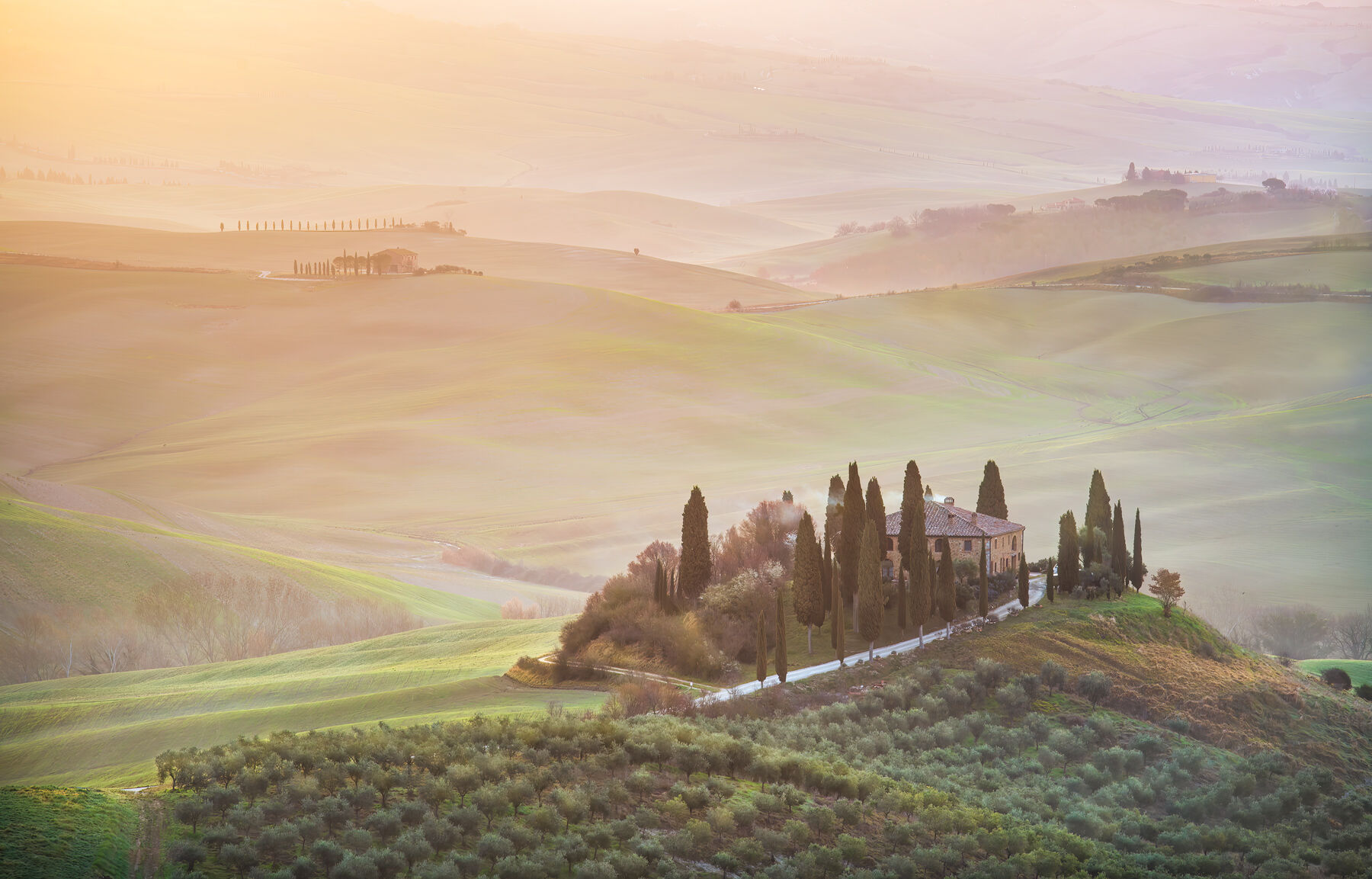
You're standing on a gravel road somewhere between Montalcino and Pienza. The cypress trees line the ridge like sentinels. The light is doing something impossible — gold and amber and the particular shade of orange that only exists in the hour before a Tuscan sunset. Below you, the Val d'Orcia rolls out in waves of wheat and sunflower and vine, and you realize that every painting you've ever seen of the Italian countryside was painted here, or was trying to be. You haven't even opened a bottle of wine yet.
This is Tuscany's opening move. It doesn't ease you in. It doesn't let you acclimate. It simply presents itself — the hills, the light, the smell of wild rosemary and warm stone — and waits for you to catch up. Most people never fully do. They spend a week here and leave with the distinct feeling that they've only scratched the surface of something ancient and vast and deeply, stubbornly alive.
That feeling is correct. Tuscany has been accumulating layers for three thousand years. The Etruscans built their cities on these hilltops before Rome existed. The Medici turned Florence into the intellectual and artistic capital of the known world. Dante wrote the Commedia here. Leonardo sketched his flying machines here. Michelangelo was born in a village in the Casentino valley and spent his early years absorbing a landscape that would show up in the backgrounds of his paintings for the rest of his life. The Renaissance didn't happen in a vacuum — it happened here, in this specific light, in this specific air, among people who had been making wine and olive oil and art for so long that beauty had become a kind of muscle memory.
What follows is not a list of things to do in Tuscany. It is an argument for why Tuscany is the most complete travel destination on earth — and a guide to experiencing it the way it deserves to be experienced.
Florence: The City That Invented the Modern World
Every trip to Tuscany passes through Florence, and every first-time visitor makes the same mistake: they try to see everything. The Uffizi, the Accademia, the Duomo, the Baptistery, the Palazzo Vecchio, the Boboli Gardens, the Ponte Vecchio — all in three days. They emerge exhausted and slightly numb, having technically seen Botticelli's Birth of Venus and Michelangelo's David but having absorbed neither.
The better approach is to choose less and see more. Spend an entire morning in the Uffizi and look at nothing but the Botticelli rooms. Stand in front of Primavera for twenty minutes. Let the allegory work on you. Notice the way the flowers in Flora's dress are botanically accurate — over five hundred species identified by scholars — and ask yourself what kind of mind paints that. Then go get lunch. Come back tomorrow for the rest.
The David deserves the same treatment. The Accademia is a relatively small museum built around a single work, and that work is so much larger than any photograph has ever suggested. He is seventeen feet tall. The veins in his hands are visible. The tension in his jaw is the tension of a young man who has just decided to fight a giant and is not entirely sure he will win. Michelangelo carved him from a single block of Carrara marble that had been rejected by two previous sculptors. He was twenty-six years old when he started. He was twenty-nine when he finished. Stand in front of him and feel the weight of that.
Florence's neighborhoods reward wandering in ways that the museums do not. The Oltrarno — the south bank of the Arno — is where the artisans still work: leather craftsmen, bookbinders, goldsmiths, picture framers. The Piazza Santo Spirito fills with locals every evening in a way that the tourist-heavy Piazza della Repubblica never does. The San Frediano neighborhood has the best aperitivo bars in the city and almost no English menus. Get lost there. Order whatever the person next to you is having.
The Duomo is best seen from the outside first, then from the top. Brunelleschi's dome — completed in 1436 without scaffolding, using a technique he invented and refused to explain to anyone — is one of the great engineering achievements in human history. The climb to the top is 463 steps and worth every one of them. The view from the lantern takes in the entire city and the hills beyond, and you understand for the first time why the Florentines built this thing: not just as a church, but as a declaration that this city was the center of the world.
The Hill Towns: Where Tuscany Keeps Its Secrets
Florence is the introduction. The hill towns are the story.
Siena is Florence's great rival — and in many ways, its superior. The Piazza del Campo is the most beautiful public square in Italy, a scallop-shaped expanse of medieval brick that slopes gently toward the Palazzo Pubblico. Twice a year, the Palio di Siena turns it into a racetrack: ten horses, ten contrade (city districts), three laps, and a chaos of silk flags and screaming crowds that has been happening since the Middle Ages. If you can time your visit for the Palio (July 2 or August 16), do. If you can't, the square is extraordinary on any evening in any season. Sit at a café on the perimeter, order a Campari soda, and watch the light change on the brick.
Siena's Duomo is arguably more beautiful than Florence's — a striped marble cathedral with an inlaid marble floor so intricate it's covered with wooden boards for most of the year to protect it. The Piccolomini Library inside contains a series of frescoes by Pinturicchio that are among the most vivid and joyful paintings of the Renaissance, and almost no one talks about them.
San Gimignano is the town of towers — fourteen medieval skyscrapers built by rival families in the 13th century as displays of wealth and power, the same impulse that builds glass towers in Manhattan today. The town is undeniably touristy, but it earns its crowds. Walk the walls at dusk when the day-trippers have left. The gelateria Dondoli on the main square has won the World Gelato Championship multiple times. The saffron-infused crema di Santa Fina is the flavor you will think about for years.
Montepulciano sits at 2,000 feet above sea level and produces Vino Nobile, one of Italy's great red wines — made from Sangiovese grapes grown in volcanic soil, aged for at least two years in oak. The town itself is a single long street climbing to a Renaissance piazza at the top, lined with wine cellars carved directly into the tufa rock. Most of them offer free tastings. The view from the piazza takes in the Val d'Orcia in one direction and the Val di Chiana in the other. Drink the wine. Look at the view. Repeat.
Montalcino is smaller and quieter than Montepulciano, and its wine — Brunello di Montalcino — is more serious. Brunello is one of the world's great wines: a minimum of five years aging, a flavor profile of dried cherry and leather and iron and something that tastes like the specific mineral composition of the soil it grew in. The Fortezza at the top of town has a wine bar where you can taste Brunello by the glass for a few euros. This is not a thing that should be legal.
Pienza was built in the 15th century by Pope Pius II as a model Renaissance city — a single man's vision of what a perfect town should look like, executed in a decade. It is tiny (three main streets) and almost absurdly beautiful. It is also the home of Pecorino di Pienza, a sheep's milk cheese aged in walnut leaves or clay that is one of the great cheeses of the world. Buy some at the market. Eat it with honey and a glass of Rosso di Montalcino on a bench in the main piazza. This is the Tuscan experience distilled to its essence.
The Food: Why Tuscany Invented the Concept of Eating Well
Tuscan cuisine is built on a philosophy so simple it sounds like a joke: start with the best possible ingredients and do as little as possible to them. The olive oil is cold-pressed and green and peppery and tastes like nothing you've had before. The bread is unsalted — pane sciocco — which sounds like a flaw until you eat it with a slice of lardo di Colonnata (cured fatback aged in marble basins in the Apuan Alps) and understand that the bread is a vehicle, not a statement. The bistecca alla Fiorentina is a T-bone from a Chianina cow, two inches thick, grilled over wood coals to rare, seasoned with nothing but salt and olive oil and a squeeze of lemon. It weighs between two and four pounds. It is ordered by weight. It is one of the greatest things you will ever eat.
The ribollita — a bread soup made from leftover minestrone, thickened with stale bread and black kale and cannellini beans — is peasant food that has been elevated to an art form. The pappardelle al cinghiale (wide pasta with wild boar ragù) is the taste of the Maremma hills. The pici all'aglione — thick hand-rolled spaghetti with a tomato and garlic sauce — is the taste of the Val d'Orcia. Every valley has its pasta. Every town has its version of the same dish. The differences are subtle and the arguments about them are passionate and this is exactly as it should be.
The wine culture is inseparable from the food culture. Chianti Classico — the real one, from the zone between Florence and Siena, with the black rooster on the label — is a wine designed to be drunk with food. It is acidic and tannic and earthy and it makes everything taste better. The Super Tuscans (Sassicaia, Ornellaia, Tignanello) broke the rules of the DOC system in the 1970s by blending Cabernet Sauvignon with Sangiovese and produced wines that are now among the most expensive in the world. The Vernaccia di San Gimignano is the white wine of the region — crisp and mineral and perfect with the local pecorino.
The mercato centrale in Florence (the ground floor, not the tourist food court upstairs) is where the city shops. The tripe sandwich from the lampredotto cart outside is the most Florentine thing you can eat. Lampredotto is the fourth stomach of the cow, slow-cooked in broth, served in a bread roll soaked in the cooking liquid with salsa verde and hot sauce. It costs three euros. It tastes like Florence.
The Countryside: Val d'Orcia, Chianti, and the Maremma
The Val d'Orcia is a UNESCO World Heritage landscape — not for a building or a monument, but for the landscape itself. The rolling hills, the isolated farmhouses (poderi), the cypress-lined roads, the white gravel strade bianche — this is the countryside that Renaissance painters used as their backgrounds, and it looks exactly the same today as it did in the 15th century. Drive it in September when the light is amber and the harvest is beginning. Drive it in April when the wheat is green and the poppies are red. Drive it in January when the fog sits in the valleys and the hilltops float above it like islands. It is beautiful in every season and heartbreaking in all of them.
The Chianti region between Florence and Siena is a different landscape — denser, more wooded, with vineyards carved into the hillsides and medieval villages hidden at the ends of long gravel roads. The Castello di Brolio, seat of the Ricasoli family since the 11th century, is where Baron Bettino Ricasoli invented the modern Chianti blend in the 1870s. The castle is open for tours and tastings. The wine is excellent. The view from the ramparts takes in the entire Chianti valley.
The Maremma — the coastal strip of southern Tuscany — is the least visited and most underrated part of the region. The Parco Regionale della Maremma protects a stretch of coast and wetland that feels genuinely wild: wild boar and deer and white Maremma cattle roaming the scrubland, Etruscan ruins half-buried in the hills, fishing villages where the catch comes in every morning and goes directly to the restaurant next door. Pitigliano, built on a tufa cliff above a ravine, looks like it was carved from the rock itself — because it was. The Jewish ghetto here, established in the 16th century, is one of the best-preserved in Italy.
Lucca: The City That Kept Its Walls and Its Soul
Lucca is the Tuscan city that most visitors skip, and most visitors are wrong. Forty-five minutes west of Florence by train, it sits inside a ring of Renaissance walls so wide and well-preserved that the locals use the top of them as a public park — cycling and jogging and pushing strollers along a promenade of plane trees two kilometers in circumference, with the city's medieval towers and church spires visible on one side and the Apuan Alps on the other.
The city inside the walls is a labyrinth of narrow streets and hidden piazzas and Romanesque churches with striped marble facades. The Piazza dell'Anfiteatro is built on the footprint of a Roman amphitheater — the oval shape of the arena preserved in the oval ring of medieval buildings that replaced it, the arches of the original structure still visible in the lower floors of the surrounding houses. It is one of the most remarkable urban spaces in Italy, and almost no one outside Tuscany knows it exists.
Lucca is the birthplace of Giacomo Puccini, and the city takes this seriously. His house is a museum. His piano is there. The score of La Bohème is in a glass case. Every summer, the Lucca Summer Festival brings major international acts to the Piazza Napoleone — in recent years, Bob Dylan, the Rolling Stones, and Ed Sheeran have all played here, in a medieval square, surrounded by Renaissance palaces. The combination is absurd and perfect.
The food in Lucca is different from the rest of Tuscany — the city has its own culinary traditions, including tordelli lucchesi (large ravioli stuffed with meat and herbs, served with a meat ragù) and buccellato (a sweet bread studded with raisins and anise). The olive oil from the Lucchesia hills is considered by many producers to be the finest in Tuscany — lighter and more delicate than the peppery Florentine oils, with a flavor that tastes like fresh-cut grass and almonds.
The Etruscan Layer: What Was Here Before Rome
Tuscany's history is usually told as a story that begins with the Romans and accelerates through the Renaissance. This is a truncation. The Etruscans were here first — a civilization that flourished in central Italy from roughly the 9th century BC until their absorption into the Roman Republic in the 3rd century BC, and whose influence on Roman culture (the arch, the toga, the gladiatorial games, the practice of reading omens in animal entrails) was so profound that Rome essentially became Etruscan with better marketing.
The Etruscan heartland was in what is now Tuscany and northern Lazio, and the traces of their civilization are everywhere once you know how to look. Volterra, a hilltop town in the Metalliferous Hills west of Siena, has an Etruscan museum with one of the finest collections of alabaster funerary urns in the world — hundreds of carved stone boxes depicting scenes from Etruscan mythology and daily life, made by craftsmen who had never heard of Greece or Rome and were working in a tradition entirely their own. The alabaster workshops in Volterra still operate today, using the same stone from the same quarries.
Populonia, on the Etruscan coast near Piombino, is the only Etruscan city built directly on the sea. The necropolis outside the town contains burial mounds the size of small hills, some of them still intact, their corbelled stone chambers accessible by crawling through a low entrance passage into a circular room where the dead were laid with their jewelry and their wine vessels and their mirrors. The silence inside is absolute. The air smells of stone and time.
The Etruscans give Tuscany a depth that the Renaissance alone cannot provide. When you stand on a hilltop in the Val d'Orcia and look at the landscape, you are looking at a landscape that has been farmed and inhabited and fought over for three thousand years. The terraces on the hillsides were cut by Etruscan farmers. The roads follow Etruscan paths. The hill towns sit on Etruscan foundations. The Renaissance is the most recent layer of something very old.
When to Go and How to Move
Tuscany in high summer (July-August) is hot, crowded, and expensive. The shoulder seasons — April through June and September through October — are when the region is at its best. The light in September is extraordinary. The harvest (vendemmia) begins in late September and runs through October, and the wineries are open and busy and generous with their pours.
Renting a car is not optional — it is mandatory. The hill towns are not connected by meaningful public transport, and the countryside is inaccessible without wheels. The strade bianche (white gravel roads) are drivable in a standard car; you don't need a 4x4. Get a small car, learn to reverse into narrow medieval gateways, and accept that you will get lost. Getting lost in Tuscany is not a problem. It is the point.
The agriturismo system — farmhouses that rent rooms and serve meals — is the best accommodation option in the countryside. You wake up to roosters and olive trees and a breakfast of local honey and fresh bread and the farmer's own olive oil. You eat dinner at a long table with other guests and the family. You drink the wine made from the grapes you can see from your window. This is not a metaphor for something. This is the thing itself.
Plan Your Tuscany Trip with Ask Leif
Three guides in the Ask Leif library are built specifically for Tuscany, each approaching the region from a different angle and pace.
The 4-Day Romantic Tuscany Itinerary for Couples is the most focused of the three — four days that move from Florence to Siena to the Val d'Orcia, with wine tastings, a truffle hunt, and a sunset dinner in Pienza built into the schedule. It's designed for couples who want the essential Tuscany without the overwhelm.
For those who want to go deeper, the 7 Days of Romance: Tuscany Wine, Renaissance Art & Hilltop Towns for Couples adds the Chianti wine road, a day in Lucca, and the Cinque Terre as a day trip from the coast. Seven days is the right amount of time to feel like you've actually lived in Tuscany for a week rather than just passed through it.
Families traveling with children will find the 7-Day Tuscany Family Adventure invaluable — it accounts for the reality that children have limited patience for the Uffizi but unlimited enthusiasm for gelato, horseback riding in the Maremma, and the medieval games at the Palio. The guide builds in the right balance of culture and movement to keep everyone engaged.
Use any of these guides as a starting point, then let Ask Leif personalize the itinerary to your exact dates, budget, travel style, and the specific hill towns you want to prioritize. The region is large enough that no two Tuscany trips need to look the same.
The Thing Nobody Tells You About Tuscany
You will plan to see Tuscany. You will arrive, and Tuscany will see you instead. It will find the part of you that has been moving too fast and eating too quickly and looking at your phone instead of the light, and it will slow that part down. Not gently. Not gradually. All at once, the way it does everything.
The Italians have a phrase — il dolce far niente — that translates literally as "the sweetness of doing nothing." It sounds like laziness. It is not laziness. It is the recognition that the quality of a moment is not determined by how much you accomplish in it. Sitting in a piazza with a glass of Brunello watching the light change on a medieval tower is not doing nothing. It is doing the most important thing. It is paying attention.
Tuscany has been teaching this lesson for three thousand years. Most of its students leave before they learn it. The ones who stay — who rent the farmhouse for two weeks instead of five days, who drive the strade bianche without a destination, who eat the lampredotto and drink the Vernaccia and sit in the piazza until the stars come out — those people come home changed.
Not because Tuscany is a place that changes you. Because it is a place that reminds you of who you already were.
Come ready to be reminded.