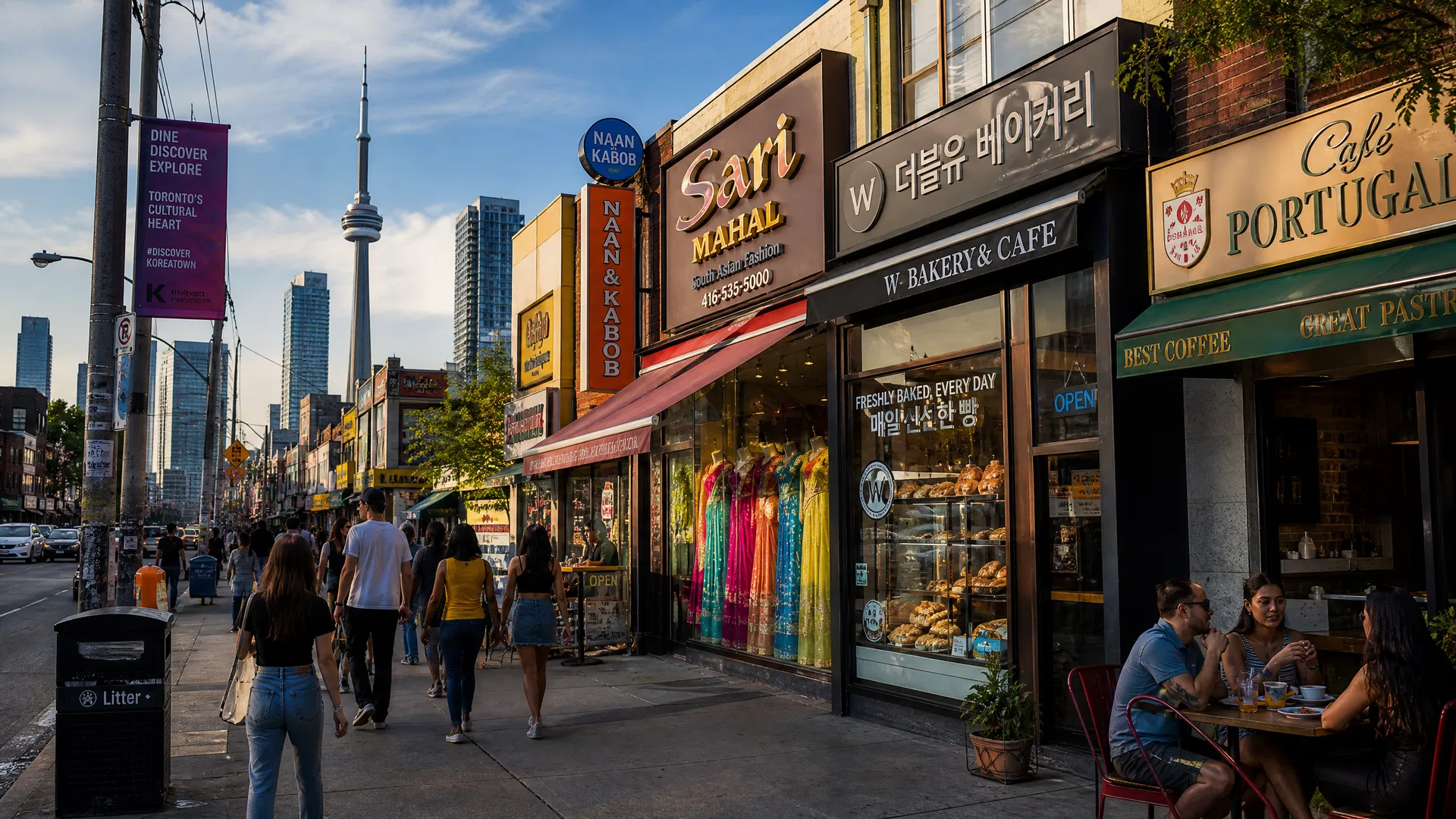
Every Other City Talks About Diversity. Toronto Is Built From It.
Destination: Toronto, Canada
Category: Destination Guide
The City That Most Visitors Miss
The Toronto that locals actually inhabit exists in a band of neighborhoods running roughly east-west along Bloor Street and Queen Street, and then spreading outward into the inner suburbs in ways that no tourist map adequately captures. It is a city of main streets — Bloor, Queen, Dundas, College, Roncesvalles, Ossington, Gerrard — each of which has its own character, its own food culture, its own reason to exist.
Understanding this geography is the first thing a visitor needs to do, and it is the thing that almost no travel guide explains. Toronto is not a city you can navigate by landmark. The CN Tower is visible from almost everywhere, but it tells you nothing about where you are or what is worth seeing nearby. The city's real landmarks are intersections: Bloor and Spadina (the edge of Koreatown and Chinatown), Queen and Ossington (the bar and restaurant corridor that locals actually use), Gerrard and Coxwell (the entrance to India Bazaar), Roncesvalles and Howard Park (the heart of the Polish neighborhood). These are the coordinates that matter.
The second thing to understand is that Toronto rewards walking in a way that most North American cities do not. The neighborhoods are dense, the streets are safe at almost any hour, and the distances between interesting places are shorter than they appear on a map. Kensington Market to Koreatown is a twenty-minute walk. Koreatown to the Annex is ten minutes. The Annex to Bloor-Yorkville — the expensive, slightly soulless shopping district that every guide mentions and locals avoid — is five minutes, but you don't need to go there.
Kensington Market: The City's Living Room
Kensington Market is the neighborhood that comes closest to capturing Toronto's essential character in a single block. It is chaotic, slightly run-down, smells of spices and coffee and occasionally something less identifiable, and it is one of the most genuinely interesting places in North America to spend a morning.
The market occupies a small grid of streets west of Spadina and south of College, and it has been a landing point for successive waves of immigration since the early twentieth century. Jewish immigrants came first, then Portuguese, then Caribbean, then a wave of counterculture in the 1960s and 1970s that gave the neighborhood its current character: vintage clothing stores, independent cheese shops, Jamaican patty stands, a Mexican taqueria that has been operating out of a converted house for years, and a coffee roaster that has been in the same spot since before specialty coffee was a concept.
On the last Sunday of the month from May through October, the neighborhood closes its streets to cars for Pedestrian Sunday — a monthly street festival that is simultaneously a neighborhood block party and one of the best free events in the city. Musicians set up on corners, vendors spill onto the street, and the neighborhood's resident cats observe the proceedings from windowsills. It is the kind of event that makes you understand why people choose to live in cities.
The specific address worth knowing: Jumbo Empanadas at 245 Augusta Avenue has been serving Argentine empanadas from a tiny storefront for decades. The line moves fast. Order the beef and the spinach-and-cheese. Eat them standing on the sidewalk.
Gerrard India Bazaar: Fifty Years of South Asian Toronto
Gerrard Street East between Coxwell and Greenwood is one of the oldest and most concentrated South Asian commercial strips in North America, and it is almost entirely absent from mainstream Toronto travel writing. This is a failure of imagination on the part of travel writers, because Gerrard India Bazaar is one of the most vivid and specific places in the city.
The strip has been operating since the 1970s, when South Asian immigrants — primarily from India, Pakistan, and Sri Lanka — established businesses along this stretch of Gerrard. What has remained is a dense concentration of sari shops, spice merchants, sweet shops selling mithai and barfi, and restaurants that have no interest in adapting their menus for non-South Asian palates.
Udupi Palace is the anchor. It is a 100% vegetarian South Indian restaurant that has been on Gerrard for decades, and it serves the kind of masala dosa — a thin, crisp rice crepe filled with spiced potato and served with sambar and coconut chutney — that you would struggle to find better outside of Tamil Nadu. The chat papdi is equally good: crisp wafers topped with chickpeas, yogurt, tamarind chutney, and a quantity of fresh cilantro that makes the dish taste like it was assembled thirty seconds ago. Order sugarcane juice from one of the vendors nearby. Drink it while walking the strip.
The neighborhood is busiest on weekends, when families from across the Greater Toronto Area come to shop for groceries, buy saris, and eat. The energy is entirely domestic — this is a neighborhood that exists for the people who live in it, not for visitors — and that is precisely what makes it worth visiting.
Koreatown: Bloor Street's Best Mile
The stretch of Bloor Street West between Bathurst and Christie is Toronto's Koreatown, and it operates with the kind of concentrated intensity that only comes from a community that has been building something in the same place for decades. Korean restaurants, karaoke bars, Korean grocery stores, and Korean bakeries occupy almost every storefront, and the neighborhood runs at full speed from noon until well past midnight.
The specific address that no travel guide misses but every visitor should understand: Hodo Kwaja at 656 Bloor Street West is a Korean bakery that makes walnut cakes — small, walnut-shaped pastries filled with red bean paste or other sweet fillings, pressed fresh in a cast-iron mold while you watch. They cost almost nothing, they are warm, and they are the kind of food that makes you understand why people develop strong opinions about specific bakeries. The line moves quickly. Buy a bag and eat them walking west toward Christie station.
For a proper meal, Buk Chang Dong Soon Tofu at 691 Bloor Street West serves Korean soft tofu stew — soondubu jjigae — in stone pots that arrive at the table still bubbling. The version with seafood and kimchi is the one to order. It is the kind of dish that makes cold weather feel like a reasonable trade-off for living in Toronto.
The neighborhood also contains Sonndr Café, housed in a converted church building on Bloor. The architecture alone is worth the detour — vaulted ceilings, stained glass, the particular quality of light that old ecclesiastical buildings produce — and the coffee is excellent.
St. Lawrence Market: The Saturday Ritual
St. Lawrence Market on a Saturday morning is one of the great urban food experiences in North America, and it is the one Toronto institution that deserves every superlative it receives. The market has been operating on Front Street East since 1803, making it one of the oldest continuously operating markets on the continent, and the Saturday farmers' market in the north building is the version that locals actually use.
The specific thing to eat: a peameal bacon sandwich from Carousel Bakery on the main floor of the south building. Peameal bacon is a Toronto invention — back bacon rolled in cornmeal, giving it a slightly sweet, slightly crisp exterior — and the version at Carousel Bakery, served on a kaiser roll with mustard, is the definitive version. It costs a few dollars. It is the Toronto sandwich in the same way that the cheesesteak is the Philadelphia sandwich or the lobster roll is the Maine sandwich.
The market is also the best place in the city to buy cheese, charcuterie, fresh pasta, and produce. The vendors are not performing for tourists. They are selling to the people who have been buying from them for years, which means the quality is consistently high and the prices are reasonable by Toronto standards.
After the market, walk east along Front Street to the Distillery District — a collection of Victorian industrial buildings that have been converted into galleries, restaurants, and shops. The architecture is genuinely beautiful, the cobblestone streets are well-maintained, and the district is worth an hour of wandering even if you don't buy anything. It is also the best place in the city to find a coffee and sit outside on a warm morning.
Maha's: The Brunch Worth the Wait
At 226 Greenwood Avenue in Leslieville, there is a small Egyptian brunch restaurant called Maha's that has been generating two-hour weekend lineups for years. The restaurant is run by an Egyptian-Canadian family, seats perhaps forty people, and serves a menu of Egyptian breakfast dishes that most visitors to Toronto have never encountered: ful medames (slow-cooked fava beans with olive oil, lemon, and cumin), shakshuka (eggs poached in spiced tomato sauce), and a dish of eggs wrapped in falafel that is simultaneously the most unusual and most logical breakfast item you will encounter in this city.
The wait is real. On a Saturday morning, arriving before 9am is advisable. The restaurant is open daily except Wednesdays, from 8am to 4:30pm. The coffee is strong, the service is warm, and the food is the kind that makes you reconsider your assumptions about what breakfast can be.
Maha's is in Leslieville, which is itself worth knowing about. The neighborhood runs along Queen Street East from roughly Carlaw to Coxwell, and it has the character of a neighborhood that gentrified slowly and thoughtfully — independent bookstores, small restaurants, vintage shops, a hardware store that has been in the same family for three generations. It is the kind of neighborhood that makes you understand why people choose Toronto over other North American cities.
Ossington: Where Toronto Goes Out
The stretch of Ossington Avenue between Dundas and Queen is Toronto's most concentrated bar and restaurant corridor, and it operates at a register that is distinctly different from the King Street West club district that most tourist guides recommend. Ossington is where people who live in Toronto actually go out — not to be seen, but to eat well and drink in places that have been designed with some care.
The specific addresses worth knowing: Hanmoto is a Japanese-influenced bar that serves excellent yakitori and has a sake list that rewards attention. ODDSEOUL is a Korean-Canadian fusion restaurant that has been doing interesting things with Korean flavors and North American ingredients for years. Mahjong Bar is a cocktail bar with a Hong Kong aesthetic and drinks that are genuinely creative rather than merely expensive.
The neighborhood is also home to some of Toronto's best independent restaurants — places that don't appear in international travel guides because they don't seek that kind of attention, but that locals return to weekly. Walking Ossington on a Friday evening, when the restaurants are full and the bars are beginning to fill, is one of the better ways to understand what Toronto actually is.
Roncesvalles: The Polish Village
Roncesvalles Avenue, running south from Bloor to Queen, is the heart of Toronto's Polish community and one of the city's most pleasant streets to walk. The neighborhood has the character of a European village transplanted to the Canadian lakefront — wide sidewalks, independent shops, bakeries that have been in the same family for decades, and a pace of life that feels deliberately unhurried.
The Polish bakeries are the reason to come. Café Polonez and the other bakeries along Roncesvalles sell pierogi, beet soup, poppy seed rolls, and the kind of dense, slightly sour rye bread that you cannot find in most North American cities. The neighborhood is also home to a significant number of excellent independent restaurants — not all Polish — and a stretch of Queen Street West just to the south that has some of the best vintage clothing stores in the city.
Roncesvalles is adjacent to High Park, Toronto's largest public park at 400 acres. The park contains a small zoo, a swimming pool, a restaurant, and — in late April and early May — the most spectacular cherry blossom display in North America outside of Washington, D.C. The sakura trees were a gift from Japan in the 1950s, and during peak bloom, the park fills with people in a way that feels genuinely celebratory rather than merely crowded.
The Toronto Islands: The City from the Water
The Toronto Islands are a chain of small islands in Lake Ontario, accessible by a fifteen-minute ferry from the foot of Bay Street, and they offer the single best view of the Toronto skyline available anywhere. The view from the islands — the CN Tower and the glass towers of downtown rising above the lake, the city reflected in the water on calm mornings — is the image of Toronto that visitors carry home, and it is worth the ferry ride for that alone.
The islands are more than a viewpoint. Ward's Island, the easternmost of the chain, has a small residential community — the only inhabited island community in the Great Lakes — and a beach that feels like a small-town lakeside community rather than a city park. The residents have lived here for generations, in small cottages with gardens that spill onto the paths between them. Walking through Ward's Island on a summer afternoon is one of the stranger and more pleasant experiences Toronto offers.
Centre Island has an amusement park, a beach, bike rentals, and a restaurant. It is the family destination. Hanlan's Point, at the western end, has a clothing-optional beach and a quieter character. The ferry tickets should be purchased online in advance to avoid the lines at the dock, particularly on summer weekends.
Scarborough: The City's Other Half
Scarborough, the eastern borough of Toronto that was amalgamated into the city in 1998, is the part of Toronto that most visitors never see and most travel guides never mention. This is a significant omission, because Scarborough contains some of the most interesting food in the city and one of its most dramatic natural features.
The Scarborough Bluffs are a series of white clay cliffs rising up to ninety meters above Lake Ontario, stretching for fifteen kilometers along the eastern lakeshore. They are genuinely dramatic — the kind of landscape feature that makes you reconsider your mental map of what Toronto looks like — and almost entirely unknown to visitors. Bluffer's Park, at the base of the bluffs, has a marina, a beach, and a restaurant. The view from the top of the bluffs, looking out over Lake Ontario, is one of the best in the city.
Scarborough also contains the largest Tamil community outside of Sri Lanka and India, concentrated along Ellesmere Road and Kingston Road in the northeast of the borough. The Tamil restaurants here — serving dosas, idlis, kothu roti, and the kind of coconut-based curries that are difficult to find elsewhere in North America — are among the best in the city. Taste of Madurai is the specific address worth knowing: authentic South Indian Tamil cuisine in a setting that makes no concessions to non-Tamil expectations, which is exactly the point.
When to Go: The Honest Seasonal Guide
Toronto has four distinct seasons, and each has a legitimate claim on the visitor's attention.
Summer (June–August) is when the city is most alive. The Toronto Islands are packed, the patios are full, the festivals are continuous — Pride in June, Caribana in August, the Toronto International Film Festival in September — and the weather is genuinely warm, occasionally hot. This is also when the city is most crowded and most expensive.
Fall (September–November) is the local's season. The summer crowds thin, the light turns golden, the trees in High Park and along the ravines go red and orange, and the city settles into a rhythm that feels more like itself. The TIFF crowds in September bring a particular energy to the downtown core, but by October the city has returned to its working character. Fall is the best time to eat in Toronto — the restaurant scene is at its most active, the farmers' market at St. Lawrence is at peak produce, and the weather is cool enough to walk all day without discomfort.
Winter (December–March) is cold, sometimes brutally so, and Toronto's response to this is the PATH — a thirty-kilometer underground pedestrian network connecting more than seventy buildings in the downtown core. The PATH is the world's largest underground shopping complex, and it allows Torontonians to commute, shop, eat, and move through the financial district without ever going outside. It is a remarkable piece of urban infrastructure, and navigating it is a genuinely interesting experience even if you have no particular destination in mind.
Spring (April–May) brings the cherry blossoms to High Park and a collective exhale from the city's population. The sakura season typically peaks in late April, and the park fills with people in a way that is worth experiencing even if crowds are not usually your preference.
The Practical Details That Matter
Getting around: Toronto's transit system — the TTC — is functional but not fast. The subway has four lines and covers the major corridors, but the city is large enough that many neighborhoods require a streetcar or bus connection. The Presto card (available at all subway stations) is the most efficient way to pay. For neighborhoods like Kensington Market, Koreatown, and Ossington, walking is faster than transit. The city also has an extensive bike-share network (Bike Share Toronto) that is the best way to cover medium distances quickly.
Where to stay: The downtown core (near Union Station and King Street) is convenient but expensive and lacks neighborhood character. Better options for visitors who want to experience the city as locals do: the Annex (near Bloor and Spadina, walking distance to Koreatown and Kensington), Leslieville (Queen Street East, close to Maha's and the Beaches), or Roncesvalles (High Park adjacent, excellent restaurants). Mid-range hotels in these neighborhoods run $150–250 CAD per night; Airbnb options are generally better value.
Currency: Canadian dollars. The exchange rate from USD is favorable for American visitors — roughly $1 USD to $1.35 CAD at current rates, meaning Toronto is meaningfully cheaper than comparable American cities for most visitors.
The weather reality: Toronto winters are cold. If you are visiting between November and March, pack accordingly. The wind off Lake Ontario adds a chill factor that the temperature alone doesn't capture. The city functions normally in winter — people walk, bike, and go out — but it requires preparation.
Tipping: Standard in Toronto is 18–20% at restaurants. The service industry here operates on tipped wages, and the expectation is clear.
Plan Your Toronto Trip with Leif
Toronto's neighborhoods are best experienced with a plan that reflects what you actually want from the city — whether that's three days of serious eating, a family trip that balances the Islands with High Park and the ROM, or a couples weekend that moves between Ossington's bars and Leslieville's brunch spots. Leif builds that itinerary for you, specific to your travel dates, your group, and your priorities.
- Toronto 4-Day Budget Guide — the full city on a considered budget
- Toronto 4-Day Couples Guide — neighborhoods, restaurants, and the experiences that make the city worth sharing
- Toronto 5-Day Family Guide — the Islands, High Park, the ROM, and the food that travels well with children
The city that most visitors describe as "nice" is the city they saw from the CN Tower observation deck. The city that locals describe as home is the one on Gerrard Street on a Saturday afternoon, or on Ossington at midnight, or on Ward's Island watching the skyline from the water. These are not hidden. They are simply not on the itinerary that most travel guides provide.
The city has 140 of them. You only need to find one.