The Seychelles Is Not a Beach Destination. It's a 750-Million-Year-Old Geological Event.
Destination: Seychelles
Category: destination
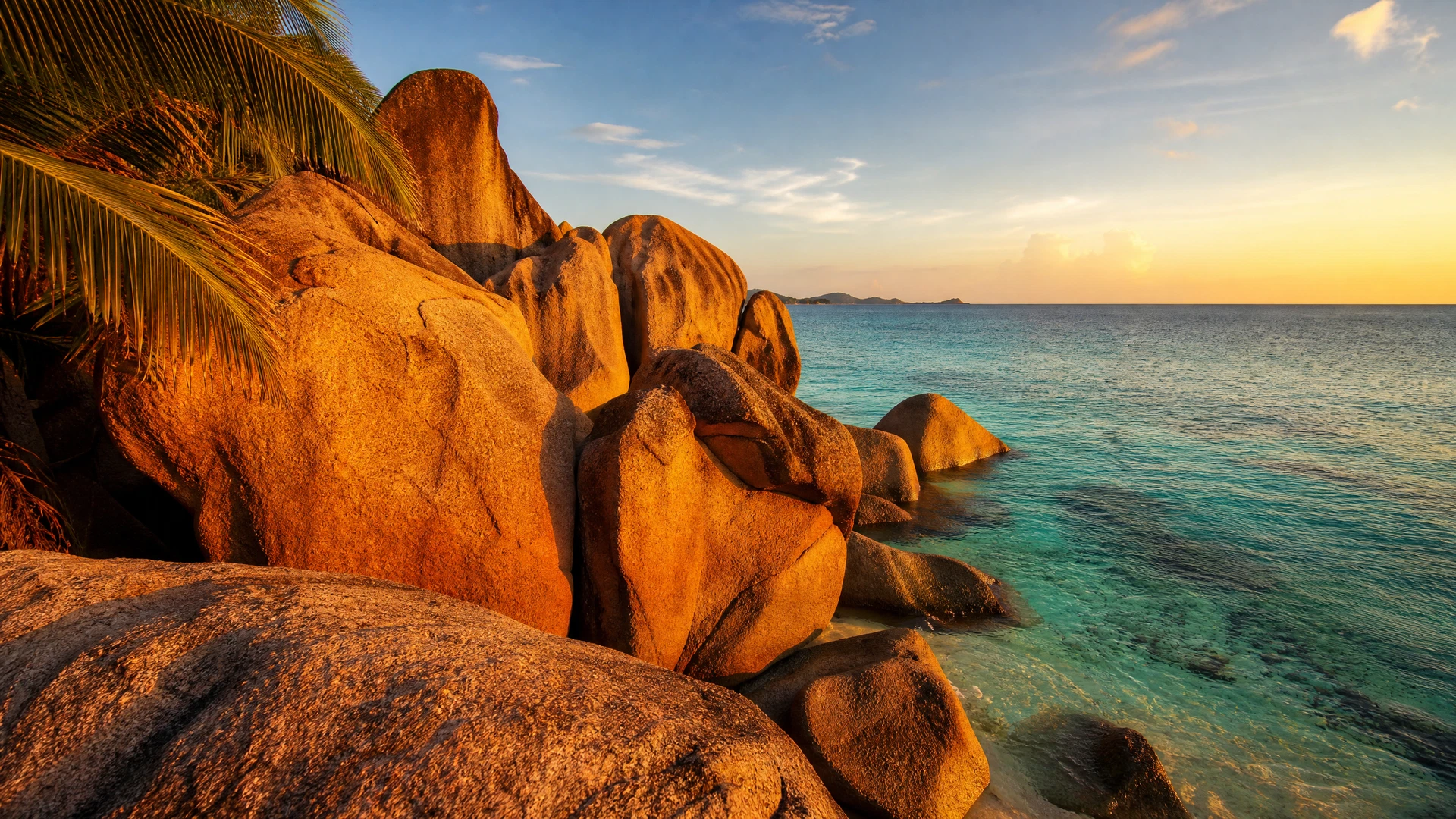
Put your hand on the boulder at Anse Lazio. Not to pose for a photograph. To feel it. The granite is warm — not from the sun, though the sun is doing its work — but with a specific density that you don't feel in other rocks. It is pink-orange in the afternoon light, streaked with quartz and feldspar, worn smooth by 750 million years of ocean air. The water in front of it is the specific turquoise that appears in every photograph of the Seychelles and that no photograph has ever accurately reproduced. The palm fronds overhead are not decorative. They are the fronds of the takamaka tree, which grows only on granite coastlines in the Indian Ocean, which exists here because this specific rock exists here.
The photographs are accurate. They show you exactly what the Seychelles looks like. What they don't show you is what you're standing on.
The Seychelles is not a beach destination that happens to have extraordinary geology. It is a geological event that happens to have beaches. The 115 islands of the Seychelles archipelago are the only mid-ocean granite islands in the world. Every other oceanic island — Hawaii, the Maldives, Mauritius, the Canary Islands — is volcanic, pushed up from the ocean floor by magma. The Seychelles granite is different in a way that is specific and irreplaceable: it is a fragment of the ancient supercontinent Gondwana, the landmass that once connected Africa, India, Antarctica, and Australia before the tectonic plates began their slow separation 180 million years ago. The granite was already 570 million years old when Gondwana began to break apart. When India separated from Africa, the Seychelles microcontinent was left behind in the Indian Ocean — a piece of continental crust stranded in the middle of the sea, too small to be a continent, too old to be an island in any ordinary sense.
Understanding this changes what you see when you stand on the boulders. You are not standing on a volcanic island that happened to develop a beautiful beach. You are standing on a piece of Africa that has been sitting in the Indian Ocean for 75 million years, accumulating the specific endemic life that 75 million years of isolation produces.
750 Million Years in the Making
The specific visual signature of the Seychelles — the pink-orange boulders, the way they stack and lean against each other in configurations that look deliberately arranged, the way they frame the water at Anse Source d'Argent and Anse Lazio and Anse Georgette — is a direct consequence of the specific mineralogy of the granite. The rock is a coarse-grained granite rich in potassium feldspar, which gives it the specific warm color. The specific rounded shapes are the result of a process called spheroidal weathering, in which water penetrates the joints in the granite and chemically weathers the corners and edges faster than the flat faces, producing the rounded forms over millions of years. The specific scale of the boulders — some the size of houses, some the size of cars, stacked in formations that seem to defy gravity — is the result of the specific joint patterns in the granite, which determined where the rock fractured as it cooled 750 million years ago.
This is not academic. It is the explanation for why the Seychelles looks the way it looks and why no other place on earth looks like it. The Maldives has atolls. Hawaii has volcanic black sand. The Seychelles has 750-million-year-old continental granite, and the specific visual experience of the islands is inseparable from the specific age and composition of that rock.
The granitic inner islands — Mahé, Praslin, La Digue, Silhouette, and about 40 others — are the pieces of Gondwana. The outer islands — the coral atolls including Aldabra — are different: younger, lower, built on the coral reef rather than on ancient granite. The Seychelles is two different kinds of island in one country, and the distinction matters for understanding what you're seeing.
What the Granite Produced
Seventy-five million years of isolation on a piece of ancient continental crust produces something that no volcanic island can replicate: endemic life of extraordinary specificity. The Seychelles has the highest density of endemic species per square kilometer of any country on earth, and the specific reason is the specific age and specific isolation of the granite.
The coco de mer — the palm tree whose seed is the largest in the plant kingdom, weighing up to 25 kilograms — exists naturally only in the Vallée de Mai on Praslin and in the Fond Ferdinand nature reserve. It exists nowhere else on earth. Not because it hasn't been transplanted (it has, to botanical gardens worldwide) but because it evolved in this specific place, on this specific granite, in this specific isolation. The specific seed — which resembles, with some anatomical specificity, the human female pelvis, and which generated centuries of legend about an underwater paradise where the trees mated during storms — takes six years to germinate and twenty-five years to produce its first fruit. The specific forest of the Vallée de Mai, where the coco de mer palms grow to 30 meters and the canopy is dense enough to block the midday sun, is the closest available experience to what the Seychelles looked like before humans arrived.
The black parrot — the Seychelles black parrot, Coracopsis barklyi — exists only on Praslin, only in the coco de mer forests, and only in a population of approximately 600 individuals. It is not black. It is dark brown with a pale beak, and it makes a sound that the ornithologists describe as a "mournful whistle" and that the Praslinois describe as the voice of the island. You hear it before you see it, moving through the coco de mer canopy above the Vallée de Mai trail.
The Seychelles warbler, the Seychelles magpie-robin, the Seychelles paradise flycatcher — each exists on a single island or a small group of islands, each the product of the specific isolation that the granite produced. The marine environment is equally specific: the ancient granite coastline has created the specific underwater topography — the granite boulders continue below the waterline, creating the specific crevices and overhangs that the specific fish of the Indian Ocean use as habitat. The hawksbill turtle nests on the specific granite beaches because the specific beach profile that the granite produces — the specific slope, the specific grain size of the sand between the boulders — is what the hawksbill requires for nesting.
The photographs show you the boulders above the waterline. The thesis is that the boulders below the waterline, and the 75 million years of life that the boulders produced, are the actual reason to go.
The Three Islands and What Each One Actually Is
Mahé is the largest island, the capital island, and the island that most travelers use as a transit point rather than a destination. This is a mistake, but it is an understandable one. Victoria, the capital, is a small city with traffic and a market and a clock tower modeled on Big Ben at one-quarter scale — the specific detail that no travel guide ever explains is that the clock tower was built in 1903 to commemorate the visit of a British governor who never actually came. The Beau Vallon beach on the northwest coast is the most accessible beach on Mahé and the site of the Wednesday night market, which is the best reason to be on Mahé on a Wednesday. The Morne Seychellois National Park covers 20% of the island and contains the specific Copolia Trail — a 1.4-kilometer hike to a granite plateau at 497 meters that takes 45 minutes and produces the specific view of the island's interior that no beach photograph captures.
Praslin is the island of the coco de mer and the Vallée de Mai. It is smaller than Mahé, quieter, and organized around the specific fact that it contains a UNESCO World Heritage Site in its interior and three of the best beaches in the Indian Ocean on its coast. Anse Lazio on the northwest tip is the beach that most serious travelers consider the best in the Seychelles — not Anse Source d'Argent, which is the most photographed, but Anse Lazio, which has the specific combination of granite boulders, clear water, and consistent swimmability that Anse Source d'Argent lacks. Anse Georgette, on the northwest coast near the Lemuria Resort, requires walking through the resort to access — you present yourself at the gate, they record your name, and you walk through the grounds to the beach. It is free. It is the least crowded of the major beaches on Praslin. Most travelers never go because the resort entrance feels like a barrier. For couples planning the full island circuit, the Seychelles Honeymoon: 7-Day Luxury Itinerary sequences the three islands around these specific beach conditions and the Vallée de Mai timing.
La Digue is the island that the marketing has made into the symbol of the Seychelles, and the island that the honest traveler needs to approach with specific information. Anse Source d'Argent — the beach with the pink granite boulders and the shallow turquoise water that appears in approximately 40% of all Seychelles photographs — is only swimmable at high tide. At low tide, the water recedes to reveal a rock flat that extends 200 meters from the shore. The beach is still visually extraordinary at low tide. You cannot swim in it. Check the tide tables before you go. The ferry from Praslin takes 15 minutes. The island has no cars — transport is by bicycle, ox cart, or the small trucks that serve as taxis. Renting a bicycle for the day costs 100 Seychellois rupees (approximately $7) and is the correct way to experience the island. Anse Cocos, on the southeast coast, requires a 45-minute walk from the bicycle rental point and is the beach that the travelers who have been to La Digue multiple times consider the best on the island — less photographed, more consistently swimmable, surrounded by the specific granite that the thesis requires.
The Vallée de Mai and the Coco de Mer
The Vallée de Mai is a 19.5-hectare nature reserve in the center of Praslin that UNESCO designated a World Heritage Site in 1983. The entrance fee is 200 Seychellois rupees (approximately $14). The trail through the valley takes 45 minutes to an hour at a slow pace. The specific experience: the canopy closes above you within 50 meters of the entrance, the temperature drops by several degrees, and the sound of the outside world disappears. The coco de mer palms are 30 meters tall. The specific sound of the valley is the sound of the black parrot and the wind moving through the coco de mer fronds, which are the largest palm fronds in the world — up to 9 meters long — and which make a specific low percussion sound in the wind that you don't hear anywhere else.
The coco de mer seed takes six years to germinate after it falls from the palm. The palm takes 25 years to produce its first fruit. The fruit takes a further 6–7 years to ripen. The specific consequence: the coco de mer is one of the slowest-reproducing plants on earth, and the specific forest of the Vallée de Mai is the result of thousands of years of this specific slow reproduction on this specific granite in this specific isolation. The legend — that the coco de mer trees walk to the beach during storms to mate, and that any human who witnesses this will die — is a legend that the Praslinois tell with the specific tone of people who know it isn't true and also know that it captures something real about the strangeness of the place.
The specific thing to look for in the Vallée de Mai that no guide mentions: the specific gecko — the Seychelles giant bronze gecko — that lives in the coco de mer fronds and that is the largest gecko in the world. It is nocturnal but sometimes visible in the early morning before the tourist groups arrive. The trail opens at 8am. Arrive at opening.
The Food That Nobody Writes About
The Seychelles food culture exists in two parallel universes. The resort universe — the buffet breakfasts, the beachside grills, the international menus priced for the European honeymoon market — and the Seychellois universe, which is cheaper, more specific, and more interesting. The two universes rarely intersect, and most travelers spend their entire trip in the first one.
The Beau Vallon Wednesday night market is the most direct available entry point into the second universe. Every Wednesday from 4pm to 8:30pm, the road along Beau Vallon beach becomes a Creole food market. The stalls sell grilled fish — the specific job fish, the specific red snapper, the specific tuna — cooked over charcoal and served with rice and chutney for 100–150 rupees ($7–10). The octopus curry stalls are the ones with the longest queues. The ladob stalls are the ones that most tourists walk past without recognizing what they are.
Ladob is the specific Seychellois dessert: banana or sweet potato cooked in coconut milk with vanilla and nutmeg until the coconut milk reduces to a thick sauce. It is served warm or cold, in a small cup, for 25 rupees. It is the most specific available taste of Seychellois food culture and it does not appear in any luxury resort menu. The specific version at the Beau Vallon market — made by the specific woman who has been selling it from the same stall for fifteen years — uses the specific plantain banana that grows on Mahé rather than the sweet dessert banana, which gives it a specific starchiness that the dessert banana version lacks.
The Sir Selwyn Clarke Market in Victoria — open Monday through Saturday, 6am to 5pm — is the other entry point. The fish section, in the back of the market, sells the morning catch directly: the specific bourgeois (a large red snapper), the specific capitaine, the specific carangue. The spice stalls sell fresh turmeric root, vanilla pods from the Seychelles vanilla plantations, cinnamon bark, and the specific dried chili that goes into Creole curry. The specific stall in the back-left corner, run by a Seychellois woman named Marie-Claire (according to the regulars who know her name), sells ladob and grilled fish from 7am until she sells out, which is usually by 10am.
The Seychellois
The Seychelles was uninhabited when the first Europeans arrived in the 16th century. The specific people who live here now are the product of the specific history that followed: French colonists who arrived in 1770, African enslaved people brought to work the plantations, Indian and Chinese laborers who arrived in the 19th century, and the specific mixing of all of these that produced the Seychellois — a people with no indigenous ancestry, no pre-colonial history, and a specific cultural identity that is entirely their own.
The language is Seychellois Creole — Kreol Seselwa — a French-based creole that is the first language of 95% of the population and one of three official languages alongside English and French. It is not French. It is not a dialect of French. It is a distinct language that developed in the specific isolation of the Seychelles from the specific mixture of French, Malagasy, Bantu, and other languages that the specific history produced. The specific sound of Kreol — the specific rhythm, the specific way the French words have been transformed — is the sound of the Seychelles in the same way that the specific sound of the coco de mer fronds is the sound of the Vallée de Mai.
The Creole Festival in October is the most important cultural event of the year — a week of music, food, and performance that celebrates the specific identity that the specific history produced. The specific music is sega — a rhythm that originated in the African diaspora of the Indian Ocean, played on the ravann (a goatskin drum) and the triangle, with lyrics in Kreol that are the specific oral history of the Seychellois. The specific dance is the moutya — older than sega, slower, with a specific call-and-response structure that the enslaved people used to communicate under the specific conditions of plantation slavery. The moutya was banned by the colonial authorities. It survived.
When to Go, Getting Around, Getting There
When to go: The Seychelles has two distinct seasons determined by the trade winds. The northwest monsoon (October to April) brings calmer seas on the west coasts of the islands and the best conditions for Mahé's Beau Vallon and Praslin's Anse Lazio. The southeast trade winds (May to September) bring rougher seas on the west coasts but calmer conditions on the east coasts and the best conditions for La Digue's Anse Cocos. The specific consequence: there is no bad time to visit the Seychelles, but the specific beach you want to swim at determines the specific month you should go. April to May and October to November are the transition months when both coasts are generally calm.
Getting there: The Seychelles International Airport is on Mahé. Emirates, Etihad, Air France, and Kenya Airways are the main carriers. There are no direct flights from North America — the connection is typically through Dubai, Abu Dhabi, Paris, or Nairobi. Flight time from London is approximately 10 hours. From Dubai, 4 hours.
Getting around: Inter-island ferries connect Mahé, Praslin, and La Digue. The Cat Cocos ferry from Mahé to Praslin takes 1 hour and costs approximately 600 rupees ($42) each way. The ferry from Praslin to La Digue takes 15 minutes and costs 150 rupees ($10). Booking in advance is essential in peak season. Domestic flights between Mahé and Praslin take 15 minutes and cost approximately $100 each way — worth it for the specific aerial view of the granite islands from above. On Mahé, car rental is the most practical option for reaching the beaches; on La Digue, bicycle is the only sensible choice.
The honest cost reality: The Seychelles is expensive. Accommodation ranges from $150 per night for a guesthouse to $2,000+ per night for a private island resort. Food at local takeaways costs $7–15 per meal. Food at resort restaurants costs $40–80 per meal. The travelers who feel the Seychelles is overpriced are usually the ones who stayed in resort restaurants for every meal. The travelers who found the Wednesday market and the Victoria Market and the local takeaways found a different Seychelles — still expensive by Southeast Asia standards, but not by European standards.
Planning Your Seychelles Trip
Seven days is the minimum for the Seychelles done properly: three days on Mahé (including the Wednesday market, the Copolia Trail, and the Morne Seychellois interior), two days on Praslin (the Vallée de Mai, Anse Lazio, and Anse Georgette), and two days on La Digue (Anse Source d'Argent at high tide, Anse Cocos, the bicycle circumnavigation). Ten days allows you to slow down on each island and spend a morning in the Vallée de Mai before the tour groups arrive.
The Seychelles Honeymoon: 7-Day Luxury Itinerary for Couples builds the trip around the specific rhythm of the islands — the specific ferry timings, the specific beach conditions by season, and the specific experiences that justify the cost. If you're building the trip independently, the AskLeif itinerary generator will account for the tidal conditions at Anse Source d'Argent, the Vallée de Mai opening hours, and the Wednesday market timing — the specific logistical details that determine whether you experience the Seychelles you came for or the one that disappointed the Reddit reviewers.
The specific practical instruction that no guide emphasizes enough: check the tide tables for La Digue before you book your ferry. Anse Source d'Argent is only swimmable at high tide. The difference between a high-tide morning and a low-tide morning on La Digue is the difference between the photograph and the rock flat. The tide tables are available at the Seychelles Meteorological Authority website. This is the most important logistical fact about the Seychelles and it is not in any luxury travel brochure.
What the Photographs Don't Show
The boulder at Anse Lazio is warm under your hand because it has been absorbing heat for 750 million years. Not this specific afternoon's heat — though that too — but the specific accumulated warmth of a piece of continental crust that has been sitting in the Indian Ocean since before the dinosaurs, since before the Atlantic Ocean existed, since before the continents were in the positions they're in now.
The photographs show you the color of the water and the shape of the boulders and the specific turquoise that no screen accurately reproduces. They don't show you the black parrot moving through the coco de mer canopy above the Vallée de Mai trail, making its mournful whistle. They don't show you the hawksbill turtle that nests on the specific granite beach because the specific beach profile is what the hawksbill requires. They don't show you the woman at the Victoria Market selling ladob from the same stall at 7am, or the specific sound of the moutya drum at the Creole Festival in October, or the specific way the Kreol language sounds when the Seychellois are talking to each other rather than to tourists.
The Seychelles is not overrated. It is misunderstood. The travelers who feel disappointed are the ones who went for the photographs. The travelers who feel transformed are the ones who put their hand on the boulder and asked what they were actually touching.
The answer is: the oldest rock in the Indian Ocean. And everything that 750 million years of isolation has produced around it.