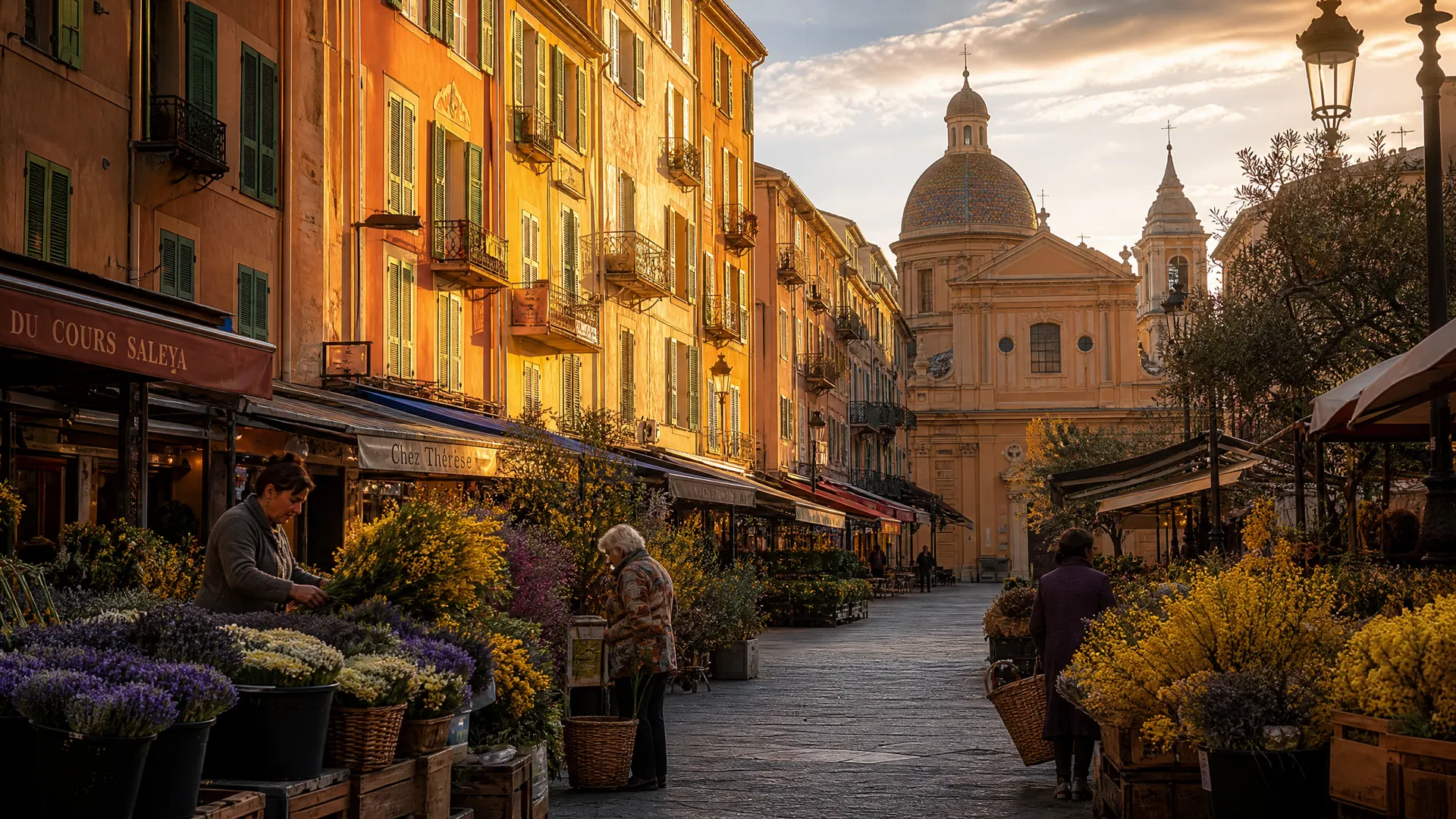
The City That Voted to Be French and Has Been Arguing About It Ever Since
Destination: Nice, France
Category: destination
On April 15, 1860, the people of Nice went to the polls to decide whether their city would become French. The ballot boxes were controlled by French military officers. There were no private voting booths. Sardinian troops had already been replaced by French ones. Every newspaper arguing against annexation had been suppressed. Prominent citizens who opposed the transfer had been taken into custody. And in most voting stations, there were no ballots for voting no.
The result was 25,743 in favor. 160 against.
Giuseppe Garibaldi — born in Nice in 1807, the man who would unify Italy, the most famous Niçois who ever lived — immediately declared the vote vitiated by electoral fraud. He was right, and everyone knew it. Within eleven years, in the first free elections held in the city, the pro-Italian lists won 26,534 votes out of 29,428 cast. The French government responded by sending 10,000 soldiers to Nice, closing the Italian newspaper Il Diritto di Nizza, and imprisoning demonstrators. Garibaldi was elected to the French National Assembly and traveled to Bordeaux to argue for the reunification of Nice with Italy. He was not permitted to speak. He resigned his seat and went home.
That is the opening scene of Nice. Not the Promenade des Anglais. Not the flower market. Not the light on the water. The opening scene is a rigged vote, a silenced general, and a city that has been quietly, persistently, architecturally, and gastronomically arguing about the result ever since.
This is what makes Nice unlike any other city on the Mediterranean. It is not French in the way that Paris is French, or Lyon, or even Marseille. It is French the way a city is French when it became French 164 years ago under circumstances that historians still debate, when a quarter of its population immediately emigrated to Italy in protest, when its official language was abolished overnight and replaced by French, when surnames like Bianchi were forcibly changed to Leblanc and Del Ponte became Dupont. Nice is French the way a city is French when it still has a square named after the man who tried to stop it.
The Architecture That Forgot to Become French
Walk into the Old Town — Vieux Nice, or Vieille Ville in French, or Nissa la Bella in Nissart, the Occitan dialect that is neither French nor Italian and that the street signs still acknowledge — and you will understand immediately that something here is not Parisian.
The buildings are ochre and terracotta and pale rose, their facades painted in the Ligurian tradition, their shutters green and blue and the color of old copper. The streets are narrow in the way that Genoese streets are narrow: carrugi, the Ligurian word for alley, is what they are called in the dialect. The Palais Lascaris on the Rue Droite is a Genoese baroque palace, built in the mid-17th century for Jean-Paul Lascaris, a member of the same family that produced the Grand Masters of the Knights of Malta. Its facade is Genoese. Its staircase is Genoese. Its ceiling frescoes are Genoese. It has nothing to do with France.
The Cathédrale Sainte-Réparate on the Place Rossetti was built in 1650 and completed in 1699, its dome covered in glazed tiles in the Genoese style, its interior a baroque profusion of gilt and fresco that would not look out of place in Genoa or Palermo. The Eglise du Gesù on the Rue du Gesù — the first baroque church in Nice, built by the Jesuits between 1642 and 1696 — was modeled on the Church of the Gesù in Rome. Its bell tower features exposed brick in the Piedmontese style. Its roof tiles are Genoese. The Chapelle de la Miséricorde on the Cours Saleya, built in 1740 and considered a masterpiece of baroque architecture, was designed by Bernardo Vittone, a Savoyard architect. It is a national monument of France. It looks nothing like France.
Then there is the Place Garibaldi. Built in 1773 as Piazza Vittorio — a place of welcome for the King of Sardinia, Victor Amadeus III of Turin — it is the oldest main square in Nice. At its center stands a statue of Giuseppe Garibaldi, the man who tried to stop Nice from becoming French. The buildings surrounding the square use trompe l'oeil to paint architectural details — columns, cornices, decorative moldings — that do not physically exist. It is a square built for an Italian king, named for an Italian general who opposed French annexation, decorated with painted illusions. If Nice were a sentence, the Place Garibaldi would be its punctuation.
The Food That Was Never French Either
The cuisine of Nice is called la cuisine niçoise, and it is not French cuisine. It is not Italian cuisine. It is its own thing, with its own logic, its own ingredients, its own vocabulary, and its own argument with the rest of the Mediterranean about who invented what.
Start with socca. You will be told it is a chickpea pancake. This is accurate but insufficient. Socca is made from chickpea flour, water, olive oil, and salt, poured onto a large copper pan and cooked at extremely high heat until the edges are crisp and the center is just set, then cut into rough triangles and eaten immediately with black pepper. It is the same dish that exists along the Ligurian coast as farinata or cecina — "made of chickpeas" — from Ventimiglia to La Spezia. It was originally a dish for workers and fishermen, eaten as merenda, the Ligurian word for a mid-morning snack. The word merenda is not French. The dish is not French. The tradition of eating it standing up at a market stall, burning your fingers on the paper cone, is not French.
Since 1928, Chez Thérésa has been selling socca from the same spot on the Cours Saleya. There have been three women named Thérésa over that century of continuous operation, but the copper pan, the wood fire, and the recipe have not changed. She arrives by bicycle. The socca is ready when it is ready. It costs between three and five euros. You eat it standing up. This is the correct way to eat socca, and it is the only way Thérésa will serve it to you.
Then there is pissaladière. The name comes from the Nissart word pissaladiero, which derives from pissalat, an anchovy paste that itself descends from the Roman garum, the fermented fish sauce that the legions carried across the empire. Pissaladière is an onion tart with anchovies and olives on a bread dough base, and the rule is that the layer of caramelized onions must be as thick as the layer of dough. It is not pizza. It is not quiche. It is a Niçois thing that predates both the French and Italian claims on this coastline.
For something more formal — or as formal as Nice gets — there is La Merenda at 4 Rue Raoul Bosio. La Merenda has no telephone. It does not accept credit cards. Reservations can only be made in person, by stopping by the day before and speaking to someone. It seats twenty people. Its former chef held two Michelin stars before deciding that what he actually wanted to do was cook Niçois food in a small room for twenty people who had bothered to show up in person to ask for a table. The menu changes with the market. The daube niçoise — the beef stew braised with olives, orange peel, and red wine — is the reason to go. The impossibility of getting in is part of the point.
And then there is the salade niçoise, which is not what you have been served in restaurants outside of Nice. The authentic version contains no cooked vegetables. No green beans. No potatoes. It is raw: tomatoes, hard-boiled eggs, anchovies, olives, raw broad beans or artichoke hearts when in season, and tuna — ideally tinned, packed in olive oil, not fresh. The dressing is olive oil and nothing else. The version with cooked green beans and potatoes that appears on menus from London to Los Angeles is a French interpretation of a Niçois dish. Nice would like you to know the difference.
The Cours Saleya and the Morning That Belongs to the Market
The Cours Saleya is not a square. It is not a street. It is a long, sun-drenched esplanade that runs along the southern edge of Vieux Nice, separated from the sea by a row of buildings that were once fishermen's warehouses and are now restaurants and galleries. Until the 13th century, this was an extension of the port. By the 18th century, the Niçois elite were taking their evening constitutionals along the terraces above the old salt warehouses. By 1861, the mayor had decreed that the flower market would occupy the western end and the produce market the eastern end, an arrangement that has not changed in 165 years.
On Tuesday through Sunday mornings from six until one, the Cours Saleya is the best argument for arriving in Nice without a plan. The flower vendors arrive first, their stalls a controlled riot of mimosa and lavender and roses cut that morning from the farms in the hills above the city. The produce vendors follow: tomatoes from the Var, courgettes with their flowers still attached, fat purple aubergines, baskets of fresh herbs. By eight o'clock, Chez Thérésa has her copper pan over the fire and the first socca is ready. By nine, the Chapelle de la Miséricorde behind the stalls has opened its baroque doors and the smell of incense drifts out into the market air.
Henri Matisse lived at the eastern end of the Cours Saleya from 1921 to 1938, in an apartment on the third floor of the Palais Cais de Pierlas, overlooking the market and the sea. He moved up to a nine-room apartment on the fourth floor and painted the Odalisque Tatouée, La Robe Tilleul, and the Grand Nu Couché with the light of the Cours Saleya coming through his windows. He had arrived in Nice in 1917, intending to stay briefly. He stayed for the rest of his life. His explanation was specific: "When I realized that every morning I would see this light again, I could not describe my joy. I decided not to leave Nice, and I stayed there practically all my life."
The light he was describing is the light of the Cours Saleya at nine in the morning in October, when the tourists have gone and the market is in full operation and the ochre facades are catching the low Mediterranean sun and bouncing it back at you from three directions at once. It is not a metaphor. It is a physical phenomenon, the result of the specific angle of the coastline, the reflectivity of the sea, and the color of the buildings. Matisse understood it as a painter. You will understand it as a person standing in a market holding a triangle of socca.
The Neighborhoods the Guidebooks Skip
Every guide to Nice covers Vieux Nice, the Promenade des Anglais, and Castle Hill. The guides are not wrong. But they are incomplete.
The Libération neighborhood — La Libé to everyone who lives there — sits north of the train station and has almost no tourist infrastructure, which is precisely why it is worth going. The Marché de la Libération is a covered market that operates Tuesday through Sunday mornings, and it is where Nice actually shops. The fish stalls are serious: whole daurade and loup de mer and rouget on ice, the kind of selection that reminds you this is a working port city. The vegetable vendors know their customers by name. There are no souvenir stalls. There is no English menu at the café on the corner. This is the correct state of affairs.
The Cimiez neighborhood, up on the hill above the city, is where the Romans built their amphitheater and where Matisse is buried. The Musée Matisse holds the world's most significant collection of his work — not because it has the most famous individual pieces, but because it has the full arc of his career, from the early dark paintings to the late cut-outs, in a 17th-century Genoese villa surrounded by olive trees. Two hundred meters away, the Musée National Marc Chagall holds the largest public collection of his works anywhere in the world: more than 400 paintings, gouaches, drawings, and pastels, including 17 large-format canvases illustrating Genesis and Exodus that Chagall painted specifically for this building. Chagall considered it the house of his work. He was not wrong.
The Cimiez Monastery, just above the Matisse Museum, has a garden of rose bushes and olive trees that has been tended by Franciscan monks since the 16th century. It is free to enter. On a Tuesday morning in September, you will have it almost entirely to yourself.
The Day Trips That Complete the Argument
The French Riviera is not a single place. It is a coastline of distinct identities that Nice sits at the center of, and understanding Nice means understanding what surrounds it.
Monaco is twenty minutes by train from Nice's Gare Thiers — from €6 to €7, with 66 trains running daily. This is one of the most underused pieces of practical information in travel writing about the region. Most visitors to Monaco arrive by tour bus and spend four hours. The correct approach is to take the morning train, walk up to the Prince's Palace and the Oceanographic Museum, eat lunch at a café in the Condamine neighborhood below the Rock where the locals eat, and take the afternoon train back. Monaco is best understood as a neighborhood of Nice that decided to become a country. The AskLeif Monaco guide has the full breakdown for those who want to stay longer.
Èze is a medieval village perched at 429 meters above the sea, between Nice and Monaco. The Chemin de Nietzsche — the Nietzsche Path — climbs 1.6 kilometers from the beach at Èze-sur-Mer to the village above, a 45-to-60-minute ascent that Nietzsche walked repeatedly while writing Thus Spoke Zarathustra. He described the view from the path as the clearest thinking he had ever done. The path is steep and requires proper shoes, but the view from the top — the coastline curving east toward Monaco and west toward Antibes, the sea an impossible blue below — is the view that explains why everyone who has ever come to this coast has found a reason to stay.
For those who want to extend the trip inland, the AskLeif Provence guide covers the villages, markets, and lavender fields that sit an hour north of Nice and make a natural extension of any Riviera trip.
Villefranche-sur-Mer is fifteen minutes by train in the other direction, a small port town with a harbor so deep that it has served as a naval anchorage since the 14th century. The Rue Obscure — the Dark Street — runs beneath the old town, a vaulted medieval passage that has been continuously inhabited since 1295. The citadel above the harbor was built by the Duke of Savoy in 1557. The chapel of Saint-Pierre on the quay was decorated by Jean Cocteau in 1957 with frescoes depicting scenes from the life of Saint Peter and the women of Villefranche. Cocteau was a regular visitor to the town. He said the light was the reason.
Everyone says the light is the reason. They are all correct.
When to Go
Nice has 300 days of sunshine per year, which means the question is not whether it will be good but how crowded it will be. July and August are peak season: the Promenade des Anglais is dense with tourists, the restaurants in Vieux Nice are booked weeks ahead, and the pebble beach — yes, pebble, not sand, which is the thing first-time visitors get wrong — is wall-to-wall sunbathers. The water is warm and the evenings are long and beautiful, but the city is operating at capacity.
May, June, September, and October are the answer. The weather is warm enough to swim, the markets are at their best with seasonal produce, the restaurants have availability, and the city feels like itself rather than like a performance of itself. October in particular — when the mimosa is not yet blooming but the light is at its most extraordinary — is when Nice rewards the visitor who has done the reading.
November through March is quiet and occasionally cold, but never unpleasant. The Cours Saleya market runs year-round. The museums are uncrowded. The restaurants are at their most relaxed. The Carnival in February — one of the oldest in the world, dating to 1294 — is worth the winter trip if you time it correctly.
Getting There and Around
Nice Côte d'Azur Airport is the second-busiest in France after Paris Charles de Gaulle, with direct connections from most major European cities and seasonal transatlantic routes. The airport is seven kilometers from the city center; the tram (Line 2) connects the airport to the city in about 25 minutes for €1.70.
Within Nice, the tram network covers the main corridors efficiently. The T1 line runs through Place Garibaldi and connects the eastern neighborhoods to the center. The T2 line runs from the airport through the city to the port. For Vieux Nice, Castle Hill, and the Cours Saleya, walking is faster than any vehicle.
The train station — Gare de Nice-Ville — is the hub for the regional TER network that connects Nice to Monaco (20 minutes, from €6), Cannes (40 minutes), Antibes (30 minutes), and Villefranche-sur-Mer (10 minutes). The Côte d'Azur is one of the few places in France where the train is genuinely the best way to travel between towns. Use it.
Planning Your Nice Trip
Nice rewards a specific kind of planning: loose enough to follow the market, tight enough to have secured a table at La Merenda. The minimum useful stay is three days. Five days allows you to do the city properly and still make it to Èze, Monaco, and Villefranche without rushing.
The structure that works: arrive in the afternoon, walk Vieux Nice before dinner, eat somewhere on the Cours Saleya that evening. Day two: the morning market, socca at Chez Thérésa, Cimiez in the afternoon (Matisse Museum and the monastery garden), dinner at La Merenda if you remembered to stop by the day before to reserve. Day three: Monaco by the morning train, back for a late lunch, the Promenade des Anglais at sunset when the light is doing what Matisse was talking about.
If you want the full Riviera context — the day trips, the coastal villages, the inland Provence connection — the AskLeif Nice couples guide and the Nice solo itinerary have the day-by-day structure already built. The AskLeif itinerary builder can also put together a custom version based on how many days you have and what you actually want to do — which is a more useful starting point than a generic list of things to see.
The practical note about the beach: bring a mat or rent one. The pebbles are smooth and sun-warmed and beautiful, but they are not sand, and lying directly on them without a mat is an experience you will not repeat. Every beach club along the Promenade rents sun loungers and mats. The public sections of the beach are free. The water is clear and cold in May, warm in July, and still swimmable in October.
What the Arguing Is Actually About
There is a statue of Garibaldi in the center of the oldest square in Nice. The square was built for the King of Sardinia. The buildings around it are painted with architectural details that don't exist. The street signs are in French and Nissart. The food is neither French nor Italian. The architecture is Genoese. The light drew artists who needed something that didn't fit any category.
Nice has been French since 1860. It has been arguing about it since 1860. The argument is not really about politics anymore — it is about identity, and identity is not something that gets resolved by a vote, rigged or otherwise. What the argument produced, over 164 years of contested belonging, is a city that has absorbed French administration and Italian architecture and Ligurian food and Occitan language and Mediterranean light and made something out of all of it that belongs entirely to itself.
The pebbles on the beach are smooth because the sea has been working on them for longer than any of the arguments. The socca at Chez Thérésa has been made the same way since 1928. The Palais Lascaris has been Genoese baroque since 1660. The light has been the light since before Matisse arrived and decided he could not leave.
You will understand all of this the first morning you stand in the Cours Saleya with a triangle of socca in your hand, watching the flower vendors arrange their mimosa in the same light that stopped a painter in his tracks a century ago. The argument will still be going on around you. That is the correct state of affairs.