The Alhambra Is Not the Point. It's the Proof.
Destination: Granada, Spain
Category: destination
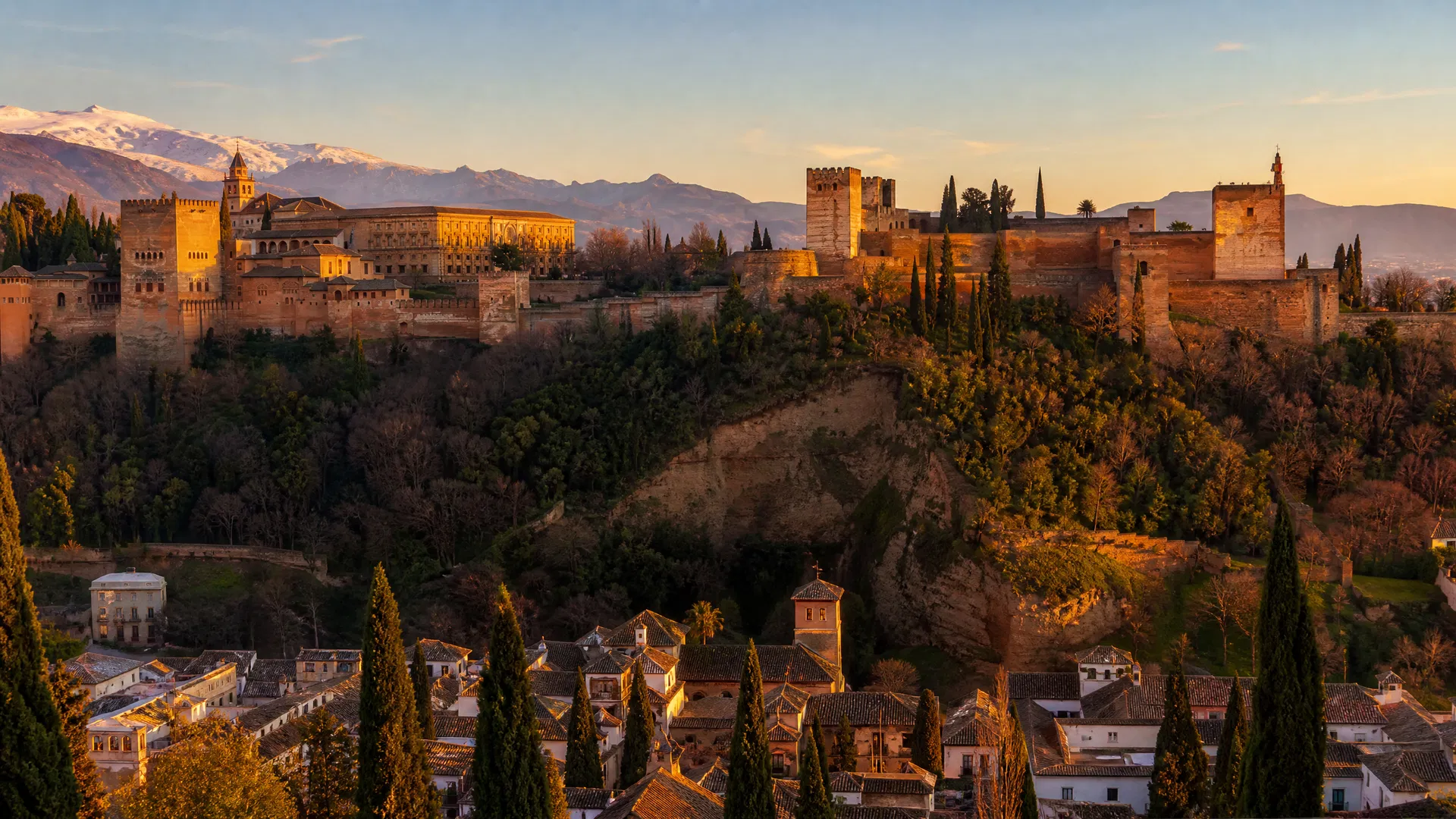
At dawn on a weekday in October, the Mirador de San Nicolás is empty. Not quieter than usual — empty. The tour groups haven't arrived yet. The flamenco guitarists haven't set up. The selfie sticks are still in hotel rooms. There is just the hill, the cold morning air coming off the Sierra Nevada, and across the valley, the Alhambra catching the first light of the day in a way that makes it look less like a building and more like something the mountain grew.
You stand there for a moment and understand something that no photograph has ever communicated: the Alhambra is not across from you. It is above you. It has always been above you. It will be above you every morning you wake up in this city, every evening you walk through the Albaicín's white-walled lanes, every night you sit outside a bar on Calle Navas with a glass of wine and a free plate of food you didn't ask for. The palace is not a destination you visit. It is a presence you live under.
This is what Granada is. Not the most visited monument in Spain — though it is that. Not the most beautiful city in Andalusia — though it may be that too. Granada is a city that has been processing a single event for five hundred and thirty years, and the processing has produced something extraordinary: a place where the past is not behind you, not preserved in museums, not explained on plaques. It is above you. It is in the tea you drink on Calderería Nueva. It is in the cave your flamenco dancer was born in. It is in the free tapa that arrives with your beer, a tradition so old and so specific to this city that the rest of Spain has largely abandoned it. The Alhambra is not the point. It is the proof. Proof of what 800 years of Moorish civilization produced. Proof of what was lost in 1492. Proof that the city below the palace has been living in the shadow of that loss — and that legacy — ever since.
The Palace That Proves Everything
The Alhambra was built between 1238 and 1358 by the Nasrid dynasty, the last Muslim rulers of the Iberian Peninsula, on a red sandstone hill above a city they had governed for six centuries. It is not a single building but a complex — the Alcazaba fortress, the Nasrid Palaces, the summer palace of the Generalife, the Palace of Charles V inserted awkwardly into the middle of it all by a Christian king who wanted to leave his mark on something he didn't fully understand. The Nasrid Palaces are what you come for. The geometric tilework, the muqarnas ceilings that look like frozen stalactites made of plaster, the Patio de los Leones with its twelve marble lions holding up a fountain that has been running for six hundred years — these are not decorative. They are a philosophical argument about the nature of paradise, rendered in stone and water and light.
Book your tickets before you arrive. Not a few days before — weeks before, ideally months. The Nasrid Palaces operate on timed entry slots and they sell out. If you miss your slot by twenty minutes, you will not be admitted. This is not a suggestion. Travelers who arrive in Granada without tickets and discover this fact are a daily fixture at the ticket office, and none of them are having a good morning.
Go in the morning, before 10am, when the light enters the Patio de los Arrayanes at an angle that turns the reflecting pool into a mirror. Leave the Nasrid Palaces and walk to the Generalife gardens before the tour groups arrive. The gardens are what the Nasrid sultans used as a summer retreat — terraced, water-channeled, planted with roses and cypresses that have been growing here for centuries. Most visitors rush through them to get back to the palace. Don't. The Generalife is where the Alhambra becomes human-scaled.
When you exit, walk down through the Bosque de la Alhambra — the forest of elm trees planted on the hillside — rather than taking the road. Halfway down, turn left onto the path that leads to Carmen de los Mártires. Almost no one goes here. It is a garden attached to a former Carmelite convent, free to enter, with peacocks wandering between the fountains and a view of the Alhambra from below that is better than the one from Mirador de San Nicolás. The peacocks are not a metaphor. They are just peacocks. But the garden is extraordinary and the Alhambra rising above it is the image that will stay with you.
One more thing: the feral cats. The Alhambra has a resident colony of cats that live in the gardens and on the walls and in the shadows of the Nasrid Palaces. They are fed by the staff and tolerated by the management and completely ignored in every official guide to the site. They are a delight.
The City That Lives Below
The Albaicín is the old Moorish quarter of Granada, a UNESCO World Heritage Site that covers the hill directly across the valley from the Alhambra. It is a neighborhood of white-walled houses, narrow cobbled streets that have not changed their geometry since the eleventh century, and a population that has resisted the kind of tourist-facing transformation that has hollowed out the historic centers of Seville and Córdoba. The UNESCO designation is part of why: strict preservation rules have prevented the wholesale conversion of residential buildings into hotels and souvenir shops. The Albaicín is still, in significant part, a place where people live.
Start at Plaza Nueva, the square at the foot of the Albaicín where the Río Darro disappears underground. Walk up Calle Elvira — the tourist-facing street with the Moroccan shops and the tea houses — but only as far as Calderería Nueva, where you turn uphill. When you reach Plaza San Gregorio, keep climbing on Cuesta de San Gregorio. You will pass El Tabanco, a small flamenco club that is not a tourist tablao — it is a bar with a stage where local musicians play on weekend evenings and the audience is mostly Granadinos. Note the address for later.
Continue up through the narrow stepped streets — Calle Rosas de San Pedro, Placeta del Rosal, Cuesta Granados — until you reach a small square called Placeta de Carvajales. Stop here. This is the viewpoint that a local Granadino will tell you about if you ask the right question, and that appears in none of the top travel guides to the city. The view of the Alhambra from Placeta de Carvajales is framed by the white walls of the surrounding houses in a way that makes it look like a painting someone composed deliberately. There are almost never more than three or four people here.
Continue to Mirador de San Nicolás — go, because the view is genuinely extraordinary and the energy of the square at dusk, with the musicians and the terrace bars and the Alhambra turning gold across the valley, is something you should experience once. But go at dawn or at 9am, not at sunset, when the tour groups arrive in waves and the square becomes a production rather than a place. The sunset view is the same view. The experience is completely different.
From San Nicolás, walk through Plaza Larga — a local square with restaurants and bars that cater to the people who live here, not the people who are visiting — and down Calle Panaderos, where you will find small groceries, a baker, and the kind of ordinary neighborhood life that the Albaicín's tourist-facing streets have largely replaced with ceramics shops. This is what the neighborhood actually is.
On Calle Almireceros, at the edge of the Albaicín where it meets the historic center, is Bodega Castañeda. It opened in the early twentieth century and has not changed much since. The walls are lined with barrels of vermouth and sherry. The bar is always crowded. The tapas that arrive with your drink are not the small, perfunctory bites you get at tourist-facing bars — they are proper plates of food, rotating daily, that constitute a meal if you order two rounds. A local on Reddit described it as "really good sherry and vermouth despite appearances." The appearances are part of the point. Bodega Castañeda looks like what it is: a place that has been serving the same neighborhood for a hundred years and has no interest in being anything else.
The Hill That Remembers
Sacromonte is the neighborhood above and beyond the Albaicín, on the same hill that the Alhambra occupies from the other side. It is where Granada's Romani community has lived for centuries, in cave houses dug into the soft sandstone of the hillside. Some of these caves are still occupied. Some have been converted into flamenco venues. Some have been turned into accommodation. The neighborhood has a complicated relationship with tourism — the cave flamenco shows have been a fixture since the nineteenth century, and the line between authentic performance and tourist spectacle is not always clear — but the neighborhood itself, walked on a weekday morning before the evening shows begin, is one of the most extraordinary places in Spain.
Walk up Cuesta Chapiz from the Albaicín and follow the path through Sacromonte toward the Abadía del Sacromonte, the abbey at the top of the hill. The abbey is worth visiting for a reason that no mainstream travel guide adequately explains: it is the site of the Lead Books, a collection of texts discovered in the hillside in 1595 that claimed to be early Christian writings in Arabic, proving that the Moriscos — the Moorish converts to Christianity who remained in Granada after 1492 — were the original Christians of Andalusia. The Vatican declared them forgeries in 1682. The debate about what they actually were — a sophisticated act of cultural resistance by a community trying to preserve its identity under forced conversion — is one of the stranger and more human stories in Spanish history, and the abbey contains the original lead tablets in its museum.
On the way back down, stop at Mirador Mario Maya. It is named after the flamenco dancer and choreographer Mario Maya, who was born in Sacromonte in 1937 and became one of the most important figures in the history of flamenco. The mirador has views of the Alhambra and the city that are comparable to Mirador de San Nicolás and almost never crowded. The name itself is a piece of local knowledge — Mario Maya is not famous outside of flamenco circles, and the mirador is not on the standard tourist itinerary.
For flamenco in Sacromonte, the cave tablaos — Cueva de la Rocío, Venta El Gallo, Los Parrones — offer genuine performances in authentic cave settings, and the experience of watching flamenco in a whitewashed cave with the Alhambra visible through the entrance is not something you can replicate anywhere else. But the most authentic flamenco experience in Granada is not in Sacromonte at all. It is at Peña La Platería, in the Albaicín, on Placeta de Toqueros 7. Granada's oldest flamenco club, founded in 1949, holds scheduled performances on Thursday evenings. The audience is local. The performers are not performing for tourists. The difference between this and a tablao is the difference between a concert and a recital — both are music, but one is for the people who need it.
If you eat in Sacromonte, order the tortilla del Sacromonte. It is an omelette made with lamb's brains and testicles, seasoned with peppers and herbs, and it is the most hyperlocal dish in Granada — specific to this neighborhood, specific to this community, served at Restaurante Chikito in the Realejo district (the former cafe where Federico García Lorca met with his intellectual circle in the 1920s and 1930s, and where a full-size statue of him now sits at one of the tables). The dish is not for everyone. It is for the people who want to eat what the neighborhood actually eats.
What the Expulsion Left Behind
In 1492, the same year Columbus sailed west, the last Nasrid sultan Boabdil surrendered the keys of Granada to Ferdinand and Isabella, ending eight centuries of Moorish rule in Andalusia. The Moriscos — Muslims who converted to Christianity to remain — were expelled in 1609. The Jews had been expelled in 1492. The city that had been one of the most cosmopolitan in medieval Europe — a place where Muslim, Jewish, and Christian scholars worked in the same libraries, where the architecture was a conversation between traditions rather than a statement of dominance — became, officially, a Catholic city.
But the city did not become a Catholic city. It became a city that carries its Moorish past in everything it does, including the things it doesn't know it's doing.
Calle Calderería Nueva, the street that climbs from Calle Elvira into the lower Albaicín, is lined with teterías — Moroccan-style tea houses that serve mint tea, pastries, and the kind of unhurried afternoon that the Spanish café culture never quite produces. The teterías are not a tourist affectation. They are a living inheritance. The families who run them are often descended from Moroccan immigrants who arrived in Granada in the twentieth century, drawn by a city that felt, in some way, like a memory of something their own culture had lost. The tea on Calderería Nueva tastes different from the tea in Marrakech, and different again from the tea in Madrid. It tastes like what it is: a tradition that crossed the Strait of Gibraltar twice and landed in a city that was already waiting for it.
For food that makes the Moorish inheritance explicit, go to Restaurante Arrayanes on Calle Cetti Meriem in the Albaicín. It serves Andalusian-Moroccan cuisine — lamb tagine, bastilla, couscous with seven vegetables — in a setting that makes the argument that the border between Andalusian and North African cooking is a political line, not a culinary one. The food is not fusion. It is the original.
For the most specific piece of local knowledge about Granada's food culture: the pionono. It is a small pastry — a cylinder of sponge cake soaked in syrup, filled with cream and cinnamon, meant to be eaten in a single bite — that was invented in the town of Santa Fé, ten kilometers outside Granada, in 1897. The original bakery is Casa Ysla, on Calle Real de Santa Fé, and the piononos they make there are different from the ones sold in Granada proper: smaller, moister, more precisely balanced between the sweetness of the syrup and the richness of the cream. The name is a corruption of Pío Nono — Pope Pius IX — because the pastry was created in the year of his canonization. Most visitors eat piononos in Granada. The real ones come from Santa Fé. The distinction matters to anyone who has tried both.
The Last City That Feeds You for Free
Granada is the last major city in Spain where most bars still serve a free tapa with every drink. This is not a marketing claim. It is a practice so embedded in the city's identity that locals treat it as a point of civic pride, and the few bars that have abandoned it are regarded with the kind of mild disapproval usually reserved for people who don't hold doors open.
The mechanics are simple: you order a beer, a glass of wine, or a soft drink, and a tapa arrives. You don't choose it — the bar chooses it for you, and it rotates. At a good bar, the tapa is a proper plate of food: a portion of fried fish, a small stew, a bocadillo, a plate of jamón. At a less good bar, it is a handful of olives and some bread. The difference between a good tapas bar and a bad one in Granada is not the price — the price is the same everywhere — it is the quality and generosity of what arrives uninvited.
The street that locals use is Calle Navas, not Calle Elvira. Calle Elvira is the tourist-facing street — the one with the Moroccan shops and the bars that have English menus in the window. Calle Navas is two blocks away, in the direction of the cathedral, and it is where the Granadinos go. The bars are less decorated. The menus are in Spanish. The tapas are better.
At Los Diamantes, the fried fish specialist on Calle Navas, the rule is specific and important: tapas are free only at the bar, not at the tables. Sit at a table and you will be charged. Stand at the bar and the food arrives with your drink. This is not a secret — it is written on a sign — but it is the kind of practical knowledge that separates a good afternoon from a confusing one.
The Mercado de San Agustín, the covered market two blocks from the cathedral, is where to go for the ingredients rather than the finished product: fresh fish from the coast, jamón from the mountains, vegetables from the Vega de Granada, the fertile plain that surrounds the city and has been farmed continuously since the Nasrid period. The market is not a tourist market. It is where the restaurants buy their produce and where the neighborhood does its shopping.
When to Go
Spring — March through May — is the best time to visit Granada. The Generalife gardens are in bloom, the weather is warm without being brutal, and the city is busy but not overwhelmed. The Alhambra tickets are harder to get in spring than in winter, so book further ahead.
Autumn — September through November — is the second-best time. The summer crowds have thinned, the light is extraordinary, and the tapas bars are at their most convivial. October is the month most locals would recommend.
Summer is honest about what it is: hot. Granada sits at 685 meters above sea level, which makes it cooler than Seville and Córdoba in July and August, but "cooler than Seville in August" is not a high standard. The Alhambra in August is also at its most crowded. If you go in summer, book the first entry slot of the day (8:30am) and be inside the Nasrid Palaces before 10am.
Winter is underrated. The temperatures are mild, the city is quiet, the tapas bars are warm and full of locals, and the Alhambra — with snow on the Sierra Nevada visible behind it — is as beautiful as it is at any other time of year. The Alhambra tickets are easier to get in January and February than at any other time.
Book Alhambra tickets at the official site (tickets.alhambra-patronato.es) directly. Third-party booking platforms charge a premium and occasionally sell tickets for sold-out slots. The official site is the only reliable source.
Getting There and Around
Granada has a small airport (Federico García Lorca Granada-Jaén Airport) with connections to Madrid and Barcelona, but most travelers arrive by train. The Renfe Avant service from Seville takes approximately two and a half hours. From Madrid, the journey is four hours. From Córdoba, ninety minutes. Granada's train station is a twenty-minute walk from the historic center, or a short taxi ride.
The city is walkable. The Albaicín and Sacromonte require walking — and climbing — but the distances are small. The historic center, the cathedral, the tapas bars on Calle Navas, and the foot of the Albaicín are all within fifteen minutes of each other on foot. For Sacromonte, the city bus (line C34) runs from Plaza Nueva up through the neighborhood to the Abadía.
Uber operates in Granada. FreeNow does not.
Planning Your Granada Trip
Three days is the minimum that does Granada justice. Four is better. The Alhambra alone — done properly, with the Generalife and Carmen de los Mártires and the walk down through the forest — takes a full morning. The Albaicín and Sacromonte together take an afternoon and an evening. The teteria culture, the tapas circuit, the Peña La Platería on a Thursday — these are not activities you can compress into a single day without losing what makes them worth doing.
If you're building a broader Andalusia trip, Granada works as the anchor. Seville is two and a half hours by train and a completely different city — louder, more theatrical, more tourist-facing, and worth three days of its own. Córdoba is ninety minutes away and can be done as a day trip, though the Mezquita-Catedral alone justifies an overnight stay. Málaga and the coast are two hours south, and the contrast between Granada's mountain gravity and the Mediterranean lightness of Málaga is one of the more pleasurable transitions in Spanish travel.
The Granada for Couples guide on AskLeif maps out a four-day itinerary that covers the Alhambra, the Albaicín, Sacromonte, and the best of the food and nightlife — built for two people but adaptable for solo travelers who want a structured starting point. For the broader Andalusia picture, the Andalusia 7-Day Couples & Culture guide covers the full circuit from Seville to Córdoba to Granada with the kind of day-by-day specificity that makes the logistics disappear. If you're planning to combine Granada with Seville, the Seville Solo guide is the most direct way to understand what that city requires — and how it differs from Granada in ways that matter for how you plan your time. For a coastal counterpoint, the Málaga guide covers Picasso's city and the Costa del Sol with the same depth.
The best way to build the trip is to start with the thesis: what are you trying to understand? If the answer is Moorish Andalusia — the civilization that produced the Alhambra and the Albaicín and the teteria culture and the free tapas tradition — then Granada is the center of gravity and everything else orbits it. Use the AskLeif itinerary builder to map the connections, set the pace, and make sure the logistics serve the argument rather than the other way around.
What the Palace Does to You
There is a specific thing that happens after two or three days in Granada. You stop looking up at the Alhambra and start feeling it. It is always there — from the Albaicín, from the tapas bars, from the teteria where you're drinking mint tea on a Tuesday afternoon, from the cave where the flamenco dancer is warming up for the evening show. The palace is not a destination you have visited. It is a fact about the city you are in.
And then you start to understand what the city has been doing for five hundred years. Every cup of tea on Calderería Nueva is a small act of cultural memory. Every free tapa is a tradition that survived the homogenization of Spanish food culture because this city decided it was worth keeping. Every flamenco performance in a Sacromonte cave is a community performing its own history for itself, with tourists as witnesses rather than audience. The Albaicín's narrow streets are not preserved because they photograph well. They are preserved because the people who live there know what was lost when the city above them was taken, and they have been keeping the shape of what remains.
The Alhambra is proof of what 800 years of civilization produced. The city below it is proof of what happens when a civilization is removed but its memory is not.
Go in October. Book the Alhambra before you book the flight. Stand at Placeta de Carvajales at 9am when no one else is there. Drink the vermouth at Bodega Castañeda. Eat the tortilla del Sacromonte at Chikito. Go to Peña La Platería on a Thursday and watch flamenco performed for the people who need it, not the people who paid for it. Then stand at the Mirador de San Nicolás at dawn, before the tour groups arrive, and look across the valley at the palace catching the first light of the day.
You will understand, in that moment, that you are not looking at history. You are standing inside it.
Explore Granada with AskLeif
- Granada for Couples: A 4-Day Romantic Itinerary Through Andalusia's Crown Jewel
- Andalusia 7-Day Couples & Culture Road Trip
- Seville Solo: A 4-Day Itinerary for the Independent Explorer
- Málaga in 4 Days: Picasso's City, Espetos & Costa del Sol Adventures
- Madrid Solo Travel: 4 Days Alone in Spain's Capital