Fourteen Islands, One City, Zero Reasons to Leave Stockholm Early
Destination: Stockholm, Sweden
Category: Destination Guides
Stockholm Doesn't Show Off. It Doesn't Have To.
There is a city in northern Europe that has quietly, methodically, and without any apparent need for your approval, become one of the most livable, most beautiful, and most quietly extraordinary places on the planet. It sits on fourteen islands where Lake Mälaren meets the Baltic Sea, and it has been doing this — being extraordinary — for roughly eight hundred years. It has never once felt the need to announce itself.
Stockholm is not a city that grabs you by the lapels. It doesn't have the operatic chaos of Rome or the relentless energy of Bangkok. What it does instead is something more insidious and more lasting: it gets under your skin slowly, through the quality of the light on an October afternoon, through the smell of cardamom from a bakery you pass on a Tuesday, through the particular silence of Gamla Stan's cobblestones at seven in the morning before the tourists arrive. You don't fall for Stockholm the way you fall for Paris. You fall for it the way you fall for a person you've known for years — gradually, and then all at once.
This is a city that has figured something out. It has figured out how to be modern without being soulless, how to be wealthy without being ostentatious, how to be design-obsessed without being cold. It has figured out that public space matters, that cycling infrastructure is a civic statement, that a coffee break — the famous fika — is not a luxury but a philosophical position. Stockholm doesn't just exist. It has a point of view.
And that point of view, once you spend a few days inside it, is almost impossible to shake.
The Geography Is the First Thing That Hits You
Most cities have a river running through them. Stockholm has an archipelago. The city spreads across fourteen islands connected by fifty-seven bridges, and beyond the city limits, the Stockholm Archipelago extends for thirty thousand islands, islets, and skerries into the Baltic Sea. This is not a backdrop. This is the city's defining characteristic — the reason it looks the way it looks, moves the way it moves, and feels the way it feels.
The water is everywhere. You see it at the end of streets. You cross it without thinking. You eat beside it, cycle along it, and in summer, swim in it — the water quality in central Stockholm is clean enough to swim in, which is a fact that should stop anyone from a major city in their tracks and make them reconsider everything they thought they knew about urban planning.
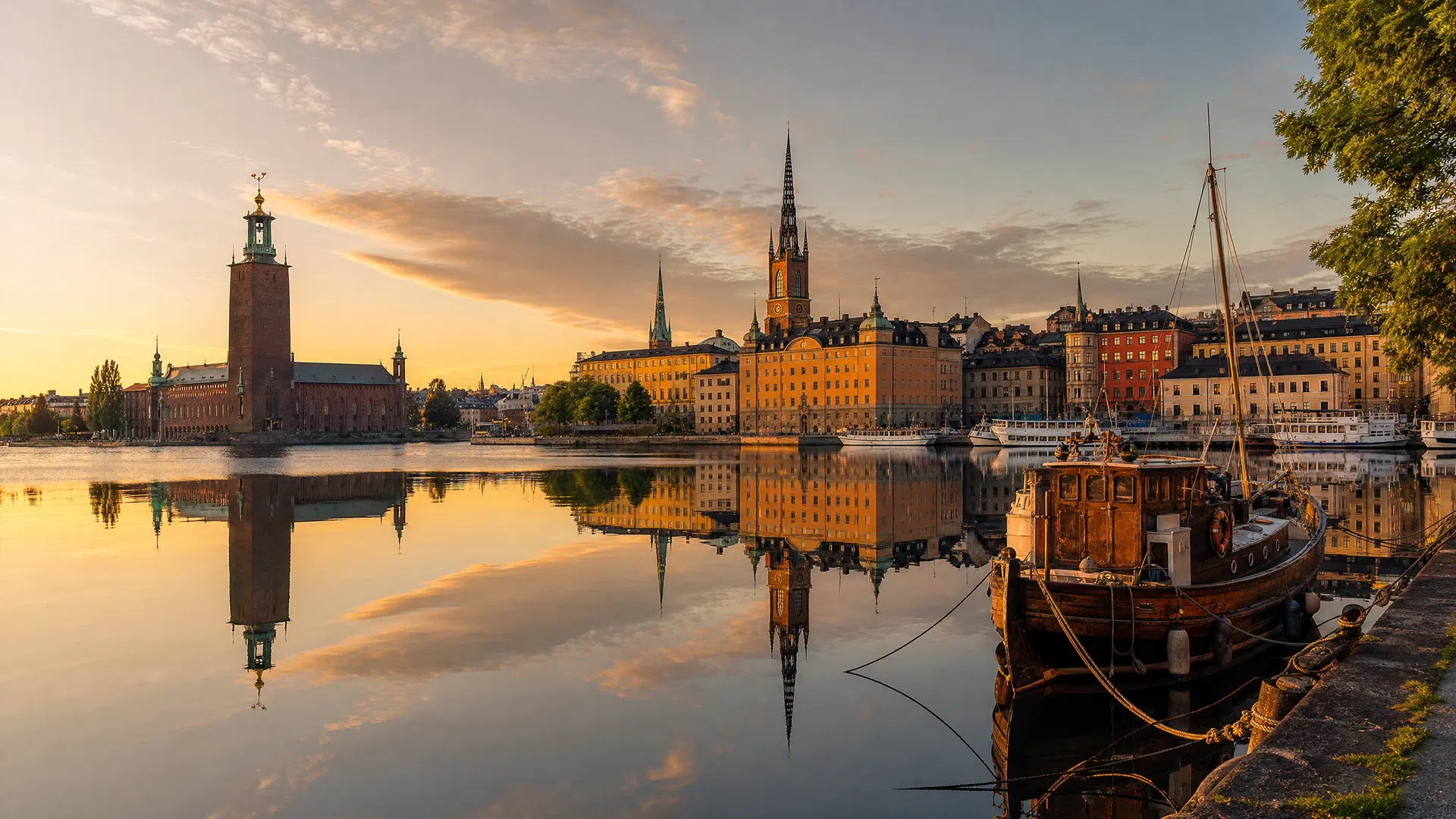
The old town, Gamla Stan, sits on its own island — Stadsholmen — and it is one of the best-preserved medieval city centers in Europe. The streets are narrow enough that you can touch both walls simultaneously in places. The buildings are painted in the colors of autumn: ochre, rust, deep red, burnt orange. The Royal Palace sits at the northern end, enormous and baroque and slightly incongruous, like a formal suit at a dinner party where everyone else is wearing beautiful, understated knitwear.
Gamla Stan is where Stockholm began, and it remains the city's emotional center — not its commercial center, not its trendy center, but the place you return to when you want to feel the full weight of eight centuries of continuous habitation. The Nobel Museum is here. The Stortorget, the main square, is here — the site of the Stockholm Bloodbath of 1520, when the Danish king executed over ninety Swedish nobles in three days, an event that led directly to Swedish independence. History in Gamla Stan is not something you read about on plaques. It is something you feel in the stones beneath your feet.
Djurgården: The Island That Belongs to Everyone
A short walk or ferry ride from the city center, Djurgården is one of Stockholm's most remarkable achievements — a vast green island that has been a royal hunting ground, a pleasure garden, and is now a public park containing some of the finest museums in Scandinavia. The fact that it exists, that it hasn't been developed into luxury apartments or a shopping district, says everything about Swedish priorities.
The Vasa Museum is here, and it is, without exaggeration, one of the most extraordinary museum experiences in the world. The Vasa was a Swedish warship that sank in Stockholm harbor in 1628, on its maiden voyage, after sailing approximately 1,300 meters. It was raised in 1961, almost perfectly preserved by the cold, low-salinity Baltic water, and is now displayed in a purpose-built museum that is essentially a cathedral built around a ship. The Vasa is 98% original — the carved wooden sculptures, the painted decorations, the cannons, the rigging. Standing in front of it, you understand immediately why the museum receives over 1.5 million visitors a year.
Also on Djurgården: the open-air museum Skansen, which has been recreating Swedish folk life since 1891 and contains over 150 historical buildings moved from across the country; the ABBA Museum, which is exactly what it sounds like and is considerably more moving than you'd expect; and the Thielska Galleriet, a private art collection in a beautiful villa that contains works by Edvard Munch, Carl Larsson, and Ernst Josephson that most visitors to Stockholm never find.
The island is also simply beautiful to walk through — forested paths, waterfront promenades, deer grazing in clearings. In summer, the outdoor restaurants and beer gardens fill up. In winter, the bare trees and the grey water and the low light create something that feels like a painting by a Scandinavian master.
Södermalm: Where Stockholm Gets Interesting
If Gamla Stan is Stockholm's history and Djurgården is its culture, Södermalm is its soul. The large island south of the city center was, for most of Stockholm's history, the working-class district — the place where the poor lived, where the artists and writers and radicals congregated, where the city's counterculture took root. It has gentrified substantially, as all such neighborhoods eventually do, but it has retained something of its original character: a slight edge, a refusal to be too polished, a density of independent coffee shops and vintage clothing stores and record shops that feels genuinely earned rather than curated.
The view from Monteliusvägen, a cliff-top promenade on the northern edge of Södermalm, is one of the great urban views in Europe. You look north across the water to Gamla Stan and Riddarholmen, with the City Hall's golden spires visible to the west and the modern city beyond. At sunset in summer, when the light turns the water gold and the old buildings glow, it is the kind of view that makes you understand why people move to cities.
Södermalm is also where you eat and drink in Stockholm. The neighborhood around Medborgarplatsen and Nytorget is dense with restaurants — everything from traditional Swedish husmanskost (home cooking) to some of the most ambitious New Nordic cuisine outside of Copenhagen. The bar scene on Götgatan and the streets around it is relaxed and unpretentious in a way that feels distinctly Swedish: people are there to enjoy themselves, not to be seen enjoying themselves.
The Fotografiska museum, housed in a former customs building on the waterfront, is one of the world's great photography museums — rotating exhibitions of major international photographers alongside a rooftop restaurant with views that justify the visit on their own. It stays open until 11 PM on weekends, which makes it one of the few museums in the world that functions as a legitimate evening destination.
The Food: Beyond the Meatball
Swedish food has a reputation problem. The reputation is meatballs and pickled herring and not much else, and it is almost entirely undeserved. Stockholm has been one of Europe's most exciting food cities for two decades, and the New Nordic movement that originated in Copenhagen has found its Swedish expression here in a cuisine that is rooted in local ingredients, seasonal obsession, and a technical precision that reflects the broader Swedish relationship with craft and quality.
The ingredients are extraordinary. Swedish crayfish, caught in freshwater lakes and eaten at raucous late-summer parties called kräftskivor. Elk and reindeer from the north. Cloudberries and lingonberries from the forests. Cold-smoked salmon from the archipelago. Gravlax cured with dill and served with a mustard sauce that is one of the great simple pleasures of Scandinavian cuisine.
The restaurants range from the Michelin-starred (Stockholm has more Michelin stars per capita than almost any other city in the world) to the humble. Oaxen Krog on Djurgården is one of the finest restaurants in Scandinavia, its tasting menu a meditation on Swedish ingredients and seasons. Pelikan in Södermalm is the opposite — a grand old beer hall serving traditional Swedish food in a room that looks like it hasn't changed since 1904, which is more or less true. Mathias Dahlgren's Matbaren at the Grand Hôtel is the middle ground: casual enough for a weeknight dinner, serious enough about the food to make you pay attention.
And then there is fika. The Swedish coffee break is not just a break — it is a social institution, a philosophical statement, a declaration that the quality of daily life matters. Swedes drink more coffee per capita than almost any other nation on earth, and they drink it slowly, in the company of others, with something sweet. The cardamom bun — kardemummabulle — is the canonical accompaniment, and the best ones, from places like Fabrique or Vete-Katten, are among the finest baked goods in Europe. To take a proper fika in Stockholm is to understand something about the Swedish approach to life that no amount of reading about Scandinavian design or social democracy can convey.
Design, Architecture, and the Swedish Way of Making Things
Stockholm is a design city in the way that Milan is a fashion city — not because it has more designers than anywhere else, but because design is woven into the civic fabric. The furniture in the subway stations is considered. The typography on street signs is considered. The parks are considered. The relationship between a building and the water it sits beside is considered. This is not an accident. It is the result of a century-long national conversation about what good design means and why it matters.
The Nationalmuseum, reopened after a major renovation in 2018, contains the finest collection of Swedish design and applied arts in the world — furniture, textiles, glass, ceramics, silver — alongside a significant collection of European paintings. The Design Torget stores scattered across the city sell contemporary Swedish design at accessible prices. The Nordiska Museet on Djurgården documents Swedish cultural history through objects, and the objects themselves are often beautiful enough to justify the visit.
The architecture of Stockholm spans eight centuries without ever feeling incoherent. The medieval lanes of Gamla Stan give way to the baroque grandeur of the Royal Palace, which gives way to the neoclassical elegance of Strandvägen, which gives way to the functionalist housing blocks of the 1930s and 1940s, which give way to the contemporary glass towers of Norrmalm. Each era has left its mark, and the city has absorbed each mark without losing its essential character.
The Stockholm Metro is worth mentioning separately. Opened in 1950 and expanded through the following decades, the T-bana has been called the world's longest art gallery — over ninety of its hundred stations have been decorated by artists, and the results range from the extraordinary (Kungsträdgården, with its vaulted ceiling of exposed rock and hanging sculptures, feels like entering a cathedral) to the merely beautiful. Taking the metro in Stockholm is not a utilitarian act. It is a cultural experience.
The Archipelago: Stockholm's Greatest Secret
Most visitors to Stockholm spend their time in the city. This is understandable and not wrong. But the Stockholm Archipelago — the thirty thousand islands that extend from the city into the Baltic — is one of the most beautiful and least-visited natural landscapes in northern Europe, and it is accessible by public ferry from the city center.
The archipelago is divided into the inner, middle, and outer sections. The inner islands are densely forested and dotted with red-painted summer cottages. The outer islands are more exposed, more dramatic — bare rock and wind and the open sea. The ferry journey itself, through channels and past islands, is one of the great slow-travel experiences in Scandinavia.
Vaxholm, the closest major island, is a forty-five-minute ferry ride from the city and has a well-preserved wooden town center and a sixteenth-century fortress. Sandhamn, in the outer archipelago, is a sailing hub with a small village that has been a gathering point for the Swedish sailing community since the nineteenth century. Utö, the furthest of the easily accessible islands, has excellent cycling and some of the best swimming in the archipelago.
In summer, the archipelago is where Stockholm goes on weekends — sailing, swimming, picking berries, sitting on rocks in the sun. In autumn, the birch trees turn gold and the light on the water is extraordinary. In winter, if the ice is thick enough, you can walk between islands. There is no bad season to be in the archipelago. There is only a different version of the same beauty.
Practical Stockholm: What the Other Guides Don't Tell You
Stockholm is expensive. This is not a secret, and there is no point pretending otherwise. A coffee costs more than it does in most European cities. A beer costs considerably more. A restaurant meal at a mid-range place will run to what you'd pay at a nice restaurant in London or New York. The way to manage this is to do what Stockholmers do: eat lunch, not dinner, at the better restaurants (many offer a dagens lunch — a set lunch menu — at roughly half the dinner price); drink before you go out rather than at bars; and use the city's extraordinary public spaces, which are free, rather than paying for entertainment.
The best time to visit is a genuinely complicated question. Summer — June through August — is when Stockholm is at its most beautiful and most alive, with long days (the sun barely sets in June), outdoor dining, archipelago ferries, and a general sense of euphoria that comes from a population emerging from a long winter. It is also when the city is most crowded and most expensive. September and October offer the best combination of good weather, lower prices, and the extraordinary autumn light that Scandinavian photographers spend their careers chasing. Winter is dark and cold, but the Christmas markets in Gamla Stan are among the finest in Europe, and there is a particular beauty to Stockholm under snow that is worth experiencing at least once.
The Stockholm Pass is worth buying if you plan to visit multiple museums. The public transport system — metro, bus, tram, and ferry — is excellent and covers the entire city. Cycling is the best way to see the city at ground level; the cycling infrastructure is world-class, and rental bikes are available throughout the city.
Swedish is the language, but English is spoken essentially universally — you will not need a single word of Swedish to navigate Stockholm, though learning tack (thank you) and förlåt (excuse me) will be appreciated.
The Guides That Will Help You Plan It
The Ask Leif guide library has Stockholm covered from every angle. Whether you're planning a romantic escape, a solo adventure, a family trip, or a deep dive into the city's food scene, these guides will give you a day-by-day framework built around the best the city has to offer:
- 4-Day Stockholm City Break: Your Ultimate Urban Adventure Guide — the comprehensive overview, covering all the major neighborhoods and landmarks across four days.
- Solo Stockholm: A 4-Day Hipster Guide to Sweden's Coolest City — for solo travelers who want to go deeper into Södermalm, the music scene, and the independent culture that makes Stockholm genuinely interesting.
- Stockholm Family Adventure: 4-Day Itinerary for Kids & Parents — Djurgården, Skansen, the Vasa Museum, and everything else that makes Stockholm one of the best family destinations in Europe.
- Stockholm Food & Fika: A 4-Day Culinary Journey for the Discerning Palate — for anyone who wants to eat their way through the city, from Michelin-starred tasting menus to the best kardemummabulle in Södermalm.
- Stockholm for Couples: A Romantic 4-Day Itinerary — the archipelago at sunset, candlelit dinners in Gamla Stan, and the particular romance of a city that takes beauty seriously.
- Stockholm on a Budget: 4-Day Itinerary for €75/Day — proof that Stockholm's reputation for expense doesn't have to define your trip, with smart strategies for eating, drinking, and experiencing the city without breaking the bank.
Why Stockholm Stays With You
There is a Swedish concept called lagom — roughly translated as "just the right amount," neither too much nor too little. It is sometimes cited as the key to understanding Swedish culture, and like all such concepts, it is both illuminating and slightly reductive. But there is something to it when you apply it to Stockholm as a city.
Stockholm is lagom in the best possible sense. It is large enough to be genuinely cosmopolitan but small enough to be navigable. It is wealthy enough to have excellent infrastructure and cultural institutions but not so wealthy that it has lost its soul. It is beautiful without being self-conscious about its beauty. It is modern without having abandoned its past.
The city will not overwhelm you. It will not exhaust you. It will not demand that you keep up. What it will do, if you give it the time it deserves, is show you a version of urban life that is so quietly, thoroughly excellent that you will spend the rest of your travels measuring other cities against it.
That is the thing about Stockholm. You leave it and you spend years trying to find it somewhere else.
You don't find it somewhere else.