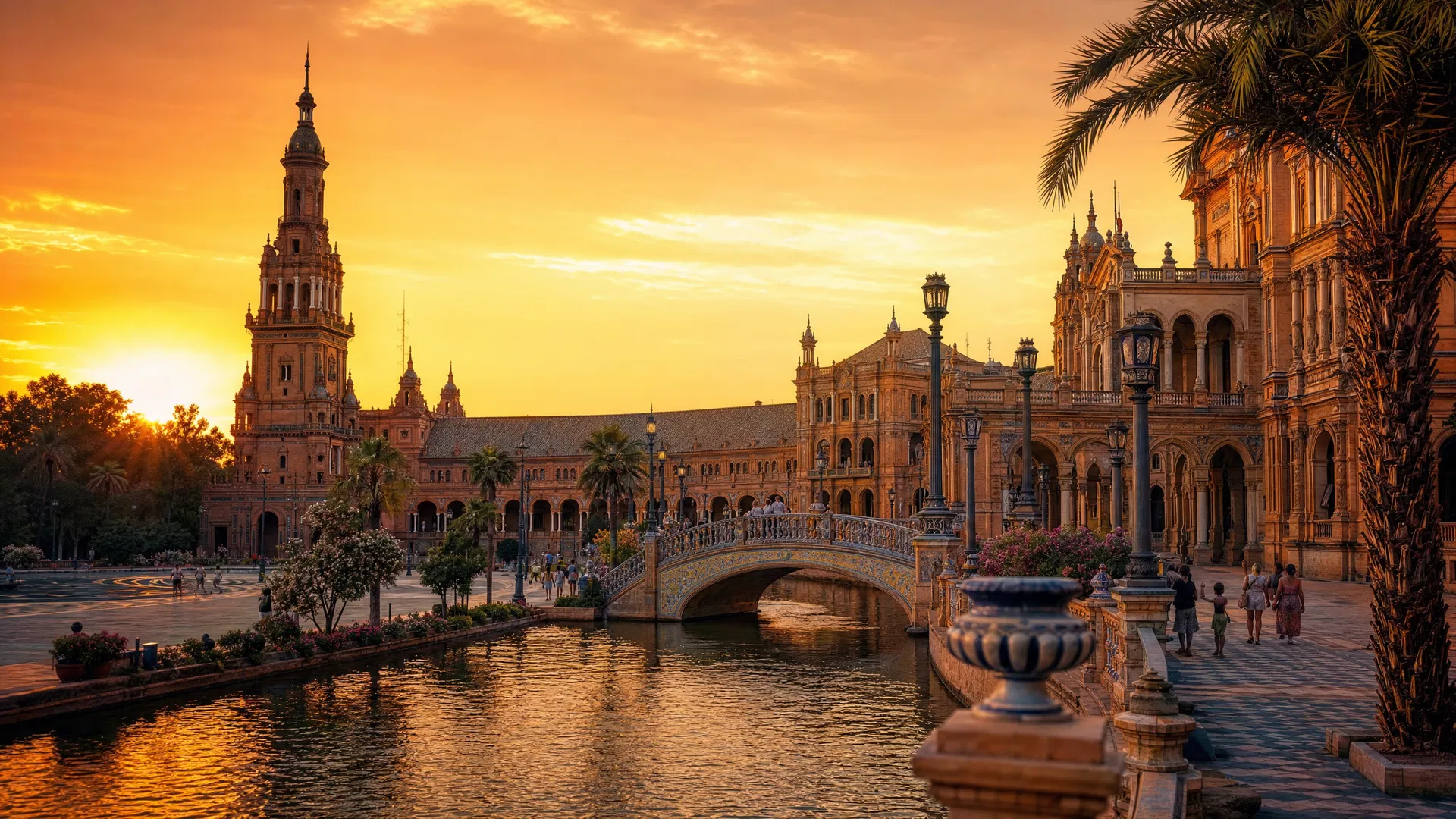
Seville Doesn't Seduce You Slowly. It Hits You All at Once.
Destination: Seville, Spain
Category: Destination Guides
Seville Doesn't Seduce You Slowly. It Hits You All at Once.
You arrive in Seville expecting a city. What you get is an argument — a centuries-long, unresolved, magnificently loud argument about what life is supposed to feel like. The orange trees lining every street smell like something you've never smelled before. The light at 9 PM is still warm and golden and completely unreasonable. Someone is playing guitar somewhere you cannot see, and the sound is traveling through stone walls that have been absorbing music for five hundred years. Within an hour of landing, you understand something that no travel guide has ever quite managed to explain: Seville isn't a destination. It's a standard.
A standard against which you will measure every other city for the rest of your life.
This is the capital of Andalusia, the southernmost major city in Western Europe, a place that has been conquered and reconquered and reimagined so many times that its identity is not one thing but a layered accumulation of everything — Roman, Moorish, Jewish, Christian, colonial, revolutionary. The result is a city that feels simultaneously ancient and alive, formal and chaotic, deeply traditional and wildly sensual. There is nowhere else quite like it on earth, and the people who live here know it with a quiet, unhurried confidence that is itself a form of seduction.
If you've been putting off Seville because you thought Barcelona was Spain, or because you assumed Madrid had the culture, or because you figured you'd get there eventually — stop. Go now. Go before the crowds that have discovered Lisbon and Porto discover this place in the same numbers. Go while the tapas bars still feel like they belong to the neighborhood rather than to TripAdvisor. Go while Seville is still, in the best possible sense, Seville.
The Weight of History You Can Actually Touch
Most cities wear their history like a museum — behind glass, labeled, climate-controlled. Seville wears it like clothing. You walk through it. You eat inside it. You sit in courtyards that were built before Columbus sailed from this very city's harbor in 1492.
The Real Alcázar is the place that makes this viscerally clear. It is not a ruin. It is not a reconstruction. It is a working royal palace — the oldest still in use in Europe — and it has been continuously inhabited and expanded since the 10th century. The Moorish architecture of the original Almohad fortress gives way to the Mudéjar masterpiece commissioned by King Pedro I in the 14th century, which gives way to Renaissance additions, which give way to baroque gardens that stretch further than you expect. Game of Thrones filmed the Water Gardens of Dorne here, and standing in those gardens, you understand why — there is something about this place that feels like it exists outside of normal time.
The Cathedral of Seville next door is the largest Gothic cathedral in the world, and it contains the tomb of Christopher Columbus, whose remains have been disputed by historians and nations for centuries but whose presence here feels fitting — Seville was the city that launched the Age of Discovery, the city through which all the gold and silver of the New World flowed, the city that was, for a brief and extraordinary period in the 16th century, the wealthiest place on earth. The cathedral's Giralda tower was originally a minaret built by the Almohads in 1198, converted to a bell tower after the Reconquista, and is still the symbol of the city. Climb it — the ramp was built wide enough for horses — and look out over a city that has survived everything history could throw at it.
The Barrio Santa Cruz, the old Jewish quarter, is the neighborhood that most visitors see first and many never leave. Its labyrinthine whitewashed alleys, hidden plazas, and wrought-iron balconies draped in bougainvillea are genuinely as beautiful as the photographs suggest, though the photographs never capture the smell of orange blossom in spring or the sound of heels on cobblestone at midnight. Walk it at dusk, when the tour groups have retreated and the light turns the white walls amber, and you will understand why people have been writing poems about this city for a thousand years.
But Santa Cruz is only the beginning. The Triana neighborhood across the Guadalquivir River is where Seville's soul lives — the birthplace of flamenco, the home of the city's ceramic tradition, a working-class barrio that has resisted gentrification with the same fierce pride it brings to everything else. The Alameda de Hércules, a tree-lined promenade that has been the city's social gathering place since 1574, is where locals actually spend their evenings — not in the tourist restaurants of Santa Cruz, but here, at outdoor tables, drinking cold beer and eating olives and talking with the unhurried intensity of people who have nowhere else to be.
Flamenco: Not a Show. A Reckoning.
Every city in Andalusia claims flamenco. Seville owns it. This is not a marketing position — it is a historical and cultural fact. The art form emerged from the fusion of Romani, Moorish, Sephardic Jewish, and Andalusian musical traditions in this region, and Seville — specifically Triana — is where it crystallized into the form the world now recognizes. The great flamenco dynasties — the Farrucos, the Montoyas, the Bacáns — were born here. The art form's most demanding and respected style, soleá, originated here.
What this means for you as a visitor is that the flamenco you see in Seville is different from the flamenco you see anywhere else. Not different in the way that a regional variation is different, but different in the way that the original is different from a copy. The performers in the serious tablaos — Casa de la Memoria, Tablao El Arenal, the Museo del Baile Flamenco founded by Cristina Hoyos — are not performing for tourists. They are performing because this is what they do, what their families have done, what the art demands. The duende — the untranslatable quality of authentic flamenco, the dark grace that García Lorca wrote about — is something you feel in your chest rather than see with your eyes.
Go to a serious tablao. Not the dinner-and-show tourist packages, but a genuine performance space with a small audience and artists who have spent their lives in this tradition. Sit close enough to hear the singer's breath. Watch the dancer's feet on the wooden floor. Feel the guitarist's hands on strings that have been tuned to something older than music theory. You will leave changed in a way you cannot fully explain.
The Food: A Masterclass in Doing More with Less
Seville's food culture operates on a principle that the rest of the world has been slowly rediscovering: that the best eating happens standing up, in small quantities, in the company of people you like. The tapa — originally a small plate of food placed on top of a glass of sherry to keep the flies out, or so the legend goes — was invented here, and Seville remains the city where the tradition is practiced with the most integrity and the most pleasure.
The Mercado de Triana is where you start. This covered market on the banks of the Guadalquivir has been the neighborhood's food hub since the 19th century, and the stalls inside sell the raw materials of Andalusian cuisine with a directness that is almost aggressive: blood-red tomatoes, fat green olives, jamón ibérico hanging from hooks, fresh fish from the Atlantic coast two hours away. Eat at the market bars — a glass of cold manzanilla sherry and a plate of boquerones en vinagre (anchovies in vinegar) at 11 AM is not a bad way to begin a day.
The tapas circuit in Seville follows no map and no schedule. It is a practice called tapeo — moving from bar to bar, eating one or two things at each, drinking slowly, talking constantly. The Calle Mateos Gago near the cathedral is the tourist version, and it is fine. The real version happens in Triana, in the Feria neighborhood, in the narrow streets around the Alameda de Hércules. Look for bars where the floor is covered in napkins — this is a sign of quality, not slovenliness; the tradition of throwing your napkin on the floor dates back centuries and indicates a busy, popular establishment.
The dishes you must eat: salmorejo (a thick, cold tomato soup from Córdoba that Seville has adopted as its own, topped with hard-boiled egg and jamón), espinacas con garbanzos (spinach with chickpeas, a Moorish-influenced dish that has been on Seville's menus for five hundred years), carrillada (slow-braised pork cheeks in sherry wine), puntillitas (tiny fried squid), and tortillitas de camarones (shrimp fritters from the coast that arrive at the table so hot they steam). Wash everything down with fino or manzanilla sherry — not the sweet, syrupy sherry your grandmother kept in a decanter, but the dry, saline, bone-cold fino that is one of the world's great food wines and costs almost nothing in Seville.
For a more formal meal, the restaurants around the Alameda and in the Macarena neighborhood offer modern Andalusian cooking that takes the region's ingredients seriously without abandoning the pleasure principle that governs all Sevillano eating. The city has no Michelin three-star restaurants, and this is not a failure — it is a philosophical position.
The Rhythm of the Sevillano Day
One of the things that disorients visitors from northern Europe and North America is that Seville operates on a completely different schedule from the one they're used to. This is not a quirk or an inconvenience. It is the city's greatest gift to you, if you're willing to accept it.
Breakfast is small and late — a tostada (thick toast rubbed with tomato and drizzled with olive oil) and a coffee at 9 or 10 AM. Lunch is the main meal of the day, eaten between 2 and 4 PM, often a three-course menú del día at a local restaurant for €12-15 that includes wine. After lunch comes the siesta — not necessarily sleep, but a withdrawal from the heat of the afternoon, a slowing down that the city enforces through the simple mechanism of closing most of its shops and restaurants between 3 and 5 PM.
The city reawakens in the early evening. The streets fill again around 6 PM, the tapas bars open, the paseo begins — the evening stroll that is as much a social institution as a physical activity. Dinner doesn't start until 9 PM at the earliest, and the streets are still full at midnight on a Tuesday. The Sevillanos are not night owls by nature; they are people who have organized their lives around the heat of the Andalusian summer and the pleasures of the Andalusian evening, and the schedule they've arrived at is, once you surrender to it, the most civilized arrangement for human life that anyone has yet devised.
Semana Santa and Feria: When Seville Becomes Itself Most Fully
If you can arrange your visit to coincide with either of Seville's two great festivals, do it without hesitation. They are among the most extraordinary human spectacles on earth.
Semana Santa — Holy Week, the week before Easter — transforms Seville into something that has no equivalent anywhere. Fifty-seven brotherhoods (hermandades) process through the city's streets over seven days, each carrying enormous floats (pasos) bearing sculptures of Christ and the Virgin Mary that are works of art of the highest order, created by master craftsmen over centuries. The nazarenos — penitents wearing the tall pointed hoods that look, to American eyes, disturbingly like Klan hoods (the resemblance goes the other way; the Klan adopted the image from Spanish colonial tradition) — walk barefoot through the streets in silence. The crowds press against the barriers. The air smells of incense and orange blossom. A saeta — an improvised flamenco lament — erupts from a balcony above the procession, and the float stops, and the city holds its breath.
Feria de Abril — the April Fair, held two weeks after Easter — is the counterweight: where Semana Santa is solemn and dark, the Feria is an explosion of color, music, dancing, and manzanilla. The fairground fills with hundreds of casetas — striped tents belonging to families, clubs, and associations — where Sevillanos dance sevillanas (a folk dance distinct from flamenco but equally demanding) from noon until dawn for six consecutive days. The women wear trajes de flamenca — the ruffled dresses that are not costumes but actual clothing, worn with the same naturalness that a New Yorker wears a blazer. The horses are as important as the people. The sherry flows without stopping.
If you cannot visit during either festival, the city's rhythms are present year-round — the Feria's spirit in the tapas bars and flamenco clubs, Semana Santa's gravity in the cathedral and the brotherhood museums that are open to visitors throughout the year.
Day Trips: The Best of Andalusia Within Reach
Seville's position in the heart of Andalusia makes it the ideal base for exploring a region that contains some of Spain's most extraordinary places.
Córdoba is 45 minutes away by high-speed train and contains the Mezquita — the Great Mosque-Cathedral, one of the most beautiful buildings in the world, a forest of red-and-white striped arches that was built by the Umayyad caliphate in the 8th century and has been absorbing history ever since. The Judería (Jewish quarter) of Córdoba is even more intact than Seville's Santa Cruz, and the Alcázar de los Reyes Cristianos has gardens that rival anything in Andalusia.
Jerez de la Frontera is an hour south and is the home of sherry — the wine that has defined Andalusian culture for centuries. The Bodegas González Byass (home of Tío Pepe) and Bodegas Lustau offer tours through cathedral-like aging cellars where hundreds of thousands of barrels of fino, amontillado, and oloroso are quietly becoming extraordinary. Jerez is also the home of the Real Escuela Andaluza del Arte Ecuestre — the Royal Andalusian School of Equestrian Art — where the Carthusian horses perform a dressage show that is as close to ballet as equestrian sport gets.
Ronda is two hours away and sits on a dramatic gorge in the mountains above the Costa del Sol. The Puente Nuevo bridge spanning the gorge is one of the most photographed structures in Spain, and the old town on the far side of it is one of the most perfectly preserved medieval cities in Andalusia. Hemingway set parts of For Whom the Bell Tolls here. Orson Welles asked to have his ashes scattered nearby. The bullring is the oldest in Spain.
Your Ask Leif Seville Guides
Seville rewards planning — not the rigid, minute-by-minute kind, but the kind that ensures you don't spend your first afternoon in the wrong neighborhood or miss the Alcázar because you didn't book tickets in advance. The Ask Leif team has built a set of guides that cover every way of experiencing this city:
The 4-Day Seville City Break: Ultimate Itinerary & Local Guide is the comprehensive starting point — four days structured to move through the city's neighborhoods with enough time to actually inhabit each one rather than check it off a list.
For those traveling with family, the 4-Day Seville Family Adventure: Theme Parks, Palaces & Flamenco Fun balances the city's cultural depth with the practical reality of traveling with children — including Isla Mágica, the theme park built on the site of the 1992 World Expo.
The Seville Food & Tapas: A 4-Day Culinary Journey for the Savvy Eater is for the traveler whose primary relationship with a city is through its food — a guide that moves through markets, tapas bars, sherry bodegas, and neighborhood restaurants with the seriousness the subject deserves.
Solo travelers will find their footing quickly with the Seville Solo Travel: A 4-Day Itinerary for the Independent Explorer — a guide that leans into the city's natural sociability, where eating alone at a tapas bar is not a solitary experience but an invitation.
For couples, the Seville for Couples: A Romantic 4-Day Itinerary and the Seville for Two: 4-Day Romantic Escape with Flamenco, Tapas & Alcázar Magic offer two takes on the most romantic city in Spain — one more culturally focused, one more experientially driven.
And for the traveler who wants to experience everything Seville offers without spending a fortune, the Seville on a Budget: 4-Day Guide to Free Tapas, Flamenco & Historic Charm demonstrates that this city — unlike Paris or London — is genuinely accessible at every price point.
Before You Go: What Nobody Tells You
Book the Alcázar in advance. The queues without a reservation can be two hours long in high season. The online booking system releases tickets 30 days ahead, and they sell out. This is not optional advice.
The heat is real. Seville is the hottest city in Western Europe, with summer temperatures regularly exceeding 40°C (104°F). July and August are survivable but demanding. The ideal months are March through May and September through November — warm enough for outdoor eating and evening strolling, cool enough to actually walk around during the day.
Learn a few words of Spanish. Seville is not as internationally oriented as Barcelona or Madrid. The locals appreciate the effort, and the effort will be rewarded with the kind of warmth that makes you feel like you've been adopted rather than served.
Don't rent a car in the city. Seville's historic center is largely pedestrianized, the streets are narrow enough to cause anxiety in experienced drivers, and the parking situation is a form of urban combat. Walk, take the tram, or use the city's excellent bike-share system.
Stay in Triana. Santa Cruz is beautiful and convenient, but Triana is where you'll feel like you're living in Seville rather than visiting it. The neighborhood has enough accommodation options at every price point, and the 10-minute walk across the Puente de Triana to the historic center is one of the great daily pleasures the city offers.
The Standard
You will leave Seville with a problem. Not a serious problem — a pleasant one, the kind that makes you smile ruefully on the plane home. The problem is that Seville will have recalibrated your sense of what a city can be. You will find yourself, in the months after your visit, sitting in restaurants that close at 9 PM and thinking about the Alameda at midnight. You will drink a glass of wine in a bar with no music and remember the sound of guitar through stone walls. You will eat a meal that is technically excellent and find yourself missing the salmorejo at a bar where the floor was covered in napkins.
This is what Seville does. It doesn't just give you a good trip. It gives you a standard. And once you have it, you carry it everywhere.
The orange trees are still there. The light is still unreasonable. Someone is still playing guitar.
Go find out for yourself.
Ready to plan your Seville adventure? Create your personalized Seville itinerary with Ask Leif — built by travelers, for travelers.