San Francisco Doesn't Apologize for Being Itself. Neither Should You.
Destination: San Francisco, California, USA
Category: Destination Guides
San Francisco Doesn't Apologize for Being Itself. Neither Should You.
There is a moment, somewhere between the fog rolling through the Golden Gate at dawn and your third Mission burrito of the week, when San Francisco stops being a destination and starts being an argument. An argument that cities can have a soul. That geography can shape character. That a place can be simultaneously the most beautiful and most maddening and most alive city in America, all at once, without contradiction.
San Francisco makes that argument every single day. And it wins.
This is not a city that tries to please everyone. It never has. The Gold Rush brought 300,000 people in three years and none of them were here to be comfortable — they were here to be transformed. The Beats came in the 1950s and decided that conformity was the enemy of everything worth living for. The Summer of Love happened here in 1967 because this was the one American city that seemed, for a moment, capable of holding that much hope. The tech boom arrived and turned the city inside out, and the city absorbed it the way it absorbs everything: with argument, with protest, with murals on the walls of buildings that cost $5 million, with a stubbornness that is the most San Francisco thing about San Francisco.
You are going to love this city. You are also going to be confused by it, frustrated by it, and occasionally cold in July when you packed for California and forgot that California is not a climate, it's a state.
That's fine. That's the deal. San Francisco doesn't apologize for being itself. You shouldn't either.
The Fog Is Not a Problem. It Is the Point.
Let's address this immediately, because it will define your trip if you don't understand it.
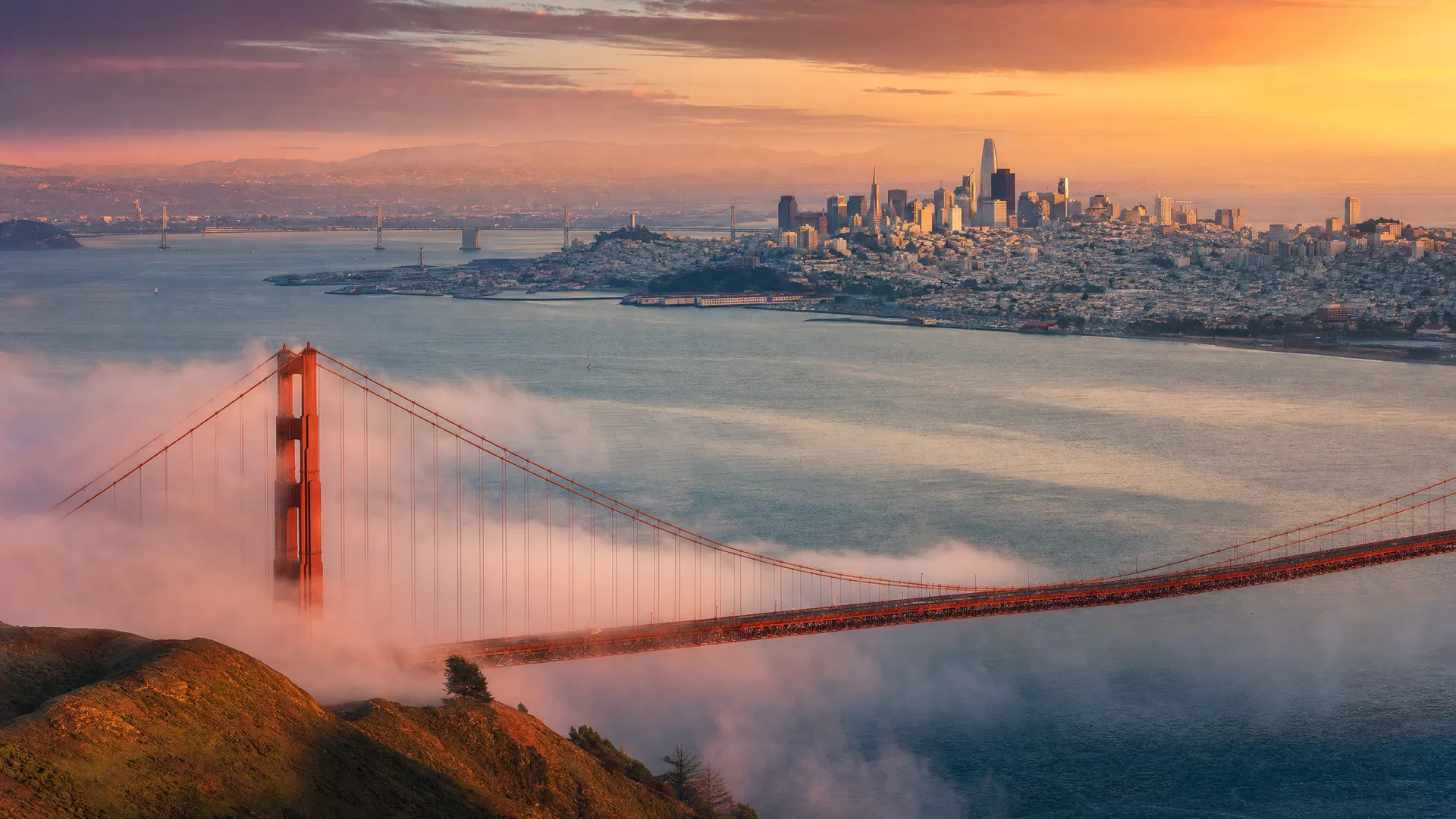
San Francisco is cold in summer. Not cold like Chicago in February — cold like a city that sits on a peninsula between the Pacific Ocean and a bay, where the temperature differential between the hot Central Valley and the cold ocean pulls fog through the Golden Gate every afternoon from June through August with the reliability of a tide. Mark Twain may or may not have said that the coldest winter he ever spent was a summer in San Francisco — the attribution is disputed — but the sentiment is accurate.
The locals have named the fog. His name is Karl. Karl the Fog has a Twitter account with 400,000 followers. This tells you everything you need to know about how San Franciscans relate to the weather: with affection, with humor, and with a light jacket that they carry everywhere regardless of what the morning looked like.
The best time to visit San Francisco is September and October. This is the city's secret — the "Indian Summer" that arrives after Karl retreats, when the temperatures climb to the low 70s, the sky turns the particular shade of blue that makes the bay look like a painting, and the city is at its most golden and most itself. The tourists have largely gone home. The locals are outside. The light in the late afternoon is extraordinary.
If you come in summer, bring layers. If you come in fall, bring sunscreen and wonder.
The Neighborhoods Are the City
San Francisco is 49 square miles. It is, by American standards, tiny. But within those 49 square miles are more distinct, fully realized neighborhoods than most cities ten times its size can claim. Understanding this is the key to understanding the city.
The Mission District is where you start. It is the warmest neighborhood in the city — sheltered from the fog by the hills to the west — and it is the most alive. The Mission has been the city's Latino heart since the 1960s, and the murals that cover its walls are among the most significant public art in America. Walk down 24th Street and count them. They are on every available surface: political murals, memorial murals, murals celebrating Día de los Muertos, murals of Frida Kahlo and Cesar Chavez and local heroes whose names you won't recognize but whose faces you won't forget.
The Mission is also where you eat. La Taqueria on Mission Street makes what many people — including, at various points, a James Beard Award committee — consider the definitive Mission burrito. The debate about whether La Taqueria or El Farolito or Taqueria Cancún makes the best burrito is the kind of argument that San Franciscans have with the same intensity that other cities reserve for sports teams. Participate in it. Try all three. Form your own opinion. This is the correct approach.
Tartine Bakery on Guerrero Street opens at 5pm on weekdays and the line forms before that. The country bread — a naturally leavened sourdough that has been described as the best bread in America by people who have eaten bread in America for decades — comes out of the oven at 5pm and sells out within the hour. The morning bun, a croissant dough rolled in orange zest and cinnamon sugar, is one of the great pastries on the continent. Go early. Go often. Don't apologize for the line.
Dolores Park is the Mission's living room — a hillside park with a view of the downtown skyline that is, on a clear day, one of the best views in the city. On weekends, the park fills with everyone: families, dog walkers, musicians, people selling homemade tamales and cannabis-infused lemonade, couples reading, groups playing volleyball, and the occasional person in a full Victorian costume because this is San Francisco and that is a normal thing. Bring food from the Mission, find a spot on the hill, and spend an afternoon doing absolutely nothing productive. This is not wasted time. This is the city working on you.
The Castro is the historic heart of LGBTQ+ San Francisco — a neighborhood that has been a center of queer culture and politics since the 1970s, when Harvey Milk opened his camera shop on Castro Street and began building the movement that would change American civil rights history. The GLBT Historical Society Museum on 18th Street is small but genuinely moving, and the neighborhood itself is worth walking slowly, reading the plaques and the history embedded in the sidewalks and storefronts. The Castro Theatre, a 1922 movie palace with a Wurlitzer organ that plays before screenings, is one of the most beautiful movie theaters in America and still shows films.
Haight-Ashbury is where the Summer of Love happened, and the neighborhood has been living with that legacy ever since — sometimes gracefully, sometimes not. The Victorian houses here are extraordinary: painted in colors that would be garish anywhere else and are somehow perfect here, their bay windows and elaborate woodwork catching the afternoon light in ways that make you understand why people spend their entire lives in this city. The intersection of Haight and Ashbury is a pilgrimage site for a certain kind of traveler. The Haight Ashbury Free Clinic, founded in 1967, still operates. Some things are worth honoring.
Chinatown is the oldest in North America — established in 1848, the same year as the Gold Rush — and it is not a museum piece. It is a living, working neighborhood where grandmothers do their grocery shopping and restaurants that have been open for 80 years serve dim sum to the same families who have been coming for three generations. Grant Avenue is the tourist-facing main street; Stockton Street, one block west, is where the actual neighborhood does its actual business. Go to Stockton Street. Buy a pork bun from a bakery that doesn't have a sign in English. Eat it on the sidewalk.
The Iconic Things Are Iconic for a Reason
Alcatraz is not a tourist trap. It is one of the most genuinely fascinating places in California, and the audio tour — narrated by former guards and inmates — is among the best museum experiences in the country. The ferry ride across the bay takes 15 minutes and the view of the city from the water, with the Bay Bridge and the hills and the skyline arranged like a postcard that somehow exceeds the postcard, is worth the ticket price alone. Book in advance. Alcatraz sells out weeks ahead in summer.
The Golden Gate Bridge is more beautiful in person than in any photograph, which is saying something given that it is one of the most photographed structures in human history. The International Orange color — chosen because it was already on the steel as a primer and an engineer's wife thought it was beautiful — catches the light in a way that changes by the hour. Walk across it. The full crossing is 1.7 miles each way and takes about 45 minutes. The wind will be significant. The views will be worth every gust.
The best view of the bridge is not from the bridge. It is from the Marin Headlands, accessible by crossing the bridge and turning right into the hills. The view from Hawk Hill — a 20-minute hike from the parking area — shows the bridge, the bay, the city, and the Pacific all at once. It is the view that makes people understand why San Francisco exists where it does.
The Ferry Building on the Embarcadero is a farmers' market, a food hall, and an argument about what American food can be, all in one beautiful 1898 building. On Tuesday and Saturday mornings, the market outside fills with the best produce in California — which is to say, some of the best produce on earth. Inside, Hog Island Oyster Company serves oysters from their farm in Tomales Bay, 40 miles north, that taste like the cold Pacific distilled into something you can eat in one bite. Blue Bottle Coffee started here. Acme Bread sells bread here. Cowgirl Creamery sells cheese here. Go hungry. Stay for hours.
Swan Oyster Depot on Polk Street has been open since 1912 and has not changed its formula once. It is a counter — literally a marble counter with stools — where you eat the freshest seafood in the city, served by people who have been working there for decades, in a room that holds maybe 20 people. The wait can be two hours. It is worth two hours. Order the Dungeness crab, the clam chowder, and whatever the fresh catch is that day. Eat slowly. Talk to the person next to you. This is what San Francisco was before it became famous for being San Francisco.
The Food City That Doesn't Get Enough Credit
San Francisco invented the modern American food movement. Not New York, not Los Angeles — San Francisco. Alice Waters opened Chez Panisse in Berkeley in 1971 and essentially created the farm-to-table philosophy that now dominates American fine dining. The Ferry Building farmers' market, the Mission burrito, the sourdough that has been made here since the Gold Rush using a starter culture that is over 150 years old — these are not trends. They are the foundation.
The city's dim sum is among the best outside of Hong Kong. Yank Sing in the Financial District is the classic choice — expensive by dim sum standards, extraordinary by any other standard. For a more local experience, Ton Kiang in the Richmond District serves Hakka-style dim sum that is different from the Cantonese standard and worth the trip to the outer neighborhoods.
The Richmond District, stretching west from Arguello Boulevard toward the ocean, is one of the most undervisited neighborhoods in the city and one of the best for eating. Clement Street is the city's "second Chinatown" — a dense strip of Chinese, Vietnamese, Korean, and Russian restaurants and bakeries that serves the neighborhood's residents rather than tourists. The Green Apple Books on Clement Street is one of the best independent bookstores in America. The Burma Superstar on Clement Street has a line every night and is worth the line.
Beyond the City: The Bay Area as a Whole
San Francisco is the center of a region, and the region is extraordinary.
Muir Woods, 12 miles north of the city, is a grove of old-growth coastal redwoods — trees that were already ancient when the Gold Rush happened, that survived the logging that cleared most of the Bay Area's forests, that now stand 250 feet tall in a cathedral silence that stops conversation. Go on a weekday morning. The shuttle from Sausalito is the easiest way to get there without a car.
Point Reyes National Seashore, an hour north, is one of the most dramatic coastlines in California: a peninsula of cliffs and beaches and dairy farms and tule elk that juts into the Pacific and catches the full force of the ocean. The oysters from Tomales Bay, on the eastern edge of the peninsula, are the same ones you'll eat at the Ferry Building. The lighthouse at the tip of the point, accessible via a 300-step staircase, looks out over water where gray whales migrate from December through April.
Sausalito, just across the Golden Gate, is a small waterfront town of houseboats and art galleries and restaurants with views of the bay that are, frankly, better than the views from San Francisco itself. The ferry from the Ferry Building to Sausalito takes 30 minutes and costs less than a taxi. Take it.
Planning Your San Francisco Trip: The Ask Leif Guides
San Francisco rewards every type of traveler, and we've built the guides to prove it.
If you want the complete San Francisco experience — neighborhoods, food, iconic landmarks, the bay — our San Francisco in 5 Days: Iconic Landmarks, Food & Neighborhoods is the definitive first-timer's guide. Five days, fully mapped, with the right balance of must-sees and local discoveries.
For a quick but complete weekend, our San Francisco Weekend Getaway: Fog, Food, and the City That Never Gets Old covers the Golden Gate Bridge, Mission burritos, Alcatraz, the Ferry Building, and the neighborhoods locals actually love — with real logistics, real prices, and real insider knowledge.
Traveling on a budget? San Francisco has a reputation for being expensive, and it is — if you stay in the wrong hotels and eat in the wrong restaurants. Our San Francisco on a Budget: 4-Day Itinerary Under $90/Day shows you the free museums, neighborhood food crawls, free parks, and the city's best experiences that don't cost $50 each.
Bringing the family? The city is more kid-friendly than its reputation suggests. Our 5-Day San Francisco Family Vacation: Kid-Friendly Fun & Iconic Sights covers the Exploratorium, Golden Gate Park, Alcatraz, and the city's most genuinely engaging experiences for kids of every age.
For the food obsessives — the people who plan trips around meals — our 4-Day San Francisco Food Lover's Itinerary: Crab, Sourdough & Mission Burritos is the most comprehensive eating guide to the city we've ever written. Dungeness crab, sourdough, Mission burritos, dim sum, and the most diverse food city in America.
For couples looking for romance without the tourist crowds, our Romantic San Francisco Weekend: A Couple's 3-Day Escape takes you through the city's most beautiful and intimate experiences — from Dolores Park at sunset to a private table at a neighborhood restaurant that doesn't need a Michelin star to be extraordinary.
And for the adventurers who want to see San Francisco from the trails and the water, our San Francisco Outdoor Adventure: 4-Day Bay Area Hiking & Nature Escape covers the Marin Headlands, Point Reyes National Seashore, Mount Tamalpais, Angel Island, and Muir Woods — the natural world that surrounds one of America's most urban cities.
The Practical Things Worth Knowing
San Francisco's BART (Bay Area Rapid Transit) connects the airport to downtown in 30 minutes and runs throughout the East Bay. Within the city, Muni — the municipal transit system — covers most neighborhoods, though the buses can be unreliable. The cable cars are slow, expensive, and genuinely wonderful: a moving piece of history that has been climbing these hills since 1873. Take one at least once, ideally the Powell-Hyde line, which crests the hill at Taylor and offers a view of Alcatraz and the bay that will stop your breath.
Walking is the best way to experience San Francisco, with the caveat that the hills are real. The climb from the Embarcadero to Coit Tower is steep. The descent from Nob Hill to the Tenderloin is steep. Wear shoes that mean it.
Uber and Lyft are cheaper and more reliable than taxis. Parking is expensive, scarce, and not worth the stress — leave the car at the hotel.
Budget: San Francisco is expensive. A mid-range hotel in a good neighborhood will run $200–350 per night. A meal at a good restaurant without wine is $30–60 per person. The good news is that many of the best experiences — the parks, the neighborhoods, the views, the farmers' market — are free.
Safety: San Francisco has real challenges in certain neighborhoods, particularly around the Tenderloin and parts of SoMa. These are not areas to avoid entirely, but they are areas to navigate with awareness. The tourist areas — the Embarcadero, Union Square, Fisherman's Wharf, the Mission, the Castro — are safe and well-traveled.
What San Francisco Actually Is
Here is the thing about San Francisco that no travel guide adequately captures: it is a city that has been, at various points in its history, the most important city in America. The Gold Rush made it the economic center of the West. The Beat Generation made it the cultural capital of a new American consciousness. The Summer of Love made it the symbolic center of a generation's hope. The AIDS crisis made it the center of one of the most significant civil rights struggles of the 20th century. The tech boom made it the center of the most consequential economic transformation since the Industrial Revolution.
Every one of those histories is still present in the city. You can walk from the Financial District — built on landfill over the bay where Gold Rush ships were abandoned — to the Haight — where the Summer of Love happened — to the Castro — where Harvey Milk was assassinated and where the AIDS Memorial Grove in Golden Gate Park honors 100,000 dead — in an afternoon. The city is a palimpsest: every era written over the last, none of them fully erased.
That density of history, compressed into 49 square miles, is what makes San Francisco unlike any other American city. New York is larger and more powerful. Los Angeles is more sprawling and more influential in culture. Chicago is more architecturally significant. But no American city carries its history the way San Francisco does — with pride and grief and argument and beauty, all at once, in a fog that rolls in every afternoon and burns off by noon and makes the light, when it comes, feel like something earned.
Go to San Francisco. Walk its hills. Eat its food. Stand on the Marin Headlands and look back at the city across the water and understand why people have been coming here, from everywhere, for 175 years, looking for something they couldn't find anywhere else.
Some of them found it. Some of them are still looking.
That's the city. That's always been the city.
Ready to plan your San Francisco trip? Use the Ask Leif itinerary builder to create a personalized day-by-day plan tailored to your travel style, budget, and dates — in under 60 seconds.