Queenstown Didn't Become the Adventure Capital. It Invented the Category.
Destination: Queenstown, New Zealand
Category: Destinations
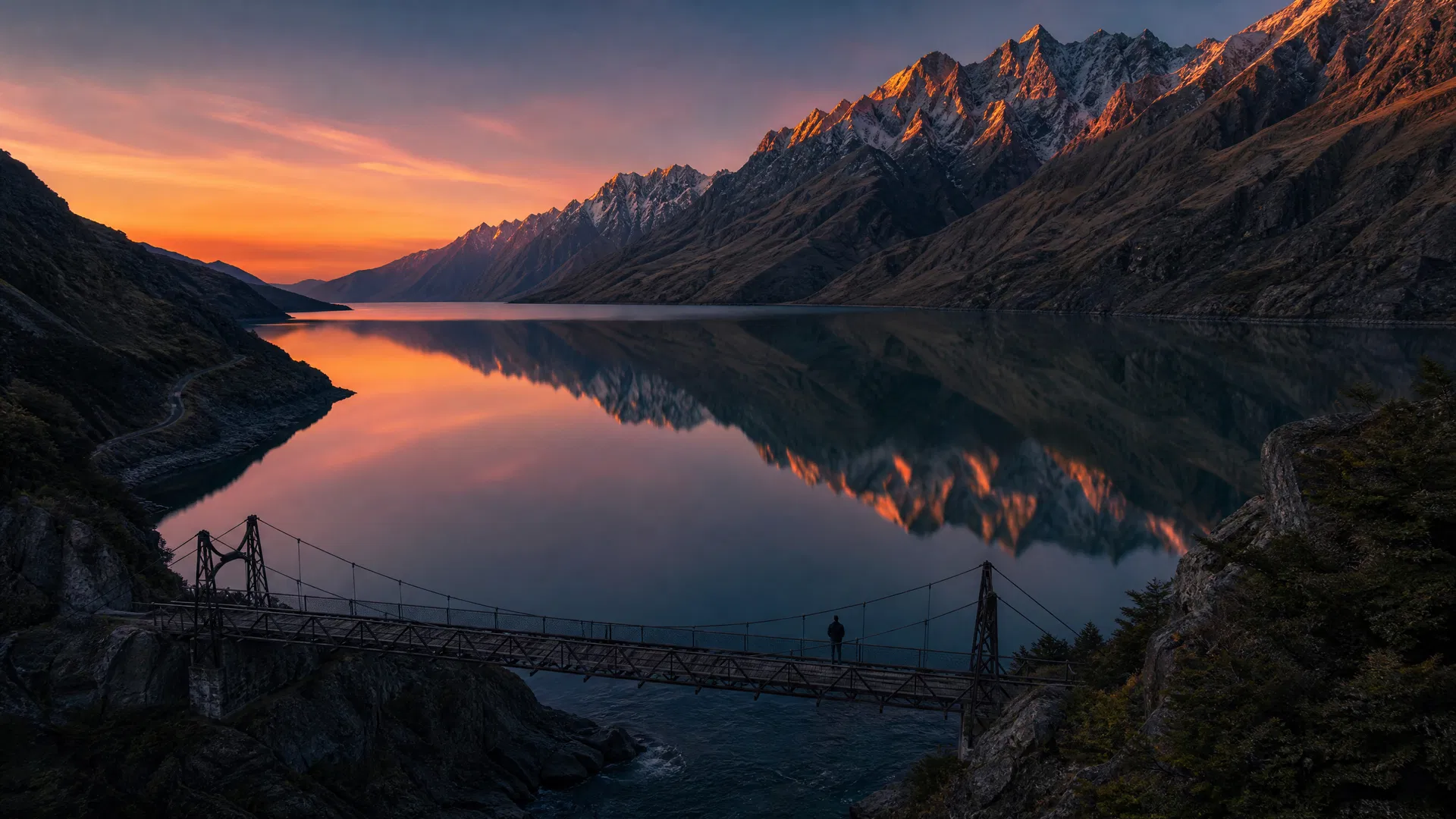
Every few minutes, Lake Wakatipu — the glacial heart of Queenstown, New Zealand — moves.
Not from wind. Not from current. The lake rises and falls roughly 20 centimeters on a cycle that has nothing to do with weather or tide — a slow, rhythmic pulse that scientists attribute to changes in atmospheric pressure but that the Māori understood long before anyone had a word for barometric anything. According to the legend of Whakatipu Wai Māori, the lake was formed when a warrior named Matakauri set fire to a sleeping giant named Matau, who had kidnapped the woman Matakauri loved. The fire burned so deep into the earth that it carved the S-shaped hollow that became the lake. The surrounding mountains melted into water. And Matau's heart — which could not be destroyed — kept beating.
Queenstown sits at the giant's knee. Glenorchy, 45 minutes north, sits at his head. Kingston, at the far southern end, sits at his feet. The lake still pulses. If you stand on the waterfront long enough and watch carefully, you can see it.
This is the first thing to understand about Queenstown: it was a dramatic place before anyone decided to make money from drama.
The second thing to understand is that someone did decide to make money from drama — specifically, from the human desire to stand at the edge of something terrifying and jump. And when that decision was made, in November 1988, on a 43-meter bridge over the Kawarau River about 20 minutes east of town, it didn't just launch a product. It launched an industry. Twenty-eight people paid $75 each to be the first commercial bungee jumpers in the world. AJ Hackett and Henry van Asch had invented a category — not just an activity, but a business model for controlled fear — and the world has been copying it ever since.
Every adventure destination you've ever heard of is operating on a template that Queenstown wrote. Understanding that changes how you experience everything here.
The Bridge That Started Everything
The Kawarau Bridge Bungy is not the highest jump in Queenstown. The Nevis, 134 meters above a river gorge, holds that distinction. The Ledge, above the town itself, offers the best views. But the Kawarau is the one that matters, because the Kawarau is where the category was invented.
On November 12, 1988, AJ Hackett opened the world's first commercial bungee operation at this bridge. The bridge itself had been there since 1880 — a suspension bridge over the Kawarau Gorge that once served the gold rush miners moving between Queenstown and the Arrow River fields. Hackett had already made headlines by jumping off the Eiffel Tower in 1987 (illegally, which was the point). He'd spent years developing the elastic cord technology with van Asch, refining the physics of deceleration, working out how to make something genuinely dangerous feel genuinely safe. Then he found the bridge, negotiated with the local council, and opened for business.
The first 28 jumpers paid $75 each. By the end of the first year, thousands had jumped. Within a decade, bungee operations had opened on every continent. The Kawarau Bridge is now a museum as much as an attraction — you can watch jumpers from a viewing platform, walk through the history of the jump, and understand exactly how a single moment of commercial audacity in a small New Zealand town rewired the global tourism industry.
If you're going to jump anywhere in Queenstown, jump here. Not because it's the most extreme option, but because it's the original. There's a difference between doing something and understanding what you're doing. At the Kawarau, you understand.
What Bill Hamilton Built Before Anyone Called It Adventure Tourism
Before the bungee cord, there was the jet boat. And before the jet boat was a tourist attraction, it was a farming problem.
Bill Hamilton was a high-country farmer in Canterbury who needed to cross the shallow, braided rivers that cut across his land. Conventional propeller-driven boats couldn't handle water that shallow. So in the 1950s, Hamilton invented a water jet propulsion system — a pump that draws water in through the hull and expels it at high pressure through a nozzle at the stern, requiring no propeller, no draft, capable of operating in water just a few centimeters deep. He built it to work his farm. He didn't build it to thrill tourists.
But by 1960, commercial jet boats were running on the Shotover and Kawarau rivers near Queenstown, and they were doing something that propeller boats couldn't: going fast through shallow gorges, spinning 360 degrees in their own length, getting within centimeters of canyon walls. The Shotover Jet still runs the same gorge today. The 360-degree spin is still the signature move. Hamilton's farming solution became the defining experience of a destination that didn't yet know it was defining itself.
This is the pattern Queenstown keeps repeating: someone solves a practical problem, and the solution turns out to be the most exciting thing anyone has ever done. Hamilton needed to cross rivers. Hackett needed to prove a point about fear. Alan Brady, in 1983, needed to figure out what to do with 20 hectares of schist-rock land in the Gibbston Valley, 25 kilometers east of Queenstown, and planted vines.
The Wine Valley That Grew Up Alongside the Adrenaline Economy
Gibbston Valley is one of the most improbable wine regions on earth. At 300 meters above sea level, with a growing season that barely qualifies as warm enough for viticulture, it should not produce exceptional Pinot Noir. The schist rock that makes the soil look barren actually drains perfectly and retains heat through the night. The temperature swings between day and night — sometimes 20 degrees Celsius in a single day — stress the vines in exactly the way that concentrates flavor. The Gibbston Valley is, in the language of wine, a place where the grapes have to work.
Alan Brady planted the first vines in 1983, five years before the first bungee jump. He produced what is regarded as Central Otago's first commercial Pinot Noir. The wine was not immediately celebrated. The region was not immediately recognized. But Brady had identified something that the adrenaline industry was simultaneously discovering: that this particular corner of the South Island, with its extreme geography and its extreme light and its extreme temperature swings, produced extreme experiences. The wine just happened to be a quieter version of the same argument.
Today, the Gibbston Valley has over a dozen wineries within a few kilometers of each other, most of them carved into the schist rock hillsides. The Queenstown 4-day food guide covers the best of them in detail, but the essential visit is Gibbston Valley Winery itself — not just for the wine, which is excellent, but for the cave cellar carved directly into the schist cliff face, where the temperature stays constant year-round and the Pinot Noir ages in the dark while, 25 kilometers away, people are throwing themselves off bridges.
The contrast is the point. Queenstown built an economy around two completely different answers to the same question: what do you do with a landscape this extreme? You can jump off it. Or you can grow something in it that could not grow anywhere else.
Arrowtown: The Version That Predates Everything
Thirty minutes east of Queenstown, past the Kawarau Bridge, past the entrance to Gibbston Valley, the road narrows and the landscape shifts from alpine drama to something older and quieter. Arrowtown is a gold rush town that has been a gold rush town since 1862, when gold was discovered in the Arrow River and a population of several thousand descended on a valley that had previously held almost no one.
The gold rush lasted about a decade. When it ended, most of the miners left. Some stayed. The town they left behind is one of the best-preserved gold rush settlements in the Southern Hemisphere — a main street of stone and timber buildings that have barely changed since the 1870s, surrounded by willow trees that turn gold in autumn, backed by the Crown Range.
The Chinese Settlement at the edge of town is the detail that most visitors miss. When the easily accessible gold ran out in the 1860s, Chinese miners were invited by the Otago Provincial Government to work the depleted fields that European miners had abandoned. They came in significant numbers, built their own settlement, and were systematically marginalized — taxed separately, excluded from many areas, their contributions to the gold rush largely erased from the official history. The settlement is now a preserved archaeological site, a collection of stone foundations and reconstructed huts that tells the part of the story that the main street doesn't.
Dorothy Browns Cinema, on Buckingham Street, is the other thing most visitors miss. It is a small, independent cinema in a historic building with armchair seating, a bookshop, and a gin bar. It screens art house films and international cinema in a room that seats perhaps 60 people. It is the kind of place that exists because a town has been a town long enough to develop the specific cultural infrastructure that only comes with time. Arrowtown has been a town since 1862. Queenstown, by comparison, is still figuring out what it is.
The Queenstown 4-day budget guide includes Arrowtown as a day trip, which is the right call — it's 30 minutes from Queenstown and costs almost nothing to explore. But it deserves more than a day trip framing. It deserves to be understood as the region's oldest layer: the version of this place that existed before anyone had decided that the mountains and rivers were worth paying to be scared by.
Glenorchy and the Edge of the World
The road from Queenstown to Glenorchy runs along the western shore of Lake Wakatipu for 45 minutes, and it is one of the most beautiful drives in New Zealand, which is saying something significant. The lake is on your right, its color shifting between grey and turquoise depending on the light and the weather. The Remarkables are across the water. The road is narrow enough in places that you have to slow down and pay attention, which is the correct way to drive it.
Glenorchy is a small town at the head of the lake — population a few hundred, one pub, one cafe, a handful of accommodation options, and the Dart River valley stretching north into Mount Aspiring National Park. The Dart River is where the Dart River Adventures jet boats run, and where, if you have the time and the fitness, the Rees-Dart Track takes you into some of the most remote alpine terrain in the South Island.
Peter Jackson's location scouts found Glenorchy in the late 1990s, looking for somewhere that could stand in for Middle-earth. The Rees Valley, just north of town, became Isengard. The surrounding mountains became the backdrop for scenes that required a landscape that looked like it had never been touched by human hands. The films brought a certain kind of tourist to Glenorchy — the kind who wants to stand in the valley and feel what it felt like to watch the Uruk-hai march. But the landscape doesn't need the films to justify itself. It was there before Jackson found it, and it will be there long after the last person who remembers the films has gone.
What Glenorchy offers that Queenstown doesn't is silence. The town is too small to be crowded, too remote to be convenient, too beautiful to be ignored. The Queenstown 5-day adventure guide builds in a full day in Glenorchy, and it's the right call — the Dart River jet boat is one of the genuinely great experiences in the region, and the drive alone is worth the 45 minutes each way.
The Remarkables and the Landscape That Earns the Name
The Remarkables are the mountain range that forms the eastern wall of the Wakatipu Basin. They were named by early European settlers who found the sight of them remarkable — a flat-topped ridge of peaks rising almost vertically from the lake, the kind of geological formation that looks like it was designed for maximum visual impact. They were formed by glaciers cutting through the Southern Alps over millions of years, and they look it: sharp-edged, high, and completely indifferent to the town that has grown up at their base.
In winter, the Remarkables ski field operates on the upper slopes — one of two ski areas near Queenstown, along with Coronet Peak, which was the site of the first commercial ski tow in the Southern Hemisphere when Bill Hamilton installed a rope tow there in 1947. The skiing is good, though not exceptional by international standards. What's exceptional is the view from the slopes: the lake below, the town below that, the mountains across the water, the scale of the whole basin visible at once.
In summer, the Remarkables are a hiking destination. The Lake Alta track takes you to a glacial lake at 1,800 meters, with views back across the basin that make the climb worth every step. The track is not technically difficult, but it gains elevation quickly and the weather can change fast. Dress for conditions that are worse than the forecast.
What the Critics Get Wrong
The Reddit consensus on Queenstown is that it's a tourist trap — overcrowded, overpriced, and the least authentically New Zealand place in the country. The consensus is not wrong about the facts. It is wrong about the conclusion.
Queenstown is not trying to be authentic New Zealand. It is trying to be the place that invented commercial adventure tourism, and it is succeeding at that specific thing with considerable skill. The town exists because people come from all over the world to be scared in a beautiful place, and it has built an entire infrastructure — the restaurants, the bars, the gondola, the activity operators, the accommodation — around serving those people well. That is not a failure of authenticity. That is a very particular kind of success.
The critics who prefer Wānaka (40 minutes away, quieter, more local in feel) or Arrowtown (30 minutes away, historic, genuinely beautiful) are not wrong to prefer those places. But they are comparing different things. Wānaka is what Queenstown might have been if the bungee cord had landed somewhere else. Arrowtown is what the region was before anyone decided fear was a product. Queenstown is what happens when a place decides to be the best in the world at one specific thing and then keeps inventing new versions of that thing for 35 years.
The question is not whether Queenstown is a tourist town. It obviously is. The question is whether what it offers is worth the price of admission. And the answer, for the specific thing it offers — the experience of being in the place that invented the category — is yes.
When to Go and What It Actually Costs
Queenstown has two peak seasons and they are genuinely different experiences. Summer (December to February) brings long days, warm temperatures, and the full complement of water-based activities — jet boating, kayaking, river rafting, the Dart River. The town is at its most crowded and its most expensive. Winter (June to August) brings the ski season, shorter days, and a different crowd — more serious about the mountains, less interested in the bungee queue. The shoulder seasons (March to May, September to November) are the best time to visit if you want the landscape without the crowds, though some activities have limited availability.
The honest answer on cost: Queenstown is expensive. Not European-capital expensive, but expensive for New Zealand, which is already not a cheap destination. Budget NZ$150–250 per person per day for accommodation, food, and one or two activities. The activities are where the cost accumulates — the Kawarau bungee runs around NZ$200, the Nevis around NZ$275, the Shotover Jet around NZ$165. If you want to do several things, the costs add up quickly. The Queenstown 4-day budget guide has specific strategies for managing this, including which activities are worth the full price and which have cheaper alternatives.
Fergburger, for the record, is not worth the queue. The burger is good. It is not a life-changing burger. The queue can be an hour. There are other options.
Planning Your Queenstown Trip with Leif
The challenge with Queenstown isn't finding things to do. It's sequencing them. The bungee and the jet boat and the wine valley and Arrowtown and Glenorchy don't fit into two days, and trying to force them does. The Queenstown 5-day adventure guide is built around the assumption that you need at least five days to do the region properly — one day for the adventure activities in and around town, one day for Gibbston Valley, one day for Arrowtown, one day for Glenorchy, and one day for the mountains. That's before you factor in the ski season, which changes the calculus entirely.
Leif's itinerary generator is built for exactly this kind of planning problem: a destination with too many options, a limited window, and the need to make choices that you won't regret. Tell Leif your travel dates, your budget, and whether you're coming for the adrenaline or the wine or the history or some combination of all three, and it will build a day-by-day sequence that doesn't try to do everything — just the right things, in the right order, with the right amount of time at each.
The Queenstown 4-day food guide and the New Zealand 14-day road trip guide are also worth reviewing before you go — the first for the specific restaurant and winery recommendations that make the food side of Queenstown genuinely worth planning around, the second if Queenstown is one stop on a longer South Island journey rather than the destination itself.
The Giant's Heartbeat
Stand on the Queenstown waterfront at dusk, when the Remarkables have gone pink and the lake has gone dark, and watch the water. If you're patient, you'll see it — the slow rise and fall, the pulse that has no obvious cause, the rhythm that the Māori understood as the still-beating heart of a giant who could not be killed.
The town behind you was built on the same principle. Someone looked at this landscape — the glacial lake, the schist gorges, the rivers that ran too shallow for normal boats, the mountains that were too extreme for normal agriculture — and decided that the extremity itself was the product.
Every adventure destination in the world is operating on a version of that logic. Queenstown wrote it first. The lake still proves it, every five minutes, without fail. So is the town.