Positano Has Been Performing Its Own Beauty Since 1953. It Still Hasn't Run Out of Material.
Destination: Positano, Italy
Category: destination
It is 6:47 in the morning and the town does not know you are watching.
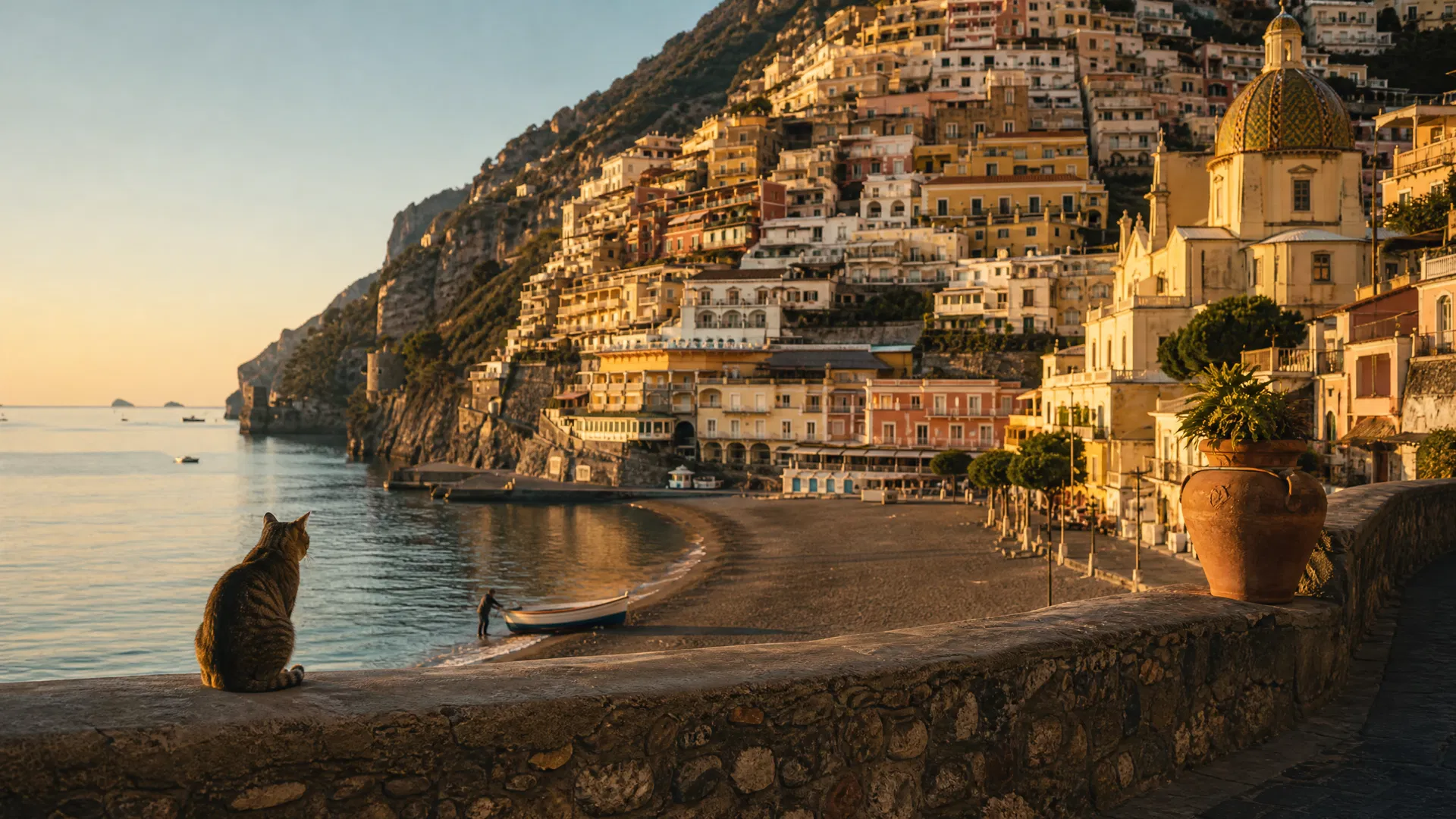
The fishermen have already been out and come back. The woman who runs the bar on Via dei Mulini has opened the metal shutters and is arranging pastries in the glass case. A cat is sitting on the stone wall above the Spiaggia Grande, looking at the water with the particular indifference of an animal that has seen this view every day of its life and has no opinion about it. The pastel buildings — the terracotta and ochre and pale yellow stacked up the cliff face like a painting someone left out in the sun — are catching the early light in a way that is not, technically, possible to photograph. You will try anyway.
This is Positano before 8:30am. Before the first ferry arrives from Amalfi. Before the tour buses from Sorrento discharge their passengers at the top of Via Cristoforo Colombo and the long, slow descent begins. Before the town becomes, once again, the most photographed village in Italy and starts performing the version of itself that John Steinbeck described in 1953 and that it has been performing, with remarkable consistency, ever since.
The question worth asking — the one that separates a good Positano trip from a mediocre one — is not whether the performance is worth seeing. It is whether you can find the thing underneath it.
The Steinbeck Problem
In the summer of 1953, John Steinbeck came to Positano and wrote an essay for Harper's Bazaar. It was not a travel piece in any conventional sense. It was a love letter to a place that had not yet been discovered by the kind of people who write love letters to places. "Positano bites deep," he wrote. "It is a dream place that isn't quite real when you are there and becomes beckoningly real after you have gone."
That sentence did something to Positano that no amount of Instagram content has managed to replicate or undo. It named the feeling precisely. The dream-place quality. The way the memory of the town is more vivid than the experience of being in it. The way you spend the entire time you are there already missing it.
What Steinbeck could not have anticipated was that his essay would become the founding document of Positano's self-mythology. Within a decade of its publication, the village — which had been a quiet fishing community of a few thousand people, accessible mainly by boat and known primarily to artists and writers who had discovered it in the 1930s — began to transform into the destination it is today. The Amalfi Coast road had been completed in 1931. The postwar economic boom was creating a new Italian middle class with leisure time. And Steinbeck had given the place a sentence that every subsequent visitor would either consciously or unconsciously carry with them.
By the 1960s, Positano had become a fixture of the international jet set. Jackie Kennedy came. Franco Zeffirelli came. Rudolf Nureyev, who would later buy the largest of the Li Galli islands just offshore, came and kept coming. The boutiques selling hand-painted ceramics and lemon-print linens multiplied. The fishing boats were joined by tourist ferries. The population of roughly 3,800 permanent residents began hosting, by some estimates, four million visitors per year.
What is remarkable is not that this happened. What is remarkable is that the thing Steinbeck named survived it.
The Two-Hour Window
The first SITA bus from Sorrento departs at 6:30am and arrives at the upper bus stop on Via Cristoforo Colombo at approximately 7:15am. The first ferry from Amalfi does not depart until 9:00am. This means there is a window — roughly 6:30 to 8:30am — when Positano belongs to the people who slept there the night before.
If you are staying in Positano, this window is the most important piece of practical information you will receive. Set the alarm. Go down to the Spiaggia Grande before the beach attendants have finished arranging the sunbeds. Walk the Via Positanesi d'America — the long staircase that descends from the main road through the heart of the old town, past the ceramic-tiled doorways and the bougainvillea spilling over the walls, all the way down to the beach. At 7am, you will have it almost entirely to yourself. At 10am, it will be a slow-moving queue of people taking photographs of the same three doorways.
The Via Positanesi d'America is named for the Positanese who emigrated to the United States in the early twentieth century and sent money back to build the staircase. It is the town's spine — the route that connects the upper residential neighborhoods to the beach, the route that every local uses every day, the route that most tourists discover only by accident. Walking it in the early morning, when the light is coming in at a low angle and the town is still making coffee and the church of Santa Maria Assunta is just opening its doors, is the closest thing to understanding what Steinbeck was describing.
The church itself is worth the early morning. The dome is covered in majolica tiles in a pattern of yellow, green, and white — visible from the beach, from the water, from the path above the town. Inside, above the altar, is a thirteenth-century Byzantine icon of the Black Madonna, brought to Positano by sailors who, according to the legend, heard a voice from the sea commanding them to stop. The story is probably apocryphal. The icon is genuinely old and genuinely strange and genuinely worth seeing before the tour groups arrive.
The Village Above
Most visitors to Positano never look up. They are too busy looking at the water, at the buildings, at each other. This is understandable. But directly above the town, at an elevation of roughly 400 meters, is a village called Montepertuso that most of them will never find.
Montepertuso is technically part of Positano — it has a Positano postal address — but it is a different world. About 200 people live there. The road up is narrow enough that passing another car requires one of you to reverse to the nearest widening. The view from the village looks down at Positano from above — the reverse angle, the one that shows you the town as a geological fact rather than a tourist destination, a cluster of buildings clinging to a cliff face above a sea that does not particularly care whether they are there.
Above Montepertuso, carved through the limestone ridge by centuries of water erosion, is a natural rock arch called La Porta — The Door. Local legend holds that the devil challenged the Madonna to a contest: whoever could pierce the rock would claim the mountain. The Madonna pierced it with a single touch. The devil tried and failed, and the mountain remained sacred. The arch is about 15 meters across. Standing beneath it and looking through to the sky on the other side is one of those experiences that is difficult to explain and easy to remember.
The practical reason to go to Montepertuso is La Tagliata. It is a family restaurant with no menu. You sit down, and the family brings you food — antipasto, pasta, secondo, contorno, dessert, wine, limoncello — until you ask them to stop, which most people do not do for a considerable amount of time. The price is approximately €35–45 per person for everything. The restaurant provides a free shuttle from Positano. The food is not the point, exactly — or rather, the food is entirely the point in the way that the food at your grandmother's house is the point, which is to say it is inseparable from the context of being fed by people who are genuinely pleased you came.
Il Ritrovo, also in Montepertuso, operates on a similar principle but with a conventional menu. The owner, Salvatore, will pick you up from your hotel in Positano. The scialatielli — the thick, short pasta that is the Amalfi Coast's own invention, created in 1978 by chef Enrico Cosentino at the Ristorante La Caravella in Amalfi — is made fresh each morning. The terrace looks down at the town and the sea simultaneously, which is a view that requires a moment to process.
The Water
From the beach at Positano, on a clear day, you can see three small islands sitting in the water about three kilometers offshore. They are called Li Galli — the Roosters — though they are also known as Le Sirenuse, the Sirens, because ancient sailors believed this was where the Sirens of the Odyssey lived and lured ships onto the rocks. The largest island is called Gallo Lungo. It is shaped like a crescent and has a Saracen watchtower on its highest point.
From 1988 until his death in January 1993, Rudolf Nureyev owned Gallo Lungo. He had bought it from the choreographer Léonide Massine, who had built a villa there in the 1920s and installed a dance studio on the roof. Nureyev spent his final years on the island, dancing on the roof studio when his health permitted, watching Positano from a distance. The islands are now privately owned and cannot be visited. But water taxis from the Spiaggia Grande will take you near them — close enough to see the tower, the villa, the dance studio — for approximately €80 round trip. The boat ride takes about twenty minutes each way and the view of Positano from the water, looking back at the cliff face with the town stacked up it, is the view that Steinbeck was trying to describe and that no photograph has ever quite captured.
Fornillo beach, a ten-minute walk west from the Spiaggia Grande along the cliff path past the Hotel Pupetto, is the beach that locals use when they want to be at the beach without being at the beach. It is smaller — about 80 meters of pebbles compared to the 300 meters of the Spiaggia Grande — and it has no road access. This is the structural fact that makes it quieter: the day-tripper buses cannot reach it. The sunbeds cost approximately €15 less per day than at the Spiaggia Grande. The bar at the back of the beach serves a spritz that is, by general consensus among the people who know, the best spritz in Positano.
What to Eat
The Amalfi Coast has its own food culture, and it is not Italian food in the generic sense. It is specifically Campanian, specifically coastal, and in several cases specifically invented here.
The scialatielli is the place to start. It is a pasta that does not exist in the same form anywhere else in Italy — thick, short, slightly irregular, with a texture that is closer to fresh egg pasta than to dried pasta but is made without eggs, using milk and basil in the dough. Enrico Cosentino invented it in 1978 at the Ristorante La Caravella in Amalfi and won a national pasta competition with it the same year. The canonical preparation is ai frutti di mare — with clams, mussels, prawns, and whatever else came off the boats that morning. Order it at any restaurant that makes it fresh. Avoid it at restaurants that serve it from a bag.
The delizia al limone is the dessert. It is a dome of sponge cake soaked in limoncello cream, glazed with more limoncello cream, and served cold. It was invented at Sal De Riso's pastry shop in Minori — a small town about 8 kilometers east of Positano — in the 1970s, and it has since become the signature dessert of the entire coast. The lemons used to make it are the sfusato amalfitano, a protected IGP variety grown exclusively on the terraced hillsides of the Amalfi Coast. They are larger than standard lemons, with a thicker pith and a lower acidity, and they are grown on terraces called macere — dry stone walls built into the cliff face, some of them dating to medieval times. The cultivation is in decline. The terraces require intensive hand labor that younger generations are not continuing. The sfusato amalfitano lemon may be, within a generation, a memory.
For the best meal in Positano that does not require a reservation six weeks in advance or a budget that implies a different kind of trip, go to Saraceno d'Oro on Via Pasitea 254, in the Fornillo neighborhood. It has been open since 1964. The same family has run it since the beginning. The pizza from the wood oven is, by the consensus of people who have eaten a great deal of pizza in a great many places, the best pizza in Positano. The €€ pricing is not a typo. Sit outside if possible. Ask for Elia.
The Path Down
The Sentiero degli Dei — the Path of the Gods — is a 7.8-kilometer hiking trail that runs along the ridge above the Amalfi Coast between the village of Agerola and the hamlet of Nocelle. It is one of the most spectacular coastal walks in Europe, and it is one of the few experiences on the Amalfi Coast that costs nothing and requires no reservation.
Nocelle is a hamlet of approximately 30 people perched on the cliff above Positano at an elevation of about 450 meters. It has a bar, a restaurant, and a view that makes the Positano beach look like a postage stamp. From Nocelle, a staircase of 1,700 steps descends directly into Positano — down through the terraced lemon groves, past the macere walls, through the upper residential neighborhoods, and eventually to the Via Positanesi d'America and the beach.
Almost no travel content mentions this as an ending point. The standard advice is to take the Path of the Gods from Agerola to Nocelle and then take a bus back down. But the descent from Nocelle into Positano on foot — 1,700 steps, roughly 45 minutes, through the part of the town that tourists never see — is the best way to arrive in Positano that exists. You come down through the town from above, through the neighborhoods where people actually live, past the vegetable gardens and the laundry lines and the cats that have no opinion about the view, and you arrive at the beach having earned it in a way that the ferry from Sorrento does not allow.
When to Go
May and early June are the best months. The weather is warm enough for the beach — water temperature around 20°C — but the crowds are a fraction of what they are in July and August. The lemon groves are in full fruit. The restaurants are not yet operating at the defensive, high-volume mode that July requires.
September and October are the second choice. The water is warmer than in May (it peaks around 25°C in August and retains heat through September), the light is different — lower, more golden, the kind of light that makes the buildings look like they are lit from inside — and the crowds thin noticeably after the Italian school year begins in mid-September.
July and August are the months to avoid if you have any flexibility. The town receives more visitors in these two months than in the rest of the year combined. The ferry queues start before 9am. The SITA buses are full before they reach the first stop. The beach is a negotiation. The restaurants are operating at a pace that does not favor the food.
November through March, Positano is largely closed. Most hotels, restaurants, and shops shutter between November and Easter. The town that remains is very small and very quiet and, by all accounts of the people who have seen it, genuinely beautiful in a way that is entirely different from the summer version. If you can find accommodation — a handful of places stay open year-round — this is the Positano that has no audience.
Getting There and Around
The most pleasant way to arrive in Positano is by ferry from Naples. The high-speed ferry from the Molo Beverello terminal in Naples takes approximately 65 minutes and costs around €25–30. It deposits you at the Spiaggia Grande, which means your first view of the town is from the water — the correct angle. Ferries run from April through October; the schedule thins significantly in shoulder season.
From Sorrento, the ferry takes about 30 minutes (€15–20). From Amalfi, about 25 minutes (€10–15). Both run frequently in high season.
Do not rent a car. This is not a suggestion. The SS163 Amalfitana — the coastal road — is a single lane in each direction with no shoulders, hairpin turns with blind corners, and a 300-meter cliff on one side. The buses that run it are driven by people who have been driving it for twenty years and have still not fully made peace with it. Driving yourself is not dangerous in the way that a statistics textbook would define dangerous, but it is exhausting in a way that will color everything else about your trip.
The SITA buses run the entire coast from Sorrento to Salerno and are the correct way to move between towns if you are not taking a ferry. The ticket costs €2.50. The bus is often full in high season, and the schedule does not always correspond to reality, but it is infinitely preferable to driving.
Within Positano itself, you walk. Everything is stairs. The town has an elevation change of roughly 200 meters from the upper bus stop to the beach. There is a local orange bus that runs the main road and costs €2, but it only covers the upper section of town. The stairs are the town.
Planning Your Trip
Positano rewards specificity. The difference between a trip that confirms every cynical thing you have heard about the place and a trip that produces the Steinbeck feeling is almost entirely a function of how you structure your time — when you wake up, where you eat, whether you go above the town or only below it.
For couples, the 3-day Positano itinerary is built around the early morning window, the Montepertuso dinner, and a boat day to Li Galli and Fornillo. The 4-day version adds the Sentiero degli Dei descent and a day based in Praiano. Both are structured around the principle that the best of Positano is not on the main beach between 10am and 6pm.
If you are using Positano as a base for the wider coast, the Amalfi Coast 5-day couples itinerary covers Ravello, Atrani, and the smaller towns that most visitors skip. For families, the Amalfi Coast family guide addresses the logistics of the stairs and the ferry schedules with children.
Naples is the natural gateway — the Naples food guide is worth reading before you arrive, because the food culture of the Amalfi Coast is continuous with Naples and not separate from it. The sfusato lemon, the scialatielli, the delizia al limone — they all make more sense in the context of a food tradition that runs from the city to the coast.
The practical details: book accommodation in Positano as far in advance as possible — the good places at reasonable prices go months before the season. If budget is a constraint, Praiano (5km east, half the price, spectacular sunset views from the church of San Gennaro built into the cliff face) is the correct base. The ferry between Praiano and Positano runs frequently in season and takes 10 minutes.
The Thing Underneath
John Steinbeck was right about the feeling. He was also, in a way he could not have intended, responsible for the conditions that make the feeling harder to find. The essay that named Positano's dream-place quality is also the essay that set the machinery of mass tourism in motion. The sentence that captured the thing is also the sentence that began the performance.
But the performance has not consumed the thing. This is what is worth understanding before you go.
At 6:47 in the morning, before the ferries arrive and the buses discharge and the beach attendants begin arranging the sunbeds, the town is still doing what it was doing before Steinbeck arrived. The woman at the bar on Via dei Mulini is arranging pastries. The cat on the wall above the Spiaggia Grande is looking at the water. The church of Santa Maria Assunta is opening its doors. The Via Positanesi d'America is empty except for a man walking down with a bag of groceries, which is what the staircase was built for.
Up in Montepertuso, La Tagliata is starting the sauce. The macere walls on the lemon terraces are holding the hillside in place the way they have been holding it in place for six hundred years. The Sentiero degli Dei is waiting above Nocelle for the first hikers of the morning.
The performance begins at 8:30am. Everything before that is the thing underneath.
Go early. Stay late. Eat the scialatielli. Walk the 1,700 steps down from Nocelle and arrive at the beach having earned it. Look at Li Galli from the water and think about Nureyev dancing on the roof in his last years, watching the town that had been performing itself for decades, performing itself still.
Positano bites deep. It still does. It will.