In Portland, the Wilderness Starts Where the Coffee Shop Ends
Destination: Portland, OR
Category: Destination Guides
You're sitting in a coffee shop on NW 23rd Avenue — third-wave espresso, a window seat, the kind of morning light that makes everything look like it was composed — and you can see, through the glass, the edge of the West Hills. Not a park. Not a greenway. The actual wilderness: Douglas fir and western red cedar climbing a ridge that begins, more or less, where the last building ends. Forest Park is up there, 5,200 acres of it, 80 miles of trails, the largest urban wilderness in the United States, and it starts approximately four blocks from where you're sitting.
This is the thing about Portland that no travel guide adequately explains, because it's not a feature of the city in the way that a museum or a food cart pod is a feature. It's the city's fundamental condition. Portland didn't build itself next to nature and then add parks as an afterthought. Portland built itself inside nature and has been negotiating that relationship ever since. The wilderness isn't a day trip from Portland. It's the edge of Portland. It's visible from downtown on a clear morning. It's the reason the city smells the way it does — that particular combination of rain and fir and coffee that is the Portland smell, the one that hits you when you step off the plane at PDX and tells you that you're somewhere specific.
Every other major American city is defined by what it built. Portland is defined by what it chose not to build — and what it chose to leave alone.
What the Mountain Means
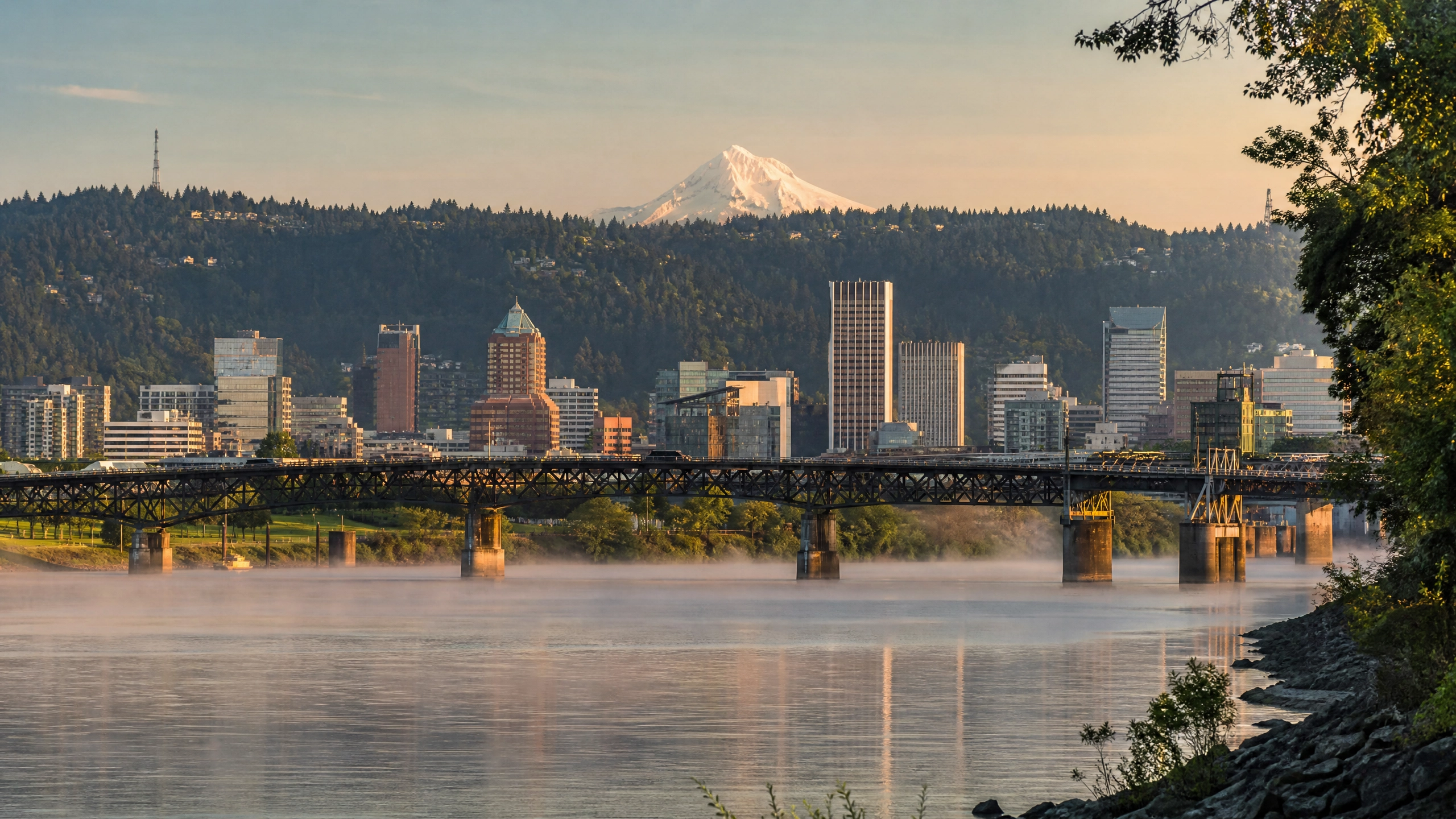
On a clear day, you can see Mount Hood from Portland. Not a smudge on the horizon. The actual mountain: 11,249 feet of volcanic rock and glacier, white-capped and enormous, rising above the Cascades to the east like a fact that the city has decided to organize itself around.
Portland's relationship with Mount Hood is not the relationship of a city to a scenic backdrop. It's the relationship of a city to a compass point. When Portlanders say "heading to the mountain," they mean it the way other cities mean "heading downtown" — it's a direction that everyone understands, a place that everyone goes, a reference point that structures the week. The mountain is 60 miles away and 90 minutes by car, which means it's close enough for a day trip and far enough to feel like a genuine departure. Timberline Lodge, the 1937 Works Progress Administration-built ski resort near the summit, operates year-round — you can ski on Mount Hood in July, which is the kind of sentence that makes sense only in Oregon.
The Columbia River Gorge begins 30 miles east of Portland, where the Columbia River has cut through the Cascades over millions of years to create a canyon 80 miles long and 4,000 feet deep. Multnomah Falls, the most visited natural attraction in Oregon, is there — a 620-foot waterfall that drops in two tiers into a pool at the base of the gorge. The falls are real and worth seeing, but the specific thing to know is that the Historic Columbia River Highway, which runs along the Oregon side of the gorge, passes a dozen other waterfalls — Latourell, Bridal Veil, Wahkeena, Horsetail — that receive a fraction of Multnomah's crowds and are, in several cases, more beautiful. Latourell Falls, the first waterfall you reach heading east from Portland, drops 249 feet in a single plunge over a basalt cliff covered in yellow lichen. On a Tuesday morning in October, you may be the only person there.
The ocean is 90 minutes west. The high desert is 90 minutes east. The Cascades are an hour in any direction. Portland sits in the middle of this geography like a city that won the lottery and decided to spend the winnings on trails.
Forest Park: The Wilderness That Starts at the Stoplight
The boundary between Portland and Forest Park is not a dramatic thing. There's no gate, no sign announcing wilderness, no moment where the city ends and the forest begins. You walk up a residential street in the Northwest neighborhood, the houses get farther apart, the sidewalk ends, and then you're in old-growth forest. The transition takes about four minutes.
Forest Park is 5,200 acres of second-growth Douglas fir, western red cedar, and big-leaf maple on the eastern slope of the Tualatin Mountains, running eight miles along the west edge of the city. The Wildwood Trail, which runs the length of the park for 30 miles, is a National Recreation Trail that connects Forest Park to Washington Park and, eventually, to the Hoyt Arboretum and the Portland Japanese Garden. You can hike from the edge of downtown to a genuine wilderness ridge without crossing a road, which is not something you can say about many cities of Portland's size.
The specific local knowledge about Forest Park is this: most visitors enter from the Thurman Street trailhead, which is the most accessible and therefore the most crowded. The Leif Erikson Drive entrance, farther north, gets you onto a 12-mile unpaved road that runs through the heart of the park and is used primarily by trail runners and mountain bikers who live nearby. On a weekday morning, you can walk Leif Erikson for two hours and see almost nobody. The forest is dense enough that the city disappears within the first quarter mile — no traffic noise, no buildings, just the sound of the creek below and the birds above and the particular quiet of old trees.
The park is also, and this is the thing that surprises people, genuinely wild. There are black-tailed deer, coyotes, and great horned owls in Forest Park. The park's bird list runs to over 112 species. The creek systems — Balch Creek is the cleanest — support native cutthroat trout. This is not a manicured urban park with paved paths and interpretive signs. It's a forest that happens to be inside a city, and it behaves accordingly.
Powell's Books: The Room Where Time Stops
Powell's City of Books occupies a full city block on West Burnside Street in the Pearl District, and it is the largest independent bookstore in the world. This is a fact that gets repeated so often it has lost its power to surprise, which is a shame, because the experience of being inside Powell's for the first time — or the fiftieth time — is genuinely unlike anything else.
The store is divided into color-coded rooms, each one dedicated to a category: the Gold Room for literature, the Rose Room for science and nature, the Blue Room for rare and collectible books. The rooms connect to each other through doorways and stairwells in a layout that is either logical or labyrinthine depending on how you approach it, and the correct approach is to not approach it at all — to walk in without a plan and see what you find. The rare book room, on the second floor of the main building, has first editions and signed copies and out-of-print titles that you will not find anywhere else, and the prices are frequently lower than you'd expect, because Powell's buys used books at the counter every day and the inventory turns constantly.
The specific thing to know about Powell's is that the staff picks — the handwritten recommendation cards attached to books throughout the store — are worth following. Powell's booksellers are, as a group, among the most well-read retail employees in the country, and the picks reflect genuine enthusiasm rather than publisher relationships. If a Powell's bookseller has written a card for a book you've never heard of, read the card. It will usually be right.
Powell's is also, and this is the part that doesn't appear in the travel guides, a neighborhood institution in a way that goes beyond being a bookstore. Author readings happen almost every night. The café inside the store — World Cup Coffee — serves some of the better espresso in a city that takes espresso seriously. On a rainy Portland afternoon, which is most Portland afternoons from October through May, Powell's is the place where the city retreats to think.
SE Division and the Food Cart Pods: How Portland Actually Eats
The food cart is not a Portland invention, but Portland turned it into something that no other American city has replicated. The food cart pod — a cluster of carts around a central seating area, operating as a kind of permanent outdoor food hall — exists in Portland at a density and quality that makes the city's food scene function differently from anywhere else. You can eat extraordinarily well in Portland for ten dollars, which is not something you can say about San Francisco or New York or even Austin anymore.
SE Division Street, running east from the Hawthorne neighborhood through the Richmond district, is the axis of Portland's independent restaurant scene. The street has been a food destination since Stumptown Coffee opened its original location here in 1999, and it has accumulated restaurants the way rivers accumulate sediment — slowly, layer by layer, each one building on what came before. Bollywood Theater, at SE Division and 30th, serves Indian street food in a room decorated with Bollywood film posters and has been packed every night since it opened. Pok Pok, Andy Ricker's Thai restaurant that put Portland on the national food map, started on Division before expanding. Ava Gene's, a vegetable-forward Italian restaurant that has been called one of the best restaurants in the country, is here. So is Apizza Scholls, which makes New York-style pizza in a city that has no business making New York-style pizza this well.
But the specific Portland food knowledge that doesn't appear in the top Google results is this: the best food cart pods are not downtown. The Hawthorne Asylum pod, on SE 11th and Hawthorne, is a covered pod with a bar and heated seating that operates year-round, which matters in a city where it rains from October through May. The pod includes Mama Chow's Kitchen, which serves Filipino food that has been written about in national publications, and several other carts that rotate seasonally. The pod is five minutes from Powell's by bike and is where the neighborhood actually eats lunch.
The other thing to know is that Portland's food scene has a specific relationship with the morning. The city takes breakfast seriously in a way that goes beyond brunch — the line at Tasty n Daughters on NW 23rd on a Sunday morning is a genuine commitment, but the breakfast burrito at Taqueria Los Gorditos on SE Division, which costs $7 and is the size of a small child, is the breakfast that Portland actually runs on. The cart has been at the same spot since 2009. The line moves fast. Order the burrito.
Alberta Arts District and the Last Thursday Ritual
The Alberta Arts District runs along NE Alberta Street from about 10th to 30th Avenue, and it is the neighborhood that most clearly embodies what Portland means when it talks about itself. The street is lined with galleries, coffee shops, bars, and restaurants that are almost entirely independently owned, and on the last Thursday of June, July, and August, 15 blocks of Alberta close to traffic for the Last Thursday art walk — a community event that has been running since the 1990s and that functions as a kind of outdoor festival where the neighborhood is the venue.
Last Thursday is not curated. There are no tickets, no wristbands, no VIP sections. Artists set up tables on the sidewalk, musicians play on corners, food vendors appear, and the neighborhood fills with people who are there to see what's happening rather than to attend something specific. The result is the kind of spontaneous urban life that cities spend millions of dollars trying to manufacture and Portland produces organically on a Thursday evening in July.
The specific thing to know about Alberta is that the neighborhood is best experienced on a weekday afternoon, when the tourists are elsewhere and the street is operating at its actual pace. McMenamins Kennedy School, a few blocks from Alberta, is a former elementary school that was converted into a hotel, restaurant, bar, and movie theater in 1997. The building still has the original classroom doors and chalkboards, and the bar — called the Detention Bar — is in the former detention room. The movie theater shows second-run films for $4. This is the kind of thing Portland does: takes a building that other cities would have torn down and turns it into something that makes you want to stay.
The Willamette and the City's Two Halves
The Willamette River divides Portland into East and West, and the division is more than geographic. The West Side — downtown, the Pearl District, the Northwest neighborhood, the West Hills — is where the money has traditionally lived, where the established institutions are, where the city presents its most polished face. The East Side — SE Division, Alberta, Hawthorne, Belmont, the Mississippi Avenue corridor — is where Portland actually happens.
This is not a universal truth, and it has been changing as the East Side has gentrified and the West Side has loosened up. But the general principle holds: if you spend your entire Portland trip west of the Willamette, you've seen the city's lobby. The East Side is where the rooms are.
The river itself is worth attention. The Willamette runs through the city for about 12 miles, and the Eastbank Esplanade — a 1.5-mile pedestrian and cycling path along the east bank of the river, connected to the Waterfront Park on the west bank by the Steel Bridge — is one of the best urban walks in the Pacific Northwest. The path passes under the bridges, past the rowing clubs and kayak launches, with views of the downtown skyline on one side and the East Side neighborhoods on the other. On a clear summer evening, with Mount Hood visible to the east and the Tualatin Mountains to the west, the walk is the kind of thing that makes you understand why people move to Portland and stay.
The bridges are worth knowing about individually. Portland has twelve bridges crossing the Willamette within the city limits, more than any other American city, and each one has a distinct character. The Hawthorne Bridge, built in 1910, is the oldest vertical-lift bridge in continuous operation in the United States. The St. Johns Bridge, at the northern edge of the city, is a Gothic suspension bridge that looks like it belongs in a different century and a different country. The Tilikum Crossing, opened in 2015, is the first major American bridge built to carry light rail, buses, cyclists, and pedestrians — but not cars. Portland built a bridge that doesn't allow cars. This is a very Portland decision.
The Rain and What It Produces
Portland receives about 36 inches of rain per year, which is less than New York and far less than Miami. But Portland's rain is not New York's rain — it doesn't come in dramatic storms that clear the streets and then end. It comes as a persistent gray mist that lasts from October through May, a rain so fine it barely qualifies as rain, a rain that soaks you slowly and thoroughly and that Portlanders have developed an entire culture around ignoring.
The rain is why Portland has so many coffee shops — not because Portlanders are more caffeinated than other Americans, but because coffee shops are where you go when the weather is gray and you need a reason to be somewhere warm and dry. The rain is why Powell's is so large — a bookstore is a place where you can spend three hours without anyone asking you to leave or buy anything. The rain is why the food cart pods have covered seating and heat lamps. The rain is why Forest Park is so green and so dense and so quiet — the Douglas firs that make the park what it is require exactly this kind of persistent moisture to grow to the heights they reach.
The rain is also why Portland summers are the way they are. From July through September, Portland receives almost no rain at all — the climate shifts to a Mediterranean pattern, and the city gets 90 days of dry, warm weather that feel like a reward for the previous eight months. The summers are when the city fully opens: the food cart pods fill up, the Alberta Last Thursday crowds are at their largest, the Willamette River fills with kayakers and paddleboarders, and the mountains are accessible without snow chains. If you're choosing when to visit, July and August are the obvious answer. But if you want to understand Portland — if you want to see the city as it actually is rather than as it is at its most photogenic — come in November, when the rain has returned and the city has retreated into itself and the coffee shops are full and the bookstore is warm and the forest is the darkest green you've ever seen.
Planning Your Portland Trip
Here is how I would build three days in Portland, and I would build them the same way every time.
Start on the West Side — not because it's better, but because it's where the city introduces itself most legibly. Walk to Powell's first, before you do anything else, and give it at least two hours. Don't go in with a list. Go in the way you'd go into a forest: without a fixed destination, following whatever looks interesting. Then walk north into the Northwest neighborhood, where NW 23rd Avenue runs through a corridor of coffee shops and restaurants that feels like the city at its most composed. The West Hills are right there. The Wildwood Trail starts four blocks from where you're standing. If you have the afternoon, walk into Forest Park — not a loop, not a destination, just up into the trees until the city disappears behind you, which takes about ten minutes. Come back down when you're ready. That's day one.
Day two belongs to the East Side, which is where Portland actually lives. Cross the Hawthorne Bridge on foot — the bridge has a pedestrian lane and the view of the river and the West Hills is worth the crossing — and spend the morning on SE Division. Breakfast at Los Gorditos, then walk east along Division, stopping wherever something looks right. The afternoon is for Alberta, which is quieter in the daytime and more itself for it. If you're there on the last Thursday of a summer month, stay for Last Thursday. If you're not, stay anyway. The East Side doesn't need an event to be worth your time.
Day three is the day trip, and the choice between the Columbia River Gorge and Mount Hood is not really a choice — it's a question of what you want to feel. The Gorge is older and stranger, a canyon the river cut through the Cascades over millions of years, with waterfalls coming off the basalt walls every few miles along the Historic Highway. Hood is the mountain you've been seeing from the city all week, and going up to it closes a loop that's been open since you arrived. Either way, you leave Portland in the morning and you come back in the evening understanding something about the city's geography that you couldn't have understood from inside it.
AskLeif's Portland guides can help you build this out in detail. The Portland food guide covers SE Division, the food cart pods, and the restaurants that define the city's eating culture. The outdoor adventure guide takes you into the Columbia River Gorge and up to Mount Hood with day-by-day structure. The 5-day Portland itinerary covers the full city across food carts, craft beer, and nature. And the family vacation guide is built for traveling with kids, with the specific knowledge that Portland is one of the most genuinely kid-friendly cities in the country.
What Portland Asks of You
Portland has been through a difficult few years. The pandemic, the protests of 2020, the homelessness crisis that followed — these things happened here, visibly and publicly, and the city has been in the process of working through them in the way that cities work through difficult things: slowly, imperfectly, with a lot of argument about what comes next. The downtown core, which was the hardest hit, is recovering. The neighborhoods — the ones that make Portland what it is — never stopped being what they are.
The city that visitors encounter now is a city that has been tested and is still here. The food is still extraordinary. The bookstore is still the bookstore. The forest is still the forest. The rain still comes in October and the mountain is still visible on clear mornings and the coffee is still the best you've had outside of a city that takes coffee as seriously as Portland does.
What Portland asks of you is the same thing it has always asked: slow down. The city is not built for efficiency. It's built for the kind of attention that notices the mural on the side of the building you've walked past three times, the kind of attention that follows a trail into the forest without knowing exactly where it goes, the kind of attention that sits in a coffee shop for two hours because the rain is good and the book is good and there's nowhere you need to be.
The wilderness starts where the coffee shop ends. But the coffee shop is worth your time too.
Plan Your Portland Trip
The guides below cover every way to experience Portland — from the food scene to outdoor adventure, family trips, and multi-day itineraries.