What Happens When a City Decides the Desert Is the Point, Not the Problem
Destination: Phoenix, Arizona, USA
Category: destination-guide
In 1950, Phoenix, Arizona, was a city of 65,000 people. By 2026, it was the fifth-largest city in the United States, with a metropolitan population approaching five million. No other American city grew that fast over that period. No other American city grew in conditions that hostile.
The Sonoran Desert, where Phoenix sits, reaches temperatures of 120°F in summer. It receives less than eight inches of rain per year. It is not, on its face, a place where millions of people should want to live. And yet here they are — and here they keep coming, at a rate that has made Phoenix one of the fastest-growing cities in the country for most of the past half-century.
The explanation is simple and total: air conditioning. Before mechanical cooling became widely available in the 1950s, Phoenix was a small agricultural town. After it, Phoenix became a destination. The invention did not just make the desert livable. It made the desert desirable. And Phoenix, rather than apologizing for its desert setting or trying to disguise it behind golf courses and imported lawns, eventually made a different decision: it decided the desert was the point.
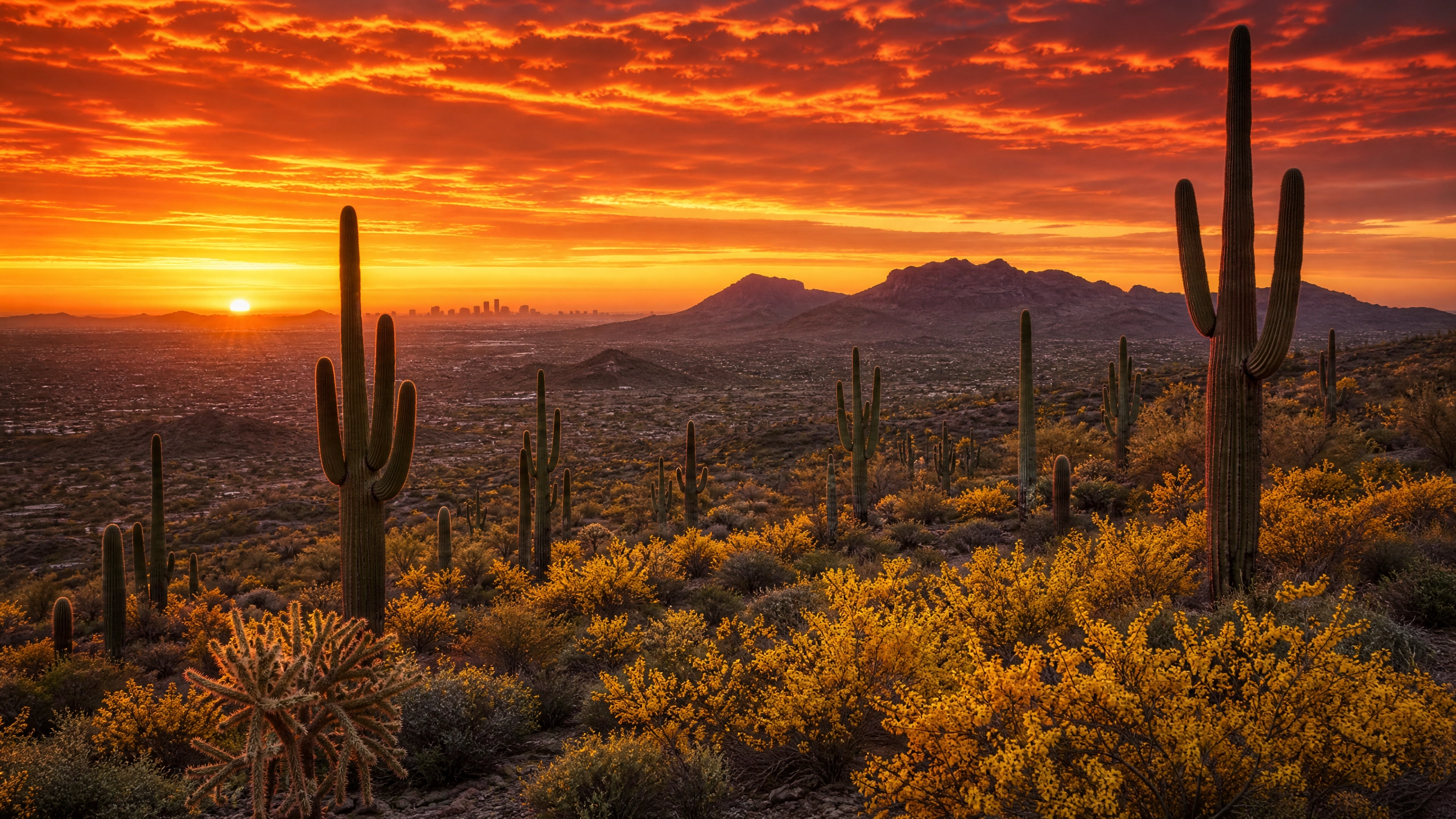
That decision — to lean into the Sonoran Desert rather than away from it — is what makes Phoenix different from every other Sun Belt city. Las Vegas built a fantasy on top of the desert. Scottsdale (Phoenix's wealthy neighbor) built a resort culture that treats the desert as scenery. Phoenix, at its best, treats the desert as the reason. The saguaro cactus outside your hotel window is not decoration. It is seventy-five years old. It was growing before your parents were born. The desert that surrounds this city is the most biodiverse desert in the world — not the driest, not the deadest, but the most alive — and understanding that changes everything about how you experience the place.
The Sonoran Desert: Not What You Think a Desert Is
Most people who have not spent time in the Sonoran Desert carry a mental image of desert that is wrong. They picture the Sahara: flat, sandy, monochromatic, empty. The Sonoran Desert is none of these things. It is mountainous, varied, and extraordinarily alive. It is the only desert in the world where the saguaro cactus grows — that iconic, arm-raising silhouette that has become the universal symbol of the American Southwest. It is home to more than 2,000 plant species, 550 bird species, and 130 species of mammals. In spring, after winter rains, it blooms in a way that stops people in their tracks.
The saguaro deserves a moment of attention, because understanding it changes how you see Phoenix. A saguaro cactus does not grow its first arm until it is approximately seventy-five years old. The ones you see with multiple arms — the ones that look like the cactus of every Western movie you have ever seen — are a hundred years old, or a hundred and fifty, or more. They were growing before the Great Depression. They were growing before World War II. They were growing when Phoenix was a farming town of a few thousand people. When you hike through the desert outside Phoenix and pass a saguaro with four arms reaching toward the sky, you are passing something that has been alive longer than anyone you know.
The Desert Botanical Garden, in Papago Park east of downtown, is the best single place to understand the Sonoran Desert without leaving the city. Its 55 acres contain more than 50,000 plants from desert regions around the world, with the Sonoran Desert collection at its center. The garden at dusk in March or April, when the cacti are blooming and the light is going golden, is one of the most beautiful experiences available in Phoenix. The Las Noches de las Luminarias event in December, when the garden is lit by thousands of luminarias, is something that people who have attended once come back for every year.
South Mountain Park, on the southern edge of Phoenix, is the largest municipal park in the United States — 51 square miles, larger than Manhattan. Locals hike here. Tourists go to Camelback Mountain, which is more famous and more photogenic, and which is genuinely worth doing — the Echo Canyon Trail is one of the best urban hikes in the country, though it is rated extremely difficult and should not be attempted in summer after 7 AM. But South Mountain is where Phoenix residents actually go, and it has trails that range from easy walks to serious technical scrambles, all within the city limits.
Camelback Mountain: The Hike That Defines Phoenix
Camelback Mountain rises 2,704 feet above sea level from the middle of the city, visible from almost everywhere in Phoenix and Scottsdale, a constant reminder that the desert is not just around the edges of the city but inside it. The mountain has two trails: Echo Canyon, which approaches from the west and is shorter and steeper, and Cholla, which approaches from the east and is longer and slightly more gradual. Both are rated extremely difficult. Both are worth doing.
The rules for Camelback are not suggestions. In summer — May through September — start before 6 AM or do not go. The mountain has no shade. The rock absorbs heat and radiates it back. People are rescued from Camelback every summer, and some of them do not survive. In the cooler months, October through April, the mountain is crowded but manageable, and the views from the summit — the entire Phoenix metro spread out below, the desert extending to the horizon in every direction, the distant peaks of the Superstition Mountains to the east — are among the best urban views in the country.
The practical advice: bring more water than you think you need. Use a hydration pack rather than a water bottle — you will need both hands on the upper sections of Echo Canyon. Wear trail shoes, not sneakers. Tell someone where you are going. These are not overcautions. They are the lessons that the mountain teaches, sometimes harshly.
Roosevelt Row: Where Phoenix Decided to Have a Culture
For most of its history, Phoenix was not a city that took culture seriously. It was a city that took growth seriously, and comfort, and real estate, and the weather. Culture was something you drove to Scottsdale for, or flew to Los Angeles for. Then, in the late 1990s and early 2000s, something started happening on Roosevelt Street in downtown Phoenix.
Artists moved in because the rents were cheap and the buildings were available. Galleries opened. Murals appeared on walls. A monthly event called First Friday — galleries open late, street food, live music, free admission — started drawing crowds that surprised everyone, including the people who organized it. Roosevelt Row, as the district came to be called, became the creative center of Phoenix: a walkable, mural-covered neighborhood in a city that was not supposed to have walkable, mural-covered neighborhoods.
Today, Roosevelt Row runs roughly along Roosevelt Street between 7th Avenue and 7th Street, with tendrils extending north and south. The murals are the first thing you notice — large-scale works by local and national artists that cover entire building facades, many of them with a strong Latino influence that reflects the neighborhood's history. The galleries are the second thing: a mix of established spaces and artist-run projects that make First Friday, held on the first Friday of every month, one of the best free cultural events in the Southwest.
The restaurants and bars that have grown up around Roosevelt Row are worth knowing. Arizona Wilderness Brewing, which has become one of the most respected craft breweries in the Southwest, has a location on Grand Avenue that is the best place in Phoenix to understand what the local craft beer scene has become. Cibo, an Italian restaurant in a 1913 bungalow with a courtyard patio, is the kind of place that feels like it belongs in a different city — intimate, unhurried, genuinely good — and locals guard it accordingly.
Grand Avenue, running diagonally northwest from downtown, is Roosevelt Row's less-visited sibling: a corridor of galleries, studios, and independent businesses that feels more raw and more interesting than the more polished Roosevelt Row proper. The Phoenix Public Market, on the corner of Central and McKinley, operates on Saturdays and is the best place in the city to understand what Phoenix is actually growing and eating.
The Heard Museum: The Cultural Institution Phoenix Gets Right
The Heard Museum, on Central Avenue in downtown Phoenix, is one of the finest museums of Native American art and culture in the world. This is not a local boast. It is a fact acknowledged by the Smithsonian, by the art world, and by the Native communities whose work and history the museum holds. The collection of Hopi kachina dolls — more than 400 pieces donated by Barry Goldwater — is the finest in existence. The exhibits on the history of Native boarding schools, which attempted to erase Indigenous languages and cultures across the American West, are among the most important and most difficult museum experiences available in the United States.
Phoenix sits in the ancestral territory of the Hohokam people, who built an extensive canal system across the Salt River Valley more than a thousand years ago — canals that the modern city's irrigation infrastructure is built on top of. The name "Phoenix" was chosen by the city's founders to evoke a city rising from the ruins of a previous civilization, which is either poetic or uncomfortable depending on how you think about it. The Heard Museum is where you go to understand what that previous civilization actually was, and what happened to it, and what remains.
The museum is open Tuesday through Sunday. Give it at least three hours. The permanent collection alone warrants a full morning, and the rotating exhibitions are consistently excellent.
Pizzeria Bianco and the Food Scene Phoenix Built
In 2005, Oprah Winfrey declared that Pizzeria Bianco, a small restaurant in Heritage Square in downtown Phoenix, made the best pizza in America. The owner, Chris Bianco, had been making pizza in Phoenix since 1988, in a space so small that he could only seat about thirty people. The declaration changed his life and did not change his pizza, which was already as good as it was going to get.
Pizzeria Bianco still has lines. It has moved to a larger space, and it has opened additional locations, but the original Heritage Square location remains the pilgrimage site: a wood-fired oven, simple ingredients, a menu that changes with the seasons, and pizza that justifies the wait. The Rosa — red onion, Parmigiano-Reggiano, rosemary, and pistachios, no tomato sauce — is the pizza that people who have eaten it describe to people who have not, in the way that people describe meals that reorganized their understanding of what food can be.
The broader Phoenix food scene has grown up around the standard that Bianco set. Barrio Café, on 16th Street, is the restaurant that put Mexican fine dining on the Phoenix map — chef Silvana Salcido Esparza has been James Beard nominated multiple times, and the mole negro is the dish that people who know Mexican food point to when they want to explain what Phoenix is doing that other cities are not. Tacos Chiwas, with locations across the city, serves Chihuahuan-style tacos that are specific to this region of the border and unavailable almost anywhere else in the country.
The Scottsdale farmers market, held on Saturdays at the Scottsdale Civic Center, is the best in the metro area and worth the drive from Phoenix proper. The winter season — November through March — is when the market is at its peak, with local citrus, dates, and vegetables that remind you that the desert, properly irrigated, is extraordinarily productive.
Scottsdale: The Neighbor Worth Understanding
Scottsdale is not Phoenix. This is a distinction that matters. Phoenix is a city of 1.6 million people that has been working for decades to develop an identity beyond "warm place with cheap real estate." Scottsdale is a city of 250,000 people that has fully committed to being a luxury resort destination, and it is very good at it.
Old Town Scottsdale, the historic district, has galleries, restaurants, and bars that draw visitors from across the country. The Scottsdale Museum of Contemporary Art is a serious institution. The resort hotels — the Phoenician, the Four Seasons Scottsdale, the Fairmont Scottsdale Princess — are among the best in the country, and the spa culture they have developed around the desert setting is genuinely distinctive.
The practical relationship between Phoenix and Scottsdale is this: if you are visiting for the first time and want to understand what the region is about, base yourself in Phoenix and day-trip to Scottsdale. If you are visiting for a resort experience and the desert is the backdrop rather than the point, Scottsdale is the right choice. The two cities are adjacent and connected by light rail, and the choice between them is really a choice about what kind of trip you want.
When to Go and How to Survive the Summer
The honest answer about when to visit Phoenix is: not July or August. The average high temperature in July is 106°F. The record is 122°F. The heat is not like the heat anywhere else — it is a physical presence, a weight, something that you feel on your skin and in your lungs. The desert does not cool down at night the way humid climates do. The ground has absorbed heat all day and releases it after dark, and the temperature at midnight in July is often still above 90°F.
October through April is when Phoenix is at its best. The weather is mild to warm, the desert is at its most beautiful, and the city's outdoor culture — hiking, cycling, outdoor dining, farmers markets — is fully operational. Spring training, when fifteen Major League Baseball teams hold their preseason camps in the Phoenix metro area, runs from late February through March and is one of the best sports experiences in the country: intimate stadiums, affordable tickets, and the chance to watch major league players up close in a relaxed setting.
If you must visit in summer — and some people do, for the resort experience, for the prices, for the specific pleasure of a swimming pool when it is 110°F outside — the rules are simple. Be outside before 8 AM and after 7 PM. Stay hydrated in a way that feels excessive. Do not hike. Do not underestimate the heat. The desert will teach you to respect it, one way or another.
Tempe, Sedona, and the Day Trips That Complete the Picture
Phoenix sits at the center of a region that offers some of the best day trips in the country, and understanding the city fully requires at least one excursion beyond its borders.
Tempe, immediately east of Phoenix, is home to Arizona State University and a downtown corridor on Mill Avenue that has more energy and walkability than most of Phoenix proper. Tempe Town Lake, a reservoir created by inflatable dams on the Salt River, has a two-mile waterfront trail that is one of the best urban walks in the metro area. The Tempe Center for the Arts, on the lake's western shore, is a striking building that hosts theater, music, and visual art. The Tempe Marketplace and the Mill Avenue District have the restaurants and bars that ASU's student population and young professional community support, and the quality is higher than you might expect.
Sedona, ninety minutes north of Phoenix, is the day trip that reorganizes your understanding of what the desert can look like. The red rock formations around Sedona — Cathedral Rock, Bell Rock, Courthouse Butte, the Chapel of the Holy Cross — are among the most photographed landscapes in the American Southwest, and they are more extraordinary in person than in photographs, which is not always true of famous landscapes. The drive up from Phoenix on State Route 179 is itself worth the trip: the red rocks emerge gradually as you climb out of the desert floor, and the moment when they come fully into view is the kind of thing that makes people pull over and just look.
Sedona has developed a significant wellness and spiritual tourism industry around its reputation for "vortexes" — sites where the earth's energy is said to be particularly powerful. Whether you find this compelling or absurd, the hiking around these sites is excellent, and the town itself has good restaurants and galleries that make it worth spending a full day.
The Apache Trail, east of Phoenix, is a less-visited but extraordinary drive through the Superstition Mountains, past three lakes formed by dams on the Salt River, through a landscape that feels genuinely remote despite being forty-five minutes from downtown. The section of the trail between Tortilla Flat and Roosevelt Dam is unpaved and requires a high-clearance vehicle, but the paved section alone is worth the drive.
Planning Your Phoenix Trip
Three days gives you the essential Phoenix. Five lets you understand it.
Start with the desert. Your first morning, go to the Desert Botanical Garden when it opens at 7 AM — the light is extraordinary, the crowds are thin, and the garden in the early morning has a quality of stillness that the city itself rarely achieves. In the afternoon, drive south to South Mountain Park and walk one of the easier trails — the National Trail offers views of the entire city from the ridgeline. In the evening, go to Roosevelt Row for First Friday if the timing works, or walk the neighborhood and find dinner at Cibo or one of the restaurants along Grand Avenue.
Day two is for culture and food. The Heard Museum in the morning — give it three hours minimum. Lunch at Pizzeria Bianco in Heritage Square, where the original restaurant is. In the afternoon, drive to Scottsdale and walk Old Town. Dinner at Barrio Café.
Day three is for Camelback Mountain, if the weather is right. Start before 7 AM. Bring more water than you think you need. The rest of the day is for recovery and exploration — the Scottsdale farmers market if it is Saturday, the Phoenix Art Museum if it is not.
AskLeif's Phoenix guides can help you build the full trip. The Phoenix 5-Day Itinerary covers desert adventures, spa experiences, and the food scene across five days for couples and solo travelers. The Phoenix Family Vacation guide is built specifically for traveling with kids, with the Desert Botanical Garden, the Phoenix Zoo, and Camelback Ranch woven into a practical four-day itinerary.
The Water Question
No honest account of Phoenix can ignore the water. The Colorado River, which supplies a significant portion of Phoenix's water, has been in crisis for years: Lake Mead and Lake Powell, the two largest reservoirs in the United States, have been at historically low levels as the region's population has grown and the climate has shifted. Arizona has been more aggressive than most Western states in managing its water supply — it has been banking water underground for decades and has invested heavily in water recycling — but the long-term arithmetic of five million people in a desert that receives eight inches of rain per year is a question that Phoenix has not fully answered.
This is not a reason to avoid Phoenix. It is a reason to understand it. The city that decided the desert was the point is now living with the full implications of that decision, and the choices it makes in the next decade about water, growth, and density will determine what kind of city it becomes. Phoenix is, in this sense, the most interesting city in America: a place where the fundamental questions about how humans can live in the twenty-first century are being worked out in real time, in a landscape that does not forgive mistakes.
The desert keeps score. Phoenix knows this. The saguaro outside your hotel window has been keeping score for a hundred years, and it will be keeping score long after the city has figured out its answers.
What the Desert Asks of You
Phoenix is a city that requires a specific kind of attention. It does not announce itself the way New York announces itself, or the way New Orleans announces itself. It sits in the desert and waits for you to look at it properly. When you do — when you understand that the saguaro outside your window is older than the city itself, that the canal you drove over was built by a civilization that flourished here a thousand years ago, that the mountain visible from the freeway is a serious wilderness that will kill you if you treat it casually — Phoenix becomes something else entirely.
The city that bet everything on the desert and won is still, in some important sense, negotiating the terms of that bet. The water supply is finite. The heat is intensifying. The growth that has defined Phoenix for seventy years is running into the limits that the desert has always imposed. These are not abstract concerns. They are the questions that Phoenix is living with in real time, and they give the city an urgency and a seriousness that its resort-and-sunshine reputation does not capture.
But the desert is still the point. The saguaro is still growing. The Sonoran Desert is still the most biodiverse desert in the world, still blooming every spring, still older and stranger and more alive than any city built inside it. Go find out what that means. The desert will show you, if you let it.