Every Other American City Is Performing. Philly Just Is.
Destination: Philadelphia, Pennsylvania, USA
Category: Travel Guides
You notice it the moment you order wrong.
Not wrong in the sense of choosing poorly — wrong in the sense of hesitating. You're standing at the counter at John's Roast Pork on Snyder Avenue, the line behind you is six deep, and you haven't decided yet whether you want the roast pork or the cheesesteak. The person behind the counter doesn't sigh. They don't smile patiently. They just look at you with an expression that says: this is not complicated, and you are making it complicated. You order. The sandwich arrives. It is one of the best things you have ever eaten. And somewhere in that transaction — the impatience, the excellence, the complete absence of performance — you understand something true about Philadelphia that no travel guide has ever quite managed to explain.
Every major American city has a persona it maintains for visitors. New York performs ambition. Los Angeles performs reinvention. Nashville performs authenticity. Chicago performs toughness while secretly being delightful. These are not criticisms — cities develop personas the way people do, as a way of managing the gap between what they are and what they want to be seen as. But Philadelphia doesn't perform anything. It is, stubbornly and completely, exactly what it is. The city that invented America, got overshadowed by every city that came after it, and responded not with bitterness or reinvention but with a kind of magnificent, unshakeable self-possession.
That self-possession is the thesis of this city. It runs through the cheesesteak debate (Pat's and Geno's are for tourists; the real argument is between John's Roast Pork and Dalessandro's in Roxborough), through the Citywide Special at Bob & Barbara's on South Street (a PBR and a shot of Jim Beam for $5, the most honest drink in America), through the Barnes Foundation's extraordinary, contested, legally-fought-over collection of 181 Renoirs and 69 Cézannes, and through the 4,000 murals that cover the city's walls like a second skin. Philadelphia doesn't need you to like it. That's the thing. And that freedom from needing your approval is exactly what makes it worth understanding.
The Weight of Being First
Stand at the corner of 5th and Chestnut Street on a Tuesday morning before the tour groups arrive, and you are standing at the exact location where the United States of America was decided. Not symbolically. Literally. The room inside Independence Hall where the Declaration of Independence was debated and signed in July 1776 is the same room where the Constitution was drafted eleven years later. The same chairs. The same windows. The same argument about what kind of country this would be.
Philadelphia was the largest city in North America in 1776. It was the nation's capital for ten years. Benjamin Franklin invented the lightning rod, bifocals, and the public library here. The first American hospital, the first American stock exchange, the first American art museum — all Philadelphia. The city was the intellectual and political center of the new republic, and then, in 1800, the capital moved to Washington, and the financial center drifted to New York, and Philadelphia was left holding the founding documents while everyone else moved on to the next thing.
This is the wound that explains everything about the city's character. Not a wound that festers — a wound that calcified into something harder and more useful. A refusal to compete on terms set by cities that arrived later and got louder. When Mark Twain observed that "in Boston they ask, how much does he know? In New York, how much is he worth? In Philadelphia, who were his parents?" he was describing a city that had already decided the other questions were less interesting.
The history here is not a museum exhibit. It is the operating system. Walk down Elfreth's Alley — 32 houses on a cobblestone lane off 2nd Street, the oldest continuously inhabited residential street in the country, dating to 1703 — and you are walking through a street where people have lived without interruption for more than three centuries. The houses are small and close together and they lean slightly toward each other across the alley as if sharing a secret. It is not a reconstruction. It is not a heritage site. People live there. That is the Philadelphia relationship with history: not preserved behind glass, but inhabited.
The Barnes: The Greatest Art Heist That Wasn't a Heist
Albert C. Barnes was born in 1872 in Kensington, a working-class neighborhood in North Philadelphia, the son of a butcher. He was brilliant, combative, and deeply suspicious of the Philadelphia establishment that had always looked past people like him. He earned a medical degree by age 20, made a fortune co-inventing an antiseptic called Argyrol, and then spent the next four decades assembling what many consider the greatest private art collection ever formed: 181 Renoirs, 69 Cézannes, 59 Matisses, 46 Picassos, and thousands of other works displayed alongside African masks, Native American pottery, and wrought-iron door hinges in arrangements that Barnes himself designed and that no one was allowed to change.
Barnes built a gallery in Merion, Pennsylvania, outside Philadelphia, and opened it as an educational institution. He held art appreciation classes for factory workers and Black community members at a time when Philadelphia's museums were functionally segregated. He loathed the city's cultural elite and made no effort to hide it. His will was explicit: the collection could not be loaned, reproduced, or moved. The Barnes Foundation was not a museum. It was a school. And it was his.
After his death in 1951, the legal battles began. The city of Philadelphia, the Pew Charitable Trusts, and the Lenfest Foundation eventually succeeded in doing what Barnes had explicitly forbidden: they moved the collection to a new building on the Benjamin Franklin Parkway in Center City, opened in 2012. The arrangement of every painting — Barnes's precise, idiosyncratic "ensembles" of works hung floor to ceiling with decorative objects — was preserved exactly. But the building is different. The neighborhood is different. The access is different.
Barnes would have hated it. He would also have been right that the collection is now seen by more people, including the 12,000 Philadelphia schoolchildren who visit every year. That tension — between a man's vision and the city's need — is very Philadelphia. Nothing here resolves cleanly. Everything here is argued over. The Barnes is now at 2025 Benjamin Franklin Parkway, open Thursday through Monday, and it is one of the most extraordinary rooms you will ever stand in. The Renoirs alone would justify the trip. The Cézannes would make you reconsider everything you thought you knew about how a painting can be organized. Go on a Thursday morning when it opens at 11am and give yourself three hours.
The City Painted Over Itself
In 1984, Philadelphia had a graffiti problem. Mayor Wilson Goode's administration created the Anti-Graffiti Network and brought in an artist named Jane Golden to work with the young people doing the tagging — not to arrest them, but to redirect them. The idea was simple: give them walls, give them paint, give them a reason to make something instead of mark something.
Forty years later, Mural Arts Philadelphia has produced more than 4,000 murals across the city. It is the largest public mural program in the country. The murals are not decorations. They are arguments. They are memorials. They are the city talking to itself about what it has been and what it wants to become.
The most extraordinary of them requires a specific journey. Steve Powers's A Love Letter For You — completed in 2009 in collaboration with Mural Arts — is a series of more than 50 rooftop murals and street-level signs along the Market Street elevated rail corridor in West Philadelphia. The messages are love letters: "I WANT TO GROW OLD WITH YOU." "YOU ARE MY SUNSHINE." "MEET ME AT OUR SPOT." They are visible only from the Market-Frankford Line elevated train, which means you have to ride the El to see them. Take the train west from 30th Street Station toward Upper Darby on a clear morning, sit on the right side of the car, and watch the city's declaration of love scroll past at 40 miles per hour. It does not appear in the top five Google results for Philadelphia. It is one of the most moving things the city has to offer.
The murals are everywhere once you start looking. The portrait of Dr. J at 1234 Ridge Avenue — the first mural in Philadelphia made using the parachute cloth technique, unveiled in 1989. The eight-story Common Threads by Meg Saligman at Broad and Spring Garden Streets. The Finally on 13th mural in the Gayborhood, the city's first mural celebrating Black queer culture, completed in 2023. Mural Arts offers walking tours and trolley tours if you want context. But the better approach is to simply walk, and let the city's second skin reveal itself.
East Passyunk and the Philosophy of the BYOB
Pennsylvania's liquor laws are among the most restrictive in the country. A full liquor license costs hundreds of thousands of dollars and requires navigating a state system that hasn't been meaningfully reformed since Prohibition. For a neighborhood restaurant operating on thin margins, a liquor license is often simply not possible.
East Passyunk Avenue responded to this constraint by becoming one of the most interesting dining corridors in America.
The avenue is a diagonal cut through South Philadelphia's grid — a geographic anomaly that gives it a different energy than the surrounding streets, as if it arrived from somewhere else and decided to stay. For decades it was old-school Italian: red sauce, massive portions, recipes unchanged since the 1940s. Then, over the past fifteen years, a new generation of chefs moved in alongside the old institutions, and the result is a street where Le Virtù — a restaurant dedicated to the cuisine of the Abruzzo region of Italy, with handmade pastas and house-cured meats — sits two blocks from Perla, a modern Filipino restaurant famous for its kamayan dinners served family-style on banana leaves, meant to be eaten with your hands.
Because most of these restaurants are BYOB, the ritual is different. You stop at a wine shop before dinner. You bring your own bottle. You sit at a table where the person who cooked your food is probably visible through the kitchen window. At the center of the neighborhood is the Singing Fountain — a small triangular plaza that serves as the unofficial gathering spot, where people sit with gelato and coffee and watch the street. The best approach to East Passyunk is to arrive early, walk the length of the avenue before dinner, stop at the fountain, and then eat somewhere that requires a reservation you made three weeks ago. For the tasting menu at River Twice, book further in advance than that.
This is where Leif earns its keep. The Philadelphia food guide maps the full culinary geography — from Reading Terminal Market's DiNic's roast pork sandwich (voted best sandwich in America by the Travel Channel) to the BYOB calculus of East Passyunk — so you're not improvising a city's worth of food decisions on the fly. And if you're building a longer stay, the 4-day Philadelphia itinerary sequences the neighborhoods in an order that makes the city legible rather than exhausting.
The Citywide Special and What It Means
In 1994, a band booker named Rick Dobrowolski suggested a special at Bob & Barbara's Lounge on South Street: a can of PBR and a shot of Jim Beam for $3. They called it the Happy Meal. It became the Citywide Special. It spread to bars across the city, each with their own variation — Dirty Frank's does a can of Hamm's and a shot of Kamikaze; La Chinesca does Tecate and tequila; Fergie's does what they call the Classy, a shot of Paddy's Irish Whiskey and a Narragansett. The price has risen to $5 at Bob & Barbara's, but the logic hasn't changed.
The Citywide is not a marketing gimmick. It is a statement of values. It says: this city does not require you to spend money to prove you belong here. It says: the best drink in the room is the honest one. It says: life is hard and this will help and we're not going to dress that up in a coupe glass and charge you eighteen dollars for it. Philadelphia Magazine's Jason Sheehan called it "a blue-collar drink for a blue-collar town. Not a loss leader or a ploy, but an honest deal: cheap and a little bit grimy, but effective."
Order one at Bob & Barbara's on a Thursday night. The bar is small and loud and the walls are covered in photographs and the jukebox plays soul music. You will understand, in the way you can only understand things by being inside them, what the city is actually about.
Fairmount Park and the City That Kept Its Green
Most American cities sacrificed their parks to development at some point in the twentieth century. Philadelphia did not. Fairmount Park — which includes the Wissahickon Valley, the Schuylkill River trail, and dozens of historic houses — is one of the largest urban park systems in the country, covering more than 9,200 acres. It is bigger than Central Park by a factor of five.
The Wissahickon Valley is the part that surprises people. You enter from the Forbidden Drive trailhead near Chestnut Hill, and within ten minutes you are in a gorge with a creek running below you and hemlocks above you and no evidence that you are inside a city of 1.5 million people. The trail runs seven miles along the Wissahickon Creek. On weekend mornings, it fills with runners and cyclists and people walking dogs. On weekday mornings, it is quiet enough that you can hear the water.
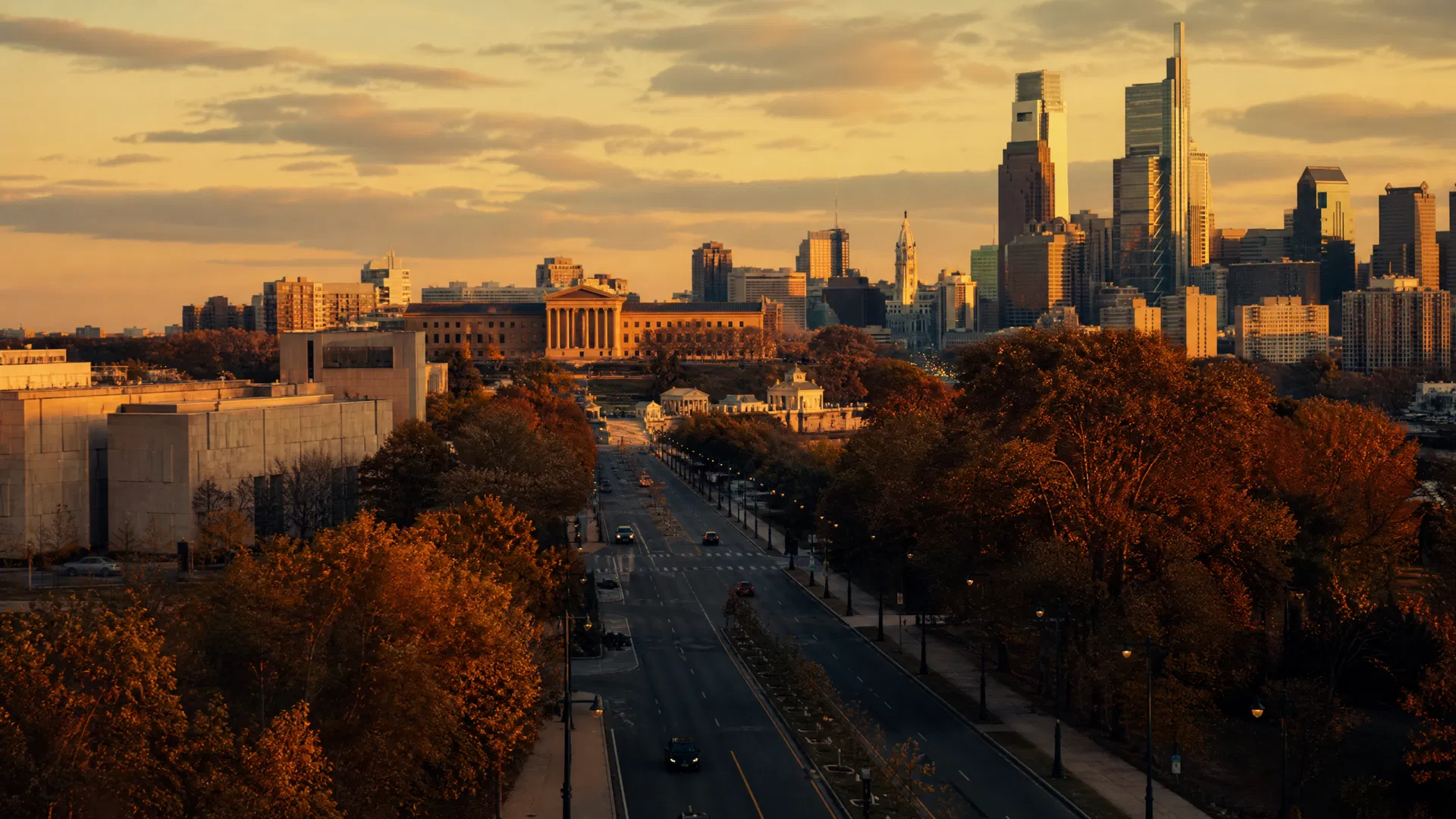
The Schuylkill River Trail connects the park to Center City along the river's eastern bank — a flat, paved path that runs from the Art Museum steps south through the city. The Art Museum steps are, of course, the Rocky Steps, and yes, people run up them, and yes, there is a bronze statue of Rocky Balboa at the base, and yes, Philadelphians have a complicated relationship with the fact that a fictional boxer is more beloved in this city than Benjamin Franklin. Sylvester Stallone has said that in Philadelphia, people address him as Rocky, not Sylvester. The Mayor once introduced him as Rocky. This is not embarrassing to Philadelphia. It is, somehow, exactly right. If you're bringing children, the park's proximity to the Franklin Institute and the Philadelphia Zoo makes Fairmount the natural anchor for a family day — the Philadelphia family vacation guide sequences exactly that.
When to Go, Getting Around, and What to Know
When to go: Philadelphia in October is the city at its best — the temperatures drop into the 60s, the trees along the Benjamin Franklin Parkway turn, and the city's outdoor dining extends well into the month. Spring (April–May) is nearly as good. Summer is hot and humid but the city's outdoor spaces — the Schuylkill Banks, the Spruce Street Harbor Park, the rooftop bars — are built for it. Winter is cold and underrated: the Reading Terminal Market is at its warmest and most atmospheric, and the crowds at Independence Hall thin to almost nothing.
Getting around: The SEPTA subway system is functional and cheap ($2.50 a ride). The Market-Frankford Line (the El) runs east-west and is essential for reaching West Philadelphia and the A Love Letter For You murals. The Broad Street Line runs north-south and connects Center City to South Philadelphia. For East Passyunk, the Tasker-Morris stop on the Broad Street Line puts you two blocks from the Singing Fountain. Most of the city's major attractions are walkable from Center City, but the neighborhoods — Fishtown, Kensington, Germantown, Chestnut Hill — require transit or a rideshare.
What to know: Philadelphia is a city of neighborhoods, and each one has its own character, its own food, its own bars. Old City is the tourist center and worth a morning. Fishtown, on the Delaware River waterfront, is where the city's music and bar scene lives — Johnny Brenda's on Frankford Avenue books national acts in a room that holds 200 people, and the neighborhood's density of good bars per square block is remarkable. South Philadelphia is the Italian-American heart of the city, home to the 9th Street Italian Market (the oldest outdoor market in the country, founded in the 1880s when Antonio Palumbo opened a boarding house for Italian immigrants) and the cheesesteak shops that locals actually use. Germantown and Chestnut Hill, in the city's northwest, are where you go when you want to understand what Philadelphia looked like before the twentieth century.
Planning Your Philadelphia Trip
The mistake most visitors make is treating Philadelphia as a history trip with food on the side. It is, in fact, a food city with history built into the walls. The correct approach is to alternate: a morning at Independence Hall, an afternoon at the Barnes, a night on East Passyunk. A morning in the Wissahickon, an afternoon at the Mütter Museum (the College of Physicians' collection of medical curiosities — a preserved human colon, the conjoined liver of Chang and Eng Bunker, a wall of 139 skulls — which is exactly as extraordinary as it sounds), a night in Fishtown.
Four days is the minimum to feel like you've touched the city rather than just passed through it. The 4-day Philadelphia itinerary sequences this correctly — neighborhoods in an order that builds on each other rather than bouncing randomly across the map. For families, the Philadelphia family vacation guide routes the same city through a different lens: the Franklin Institute's hands-on science exhibits, the Please Touch Museum, the Zoo, and the history sites that actually hold children's attention (Eastern State Penitentiary, with its crumbling cellblocks and Al Capone's furnished cell, is genuinely gripping for anyone over ten).
The budget case for Philadelphia is also strong. Most of the history is free — Independence Hall, the Liberty Bell, the Second Bank Portrait Gallery, the Edgar Allan Poe National Historic Site. The Barnes costs $30. The Mütter costs $25. The murals cost nothing. A Citywide Special costs $5. A roast pork sandwich at DiNic's in Reading Terminal Market costs $12. You can spend a serious day in this city for less than $60, and it will be one of the better days you've had anywhere.
Leif builds the full trip — sequenced neighborhoods, timed reservations, the BYOB logistics for East Passyunk, the transit routes that make the murals accessible — so that the city's complexity becomes navigable rather than overwhelming. Use the Philadelphia food guide to anchor the culinary decisions before you arrive, and let the rest of the city reveal itself the way Philadelphia prefers: on its own terms, without a performance.
Plan Your Philadelphia Trip with Leif
These three guides were built for the way Philadelphia actually works — not as a checklist of landmarks, but as a city that rewards the reader who goes deeper. Start with the itinerary if you want the full four-day arc; go straight to the food guide if East Passyunk is the reason you're coming; and if you're traveling with kids, the family guide routes the same city through the Franklin Institute, Eastern State Penitentiary, and the Zoo without losing any of what makes Philadelphia worth the trip.
- 4-Day Philadelphia Itinerary: History, Food & Art
- Philadelphia Foodie Frenzy: A 4-Day Culinary Adventure
- Philadelphia Family Vacation: 4-Day Kid-Friendly Itinerary
The City That Doesn't Need the Compliment
There is a moment that happens to most people somewhere in their first or second day in Philadelphia. It usually occurs in a bar, or at a counter, or on a street corner where someone gives you directions with the specific, unsentimental efficiency of a person who has better things to do but is going to help you anyway. The city does something to you in that moment. It recalibrates something.
You came expecting the Liberty Bell and the cheesesteak and the Rocky Steps, and you got those things, but you also got a city that has been right about things for three hundred years and never needed anyone to tell it so. A city that invented the concept of the public library and the public hospital and then watched other cities get the credit. A city that built one of the great art collections in the world and then fought a legal battle to keep it from being moved and lost. A city that turned a graffiti abatement program into 4,000 murals and a philosophy. A city that responded to restrictive liquor laws by creating a dining culture more interesting than cities with none.
Every other American city is performing something. Philadelphia is just being itself. That turns out to be more than enough.