Most Pacific Northwest Road Trips Turn Right. Here's What's Left
Destination: Pacific Northwest, USA
Category: Travel Guides
The standard Pacific Northwest road trip has been written so many times that it has become a single document with different bylines. Seattle for two days. Mount Rainier for one. The Columbia River Gorge. Crater Lake if you have time. Portland at the end. The route runs south and slightly east, following Interstate 5 and Highway 101 through terrain that is genuinely extraordinary and also, in July and August, genuinely crowded. It is a good road trip. It is also exactly what everyone else on the road is doing.
The road trip that nobody is writing about turns left out of Seattle instead of right. It goes northwest to the Olympic Peninsula — a landmass so geographically extreme that it contains a temperate rainforest, an alpine wilderness, and a wild Pacific coastline within a single national park boundary. Then north to Port Townsend, the Victorian seaport that was supposed to become the great city of the Pacific Northwest and stopped in 1890 when the railroad went elsewhere. Then east through the North Cascades on Highway 20, past Diablo Lake's turquoise water and into the Methow Valley. Through Winthrop, the frontier town that voted to rebuild itself as a Wild West village in 1972 and has lived inside that identity for fifty years. Through Leavenworth, the Bavarian alpine village that has no historical connection to Bavaria and is more authentically Bavarian than most American cities with genuine German immigrant populations. And finally south to the Columbia River Gorge, where the left turn rejoins the right and the geological force that explains the entire Pacific Northwest is waiting at the end.
This is not a supplementary route. It is a replacement route. The traveler who does this trip does not feel they have added something to the standard itinerary. They feel they have found the version of the Pacific Northwest that the standard itinerary was drawing attention away from.
The Route Logic: Why Left and Not Right
Before the first stop, the route deserves an explanation, because it is not the obvious choice and the non-obviousness is the point.
The standard Pacific Northwest road trip turns right because the right turn leads to the most famous destinations — Rainier, the Gorge, Crater Lake, Portland. These are extraordinary places. They are also the places that every travel guide, every Instagram account, and every road trip blog covers in detail. The traveler who turns right is well-served by existing content and will share the road with everyone who read that content before them.
The left turn leads to terrain that is equally extraordinary and almost entirely unrepresented in mainstream travel content. The Olympic Peninsula is four hours from Seattle and contains the rarest ecosystem type on earth — a temperate rainforest — within a national park that also includes glaciated peaks and 73 miles of wild Pacific coastline. The North Cascades contain more glaciers than the rest of the contiguous United States combined and receive fewer annual visitors than almost any other national park in the continental lower 48. Winthrop and Leavenworth are two of the most unusual towns in the American West, each having chosen its own identity rather than inherited it. The Columbia River Gorge, at the end of the route, is the geological explanation for everything that came before it — the only sea-level gap through the Cascade Range, the force that created the weather patterns, the ecosystems, and the wind that defines the Pacific Northwest.
The route runs roughly 900 miles over ten to twelve days, starting and ending in Seattle. It requires a car. It rewards the traveler who is willing to drive two hours to see something that has no equivalent anywhere else in the country.
Stop 1: The Olympic Peninsula — The Rainforest That Shouldn't Exist
The Hoh Rain Forest receives between 140 and 170 inches of rain per year. It sits on the Pacific coast of Washington State, which means it is a temperate rainforest — the rarest ecosystem type on earth, found only in a handful of coastal zones where cold ocean currents produce the specific combination of precipitation and mild temperatures that this ecosystem requires. The Hoh is one of the largest intact temperate rainforests in the contiguous United States. It is four hours from Seattle. Most travelers who visit the Pacific Northwest never reach it because it requires the left turn.
The Hall of Mosses trail is the Hoh's most famous walk — a 0.8-mile loop through old-growth bigleaf maple draped in club moss so thick the trees appear to be wearing coats. The photographs that appear in travel content were taken in the afternoon, when the light is flat and the trail is crowded. The Hall of Mosses at 6am, before the day hikers arrive, is a different place. The light filters through the moss canopy in a specific way — diffuse, green-tinted, moving with the fog — that afternoon visitors never see. The trail is empty. The sound is the Hoh River, which runs alongside the campground, and nothing else.
The Quinault Rain Forest, on the south side of the Olympic Peninsula, receives a fraction of the Hoh's visitors and contains three world record trees within driving distance of each other: the world's largest Sitka spruce, the world's largest Douglas fir, and the world's largest western red cedar. Lake Quinault Lodge, built in 1926, is where Franklin D. Roosevelt stayed in 1937 and signed the executive order creating Olympic National Park nine days later. The lodge serves dinner in a dining room that looks out over the lake and has not changed its fundamental character in ninety years.
Ruby Beach, on the Olympic coast, is the thesis made visual. The sea stacks rise from the Pacific in formations that have no equivalent on the East Coast or the Gulf — basalt columns worn into shapes by ten thousand years of Pacific swells, surrounded by driftwood logs the size of telephone poles deposited by winter storms. At sunset, the light on the sea stacks is the specific orange that Pacific photographers know and visitors who arrive at noon never see.
The Olympic Peninsula 7-Day Road Trip guide sequences the full peninsula — Hoh, Quinault, Ruby Beach, and the alpine wilderness of Hurricane Ridge — into a route that can be done as a standalone trip or as the first leg of this one. For families, the Olympic National Park 5-Day Family Adventure guide routes the same terrain with kids in mind.
Stop 2: Port Townsend — The City That Stopped in 1890
Where the Olympic Peninsula proves the thesis ecologically, Port Townsend proves it architecturally. Port Townsend was supposed to be the great city of the Pacific Northwest. In the 1880s it had more millionaires per capita than San Francisco and was widely expected to become the western terminus of the transcontinental railroad. The railroad went to Tacoma instead. Port Townsend stopped building in 1890.
The result is the most intact Victorian seaport in the western United States. Seventy blocks of Victorian commercial and residential architecture that were never torn down because there was never enough money or ambition to replace them. The buildings that were too expensive to demolish became, over a century, too valuable to lose. Port Townsend is now on the National Register of Historic Places as one of only three Victorian seaports in the country — and unlike the other two, it is still a working town. People live in those Victorian houses. The shops on Water Street occupy storefronts built for a city that was going to be much larger than it became.
The Uptown/Downtown distinction is real and specific. The merchant class built Downtown near the water — the commercial district, the hotels, the saloons. The working class built Uptown on the bluff above it, connected by a staircase that still exists. The two communities did not mix in 1890, and the architectural distinction between them — the ornate commercial facades of Downtown versus the simpler residential vernacular of Uptown — is still visible in every building.
The Brass Screw Consortium, Port Townsend's annual steampunk festival, convenes every June and is the most accurate expression of what Port Townsend actually is: a Victorian city that has decided to inhabit its own history with full commitment and a sense of humor. The festival fills the streets with people in elaborate Victorian costumes, which is either absurd or completely appropriate depending on how you feel about a town that has been living inside 1890 for 130 years.
The Saturday farmers market at the Uptown parking lot is where the farming community from the surrounding peninsula comes to sell. It is the most useful two hours in Port Townsend — the place where the town reveals itself as a working community rather than a preserved artifact.
Stop 3: North Cascades National Park — The American Alps Nobody Visits
Where Port Townsend won by being bypassed, the North Cascades won by being ignored. The North Cascades contain more glaciers than the rest of the contiguous United States combined. The park receives fewer annual visitors than almost any other national park in the continental lower 48. It is three hours from Seattle. These three facts together are the thesis — the most alpine terrain in the lower 48 states is the least visited national park within driving distance of a major American city, and the reason is simply that most Pacific Northwest road trips turn right instead of left.
Highway 20 — the North Cascades Highway — is one of the great drives in the American West. It closes every winter from late November to late April, when the snowpack makes it impassable, and reopens each spring to a landscape that has been sealed off from human access for five months. The first drive of the season, in late April or early May, passes through snowfields that are still ten feet deep on either side of the road. The drive in early October, when the larch trees on the high ridges have turned gold, is something else entirely.
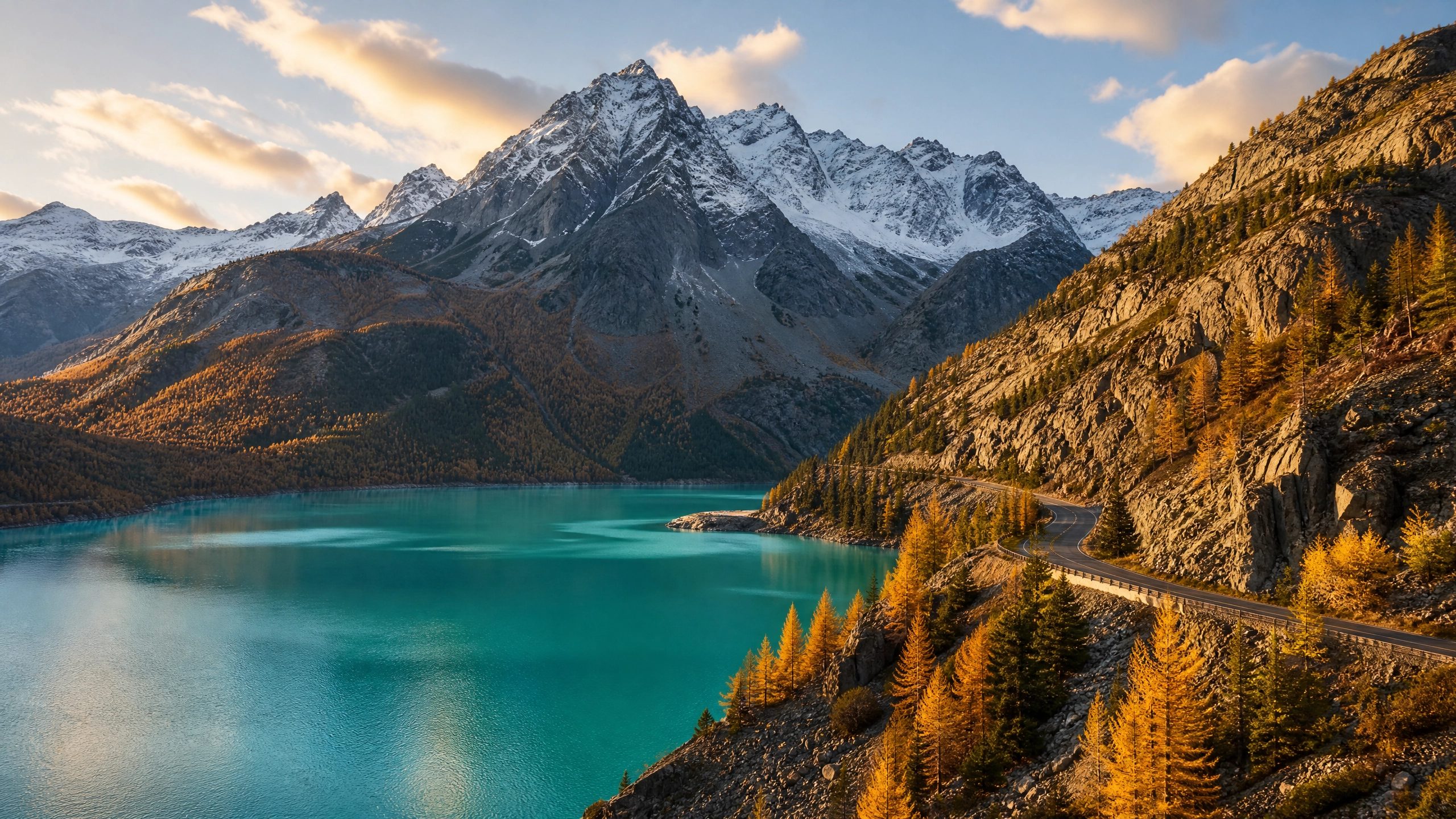
Diablo Lake sits in the middle of the highway corridor, its water a specific turquoise that has no equivalent in the region. The color comes from glacial flour — rock particles ground so fine by glacial movement that they remain suspended in the water and refract light differently than any other lake. The overlook is directly off the road. No hike required. The color is real and it is not a photograph filter.
Ross Lake Resort, accessible only by boat or on foot — there is no road — has operated since the 1950s on floating cabins above the reservoir. The resort runs a truck portage service between Diablo Lake and Ross Lake for guests arriving by boat. It is one of the most unusual accommodations in the American West and appears in almost no mainstream Pacific Northwest travel content.
The Maple Pass Loop, rated by the Washington Trails Association as the best day hike in Washington State, is seven miles with 2,000 feet of elevation gain. The peak window for larch color is mid-October — a two-week period when the subalpine larches on the ridge above Lake Ann turn gold against the granite and the remaining snow. The trailhead requires a Northwest Forest Pass and fills by 8am on October weekends.
The North Cascades 3-Day Adventure guide covers Diablo Lake, the Maple Pass Loop, and the specific logistics of Highway 20 — including the seasonal closure dates and the best campgrounds along the corridor.
Stop 4: Winthrop — The Town That Chose Its Own Identity
Where the North Cascades prove the thesis geologically, Winthrop proves it culturally. Winthrop is a small town in the Methow Valley on the eastern side of the North Cascades that in 1972 — facing economic decline after the timber industry collapsed — voted to rebuild its entire downtown as a Wild West frontier town. Every building on Winthrop's main street has been retrofitted with false fronts, wooden boardwalks, and hitching posts. The identity was chosen rather than inherited. The town has lived inside it for fifty years and made it real.
The Methow Valley trail system is the largest groomed cross-country ski trail network in the American West outside of resort ski areas — 120 miles of trails that become mountain bike and hiking trails in summer and fall. The valley is the reason serious cross-country skiers know Winthrop exists. The rest of the country doesn't.
The specific autumn window — late September to mid-October — is when the Methow Valley's cottonwood trees turn gold along the creek corridors. The combination of the cottonwood color, the frontier architecture, the North Cascades visible to the west, and the high desert light of the eastern Cascades produces something that looks like a painting and photographs like one. The Winthrop Brewing Company, operating since 1994 in a building that maintains the frontier aesthetic, serves genuinely good craft beer from a porch that looks down the main street toward the mountains.
Sun Mountain Lodge sits above Winthrop on a ridge with a view across the Methow Valley that no travel photographer has adequately captured — the valley floor, the cottonwood corridors, the North Cascades, and the specific quality of eastern Cascade light at dusk. It is the best place to stay in the Methow Valley and one of the better lodge experiences in the American West.
The 7-Day Washington Cascade Loop Road Trip guide covers the Methow Valley and Winthrop as part of the full Cascade Loop — useful context for travelers who want to extend the route or understand how Winthrop fits into the broader eastern Cascades geography.
Stop 5: Leavenworth — The Bavarian Village That Took the Joke Seriously
Where Winthrop chose its identity and maintained it with frontier commitment, Leavenworth took the same premise to its logical extreme. In 1962, Leavenworth's economy collapsed when the railroad rerouted and the timber industry declined. The town voted to rebuild as a Bavarian alpine village. Every building in the historic district is required by ordinance to maintain Bavarian architectural standards. The result is a town that has no historical or cultural connection to Bavaria and is nevertheless more authentically Bavarian in its food, its beer, its festivals, and its architecture than most American cities with genuine German immigrant populations.
The Leavenworth Nutcracker Museum is the most unusual cultural institution in the Cascade foothills and possibly in the state of Washington. Arlene Wagner, who turned 101 in 2025 and has been collecting nutcrackers since the 1960s, operates a museum of more than 9,000 nutcrackers from 38 countries, spanning Roman times to the present, in a building on Front Street that most visitors walk past without entering. NPR ran a story on her in December 2025. The museum is open daily from 11am to 5pm and costs $5 to enter. It is one of the stranger and more rewarding hours available in the Pacific Northwest.
The Icicle Creek Music Center, a professional classical music conservatory operating in the mountains outside Leavenworth, has no equivalent within 200 miles. Summer concerts take place in an outdoor amphitheater surrounded by ponderosa pine. The programming is serious — faculty and students from major conservatories, chamber music at a level that would be unremarkable in a major city and is extraordinary in a Bavarian village in the Cascades.
Oktoberfest in Leavenworth runs across three weekends in October. The Festhalle fills with accordion music, genuine Bavarian beer, and a crowd that has traveled specifically for this. Accommodation books out months in advance for Oktoberfest weekends. The town's population multiplies tenfold. The specific booking window — mid-July for October weekends — is the detail that most visitors miss until it's too late.
The Leavenworth Weekend Escape guide covers the two-day version of Leavenworth — the Nutcracker Museum, the Icicle Creek trail system, the specific restaurants that maintain the Bavarian standard, and the timing for Oktoberfest.
Stop 6: Columbia River Gorge — The Wind That Made Everything
Where Leavenworth proves the thesis culturally, the Columbia River Gorge proves it geologically. The Gorge is the only sea-level gap through the Cascade Range — the point where the Columbia River cut through the mountains over millions of years and created the only continuous route from the Pacific Coast to the interior. The wind that funnels through this gap at 30 to 40 miles per hour year-round made Hood River the windsurfing and kiteboarding capital of the world. It drives the weather patterns of the entire Pacific Northwest. It shaped the ecosystems of both sides of the river into something that has no equivalent on earth: temperate rainforest on the Oregon side, high desert on the Washington side, separated by a single river.
The Gorge is the road trip's final argument. The left turn that began on the Olympic Peninsula ends here, where the geological force that explains everything about the Pacific Northwest — the wind, the rain, the mountains, the contrast between wet west and dry east — is visible in a single view from the Washington side of the river.
The Historic Columbia River Highway — the original 1916 road that predates Interstate 84 — has been restored in four sections as a car-free trail for cyclists and pedestrians. The restored sections pass viewpoints that the interstate bypasses entirely, including the Mosier Twin Tunnels section, where the original tunnel cut through basalt columns that the highway engineers worked around rather than through. The afternoon light on the basalt columns from the restored highway is the specific light that the interstate traveler never sees.
Multnomah Falls at 7am on a weekday in October is a different experience from Multnomah Falls at noon on a Saturday in July. The specific light on the basalt columns at dawn — the falls backlit, the mist catching the low sun — is the photograph that the afternoon images never capture. The parking lot is empty. The trail to the bridge is quiet. The falls are the same falls and they are not the same falls.
The Maryhill Museum of Art, on the Washington side of the river, is one of the most unusual cultural institutions in the American West. A Beaux-Arts mansion built in 1926 by Sam Hill contains a Rodin collection, a collection of chess sets gifted by Queen Marie of Romania, and a collection of Native American artifacts from the Columbia Plateau. Three miles east of the museum, on the bluff above the river, stands a full-scale replica of Stonehenge that Hill built in 1918 as a memorial to the servicemen of Klickitat County who died in World War I. Hill believed, incorrectly, that the original Stonehenge had been a site of human sacrifice. He built the replica to argue that modern warfare was the same thing. The replica is complete, accurate in its astronomical alignments, and appears in almost no mainstream Pacific Northwest travel content.
The Columbia River Gorge 4-Day Circuit guide covers both sides of the river — Multnomah Falls, the Historic Highway, Hood River, and the Washington side viewpoints — in a sequence that builds from the Oregon waterfall corridor to the Gorge's geological argument. The Hood River Couples Escape guide covers Hood River specifically — the windsurfing culture, the fruit loop, the specific restaurants that the windsurfing community built over forty years.
The Exclusion Argument: Why Mount Rainier, Crater Lake, and Portland Are Not on This Route
The three most obvious omissions from this itinerary deserve explicit arguments, because the travelers who have done the standard route will notice their absence.
Mount Rainier is extraordinary. It is also the anchor of the right turn — the destination that makes the standard route the standard route. A traveler who includes Rainier is doing the standard route with additions. This post is about the route that replaces the standard route rather than supplements it. Rainier has its own dedicated guides in the AskLeif library. It belongs on a Pacific Northwest trip. It does not belong on this specific trip.
Crater Lake requires two days minimum from Portland to do properly and adds significant mileage to an already ambitious route. More importantly, it is the most covered destination in the standard Pacific Northwest road trip canon. Including it would make this post indistinguishable from the content it is trying to differentiate from. Crater Lake is extraordinary. It is also exactly where everyone else is going.
Portland has its own destination post in the AskLeif library. This road trip ends at the Columbia River Gorge, where the left turn rejoins the right, and the reader who wants Portland after the Gorge has the Portland guides to navigate it. Excluding Portland from this post is both thematically correct — Portland is the right turn's destination, not the left turn's — and practically useful, because the traveler who has just driven Highway 20 and spent a night in Winthrop is not the same traveler who needs a Portland food cart guide.
Planning Your Pacific Northwest Left Turn: Route, Timing, and Nights
This is a ten-to-twelve-day route covering approximately 900 miles from Seattle. It is not a weekend trip. It is not a trip that can be compressed into five days without losing the stops that make it worth doing. The Olympic Peninsula alone deserves three nights. The North Cascades deserve two. The Methow Valley and Leavenworth can be combined into two to three nights. The Gorge deserves two.
The recommended route and nights:
- Seattle (base, fly in): 0 nights — pick up rental car and drive directly to the peninsula
- Olympic Peninsula (Hoh/Quinault/Ruby Beach area): 2–3 nights
- Port Townsend: 1 night
- North Cascades / Diablo Lake area: 1–2 nights
- Winthrop: 1–2 nights
- Leavenworth: 1–2 nights
- Columbia River Gorge / Hood River: 2 nights
- Return to Seattle: 3.5 hours from Hood River
When to go: Late September to mid-October is the optimal window. The Methow Valley cottonwood color peaks late September. The Maple Pass Loop larch color peaks mid-October. The Gorge in October has the specific light quality that summer haze obscures. The Olympic Peninsula is rainier in fall — which is the point. The Hoh in October rain is the Hoh at its most itself.
Summer (July–August) is viable but crowded on the Olympic Peninsula and hot in the Methow Valley. Spring (May–June) is excellent for the North Cascades immediately after Highway 20 reopens — the snowfields are still dramatic and the crowds haven't arrived. Winter closes Highway 20 entirely, making the North Cascades section impossible.
Budget range: $150–250/day for two travelers covering accommodation, food, and activities. The Olympic Peninsula has a range from campgrounds ($25/night) to Lake Quinault Lodge ($200+/night). Winthrop and Leavenworth have mid-range lodges and B&Bs at $120–180/night. The Gorge has Hood River's full range from hostels to boutique hotels.
Getting around: A standard rental car handles the entire route. The Piilani Highway equivalent here is the back roads of the Methow Valley — paved, no special vehicle required. Highway 20 between the North Cascades and Winthrop is a mountain pass road; check conditions in spring and early fall.
A six-stop road trip with this many variables — driving times between passes, booking windows that close months in advance, seasonal windows that shift week by week — is exactly the kind of planning problem Leif was built for. Feed it the route, your dates, and how many nights you want at each stop, and it builds the day-by-day detail so you arrive at the Maple Pass trailhead at 7am instead of 10am, and at Oktoberfest with a room instead of a search. The guides below cover each stop in depth — use them alongside Leif or as standalone trip anchors.
- 7-Day Olympic Peninsula Adventure Road Trip: Hoh Rainforest & Wild Coast
- Olympic National Park: 7-Day Couples Adventure Through Rainforest, Coast & Mountains
- Olympic National Park 5-Day Family Adventure: Mountains, Rainforest & Beaches with Kids
- North Cascades Adventure: 3-Day Itinerary for Rugged Peaks & Turquoise Lakes
- 7-Day Washington Cascade Loop Road Trip: Leavenworth, Chelan & North Cascades
- Leavenworth Weekend Escape: A 2-Day Bavarian Village Itinerary
- Columbia River Gorge 4-Day Circuit: Multnomah Falls, Hood River & Both Sides of the River
- Hood River Couples Escape: 3-Day Windsurfing, Wine & Waterfalls
- Whidbey Island: A 3-Day PNW Island Escape for Couples
Specific Details by Stop
Olympic Peninsula:
- Hoh Rain Forest: 31 Hoh Rain Forest Visitor Center Rd, Forks, WA. Arrive before 7am for Hall of Mosses. Day use fee included in Olympic National Park pass ($35/vehicle, valid 7 days). Hoh Campground: 72 sites, first-come-first-served, $25/night. Site 17 is closest to the river.
- Quinault Rain Forest: South Shore Road, Amanda Park, WA. World's largest Sitka spruce is 0.5 miles from the Quinault Rain Forest Loop trailhead. Lake Quinault Lodge: 345 S Shore Rd, Amanda Park. Dinner reservations recommended.
- Ruby Beach: Mile marker 164.7 on Highway 101. No fee with national park pass. Arrive 45 minutes before sunset. The driftwood logs make the beach impassable at high tide — check tide tables.
Port Townsend:
- Water Street (Downtown): the commercial Victorian district. Jefferson County Historical Society Museum in the old City Hall building at 540 Water St.
- Uptown: take the Tyler Street stairs from Downtown. The Saturday farmers market runs 9am–1pm at Tyler St and Lawrence St.
- Brass Screw Consortium: annually in June. Book accommodation 3–4 months in advance for festival weekend.
North Cascades:
- Highway 20 / North Cascades Highway: opens late April, closes late November. Check WSDOT for current status.
- Diablo Lake Overlook: mile marker 131 on Highway 20. Pull-off, no hike required. Best color June–September.
- Maple Pass Loop trailhead: Rainy Pass, mile marker 157.5 on Highway 20. Northwest Forest Pass required ($5/day or $30/year). Arrive by 7:30am on fall weekends. Peak larch color: second and third week of October.
- Ross Lake Resort: boat portage from Colonial Creek Campground on Diablo Lake. Reservations open in January; summer and fall weekends book within hours. rosslakeresort.com.
Winthrop:
- Winthrop Brewing Company: 155 Riverside Ave. Open daily. Porch seating looks down Riverside toward the mountains.
- Sun Mountain Lodge: 604 Patterson Lake Rd. Sunset views from the main lodge deck. Dinner reservations required in fall.
- Methow Valley cottonwood color: peak late September to mid-October along Highway 20 between Mazama and Winthrop.
Leavenworth:
- Nutcracker Museum: 735 Front St. Open daily 11am–5pm, $5 entry. Last entry 4:30pm.
- Icicle Creek Music Center: 7409 Icicle Rd. Summer concert schedule at iciclecreek.org.
- Oktoberfest: three weekends in October. Festhalle at Front St and 9th St. Book accommodation by mid-July for October weekends.
Columbia River Gorge:
- Historic Columbia River Highway State Trail: eastern trailhead at Hood River, western trailhead at Mosier. Mosier Twin Tunnels section is 4.5 miles round trip. Bike rentals available in Hood River.
- Multnomah Falls: arrive before 8am on weekdays. Parking at the Historic Columbia River Highway State Trail trailhead, not the main lot.
- Maryhill Museum of Art: 35 Maryhill Museum Dr, Goldendale, WA. Open daily 10am–5pm, March–November. Stonehenge replica is 3 miles east on Highway 14. Free to visit.
- Hood River Event Site vs. The Hook: the Event Site (Port Marina Park) is where competitions are held. The Hook (1 mile west) is where locals actually sail. Wind window: noon to 6pm.
The Road That Turns Left
The standard Pacific Northwest road trip is good. It covers extraordinary terrain. It ends in Portland with a food cart meal and a craft beer and the feeling of having done the thing correctly.
The left turn covers terrain that is equally extraordinary and almost entirely your own. The Hoh Rain Forest at dawn. The Victorian city that stopped in 1890 and never started again. The turquoise lake in the most glaciated range in the lower 48. The frontier town that voted to become itself. The Bavarian village that took the joke more seriously than Bavaria does. The geological gap that explains the wind, the rain, the mountains, and the specific quality of Pacific Northwest light that photographers spend their careers trying to capture.
Most Pacific Northwest road trips turn right. The traveler who turns left finds out what's been there the whole time.