The Island That Invented Paradise and Paid for It With a Kingdom
Destination: Oahu, Hawaii, USA
Category: Travel Guides
There is a moment that happens to most people on their first day in Oahu, usually somewhere between the airport and Waikiki, when the Pacific light hits the Ko'olau Mountains and the water turns a color that doesn't exist in any other ocean and you think: this is the most beautiful place I have ever seen. That moment is real. The beauty is not manufactured. The light is not a trick. Oahu is genuinely, almost aggressively beautiful, and the feeling it produces in a first-time visitor is not hyperbole — it is the accurate response to an accurate stimulus.
What happens next is where most visits go wrong.
Most visitors spend the next five days inside the paradise that was made for them — the resort strip, the luau buffets, the Diamond Head hike, the Pearl Harbor audio tour — and leave having seen the surface of a place they never actually entered. They experienced the Hawaii that was designed for their experience. They missed the Hawaii that was here before anyone designed anything.
Oahu is the only place in America where the country's most consequential act of colonial acquisition is still physically present, still unresolved, and still visible to anyone who looks. The island holds two realities simultaneously: the paradise that was made for you, and the kingdom that was taken. Understanding both is what separates a visit from a reckoning. This is not a post about avoiding the beach. The beach is extraordinary. This is a post about what the island actually is — all of it — and why that makes it the most layered, most complicated, most honest destination in the American Pacific.
The Kingdom That Was Here
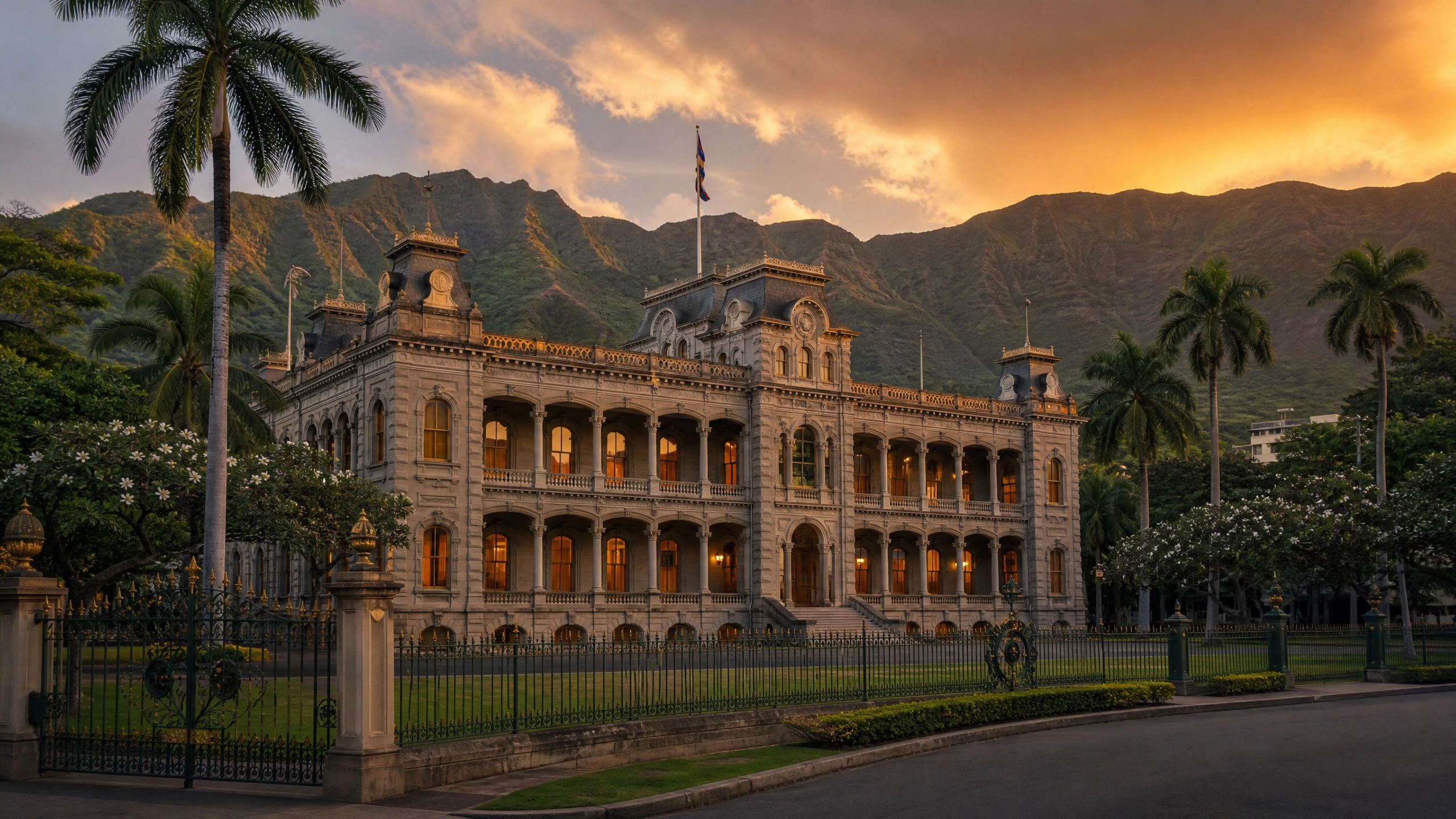
The building at the corner of King and Richards Streets in downtown Honolulu looks like it belongs in a European capital. It has four floors of Italian Renaissance architecture, a throne room, a grand staircase, and a basement where a queen was imprisoned. It had electricity before the White House.
'Iolani Palace was completed in 1882 under King Kalākaua, who had traveled to Europe and returned determined to build a royal residence that would signal to the world that the Kingdom of Hawai'i was a sovereign nation equal to any other. He installed electric lights — four years before the White House had them. He installed a telephone system. He commissioned the crown jewels. The palace was, by any measure, the most technologically advanced building in the Pacific.
Eleven years later, on January 17, 1893, a group of American businessmen backed by the U.S. Marines surrounded the palace and demanded that Queen Lili'uokalani surrender. She did, under protest, explicitly noting that she was yielding not to the conspirators but to the "superior force of the United States of America." Five years later, the United States annexed Hawai'i. In 2023, the U.S. Congress formally apologized for the overthrow — 130 years after it happened.
The palace was used as the government building for the Territory of Hawai'i, then the State of Hawai'i, until 1969. The throne room was the governor's office. The queen's bedroom was a storage room. It was restored and opened as a museum in 1978.
The guided tour of 'Iolani Palace is the most important 90 minutes on the island. Not the most historically interesting — the most important. It is the experience that makes everything else on Oahu legible. The North Shore makes more sense after you've stood in the throne room. Pearl Harbor makes more sense. The Duke Kahanamoku statue on Waikiki Beach makes more sense. The island's relationship with its own tourism — the careful, complicated performance of aloha for visitors who mostly don't know what they're standing in the middle of — makes more sense.
The palace is open Tuesday through Saturday. Book in advance. Go on the first morning.
The Ocean That Made the World
Duke Paoa Kahinu Mokoe Hulikohola Kahanamoku was born in Honolulu in 1890 and learned to surf in the waves off Waikiki at a break called Castles. He was a swimmer first — he set a world record in the 100-yard freestyle in 1911 that the Amateur Athletic Union initially refused to ratify because they didn't believe a human being could swim that fast. He won gold at the 1912 Stockholm Olympics, silver at the 1920 Antwerp Olympics, gold again at the 1920 Antwerp Olympics, and silver at the 1924 Paris Olympics. He was 34 years old at the 1924 Games.
Between Olympic appearances, he demonstrated surfing in California, Australia, and New Zealand — introducing the sport to the world from a board he shaped himself. He is the reason surfing exists outside of Hawai'i. He is the reason it exists at all as a global sport.
The bronze statue of Duke Kahanamoku on Waikiki Beach faces inland, toward the hotels. Locals will tell you this is wrong — that Duke should face the ocean, the way he always did. The statue was placed by the city. The orientation was a bureaucratic decision. It is a small thing that contains the entire argument about who Oahu is for.
Stand at the statue and look out at the water. The break directly in front of you is where Duke learned to surf. The same waves are still there. The same light. The same Pacific. The surfboard rental stands are fifty yards away, staffed by instructors who will have you standing on a board within an hour, in the same water where the sport was born. This is not a recreation. This is the original.
The North Shore and What It Asks of You
In summer, the North Shore of Oahu is a quiet stretch of small towns, roadside shrimp trucks, and beaches so calm you can wade out a hundred yards and still be standing. In winter, it becomes the most consequential stretch of coastline in the surfing world.
The swells that arrive on the North Shore between November and February travel thousands of miles from storms in the North Pacific and arrive at Waimea Bay and the Banzai Pipeline with a force that produces waves between twenty and sixty feet. These are not waves in the recreational sense. They are geological events that happen to be surfable by a small number of human beings who have spent their lives preparing for them.
Eddie Aikau was one of those human beings. He grew up on Oahu, became the first lifeguard ever stationed at Waimea Bay in 1968, and over the next decade saved more than 500 people from waves that would have killed anyone else. "Eddie Would Go" is the phrase — meaning that when conditions were too dangerous for anyone else to paddle out, Eddie would go. He was lost at sea in 1978 after the traditional Hawaiian voyaging canoe Hōkūle'a capsized on a voyage to Tahiti. He paddled away from the overturned hull on his surfboard to get help. He was never found.
The Eddie Aikau Big Wave Invitational at Waimea Bay is held in his honor. It runs only when waves exceed forty feet — a threshold that has been met fewer than ten times in forty years. When it runs, it is the most important day in surfing. When it doesn't run, Waimea Bay in December is still worth the drive: twenty-foot waves breaking in a bay so beautiful it looks like it was designed for the purpose.
Stop at Matsumoto Shave Ice in Hale'iwa on the way back. It has been there since 1951. The line is long. The shave ice is the real thing — not a snow cone, not a slushie, but finely shaved ice packed around a scoop of vanilla ice cream and drenched in house-made syrup. The locals' order is the rainbow: strawberry, lemon, and blue vanilla. Get the ice cream base. Eat it in the parking lot. This is what the North Shore tastes like.
The Food That Tells the Story
The plate lunch is the most honest food in Hawai'i. Two scoops of white rice, a scoop of macaroni salad, and a protein — usually chicken katsu, kalbi short ribs, or garlic shrimp — served in a styrofoam container that costs between ten and fifteen dollars. It is the food that plantation workers ate in the fields in the early twentieth century, when Japanese, Chinese, Filipino, Korean, and Portuguese laborers worked side by side and shared their lunches. The plate lunch is what happens when five food cultures eat together for long enough that the boundaries dissolve.
Helena's Hawaiian Food on North School Street in Kalihi has been serving traditional Hawaiian food since 1946. Helen Chock opened the restaurant the year after World War II ended and ran it for decades. In 2000, the James Beard Foundation named it an America's Classic — the only Hawaiian restaurant ever to receive that designation. The pipi kaula (dried beef) is hung in 250-pound batches above the stove using the same method Helen used in 1946. The poi is made fresh. The laulau — pork and butterfish wrapped in taro leaves and steamed — is the best version of the dish available anywhere.
Helena's is not in Waikiki. It is in Kalihi, a working-class neighborhood that most visitors never see. It is closed Sundays and Mondays. It fills up by noon. Go on a Tuesday morning, arrive at 10:30 when it opens, and order the combination plate: pipi kaula, laulau, and poi. This is not a tourist experience. This is what the island eats.
For something more recent, drive to Chinatown — the neighborhood directly west of downtown Honolulu that has been the island's immigrant quarter since the 1850s. The Pig & The Lady on North King Street is Andrew Le's Vietnamese-Hawaiian restaurant, and the dish that doesn't appear in any mainstream guide is the pho French dip: a French dip sandwich served with a side of pho broth for dipping. It is the specific dish that makes the argument about what Hawaiian food actually is — not a single cuisine, but a conversation between every culture that has ever arrived on this island and stayed.
The Windward Side
Forty-five minutes from Waikiki, over the Ko'olau Mountains through the Pali Highway tunnel, is a different island. The windward side of Oahu — the eastern coast facing the trade winds — is where the island's permanent residents live, where the beaches are uncrowded, and where the water is the color that makes people question whether they're still on the same planet.
Kailua Beach is consistently rated among the best beaches in the world. It is a two-mile arc of white sand with the Mokes — two small islands — visible offshore. The water is shallow, warm, and so clear that you can see the bottom at fifteen feet. On weekday mornings, it is occupied almost entirely by locals walking dogs and paddleboarders heading out to the Mokes. The town of Kailua behind the beach has a farmers market on Thursdays and Sundays, a bookstore, and restaurants that have never appeared in a travel magazine.
Lanikai Beach, a ten-minute walk south of Kailua, is smaller and more protected. The Mokes are closer here. At sunrise, the light hits the water at an angle that turns it from blue to green to gold in the space of twenty minutes. This is the beach that photographers come to Oahu to photograph. It is not a secret — but it is not Waikiki, and the difference is everything.
The Oahu family guide sequences the windward side into a full day that pairs Kailua Beach with the Ho'omaluhia Botanical Garden and the Byodo-In Temple in the Ko'olau foothills — a circuit that takes you from the ocean to the mountains and back in a single afternoon.
The View From Above
There is a ten-mile loop road above Honolulu called Tantalus Drive — or Round Top Drive, depending on which direction you're traveling — that winds through a rainforest canopy above the city and provides, at the Pu'u 'Ualaka'a State Wayside lookout, the only vantage point on the island where you can see Honolulu, Diamond Head, and Pearl Harbor simultaneously.
Most visitors never find it. It is not on the standard tourist circuit. There are no tour buses. The road is narrow and winding and requires a car. But the view from Pu'u 'Ualaka'a at sunset — the city spreading from the mountains to the sea, Diamond Head at the far right, the Pearl Harbor inlet visible to the left, the Pacific stretching to the horizon — is the view that makes the island's geography legible. You can see, from this single point, the entire argument of the post you're reading: the resort coast, the harbor where the U.S. Navy arrived, the mountains where the last battle of the Hawaiian Kingdom was fought, and the ocean that connects all of it.
Go at sunset. Bring a jacket — it is cooler at elevation than on the coast. Stay until the city lights come on. This is what Oahu looks like whole.
When to Go, Getting Around, and What to Know
Best time to visit: April through June and September through November. The shoulder seasons offer lower hotel rates, smaller crowds at popular sites, and consistent trade wind weather — warm days, cool evenings, brief afternoon showers that clear quickly. December through February brings the North Shore swells (worth planning around if surfing is the goal) but also higher prices and peak tourist volume. July and August are the busiest and most expensive months.
Getting around: A car is essential for anything beyond Waikiki. The island's bus system (TheBus) is functional but slow. Waikiki to Kailua is 45 minutes by car; it is over two hours by bus. Rent a car for at least two days — the windward side, the North Shore, and Tantalus Drive are all inaccessible without one. Parking in Waikiki is expensive; park once at the hotel and walk or take rideshare within the resort area.
Pearl Harbor: Book the USS Arizona Memorial tour in advance — it fills weeks ahead during peak season. The audio tour is included with admission. Plan a full day: the Arizona Memorial, the USS Missouri battleship, and the Pacific Aviation Museum together constitute one of the most complete World War II sites in the world. The emotional weight of the Arizona Memorial is not something that can be rushed.
'Iolani Palace: Open Tuesday through Saturday, 9am–4pm. Guided tours are 90 minutes and must be booked in advance. The self-guided audio tour is available but the guided tour is significantly better — the guides are Native Hawaiian and bring a perspective to the history that the audio tour cannot replicate.
Budget: Mid-range travel on Oahu runs $250–$400 per day including accommodation, food, and activities. The North Shore and windward side are significantly cheaper than Waikiki. Helena's Hawaiian Food and the plate lunch trucks are $10–$20 per person. The Waikiki 5-day vacation guide covers the full budget breakdown for the resort area and how to sequence the major sites without overpaying.
Planning Your Oahu Trip with Leif
The gap between reading about Oahu and actually being there is the gap between knowing the island has two realities and knowing which day to go to Helena's, which morning to drive to Tantalus, and how to sequence Pearl Harbor and 'Iolani Palace so that one illuminates the other rather than competing for the same emotional bandwidth.
Leif builds the day-by-day architecture for exactly this kind of trip — the kind where the history and the beach and the food and the drive all need to land in the right order to make the argument the island is trying to make. Feed it your dates, your travel style, and how many days you have, and it sequences the island so that the Pali Lookout comes before the North Shore, and Helena's comes before the Chinatown dinner, and the Tantalus sunset comes on the last evening when you're ready to see the whole thing at once.
The guides below cover the island in depth — use them alongside Leif or as standalone trip anchors:
- Oahu Family Adventure: 7 Days of Beaches, Pearl Harbor & North Shore Surfing
- 5 Days in Waikiki: Diamond Head, Hanauma Bay, North Shore & Pearl Harbor Itinerary
If the sovereignty movement context resonated — and it should — consider adding the 'Iolani Palace tour and the Bishop Museum's Hawaiian Hall to your first day rather than your last. The island makes more sense when you understand what it was before you experience what it became.
The Island That Paid
The 'Iolani Palace was used as a government building for 76 years after the overthrow. The throne room became a courtroom. The queen's bedroom became a records storage room. The crown jewels were locked in a basement vault. When restoration began in the 1970s, volunteers found the original koa wood floors under layers of linoleum. They found the original chandeliers in storage. They found the queen's personal belongings, catalogued and preserved, waiting.
The palace was restored because people decided it should be. Because the argument it makes — that a sovereign kingdom existed here, that it was taken, that the taking was wrong — is an argument that deserves a building to make it in.
The restoration took decades. Volunteers stripped linoleum from the koa floors by hand. Chandeliers were found in storage and rehung in the rooms they were built for. The queen's belongings — her personal effects, her correspondence, her feather cloaks — were catalogued and returned to the rooms where she had kept them. The palace was given back to itself, piece by piece, by people who understood that the argument it makes is not a historical argument. It is a present-tense argument. It is being made right now, every day, in a building on a street in downtown Honolulu that most visitors drive past on the way to Waikiki.
Oahu is beautiful in the way that the Pacific is beautiful: completely, without apology, at a scale that makes the human response to it feel inadequate. The light is real. The water is real. The beach is real. And the palace is real, and the throne room is real, and the queen who was imprisoned there is real, and the kingdom that was taken is real, and the island that holds all of it simultaneously — the paradise and the wound, the resort and the reckoning — is the most honest place in the American Pacific.
It sounds like too much to hold. It isn't. The island holds it every day.