Why the People Who Love Naples Most Are the Ones Who Stopped Expecting It to Be Rome
Destination: Naples, Italy
Category: Destination Guides
Rome performs its grandeur for you. Florence performs its beauty. Venice performs its romance. Naples doesn't perform anything. It just continues being Naples, at full volume, in every direction at once, and the people who love it most are the ones who stopped waiting for it to calm down and started paying attention instead.
The train from Rome takes about an hour and ten minutes, and somewhere around the approach to Napoli Centrale the landscape changes in a way that is hard to articulate but impossible to miss. The architecture gets denser and more vertical. The laundry lines appear between buildings. The graffiti becomes more elaborate, more political, more present. By the time you step off the train and into the organized chaos of the station forecourt — taxis, scooters, vendors, noise, the smell of coffee and exhaust and something frying — you understand immediately that you are not in Rome anymore. You are not in a version of anywhere else. You are in Naples, and Naples is entirely itself.
This is the thing that most travel writing about Naples gets wrong. The framing is almost always some version of "gritty but beautiful" or "chaotic but worth it" — as if the chaos is a tax you pay to access the beauty, as if Naples is a difficult person you have to manage in order to get what you came for. This framing misunderstands the city completely. The chaos and the beauty are not in tension. They are the same thing. Naples is not a city that is beautiful despite its disorder. It is a city whose disorder is inseparable from its character, and its character is the product of 2,500 years of being exactly what it is.
Why Naples Is the Way It Is
The Greeks founded Neapolis — New City — in 470 BC on a site that had already been settled for centuries. The Romans expanded it into one of the most important cities in the empire. The Normans came, then the Hohenstaufens, then the Angevins, then the Aragonese, then the Spanish Habsburgs, then the Bourbons, then Napoleon's brother, then the Bourbons again, then Garibaldi. Every single one of these powers left something behind — a palace, a church, a street grid, a food tradition, a legal system — and none of them managed to make Naples into something other than Naples.
This is not a small thing. Most cities, over 2,500 years, get absorbed into larger identities. Naples absorbed everyone who tried to absorb it. The result is a city with a density of history that is literally vertical — the street level of the medieval city sits on top of the Roman city, which sits on top of the Greek city, which sits on top of the original settlement. You can walk down into all of it. The underground is not a metaphor. It is an actual place you can visit.
Napoli Sotterranea — Underground Naples — is a network of tunnels, cisterns, and chambers that runs 40 meters beneath Spaccanapoli, the arrow-straight street that cuts through the historic center. The Greeks quarried the tufa rock to build Neapolis above ground, leaving a network of cavities that the Romans converted into aqueducts. The aqueducts served the city for centuries until a cholera epidemic in 1884 prompted the city to switch to a modern water system, at which point the underground was sealed and forgotten. During World War II, the tunnels were reopened as bomb shelters. After the war, they were sealed again. In the 1960s, a group of enthusiasts began excavating and mapping them. Today you can take a guided tour through 2,500 years of continuous human use — Greek quarry, Roman cistern, medieval well, WWII shelter — in a single two-hour walk beneath the city streets.
Spaccanapoli: The Street That Cuts the City in Half
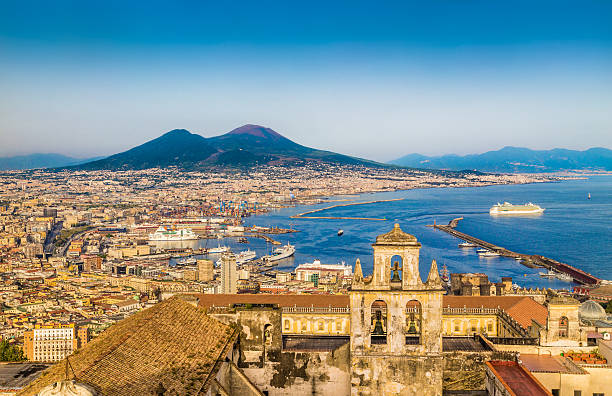
Spaccanapoli means "Naples-splitter," and the name is accurate. Viewed from the Castel Sant'Elmo on the Vomero hill above the city, the street is a perfectly straight line running east to west through the historic center, as if someone drew it with a ruler across the map of the city. It follows the original Greek street grid — the decumanus inferior of ancient Neapolis — and it has been a continuous urban thoroughfare for 2,500 years.
Walking Spaccanapoli from east to west takes about forty minutes if you don't stop, and you will stop constantly. The street passes the Church of the Gesù Nuovo, whose diamond-pointed stone facade dates to 1470 and was originally a Renaissance palace before the Jesuits converted it into a church. It passes the Basilica di Santa Chiara, a fourteenth-century Gothic church with a cloister decorated in majolica tiles that is one of the most quietly beautiful spaces in the city. It passes San Gregorio Armeno — the street of the presepe makers, where artisans have been crafting nativity scene figures for centuries and now also craft figures of soccer players, politicians, and celebrities alongside the traditional saints and shepherds.
The street also passes through the daily life of the city in a way that most tourist routes don't. The fruit vendors, the laundry overhead, the children playing in the piazzas, the old men arguing outside the bar — Spaccanapoli is not a museum street. It is a living street that happens to be 2,500 years old, and the combination of those two facts is what makes it unlike anything in Rome or Florence.
The Underground City
The entrance to Napoli Sotterranea is on Piazza San Gaetano, a small square off Spaccanapoli that sits directly above the ancient Greek agora. The tour descends through a series of narrow passages — some barely wide enough for a single person — into a world that is simultaneously ancient and intimate. The tufa walls still bear the marks of the Greek quarrying tools. The Roman cisterns are vast, cathedral-like chambers where the water was stored for centuries. The WWII bomb shelter section contains the remnants of the lives people brought underground with them: a child's shoe, a cooking pot, graffiti scratched into the walls.
What makes Napoli Sotterranea different from other underground attractions is the continuity. This is not a preserved archaeological site that has been sealed off from the present. It is a living system that has been in continuous use, in various forms, for 2,500 years. The city above has been built and rebuilt on top of it. The city below has simply continued.
Book in advance, especially in summer. The tours run in multiple languages and last approximately two hours. Bring a jacket — the temperature underground is a constant 15°C regardless of the season.
The Food That Is Not a Performance
Naples invented pizza. This is not a marketing claim. The modern pizza — flatbread, tomato, mozzarella, baked in a wood-fired oven at very high heat — was developed in Naples in the eighteenth century, when tomatoes (a New World import) became affordable enough for the poor to eat. The margherita was allegedly created in 1889 for Queen Margherita of Savoy, garnished with basil, mozzarella, and tomato to represent the colors of the Italian flag. The story may be apocryphal. The pizza is not.
The best pizza in Naples is a matter of genuine civic passion, and the debate between L'Antica Pizzeria da Michele (founded 1870, serves only margherita and marinara, cash only, always a line) and Sorbillo (on Via dei Tribunali, larger menu, more accessible) has been running for decades. Both are correct. The more important point is that Neapolitan pizza — soft, slightly charred, with a cornicione (crust) that puffs and blisters in the 485°C oven — is a fundamentally different object from the pizza you have eaten everywhere else, and eating it in Naples, in a room where the oven has been burning for a hundred years, is not the same experience as eating it anywhere else.
But the food that most visitors miss entirely is the street food of the Quartieri Spagnoli — the Spanish Quarter, a grid of narrow streets west of Via Toledo that was built in the sixteenth century to house Spanish troops and has been one of the most densely populated urban neighborhoods in Europe ever since. The real street food here is not the sit-down margherita. It is pizza fritta — fried pizza, a folded dough pocket filled with ricotta, salami, and cicoli (rendered pork fat), deep-fried in lard and eaten standing up. It was the food of the poor during the postwar years when wood-fired ovens were too expensive to operate, and it is still the food of the neighborhood.
The other essential Neapolitan food experience is sfogliatelle, and the distinction between the two types is something most visitors never learn. Sfogliatelle riccia — the shell-shaped, crispy, layered pastry — is made from a paper-thin dough that is rolled, coiled, and baked until it shatters when you bite into it, revealing a filling of ricotta, semolina, candied citrus peel, and cinnamon. Sfogliatelle frolla — the soft version — uses a shortcrust pastry and the same filling, and is easier to make but considered by purists to be a lesser thing. Fratelli Attanasio, located approximately ten steps from the exit of Napoli Centrale train station (Vico Ferrovia 1–2), has been making sfogliatelle riccia since the 1930s. They are served piping hot. The line moves quickly. Eat them immediately.
Rione Sanità: The Neighborhood That Decided to Save Itself
Rione Sanità sits in a valley north of the historic center, cut off from the rest of the city by a viaduct built in the nineteenth century that effectively isolated the neighborhood from the economic development happening above it. For most of the twentieth century, Rione Sanità was one of the most economically marginalized neighborhoods in Naples — high unemployment, limited infrastructure, a reputation for danger that kept tourists away entirely.
Then, in 2006, a group of young people from the neighborhood formed a social cooperative called La Paranza and proposed something that had never been tried: they would take over the management of the Catacombs of San Gennaro — a vast early Christian burial site beneath the neighborhood, dating to the second century AD — and use the revenue from tourism to fund employment and social programs for the neighborhood's youth. The city agreed. The cooperative trained local guides, restored the catacombs, and began running tours.
Today, the Catacombs of San Gennaro are one of the most remarkable sites in Naples — vast underground galleries decorated with early Christian frescoes, mosaics, and sarcophagi, extending for hundreds of meters beneath the neighborhood streets. The guided tours are led by young people from Rione Sanità itself, and the €9 entry fee funds their salaries and the cooperative's social programs. The catacombs are not funding the neighborhood as a charity project. The neighborhood decided to fund itself, using what it already had.
This story is almost never told in English-language travel content about Naples. It should be the first thing you read.
Vomero: The Naples That Tourists Miss
The Vomero hill rises steeply above the historic center, accessible by funicular from three different points in the city, and the neighborhood at the top is where actual Neapolitans live — a residential district of wide streets, good restaurants, and the kind of daily life that is entirely absent from the tourist circuit below.
Castel Sant'Elmo, a fourteenth-century star-shaped fortress at the highest point of the hill, offers the best view of Naples available anywhere — the entire city spread below, the bay curving to the south, Vesuvius rising on the eastern horizon, Capri visible on clear days as a dark shape in the water. The view is the reason to go. The Certosa di San Martino, a former Carthusian monastery immediately adjacent to the castle, contains the city's finest museum of Neapolitan art and history, including an extraordinary collection of presepe figures and a cloister that is one of the most beautiful spaces in the city.
Come up in the late afternoon, walk the residential streets, eat dinner at one of the restaurants that caters to the neighborhood rather than to tourists, and take the funicular back down after dark, when the city below is lit up and the bay is black and the whole thing looks like a painting of itself.
Pompeii: The Thesis Extended
Pompeii is forty-five minutes south of Naples by Circumvesuviana train, and it is the reason that many visitors come to the region at all. The site — a Roman city of approximately 11,000 people buried by the eruption of Vesuvius in 79 AD and preserved under four meters of volcanic ash for 1,700 years — is one of the most extraordinary archaeological sites on earth. The streets, the houses, the bakeries, the brothels, the election graffiti on the walls, the plaster casts of the people who died where they fell — all of it is still there, still legible, still human in a way that most ancient sites are not.
But Pompeii is also the thesis of Naples extended into history. Naples has always lived next to Vesuvius, which is still an active volcano, which last erupted in 1944, which is monitored continuously by the Osservatorio Vesuviano because the three million people who live in the Campania region are, technically, living in a volcanic hazard zone. The Neapolitans know this. They have always known this. They built their city here anyway, on top of the Greeks who built their city here, on top of the people who were here before the Greeks. The willingness to live with that proximity — to build something beautiful and permanent next to the thing that could erase it — is not recklessness. It is a very specific form of defiance that Naples has been practicing for 2,500 years.
Pompeii is what happens when the defiance fails. Naples is what happens when it doesn't.
The Camorra Context: What It Actually Means for Visitors
No honest piece of writing about Naples can avoid the Camorra, and most travel writing handles it in one of two ways: either by ignoring it entirely, or by treating it as a reason not to go. Both approaches are wrong.
The Camorra is the Neapolitan organized crime network, one of the oldest and most deeply embedded criminal organizations in Italy. It operates primarily in the construction industry, waste management, drug trafficking, and the counterfeit goods trade. Its presence in Naples is real and its effects on the city — particularly in the peripheral neighborhoods and in the waste crisis that plagued Campania in the 2000s — have been genuinely damaging.
For visitors, the practical reality is this: the historic center, the Quartieri Spagnoli, Rione Sanità, Vomero, and the waterfront areas where tourists spend their time are not places where visitors encounter Camorra activity in any meaningful way. Petty theft — pickpocketing, bag-snatching on scooters — is a real risk in crowded areas, particularly around Napoli Centrale and in the tourist-heavy parts of the historic center. This is a different thing from organized crime, and the precautions are the same as in any major European city: keep your bag in front of you, don't leave valuables visible, be aware of your surroundings.
The more interesting question is what the Camorra has done to Naples' reputation, and whether that reputation is accurate. The answer is that Naples is significantly safer than its reputation suggests, and that the reputation has been shaped by decades of Italian and international media coverage that focused on the worst moments in the city's recent history. The murder rate in Naples has fallen dramatically over the past fifteen years. The city has invested heavily in tourism infrastructure. The neighborhoods that were genuinely dangerous a generation ago — including Rione Sanità — have been transformed by exactly the kind of community-led initiatives described above.
Go. Be sensible. Don't let a reputation that is twenty years out of date keep you from one of the most extraordinary cities in Europe.
The Bay of Naples: Capri, Ischia, and the Amalfi Coast
Naples is the gateway to one of the most concentrated collections of extraordinary destinations in the world, and the city's position at the center of the Bay of Naples means that day trips and short excursions are genuinely easy.
Capri is forty minutes by hydrofoil from the Molo Beverello ferry terminal in Naples. The island is small, beautiful, expensive, and extremely crowded in summer — the Blue Grotto, the Villa Jovis, the Faraglioni rock formations, the chairlift to Monte Solaro. The crowds are real and the prices are high, but the landscape is genuinely extraordinary, and arriving by hydrofoil in the early morning before the day-trippers from the mainland arrive gives you an hour or two of the island at its best.
Ischia is larger, less famous, and significantly less crowded than Capri. The island has thermal springs, a medieval castle on a volcanic rock connected to the main island by a causeway, and a food culture that is more authentically Campanian than anything you will find on Capri. The hydrofoil takes about an hour from Naples. Most visitors stay at least two nights.
The Amalfi Coast — the stretch of coastline south of Naples between Positano and Salerno — is one of the most photographed coastlines in the world, and the photographs do not exaggerate. The road that runs along it is also one of the most terrifying driving experiences in Europe: single-lane in places, carved into cliff faces, shared with tour buses and delivery trucks and the occasional herd of goats. Take the ferry from Naples to Positano or Amalfi instead of driving. The journey along the coast by boat, with the villages stacked up the cliff faces above you, is the correct way to arrive.
When to Go and What to Expect
Naples is a year-round city, but the experience varies significantly by season. Spring (April and May) and autumn (September and October) are the best times to visit: the temperatures are comfortable (18–25°C), the summer crowds have either not yet arrived or have already left, and the light in the late afternoon on the bay is the kind of thing that makes you understand why painters have been coming here for centuries.
Summer (June through August) is hot, crowded, and expensive. The Amalfi Coast is at its most beautiful and its most impossible to navigate simultaneously. The city itself empties somewhat as Neapolitans leave for the coast, which means the historic center is quieter than you might expect but the restaurants and shops operate on reduced hours. The heat is serious — 35°C is common in July and August — and the underground city tour becomes genuinely appealing as a way to spend the hottest part of the afternoon.
Winter (November through March) is the least visited season and, in some ways, the most interesting time to go. The city is entirely itself — no tour groups, no cruise ship passengers, no lines at the pizza restaurants. The weather is mild by northern European standards (10–15°C) and occasionally rainy. The Christmas season in Naples is extraordinary: the presepe tradition reaches its peak in December, and the artisan workshops on San Gregorio Armeno are in full production. The nativity scenes in the churches are elaborate, centuries-old, and genuinely moving.
The one thing to know about Naples in any season: the city operates on Neapolitan time, which means later than you expect. Dinner before 8pm marks you as a tourist. The best restaurants don't fill up until 9pm. The street food is available at midnight. Adjust your schedule accordingly and you will eat better.
Naples is also, by Italian standards, an affordable city. A margherita at L'Antica Pizzeria da Michele costs €5. A sfogliatella at Fratelli Attanasio costs €1.50. A glass of local wine at a bar in the Quartieri Spagnoli costs €3. The city's affordability is partly a function of its reputation — the tourists who avoid Naples because of its image leave the prices lower for the ones who come — and partly a function of a local economy that has never been oriented toward extracting money from visitors. The result is that Naples rewards the traveler who is willing to eat where the locals eat, walk where the locals walk, and stay long enough to understand what they are looking at.
The question that most visitors ask before going to Naples is whether it is safe. The question they ask after going is why they waited so long. The city is not perfect. It is loud and chaotic and occasionally overwhelming and the traffic is genuinely alarming and the streets in the historic center are narrow enough that the buildings on either side seem to lean toward each other overhead. It is also one of the most alive cities in Europe, with a density of history and food and art and human energy that is unlike anything in Rome or Florence or Milan. The people who love Naples most are not the ones who came with low expectations and were pleasantly surprised. They are the ones who came with open eyes and paid attention, and who let the city be exactly what it is.
Plan Your Naples Trip
The guides below cover every way to experience Naples — from the food circuit through the Quartieri Spagnoli to the family itinerary that combines Pompeii with the Amalfi Coast.